Yashsvi Singh
25 Oct 2026 6 min read
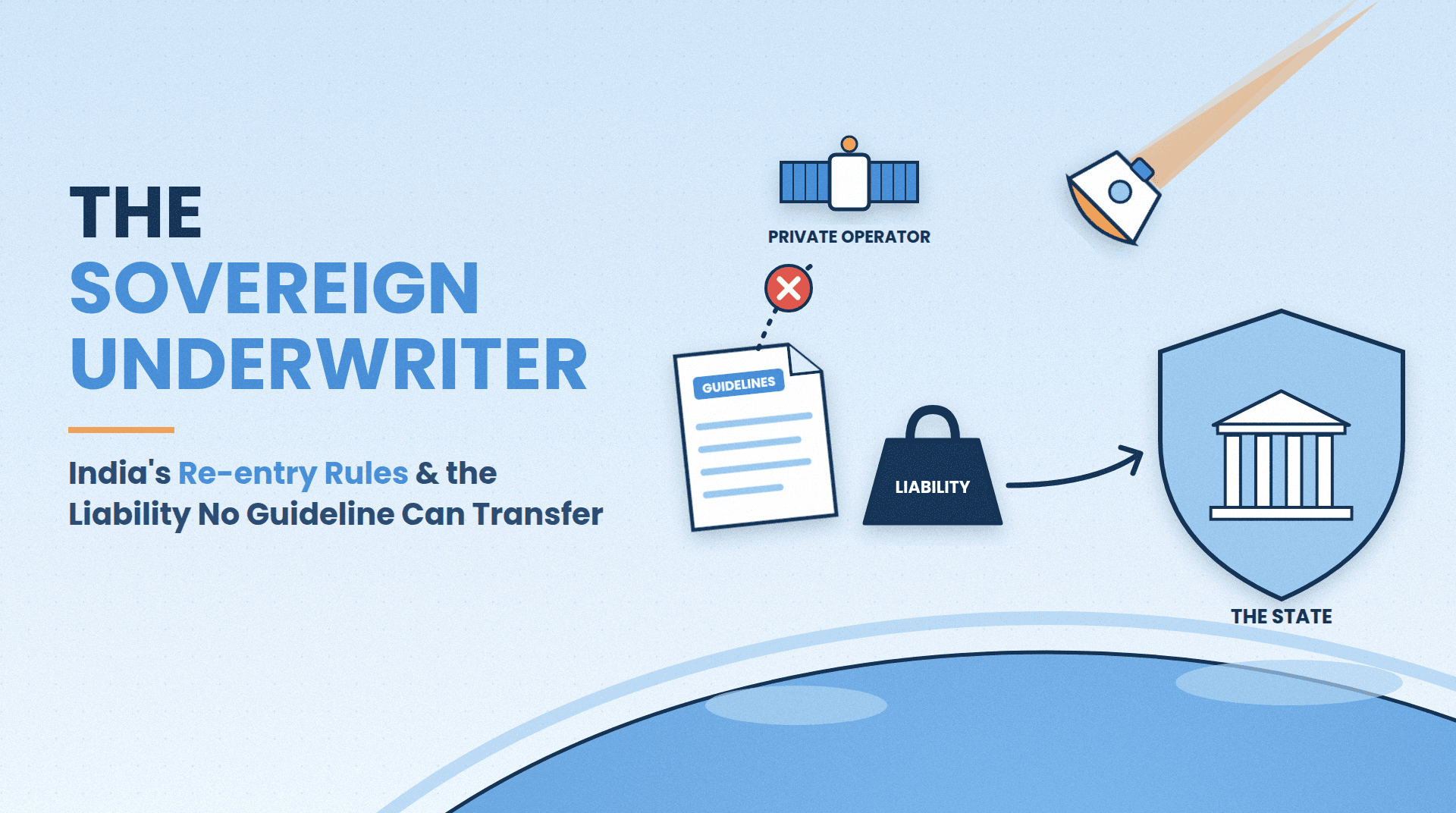
On 18 July 2026, Skyroot Aerospace's Vikram-1 reached orbit, ending six decades in which every Indian rocket to orbit was built by the State. Within days, IN-SPACe published its norms for the planned re-entry of space objects, declaring that operators must undertake re-entry at their own risk and peril and must not expose the Government of India to any liability.
The sentence reads like a transfer of risk. It is something smaller: a promise between the State and its licensee, to which neither a foreign victim nor an Indian victim is a party. India has converted a sovereign treaty obligation into a private indemnity without a statute to carry it, and the seams show in three places: before international claimants, before Indian citizens, and inside the risk number on which the whole scheme rests.
Article II of the 1972 Liability Convention makes the launching State absolutely liable for damage its space object causes on the surface of the earth or to aircraft in flight. Article VI of the Outer Space Treaty goes further: a State bears international responsibility for the activities of its non-governmental entities and must authorise and continuously supervise them. In this architecture the private operator does not exist as a defendant. A Sri Lankan fisherman struck by an Indian upper stage has a claim against India, presented State-to-State through diplomatic channels.
The only claim ever brought under the Convention shows how that system actually behaves. When the Soviet satellite Cosmos 954 scattered radioactive debris across northern Canada in 1978, Canada sought roughly C$6 million and, after years of negotiation, accepted C$3 million in a 1981 settlement that did not admit legal liability. Space liability, in practice, is diplomacy priced in compromise.
Against that backdrop, IN-SPACe's "no exposure" clause cannot alter what India owes the world. At most it gives India a right of recourse after it pays. That right is only as strong as two assumptions: that an authorisation condition is an enforceable undertaking, and that the operator is still solvent when the bill arrives. A start-up that has just lost its only spacecraft over someone else's territory is precisely the entity least likely to satisfy a sovereign indemnity. The State remains the underwriter of last resort; the guideline merely relabels it.
The Convention has a striking blind spot. It does not apply to damage a launching State's object causes to that State's own nationals. If debris from an Indian private re-entry falls on a farm in Andhra Pradesh, there is no treaty claim, and since India has no space statute, there is no statutory one either.
The victim's route is domestic tort, and here Indian law is better equipped than its space regime realises. In M.C. Mehta v. Union of India (the Oleum gas leak case), the Supreme Court replaced the escape-laden rule in Rylands v. Fletcher with absolute liability for enterprises engaged in hazardous or inherently dangerous activity and tied the measure of compensation to the enterprise's capacity to pay. Controlled re-entry of a hardened object through populated airspace fits that description with uncomfortable ease.
But absolute liability is a principle, not a fund. It does not tell a victim which forum to approach, how damages are quantified, whether insurance must respond directly, or what happens if the operator is insolvent. India has confronted this exact problem before. For nuclear damage, Parliament did not leave victims to M.C. Mehta; it enacted the Civil Liability for Nuclear Damage Act, 2010, channeling liability to the operator, fixing caps, mandating financial security and placing the State behind the operator. Space, a sector now projected to reach USD 44 billion by 2033, still runs on a sentence in a guideline.
The re-entry norms require that the expected casualty risk stay below 1 in 10,000, a threshold drawn from international engineering practice. It is a sensible number, but it is worth understanding what kind of number it is.
Expected casualty is an average across a probability distribution. It is ideal for comparing missions and pooling risk across many events. It says little about the single tail outcome that bankrupts a small operator, and tails are exactly what insurers price and what courts are asked to compensate. A regulator that approves means while the market prices extremes has built a scheme in which an operator can be fully compliant and still uninsurable. The figure is also produced by the applicant's own survivability and fragmentation models, which raises a question of verification capacity that the norms do not answer.
There is a deeper paradox. Separate authorisation applies only to objects designed to survive re-entry or intentionally brought down in a controlled manner. The operator who plans a re-entry is regulated; the operator who simply lets a defunct satellite or spent stage decay is not caught by this instrument at all, though uncontrolled decay is where much of the real-world risk lies. A liability rule that bites hardest on responsible behaviour sends the wrong signal to a young industry.
The deeper difficulty is constitutional. The re-entry norms implement the Indian Space Policy 2023, an executive policy, administered by IN-SPACe, a body that still lacks statutory footing. Restrictions on the freedom to carry on a business under Article 19(1)(g) must, under Article 19(6), be imposed by law. Unlimited, uncapped liability imposed as a licensing condition sits uneasily with that requirement, and an aggrieved operator has no defined appellate forum in which to contest it. The Space Activities Bill, first drafted in 2017, remains pending even as private launches have begun.
Comparative practice suggests a better design. The United Kingdom ordinarily sets operator insurance for standard missions at about GBP 60 million, and Australia caps operator exposure while the government absorbs excess liability up to AUD 3 billion. The logic is not leniency. A known cap makes risk insurable, insurability makes capital available, and a State backstop above the cap honestly reflects where international law already places the final burden.
An Indian statute should therefore do four things: fix graded, mission-scaled liability caps backed by mandatory insurance; place an explicit State guarantee above the cap, with a statutory right of recourse for willful misconduct; create a no-fault compensation mechanism for Indian victims that codifies the M.C. Mehta principle with defined quantum and forum; and extend end-of-life disposal duties to uncontrolled objects, not merely planned re-entries.
Whether India will be liable for what its private rockets drop was settled in 1972. The only open question is whether India decides in advance who pays, or discovers the answer in the debris.
Author: Yashsvi Singh
B.A.LL.B. - 3rd Year, Lloyd School Of Law
Sign in to join the discussion.

This is the uncomfortable territory where trauma, memory and testimony meet. The central problem is not whether memory can be imperfect. It can. The deeper problem is what we conclude from that imperfection.

The connection between trauma, memory and the credibility of the victim's testimony raises a pertinent issue in the judicial process. The impact of trauma on memory, behaviour and the way in which the incident is described might lead to late reporting, fragmented memory or even variations in testimony. Such reactions when judged without knowledge of trauma may have a negative impact on credibility assessment.