Isha Kumari
20 Sept 2026 7 min read
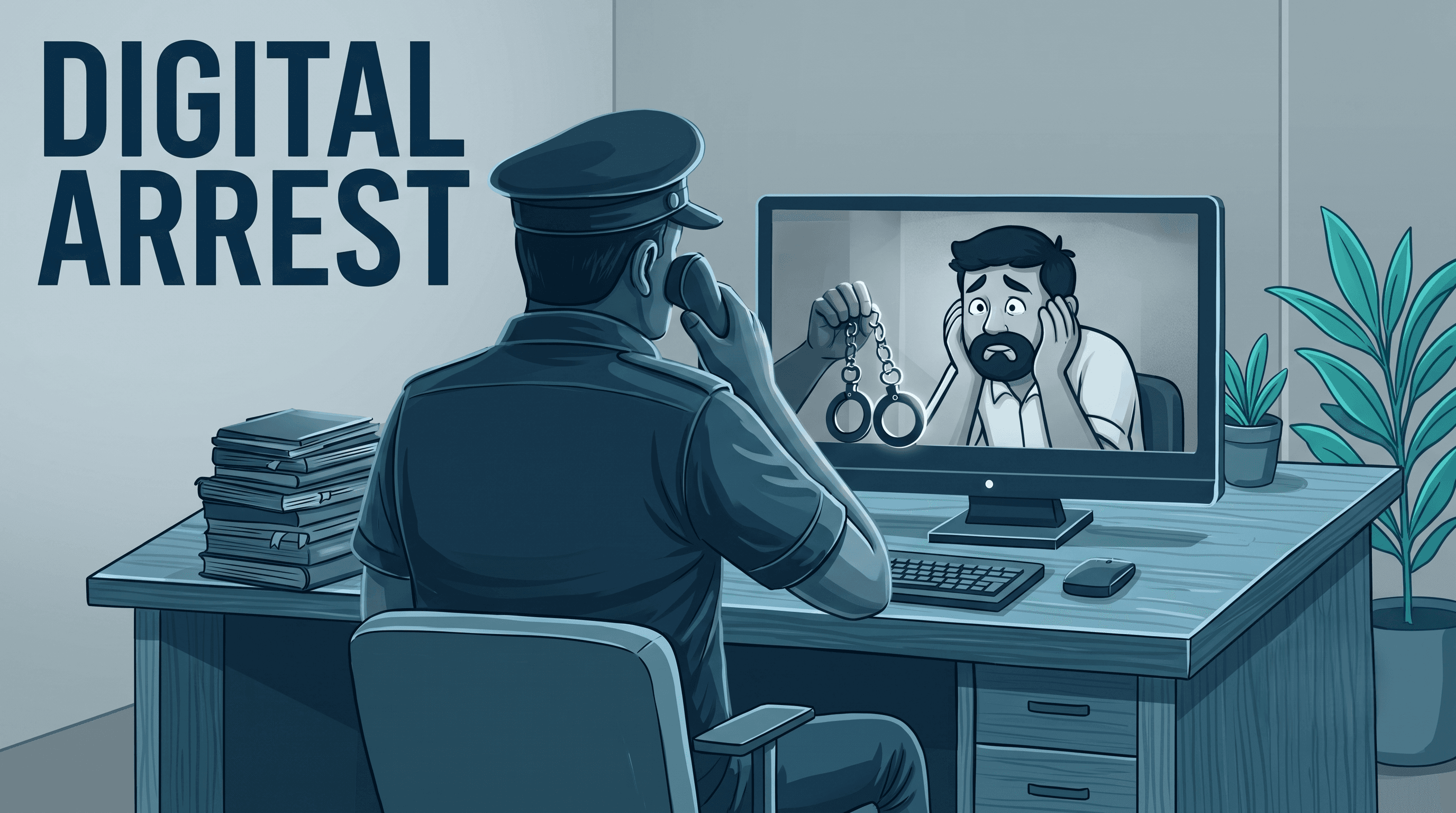
NO COURT WILL EVER ARREST YOU OVER A VIDEO CALL: INSIDE THE SUPREME COURT'S CRACKDOWN ON "DIGITAL ARREST" SCAMS
A retired schoolteacher receives a phone call. The caller says they are from a courier company. After another call comes. This time from someone claiming to be a policeman. Then a third call. This one from a called CBI officer. Within a few hours she is on a video call with a man in a fake police uniform. He tells her she is under investigation for money laundering. He demands that she transfer her life savings to a "verification account." If she does not, he warns, she will face arrest.
There is no warrant. There is no FIR. There is no lawyer involved. There is certainly no such thing as an arrest conducted over WhatsApp. This scenario, now known as the "digital arrest" scam has drained the savings of thousands of Indians. Most of the victims are elderly. These scams have grown so widespread that the Supreme Court of India is now treating them as a matter of public concern.
This case began with a family’s complaint. It has quickly expanded into a major legal inquiry. It is now one of the closely watched Suo motu proceedings before the Supreme Court. What started as a fraud allegation has turned into a deep judicial review. The court is examining banking rules, telecom policies and criminal law at once. It is not about how the scam works. It is also about how institutions fail those who need protection the most. The Supreme Court has taken steps. It has ordered banks to freeze transactions. It has asked telecom companies to strengthen caller ID verification. It has even directed the government to create a hotline for reporting these scams. The court has emphasized that technology must not be used to exploit trust among the vulnerable. What makes this case so important is not the money lost. It is the way the court is handling it. By taking action without waiting for a petition the Supreme Court is showing that it sees justice not just as a process but as an obligation. This is not about stopping fraud. It is, about protecting the weak from being targeted by people who use technology to look like authority. The digital arrest scam may seem specific. Its impact is much broader. It exposes gaps in our systems. It shows how easily trust can be broken when fake voices sound official. It reminds us that real justice must keep pace with new forms of crime. The way the Supreme Court is dealing with this issue sets an example. It shows that the law must adapt. Not to change, but to protect.
HOW THE CASE REACHED THE SUPREME COURT
The matter, registered as In Re: Victims of Digital Arrest Related to Forged Documents started after an elderly couple wrote to the Court. They said they had been cheated out of their retirement savings. The fraud happened using a method that was like the one described in the case. Of treating this as just one complaint the Court turned it into a wide-reaching ongoing investigation across the country. Since its major order, on December 1 2025 a bench headed by the Chief Justice of India has been sending regular instructions. These instructions go to police agencies, banks, telecom companies and state governments. The Court has effectively taken charge of building a system to fight a kind of crime that did not exist in this form five years ago.
THE LATEST ROUND OF DIRECTIONS
On 4 August 2026 the bench of Chief Justice Surya Kant, along with Justices Joymalya Bagchi and V. Mohana issued a set of interim orders. These orders came after reviewing the status report filed by the Indian Cyber Crime Coordination Centre. The Reserve Bank of India was directed to adopt, within four weeks a Standard Operating Procedure. This procedure requires banks to place debit holds on accounts that are linked to mule activity. This move essentially adds a speed bump into the system. It stops stolen money from vanishing across a chain of accounts quickly.
States and Union Territories were told to operationalize cybercrime grievance mechanisms already designed by the Ministry of Home Affairs. They were also asked to set up dedicated Cybercrime Coordination Centers. These centers should have -Zero FIR facilities. This ensures that a victim does not lose the first hour after reporting fraud. That first hour is vital because it often happens at the police station leading to delays. Perhaps the striking direction concerns the very tool that scammers rely on. The Court has asked the Ministry of Electronics and Information Technology, the Department of Telecommunications and the Cyber Crime Coordination Centre to examine the feasibility of time-based restrictions on audio and video calls. A possible call "kill switch" is also being considered. This is because the fraud depends on keeping the victim on an intimidating call. The caller aims to panic the victim into transferring money. A time limit or kill switch could disrupt this process before the scam succeeds. The Court also revived a suggestion, for a shared-liability and victim-compensation framework. This means responsibility could be shared between parties. It also allows victims to get compensation when they are harmed. The Court kept the door open for the Department of Telecommunications to answer for lapses. These lapses involve telecom operators and point-of-sale agents. These agents issue SIM cards without verification. That lack of verification helps scammers operate easily.
WHY THIS IS MORE THAN A POLICING STORY
What makes this proceeding stand out is how broad the legal areas it involves are, with no single law covering the process from start to finish. There isn’t a Digital Arrest Act." Instead, the Court has built its response by combining legal tools. It uses its writ power under Article 32 draws on banking rules enforced by the RBI applies telecom laws through the Department of Telecommunications and relies on criminal laws under the Bharatiya Nyaya Sanhita for offenses like cheating, impersonation of a public servant and criminal intimidation. In terms the judiciary is stepping in as a central coordinator between government departments that usually don’t work together. It’s doing this through continuing mandamus. Keeping pressure on institutions after a one-time judgment might have faded away. The results far are encouraging. Complaints dropped sharply: from around 1,23,672 in 2024 to 58,239 in 2025 and then down further to just 16,377, by mid-2026. Thousands of cases have already seen money returned to victims. But the reports also show something the fraud is not gone. It’s adapting. Scammers are changing their methods. Using impersonation tactics and more sophisticated mule networks that are harder to spot. As people become more aware the tricks evolve. That’s why this case remains active before the Court. The legal framework is still being shaped, while the crime itself keeps shifting. It’s a struggle that hasn’t ended.
KEY TAKEAWAYS
1 No Indian investigating agency arrests, Demands money over a phone or video call. Any call claiming otherwise is itself the offence.
2 The Supreme Court is using continuing mandamus to coordinate the RBI, telecom regulators, state police and the CBI in the absence of a statute.
3 A mandatory RBI SOP on temporary debit holds wider e-Zero FIR adoption and a possible call "kill switch" are all in motion, as of August 2026.
4 Complaint numbers are falling sharply. The fraud is adapting rather than disappearing, which is why the matter remains under active judicial monitoring.
For lawyers this case shows how far continuing mandamus can go in constitutional law when Parliament has not yet passed full laws on a new kind of harm. It is important to see how much the courts can do in guiding bodies before the executive takes over that role properly. For citizens the court’s own orders send a clear and simple message: no investigating agency in India makes arrests questions people or freezes money through a phone call or video call. Any call that says it is law enforcement is not really law enforcement. It is a crime. That is what the Supreme Court is now working to break down one order, after another. The next hearing and the RBI’s promised standard operating procedure will tell us whether this legal structure built by the courts can keep up with fraud that keeps changing its shape.
Isha Kumari
ITM University Raipur
Sign in to join the discussion.

The natural law theory may be considered the most durable foundation of jurisprudence, allowing one to look at the validity, morality, and purpose of the positive law. As suggested by Italian jurist Giorgio Del Vecchio, natural law is a system of high principles like morality, justice, ethics, right reason, equality, and freedom as a constant striving for justice.

The law can protect property, enforce obligations, and provide remedies for legal wrongs. But it cannot force someone to love another person. A promise may begin in the heart, but only certain promises can find their way into the courtroom. Perhaps that is where the law wisely draws its line: it can regulate the legal consequences of love, but it cannot regulate love itself.