Palak Sharma
8 Sept 2026 7 min read
Marital rape, understood as non-consensual sexual intercourse by a husband with his wife, remains one of the most contested issues in Indian criminal law. Several countries have treated it as a clear violation of bodily autonomy. Indian law, however, continues to carry an exception that keeps such acts outside the definition of rape.
Exception 2 to Section 375 of the Indian Penal Code, 1860, and the corresponding Exception 2 to Section 63 of the Bharatiya Nyaya Sanhita, 2023, state that sexual intercourse by a man with his own wife, provided she is not under eighteen years of age, does not amount to rape. The provision draws from the 18th-century common law view associated with Sir Matthew Hale, under which marriage was taken to confer a form of permanent consent to sexual relations.
That presumption sits uneasily with present-day constitutional standards. As the jurisprudence on privacy, dignity and autonomy has grown, the continued existence of this exception has become a serious constitutional question rather than a narrow statutory debate.
Any assessment of the marital rape exception has to begin with the fundamental rights under Articles 14, 15 and 21.
Article 14 guarantees equality before the law and equal protection of the laws. The exception draws a line between married and unmarried women, giving only the latter the full protection of the rape provisions. This classification appears arbitrary. It lacks an intelligible differentia and shows no rational connection with the object of the law, which is to protect persons from non-consensual sexual acts.
In Joseph Shine v. Union of India, the Supreme Court observed that provisions rooted in patriarchal assumptions cannot stand within a constitutional order committed to equality.3
Article 21 has been read to include the right to live with dignity, bodily integrity and personal autonomy. In Justice K.S. Puttaswamy v. Union of India, the Court recognised the right to privacy as part of personal liberty and affirmed decisional autonomy in intimate matters.4 The idea of constitutional morality, developed further in Navtej Singh Johar v. Union of India, places individual rights above majoritarian or traditional preferences.5
Against that background, the marital rape exception raises clear difficulties. By treating consent as continuous once marriage takes place, it removes a woman's control over her own body and undermines the dignity and autonomy that Article 21 protects.
The exception falls almost exclusively on women and entrenches inequality inside marriage. It rests on a gendered view of marital relations in which the wife's consent is either presumed or treated as irrelevant. That approach sits uncomfortably with the constitutional bar on discrimination on the ground of sex.
Courts have examined different facets of the issue over the years.
Independent Thought v. Union of India: The Supreme Court read down Exception 2 so that sexual intercourse with a wife below eighteen years of age is criminalized, holding that marital status cannot displace age-based protection.6
RIT Foundation v. Union of India (Delhi High Court): The Court delivered a split verdict. Justice Rajiv Shakdher held Exception 2 unconstitutional; Justice C. Hari Shankar upheld it on grounds of legislative domain.7
Hrishikesh Sahoo v. State of Karnataka: The High Court observed that "rape is rape" irrespective of marital status. The matter is now before the Supreme Court.8
These rulings mark important steps, yet the larger constitutional question remains open. The outcome of the pending Supreme Court proceedings will carry significant consequences for gender justice.
Section 375 of the IPC defined rape and expressly excluded marital rape through Exception 2. Section 63 of the Bharatiya Nyaya Sanhita, 2023, retains the same exception, so the legal position has not changed despite the wider reform of criminal law.
Limited protection exists in certain situations. Section 67 of the BNS (earlier Section 376B IPC) penalises sexual intercourse by a husband with his wife during judicial separation or while living separately. The provision acknowledges the possibility of non-consensual acts within marriage, but only in those narrow circumstances and with a lighter sentence than ordinary rape.
In the absence of a full criminal offence, victims may turn to civil remedies. The Protection of Women from Domestic Violence Act, 2005, treats sexual abuse as a form of domestic violence and allows protection orders and monetary relief.10 Forced sexual acts can also amount to cruelty and form a ground for divorce under personal laws. Civil remedies, however, do not carry the same deterrent force or public condemnation as criminal sanctions.
Lower courts remain bound by the statutory text. In Vivek Singh Bhadoriya v. State of Madhya Pradesh (2024), the High Court reiterated that, under the existing language of the law, sexual intercourse by a husband with his wife does not constitute rape.11 Such decisions underline the limits of judicial action until the constitutional question is finally settled.
A central difficulty is the tension between the marital rape exception and constitutional morality. Constitutional principles place individual dignity and autonomy above traditional or institutional considerations.
The exception is a product of colonial-era legal thought, particularly the doctrine of coverture under which a wife was treated as subordinate to her husband. The United Kingdom abolished marital rape immunity in R v R [1991].12 India is among the few jurisdictions that still retain the rule, a position that also sits uneasily with its obligations under international instruments such as CEDAW.
The absence of a criminal remedy leaves victims without adequate legal recourse for a serious violation of bodily integrity. Civil options, while useful, do not fully address the gravity of the harm.
Marital rape is heavily under-reported. Social stigma, economic dependence and the normalisation of forced sexual relations within marriage continue to deter women from seeking legal remedies.
One recurring argument against criminalisation is the fear of misuse or of damage to the institution of marriage. Similar concerns arise with many other offences. The legal system ordinarily deals with them through evidentiary standards and procedural safeguards rather than by withholding protection from an entire class of persons.
The lack of a conclusive Supreme Court ruling has produced doctrinal uncertainty. Trial courts remain constrained by the statutory text, and High Courts have taken divergent views. Clarity from the apex court is required.
Exception 2 to Section 63 of the Bharatiya Nyaya Sanhita (and its predecessor under Section 375 of the IPC) stands as a notable inconsistency in Indian criminal law. It conflicts with the constitutional guarantees of equality, dignity and personal liberty that the courts have steadily expanded.
Judicial decisions have enlarged the scope of fundamental rights in many areas, yet this statutory immunity continues to mark a gap between constitutional principle and the letter of the criminal law. The matters pending before the Supreme Court offer an important opportunity to address that gap.
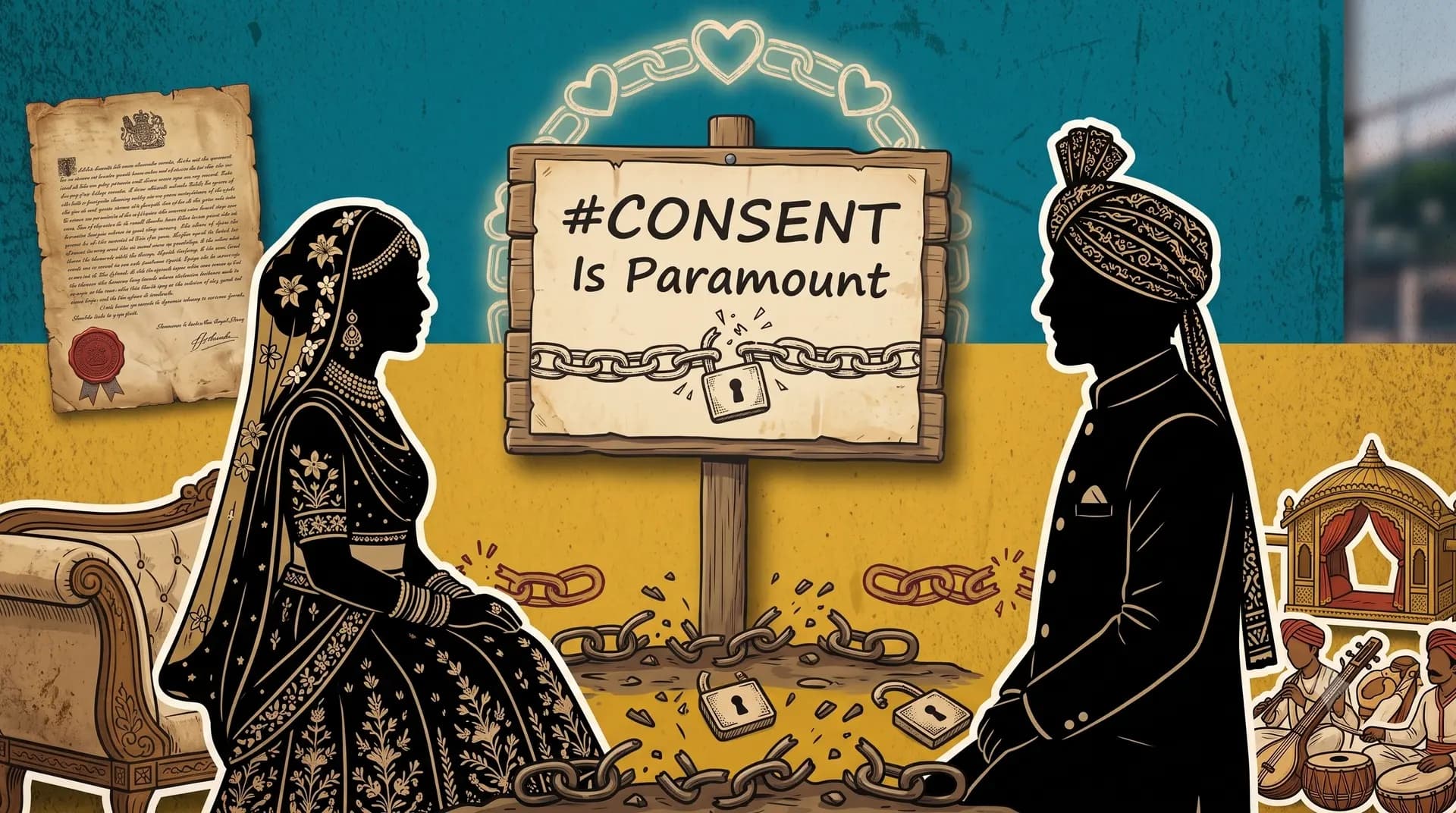
The issue is not only about criminalisation. It is about whether marriage can be treated as a licence to override an individual's autonomy. A legal framework that respects dignity and equality requires that consent remain the governing standard, regardless of marital status.
No. | Citation |
1 | Indian Penal Code, 1860, § 375 Exception 2; Bharatiya Nyaya Sanhita, 2023, § 63 Exception 2. |
2 | Sir Matthew Hale, History of the Pleas of the Crown (1736). |
3 | Joseph Shine v. Union of India, (2019) 3 SCC 39. |
4 | Justice K.S. Puttaswamy v. Union of India, (2017) 10 SCC 1. |
5 | Navtej Singh Johar v. Union of India, (2018) 10 SCC 1. |
6 | Independent Thought v. Union of India, (2017) 10 SCC 800. |
7 | RIT Foundation v. Union of India, 2022 SCC OnLine Del 1404. |
8 | Hrishikesh Sahoo v. State of Karnataka, 2022 SCC OnLine Kar 1612. |
9 | Bharatiya Nyaya Sanhita, 2023, § 67. |
10 | Protection of Women from Domestic Violence Act, 2005, § 3. |
11 | Vivek Singh Bhadoriya v. State of Madhya Pradesh, 2024 SCC OnLine MP. |
12 | R v R, [1991] UKHL 12. |
PALAK SHARMA
Model Institute of Engineering and Technology
Sign in to join the discussion.
Childhood is often regarded as the purest expression of human innocence. Yet the very mind we instinctively associate with innocence is also one still learning how to remember, interpret, and make sense of the world.