Namrata Jana
21 Sept 2026 5 min read
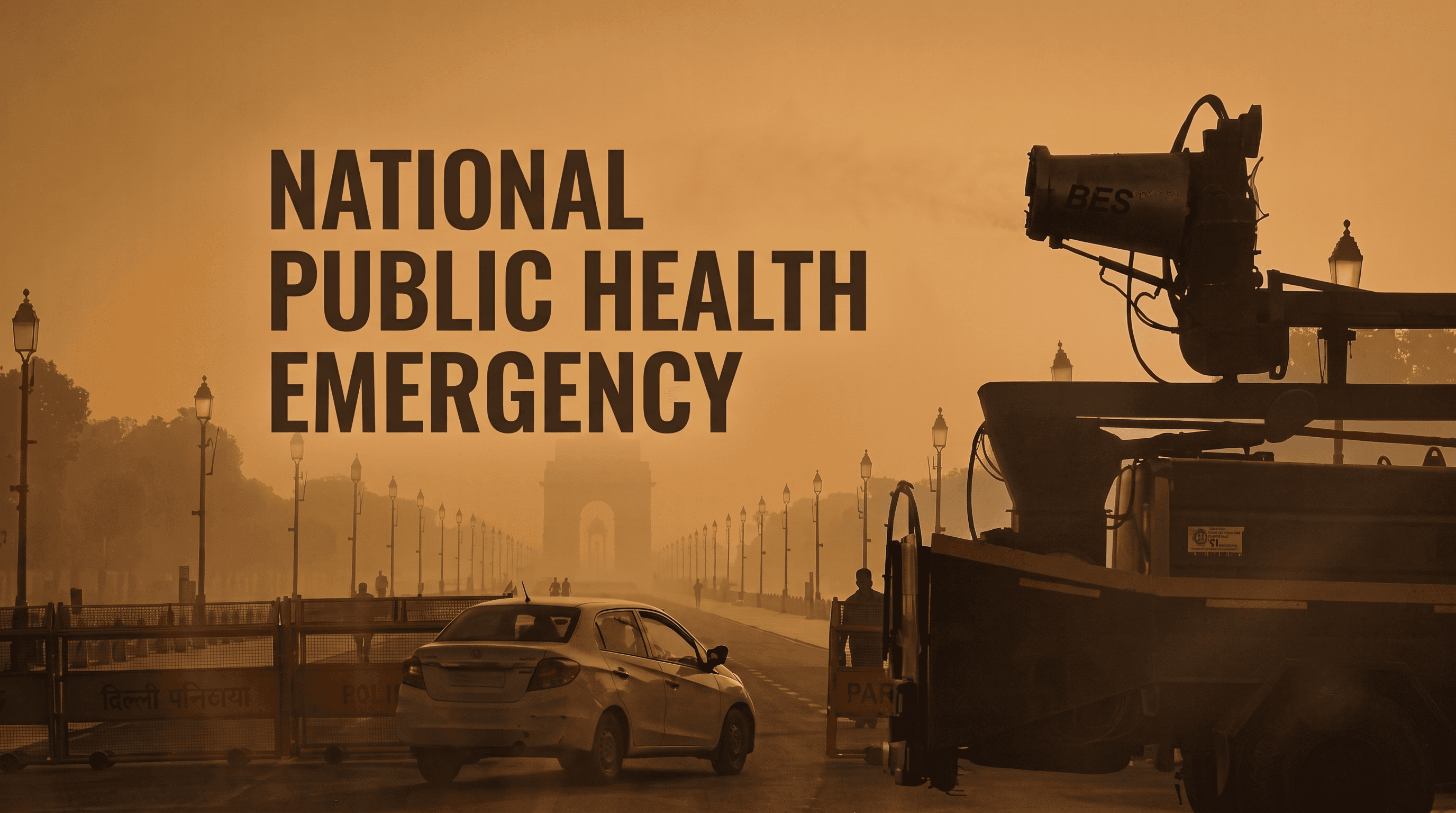
Air pollution has emerged as one of the most pressing environmental and public health challenges in India. Major cities such as Delhi, Kolkata, Lucknow and Varanasi repeatedly record air quality levels far exceeding safe limits established by the World Health Organisation). with millions of Indians exposed to harmful pollutants every day, the question arises: Should air pollution in India be declared a National Public Health Emergency? it critically evaluates the potential benefits and limitations of such a declaration and argues that recognizing Air pollution as a public health emergency could strengthen accountability, enable coordinated governmental action and prioritise the right to life and health under Article 21 of the Constitution. This Article concludes by emphasising the need for a balanced approach that combines emergency measures with long- term structural reforms to effectively address India’s Air pollution crises.
Understanding Air Pollution in India
Air pollution is a complex mixture of harmful gases and aerosols and is the most serious environmental concern among the scientific community. The unprecedent growth in industrialization, urbanization, population, fossil fuel consumption and ever- increasing transportation network are deteriorating the air quality of the environment. There is a certain percentage of gases present in the atmosphere. An increase or decrease in the composition of these gases is harmful to survival. This imbalance in the gaseous composition has resulted in an increase in earth’s temperature, which is known as global warming
Types of Air Pollutants
There are two types of Air Pollutants:
Primary Pollutants – The pollutants that directly cause air pollution are known as primary Pollutants. Sulphur – dioxide emitted from factories is a primary Pollutants.
Secondary Pollutants – The pollutants formed by the intermingling and reaction of primary Pollutants are known as secondary Pollutants. Smog, formed by the intermingling of smoke and fog, is a secondary Pollutants
Key Sources in India include:
Vehicular emissions
Industrial discharge
Crop burning in agricultural regions
Constitution dust
Burning of coal and biomass
According to research, particulate matter (PM2.5 and PM10), nitrogen oxides, Sulphur dioxide and ozone are consistently above safe thresholds, leading to respiratory ailments, cardiovascular diseases and reduced life expectancy in affected population.
What is Public Health Emergency?
A public health emergency (PHE) is a formal declaration by a government or international authority (such as the world health organisation) of a severe, sudden and unusual event that poses a significant threat to the health of a population. These situations typically involve a high risk of widespread illness, injury or death that threatens to overwhelm routine health services.
Levels of Declaration –
Public Health Emergency of International Concern (PHEIC) – Declared by the WHO for events that pose a risk to multiple countries, requiring a coordinated international response (e.g., COVID – 19, Ebola, mpox).
National/ Regional PHE – Declared by national (e.g., US HHS Secretary) or local leaders (governors) to free up emergency funds, personnel and suppliers to manage local crises, such as hurricanes or opioid surges.
Examples of Public Health Emergency
Global Public Health Emergencies
Mpox (formerly monkeypox) outbreak (2024- present)
Ongoing or Recent Disease Outbreak
2025 Uganda Ebola outbreak
2024-2026 Mpox epidemic
2024 dengue epidemic in Argentina
2023- 2024 Zambian cholera outbreak
Local or National Public Health Emergencies
Recent Nipah virus outbreak in India
Public health emergency declared over high infant mortality in Mississippi
Legal framework Relevant to Air Pollution
The legal framework for air pollution in India is anchored by The Air (Prevention and Control of Pollution) Act, 1981, which mandates central and state boards (COCB/ SPCBs) to regulate emissions, set industry standards and prohibit polluting activities.
Key Legislations Components:
1 Air (Prevention and Control of Pollution) Act, 1981: The primary legislations aimed at reducing air and noise pollution. It Mandates that industries in designated areas must obtain consent from the State Pollution Control Board and comply with emission standards.
2 Air (Prevention and Control of Pollution) Amendment Act, 1987 – Empowered pollution control boards to act in grave, emergency scenarios.
3 Environment (Protection) Act, 1986- Empowers the Central Government to take measures to protect the environment, including establishing standards for air quality.
4 Motor Vehicle Act, 1988(Amended 2019) – Enforces Bharat Stage (BS) emission standards and introduces penalties for polluting vehicles, including rules for vehicle recalls.
5 National Green Tribunal (NGT) Act, 2010: Provides for fast- track adjudication of environmental causes related to air pollution.
Should Air Pollution in India be declared a National Public Health Emergency??
Yes, there is a strong case for Declaring air pollution in India a National Public Health Emergency, though it should be done with a clear legal framework and time – bound action plan
Why it should be declared an Emergency??
Arguments for Declaring a National Public Health Emergency
Declaring a National Public Health Emergency) is a critical legal action taken to address, contain and mitigate significant health threats like pandemics or disasters. It enables the rapid mobilization of emergency funds, resources and Personal, while allowing regulatory flexibility to accelerate vaccine/ drug deployment, ensure medical supply access and strengthen surveillance.
Arguments against for Declaring a National Public Health Emergency
Arguments against declaring a National Public Health Emergency often centre on the potential for overreaching executive powers, Economic disruption and the risk of fostering public panic or apathy. Critics warn of the erosion of civil liberties, such as restricted movement and privacy concerns, often without sufficient legislative oversight. Air pollution in India has moved beyond an environmental concern and now constitutes a grave public health crisis with widespread and long- term consequences. It’s impact on mortality, morbidity, healthcare systems and vulnerable populations justifies recognition as a National Public Health Emergency. Such a declaration would not merely be symbolic; it would enable coordinated governance, emergency funding, stricter enforcement of environmental norms and integration of Public Health priorities into air- quality Management. While concerns about Economic disruption and administrative feasibility exist, the cost of inaction – measured in lives lost, productivity diminished and constitutional rights compromised – is far greater. Declaring air pollution, a National Public Health Emergency would reflect the State’s obligations under Article 21 to protect the right to life and health and would mark a decisive shift from fragmented regularization to urgent, accountable and right – based action.
Namrata Jana
Law student, Fakir Mohan University Balasore-Orissa
Sign in to join the discussion.

Childhood is often regarded as the purest expression of human innocence. Yet the very mind we instinctively associate with innocence is also one still learning how to remember, interpret, and make sense of the world.

This article aims to examine the structural tension that arises when private commercial or civil matters are escalated into criminal prosecution. It addresses how the requirements of criminal law such as strict proof, proportionality and procedural safeguard can sit uneasily with routine infringement claims.