Shahe Umam
17 Nov 2026 5 min read
Introduction: A right is not a rule
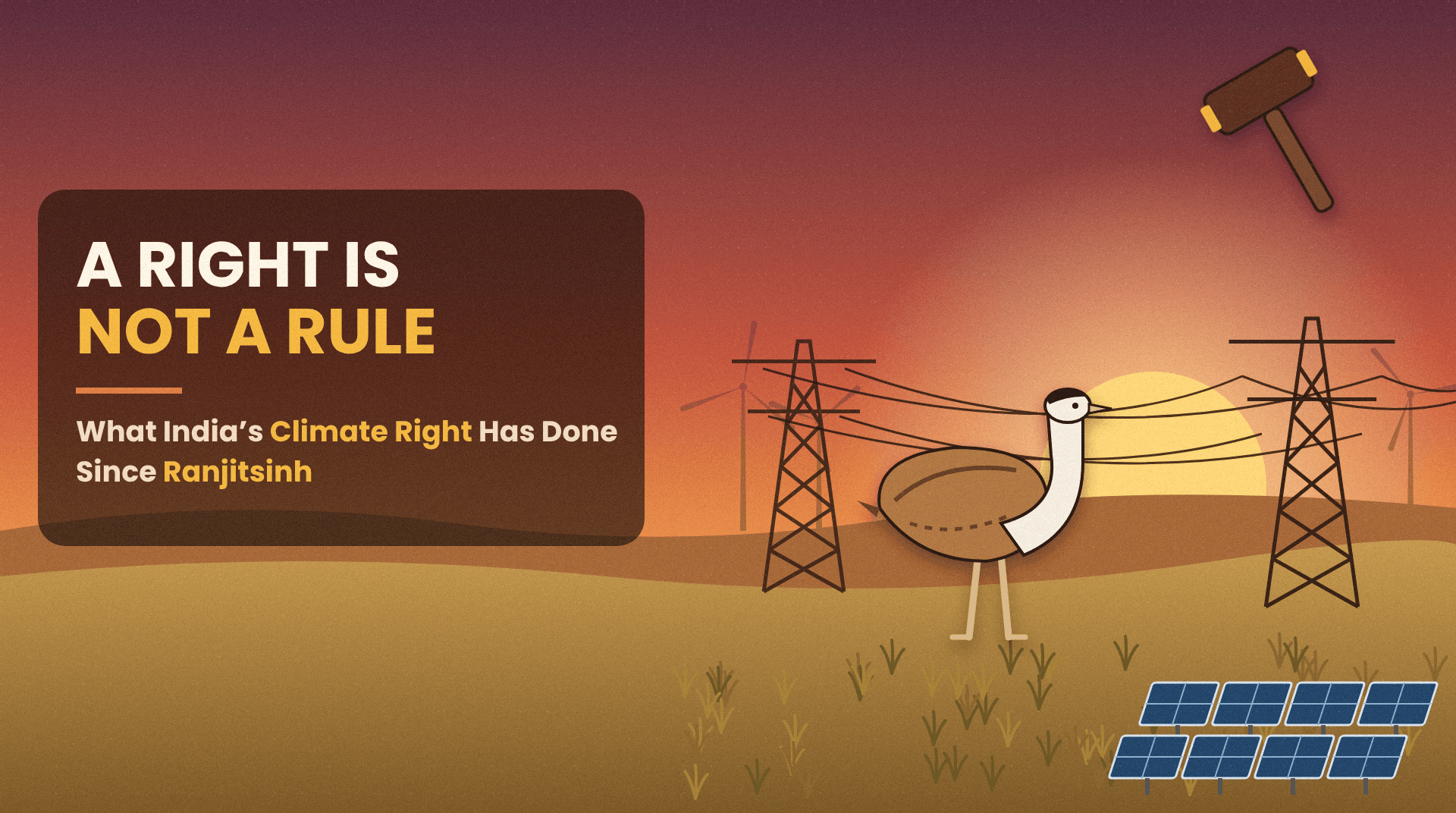
In March 2024 a three-judge bench led by Chief Justice Chandrachud did something few constitutional courts have done: it named a right to be free from the adverse effects of climate change and anchored it in Articles 14 and 21. The case was about a bird. M.K. Ranjitsinh v. Union of India concerned the Great Indian Bustard, a species so depleted that collisions with overhead power lines are among its leading threats. Commentators celebrated the declaration, and some, like this Verfassungsblog analysis, noted that tying the right to equality as well as life gave it unusual breadth. Two years on, the more useful question is what the right has actually done. My argument is uncomfortable for admirers of the judgment. The right has so far worked as a reason to relax a conservation order, not to tighten one, and it still lacks a standard a court can apply. Until it acquires one, it will remain a statement of principle that the executive can claim as readily as the citizen.
The right arrived with a retreat
In April 2021 the Court ordered overhead lines in the bustard's priority and potential habitats, roughly 99,000 square kilometres in Rajasthan and Gujarat, to be moved underground. The Union and renewable-energy developers objected that this was technically and financially unworkable, and that it threatened India's solar and wind targets. One Bloomberg report carried industry estimates of about $4 billion in extra cost and nearly 20 gigawatts of awarded projects at risk. Those figures were claims made by interested parties, not findings of the Court.
In 2024 the Court recalled the blanket direction and left the details to an expert committee. The passage that recognizes the climate right sits within that reasoning: protecting the bustard had to be weighed against climate mitigation through renewables. Birsha Ohdedar asks in her SOAS paper whether the new right is a boon or a bane for climate justice. The sequence supports her question. The first work the right did was to justify loosening a protective order. That does not make the 2024 modification wrong. Courts must choose between real goods, and a blanket undergrounding order across that area may well have been infeasible. The difficulty lies in the right itself. It points in two directions. It protects people from climate harm (heat, floods, ecological loss), and it also supports the infrastructure that reduces emissions. When a conservationist invokes it against a solar park, the State invokes it for the solar park. A right that both sides can claim does not decide the case. It relabels the balancing exercise.
What the 2025 judgment shows
The Court delivered its final judgment in the case on 19 December 2025. According to a law-firm summary, it accepted the expert committee's framework and fixed Revised Priority Areas of 14,013 square kilometres in Rajasthan and 740 in Gujarat. It barred new wind turbines and new solar plants above 2 MW inside them, required new overhead lines to run through designated corridors, set time-bound mitigation for existing lines, and made the environment ministry the monitoring agency. It also declined to treat bird flight diverters as a substitute for those measures. This is a serious regime, and in several ways a better one than the 2021 order: it is specific, dated and reviewable. But look at the tools. Maps, capacity thresholds, corridors and deadlines are the ordinary instruments of wildlife and electricity regulation. As far as the summaries I have read show, nothing in this scheme needed a constitutional climate right to operate. The Court had declared a right and then solved the dispute with a siting plan. A Down To Earth piece reports that the 2024 ruling has not visibly changed the way courts approach environmental matters, which fits what the final judgment appears to show.
What the right lacks: a yardstick
International law has begun to supply the missing content. In its advisory opinion of 23 July 2025 the International Court of Justice said that states have obligations under human rights law to take necessary measures to protect the climate system, and that the standard of due diligence is high. The opinion is not binding, and India told the Court that states have no specific obligation to phase out fossil fuel subsidies, as Mongabay India reported. But the opinion shows what a standard looks like: an obligation to act with care, measured by what a state knew and what it did. Indian courts have nothing equivalent. In Ranjitsinh the Court itself noted the absence of climate legislation, so the judgments are in effect the only operating law. Leaving the right undefined hands its content to the executive by default.
A workable test
Courts do not need a statute to give the right content. Three questions would be enough, and the Court has in practice asked versions of each in the bustard litigation. First, assessment. Before approving a project in a climate-sensitive setting, did the authority record both the emissions consequences and the vulnerability consequences, and give reasons? Second, proof of the competing benefit. If mitigation is offered as the reason to relax a protective measure, the State should show the benefit with evidence, such as capacity actually at stake and alternatives considered, rather than relying on industry claims. Third, monitoring. Any compromise should come with deadlines, an accountable agency and a way for the petitioner to return to court. The December 2025 judgment already contains the third element. The step still to be taken is to name these as the content of the right under Articles 14 and 21, so that future petitioners, such as outdoor workers exposed to extreme heat or coastal communities, can invoke something more concrete than a declaration. An objection is that setting such standards is the legislature's job. That is fair, and a climate statute would be better. But the Court has already chosen to declare the right. Declaring it and declining to say how it applies is not restraint. It simply moves the decision to the executive without any guidance. A right is only as strong as the question it allows a court to ask. After Ranjitsinh, the question is whether a decision was reasonable on balance. It should be what the authority assessed, what it weighed and how it will be held to account. Until the climate right is given that shape, India will have recognized it on paper and used it, so far, mainly to explain why a conservation order had to give way.
Shahe Umam
Jamia Milia Islamia, New Delhi
Sign in to join the discussion.
Jharkhand sits on some of India’s richest mineral reserves, yet it has little control over how the wealth beneath its soil is taxed.

Transitional Shift from Sec. 65B of Indian Evidence Act, 1872 to Sec. 63 of Bharatiya Sakshya Adhiniyam, 2023