Adhiraj Sahgal
18 Nov 2026 6 min read
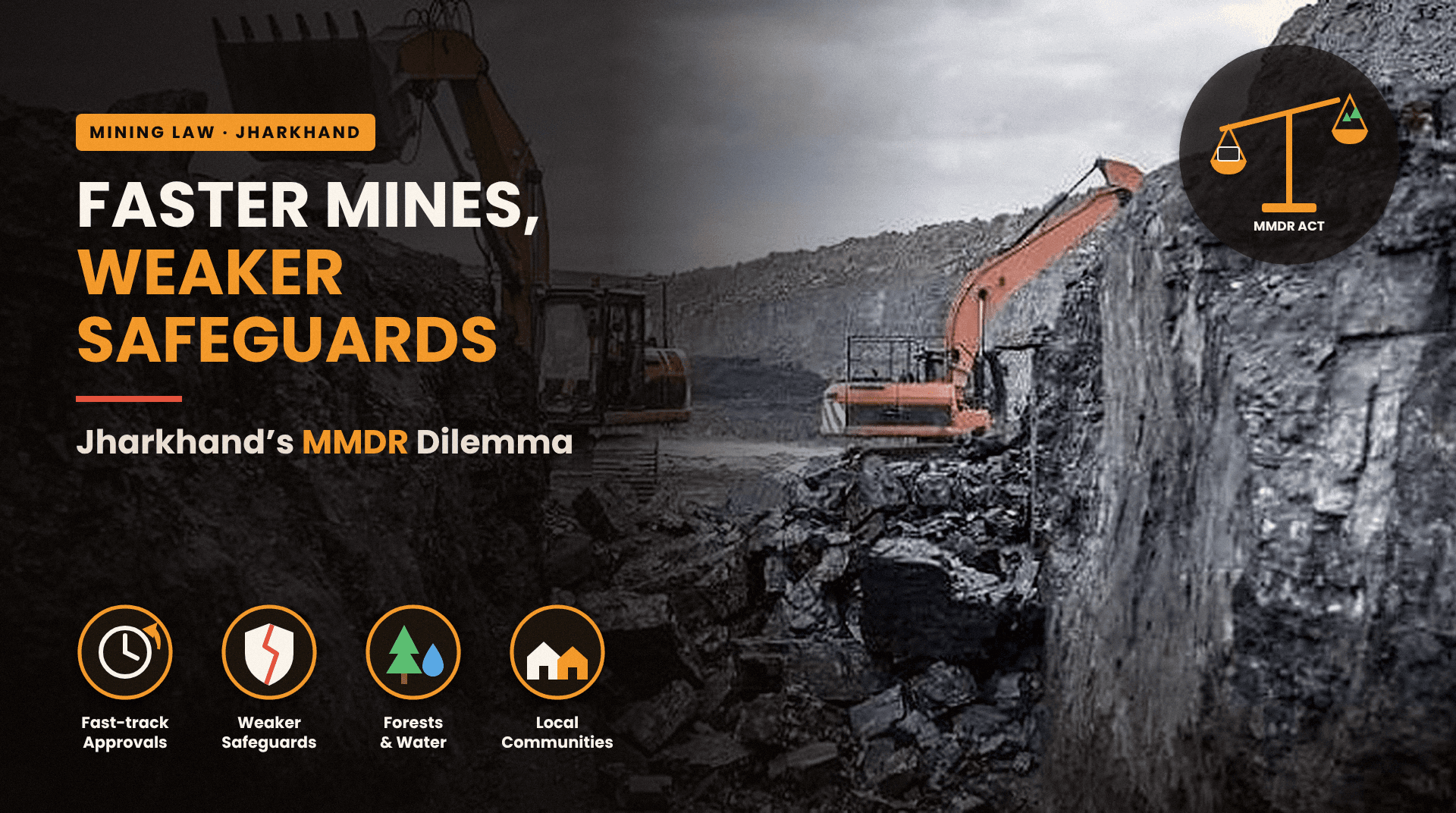
The MMDR Amendment Act, 2026 promises certainty for miners, but for Jharkhand it narrows the state’s ability to tax an industry that shapes its budget, land and politics. Exploration of more mining sites and clearer regulations does not only result in revenue generation but it also carries its heavy demerits; it relocates people residing there and sometimes leaving them abandoned.
Jharkhand sits on some of India’s richest mineral reserves, yet it has little control over how the wealth beneath its soil is taxed. The Mines and Minerals (Development and Regulation) Amendment Act, 2026 deepens that imbalance. It inserts a new Section 9D into the parent Act, barring State governments from levying any tax, cess or other charge on mineral rights or mineral-bearing land - whether calculated on quantity of the mines, value, royalty or any other basis - except under conditions and restrictions prescribed by the Central government.
The Centre frames this as reform: a uniform fiscal regime that will end “unregulated and varying State levies”, reduce costs and protect mining viability. Those are legitimate concerns. Mining companies do face multiple charges, and fragmented taxation can raise costs across steel, cement and power. But for a mineral-dependent state such as Jharkhand, the amendment does something else too. It shifts a consequential fiscal decision from Ranchi to New Delhi.
What Jharkhand stands to lose
Jharkhand’s government says that the state produces close to 160 million tonnes of minerals annually, worth around ₹15,000 crore, and earns about ₹3,500 crore in mineral revenue. But this revenue might be risked while implementation of the recent changes.
This amendment does not exist in a vacuum. It is a direct legislative override of the Supreme Court’s 2024 decision in the MADA case, where the Court affirmed the states’ constitutional right to tax mineral rights under Entry 50 of List II. By inserting Section 9D, the Union has attempted to use its regulatory power under Entry 54 of List I to hollow out the states’ fiscal autonomy.
The 2026 amendment Act does not abolish royalty, auction premiums, District Mineral Foundation contributions or the state’s existing revenue streams. PIB says all these will still continue, and that States receive nearly 90 per cent of mining-sector revenue. But the Act does restrict the state’s ability to respond to future fiscal needs. If Jharkhand later wants a cess for mine restoration, water recharge, road repair or compensation for pollution, it may need central approval through rules framed under Section 13.
This clearly shows us that between all these amendments Jharkhand is facing a real loss of autonomy. A state that bears the local costs of extraction should not ideally be asking the Centre for permission to fund remedies for those costs.
The retrospective question
The Act also declares invalid any levy that was not paid or collected before its commencement, while protecting amounts already deposited or recovered. For companies, this removes uncertainty and potential liabilities. For states, it closes a revenue door that had already been contested in litigation.
The Centre argues that retrospective demands deterred investment and hurt small and medium miners. There is force in that argument. But the remedy should not be framed as though state levies were inherently illegitimate.
The mining experience of Jharkhand has always been one where there has been a disconnect between the money earned and the services, rehabilitation of environment and livelihood support that is required in the region. If there is no settlement process in place, and dues are invalidated, it may be an attempt to resolve that imbalance in favour of the lessee.
Revenue without accountability
The Act preserves the District Mineral Foundations and Pradhan Mantri Khanij Kshetra Kalyan Yojana that is supposed to ensure the mining revenue is channeled to the affected district without any diversion. Although this is important, it is not enough.
Minor minerals audit report submitted by Comptroller & Auditor General (CAG) revealed that the dead rent of ₹ 2.23 crore was not realised in 15 cases and short levy of royalty including District Mineral Foundation Trust funds was made in 30 cases in the state of Jharkhand during October 2019 to January 2022.
Jharkhand may tax the miners is not the main problem rather it is whether they would collect what is already due and spends it where damage occurs. Before proclaiming a “stable” fiscal regime the state must publish a district-wise DMF collections, expenditure, pending restoration liability and audit findings. This should be done in a way that does not result in the stability of investors’ investment being equated with silence of citizens.
Jobs and the local bargain
The local barter is carried out according to the following principles:
Almost five lakh people are directly and indirectly involved in the coal employment sector as per the reports while the non-coal mining supports more than one crore workers nationally. Jharkhand’s mining districts know these numbers are politically charged and it could influence the politics of the land. Job opportunities in a mine do not equate to development in a mining district.
Of the respondents in the CAG's beneficiary survey, 29 per cent cited mining as an employment opportunity and 68 per cent indicated that environmental degradation, degradation of their fields, falling groundwater levels, poor road conditions and a lack of restoration had all negatively impacted their quality of life. The findings should inform the implementation of the new law in Jharkhand in the context of local employment quotas, skill training, independent environmental monitoring and enforceable closure plans.
This reverts us to the heart of the matter of these amendments, which is that, if Jharkhand cannot, relieve itself of the exact environmental damages outlined by the CAG, it has to approach the Centre for restoration funds - an unfortunate scenario for a state that suffers the most from extraction.
A fairer mineral federalism
A more balanced approach to federalism is needed.
The 2026 amendment could help to make mining more predictable. But for whom would this predictability be for? For a business, it's a predictable tax liabilities. For a village not far from a growing mine, it means clean water, roads that work, jobs and a payment on the exit of the mineral.
Jharkhand must take maximum advantage of the fiscal space provided by the new arrangement to improve the state's ability to manage DMF, insist on community consultation and demand a clear central mechanism for state-level levy to restore and provide welfare to the citizens of the state. If not, the state will keep providing the country with its raw materials and lose its fiscal instruments to mending the damage caused by their extraction.
Author: Adhiraj Sahgal

B.A. LL.B.(Hons.)- Batch of 2030
National University of Study and Research in Law, Ranchi.
Sign in to join the discussion.
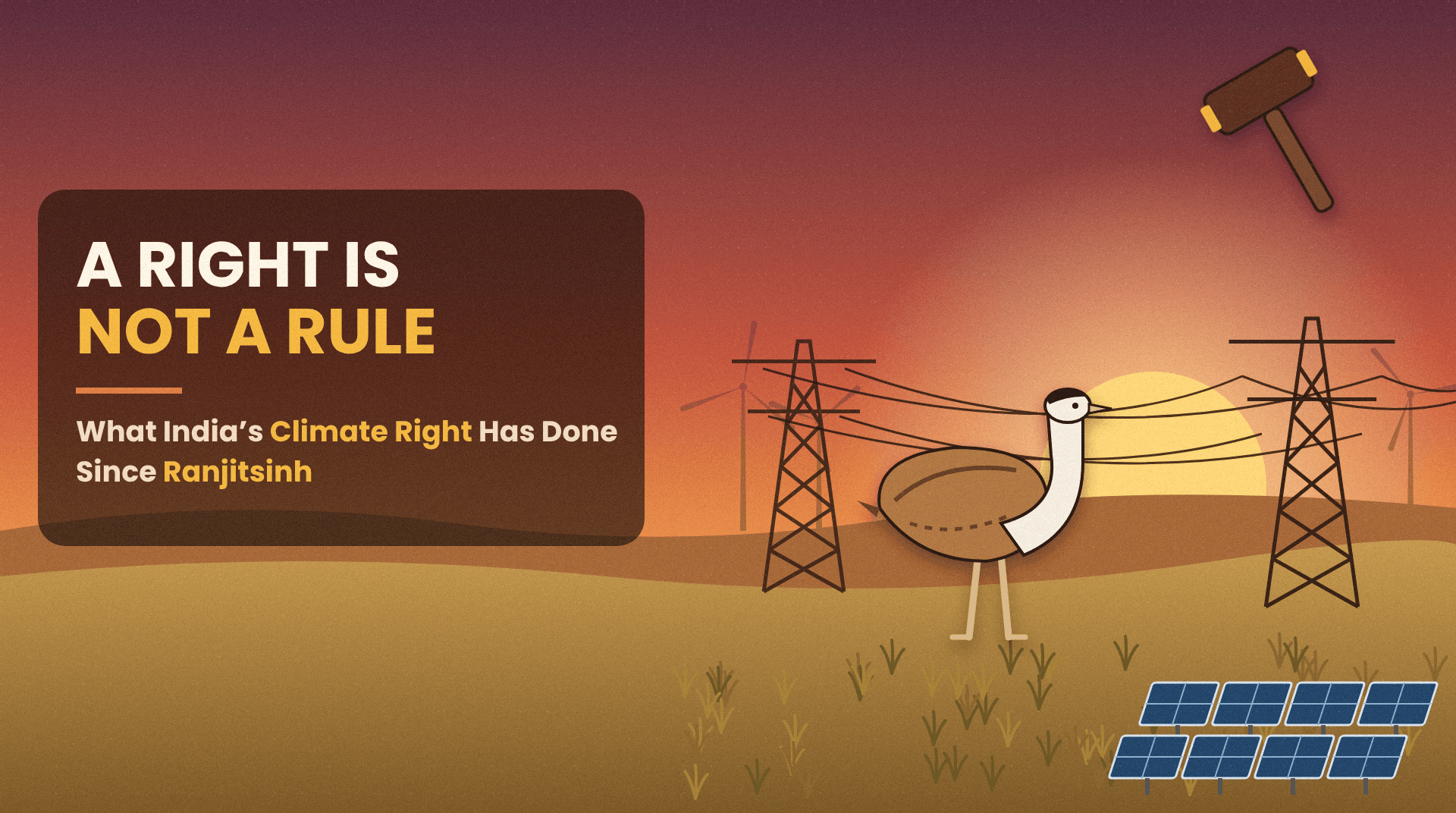
The case was about a bird. M.K. Ranjitsinh v. Union of India concerned the Great Indian Bustard, a species so depleted that collisions with overhead power lines are among its leading threats. Commentators celebrated the declaration, and some, like this Verfassungs blog analysis, noted that tying the right to equality as well as life gave it unusual breadth. Two years on, the more useful question is what the right has actually done.

Transitional Shift from Sec. 65B of Indian Evidence Act, 1872 to Sec. 63 of Bharatiya Sakshya Adhiniyam, 2023