Kavin D
2 Oct 2026 6 min read
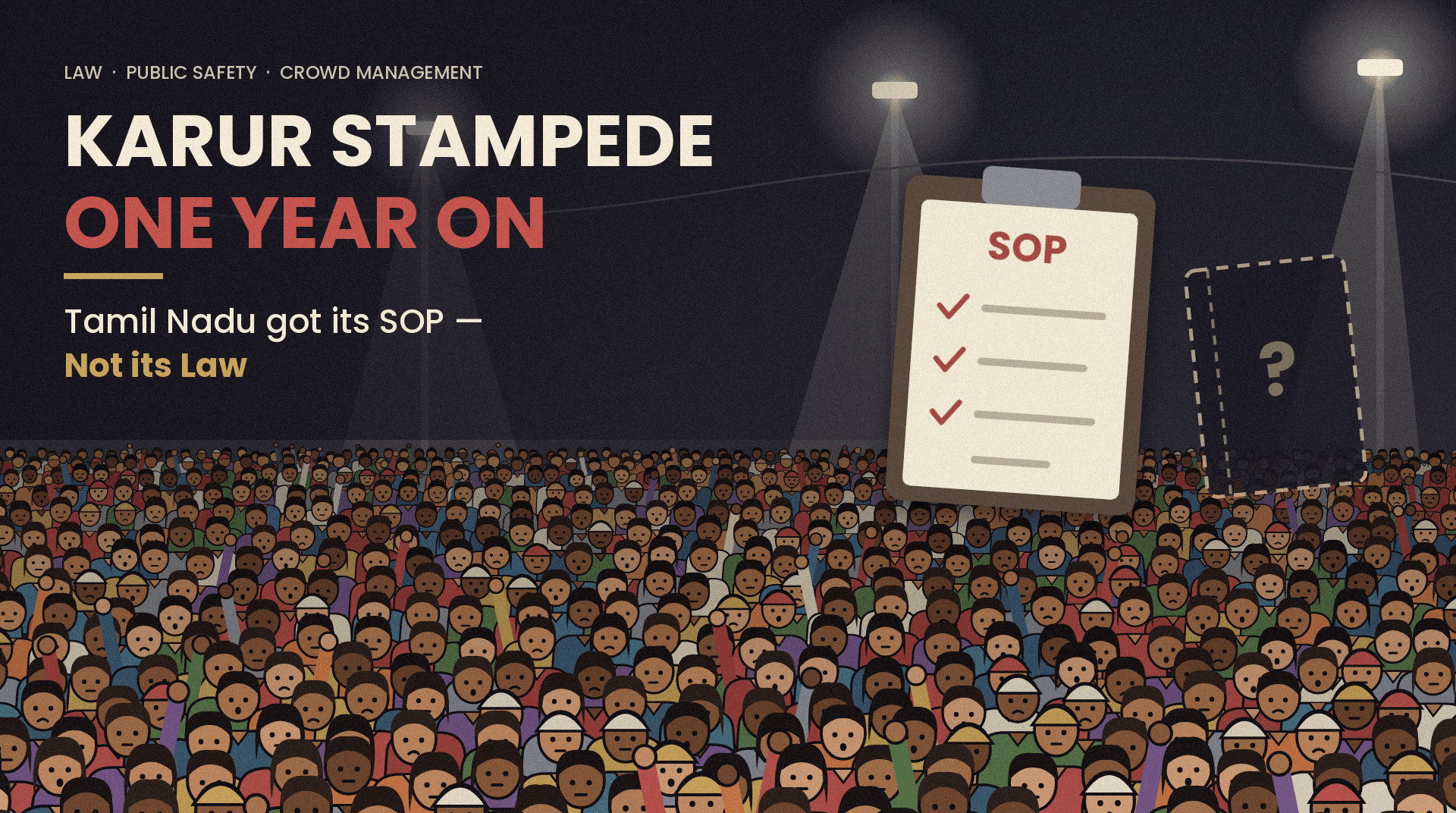
On September 27, 2025, a crowd gathered at Velusamypuram in Karur to hear actor-turned-politician Vijay address a rally for his new party, Tamilaga Vettri Kazhagam (TVK). The stampede that followed resulted in the deaths of 41 people and injuries to over 100. A year later, Vijay’s TVK is no longer a new party, as it swept the 2026 Assembly elections, and Vijay became the Chief Minister of Tamil Nadu. However, the important thing here lies in how the year went by, showing how difficult it was to make a SOP to regulate the organising of political rallies in Tamil Nadu, and how quickly the safeguard everyone wanted was negotiated out of it.
Permission for the political rally in question was granted on September 26, 2025, to the organisers of the said rally by the Deputy Superintendent of Police of Karur, subject to eleven conditions. However, according to the organisers themselves, only two of them were complied with. The problem, however, as stated by the Madras High Court is that no one could identify where the power to grant that permission came from at all. Sections 22 to 41 of the Tamil Nadu District Police Act, 1859 once provided a statutory basis for regulating the assembling and processions. All of these have long been repealed except for Section 42A which provides that police could depute an officer to keep a watch on and report about an assembly. There exists no permission system as far as regulation of assemblies goes. The closest thing which could serve as a permission system would be a provision under the Tamil Nadu State Highways Act which allows the government only to charge rent for use of roads.
In response to the vacuum, litigation came from all directions. TVK itself had filed an application in the Madras High Court's principal bench some weeks earlier for obtaining permissions readily. Post stampede, the petition for SOP was presented seeking the Court to direct the state to think of an SOP only. On 3 October 2025, the Single Judge hearing this narrow petition impleaded a police officer suo moto, expressed dissatisfaction in the investigation and constituted a Special Investigation Team on the basis of an unrelated precedent about organ trafficking. On the very same day, the Madurai Bench of the Madras High Court, having jurisdiction in the matter since Karur falls within it, rejected the petition for CBI probe since there was no shown defect in the investigation, and closed the SOP petition on the ground that another similar petition is pending in Chennai.
The order dated 13 October 2025 of the Supreme Court was no less harsh. It pointed out that the Madurai Bench having jurisdiction did not find any defect in the investigation, but the same set of facts brought a completely different view from a single judge in Chennai sitting without even hearing TVK without any prayer for SIT being put forward and without a Chief Justice ordering him to hear public interest litigation. On the principle laid down by the court itself in State of West Bengal v. Committee for Protection of Democratic Rights - that the court-ordered CBI probe is exceptional, reserved for restoration of credibility - it ordered transfer of the matter to CBI, suspended the makeshift SIT and the investigation committee of the state, constituted a three-member committee headed by former Justice Ajay Rastogi as a supervising mechanism, and sent the original petition back to a division bench.
That bench acted fast: a ten-day time period to come up with a draft SOP, consultation with all parties, forty-six pages of draft SOP, and finally, an order passed on 19 December 2025, asking the government to notify the same by 5 January 2026. They did. Thus, now Tamil Nadu has a notified system of regulations for large gatherings of more than 5,000 people - capacity regulation, entry through a QR code, availability of water, sanitation, and medical facilities, as well as protection of the vulnerable in the audience - all of which is already used to limit the number of participants in a TVK rally in Salem to 4,998. This is indeed a considerable achievement. However, the draft included an interesting provision that has been omitted due to political objections i.e., a refundable security deposit of up to Rs 20 lakhs from the organizer of the event. This is precisely what the original petitioners wanted from the beginning. However, it was eventually dropped after political parties objected. The rulebook regulates entry and amenities. It says nothing about what an organiser owes the people who don't make it home. The probe by the CBI and the committee headed by Rastogi continues. It is reported that the newly re-filed FIR includes even the General Secretary of TVK Mr. Bussy Anand among the accused. In December 2025, a Supreme Court bench hearing its review of the High Court's report noted that there was something definitely wrong with the way the latter had handled the matter. In July 2026, with TVK now in power, the opposition party DMK sought to ask the Court to restrain Chief Minister Vijay and one of his ministers from making any public comments on the probe, but the Court rejected this request, corrected the false information given by DMK that Vijay himself was one of the accused and warned about politicization of courts. The application was withdrawn.
This is the true measure of 2026. The Supreme Court can supervise the investigation and discipline a court that ties itself in knots. It cannot substitute, case by case, for a legislature that never codified the organizer liability or witnesses' protection standards - so, when the political situation changes, the only thing that remains is an ad hoc plea to the court which does not have a standard to base its decision on. Karur received a rulebook regulating permission in three months. What happens when the people responsible are, a year later, the government the law depends on to police itself is still being litigated one petition at a time - because it was never written down.
Senthilkannan v. Director General of Police, 2025 SCC Online Mad 7493 (Madras High Court, Madurai Bench, 3 Oct. 2025).
P.H. Dinesh v. Home Secretary, Government of Tamil Nadu, 2025 SCC Online Mad 7501 (Madras High Court, Principal Bench, 3 Oct. 2025).
Tamilaga Vettri Kazhagam v. P.H. Dinesh, 2025 SCC Online SC 2218 / 2025 INSC 1224 (Supreme Court of India, 13 Oct. 2025). Case record: order. Law
State of West Bengal v. Committee for Protection of Democratic Rights, (2010) 3 SCC 571. Case record: order. Law
In re: Ramlila Maidan Incident, (2012) 5 SCC 1.
Mazdoor Kisan Shakti Sangathan v. Union of India, (2018) 17 SCC 324.
Tamil Nadu District Police Act, 1859, ss. 22–41 (repealed) and s. 42A.
Madras HC sets Jan. 5 deadline for TN to notify SOP for regulating massive rallies and roadshows, The Statesman (19 Dec. 2025): thestatesman.com
Karthik Bhatt, Public gatherings in Tamil Nadu: SOPs must be followed in full spirit for safety, Citizen Matters (26 Feb. 2026): citizenmatters.in
Vijay-led TVK gets restricted permit for Salem meet; no entry for pregnant women, children and elderly, Deccan Herald (Feb. 2026).
Karur Stampede: CBI Takes Over Probe, Lists TVK Officials As Accused In FIR, ETV Bharat (26 Oct. 2025).
'Something wrong': Supreme Court flags concerns over Madras HC order in Karur stampede (12 Dec. 2025), reported via Live Law.
Supreme Court refuses to entertain application seeking to restrain Tamil Nadu CM Vijay from meeting Karur stampede victims, Ver dictum (7 July 2026): verdictum.in
2026 Tamil Nadu Legislative Assembly election results (results declared 4 May 2026; Vijay sworn in as Chief Minister 10 May 2026).
Kavin D, Final-Year LL.B. (Hons.) Student,
National Law School of India University (NLSIU), Bengaluru
Sign in to join the discussion.

In India the practice survives as khatna or khafz, performed mostly on six- and seven-year-old girls in the Dawoodi Bohra community. There is no official data on it: the government told the Supreme Court that no official data supported the practice’s existence

Consent should be judged by whether a person understood what they agreed to, not by whether a click was logged. Until the law asks that question, “I Agree” will stay closer to ritual than choice.