Payal bahmania
9 Sept 2026 8 min read
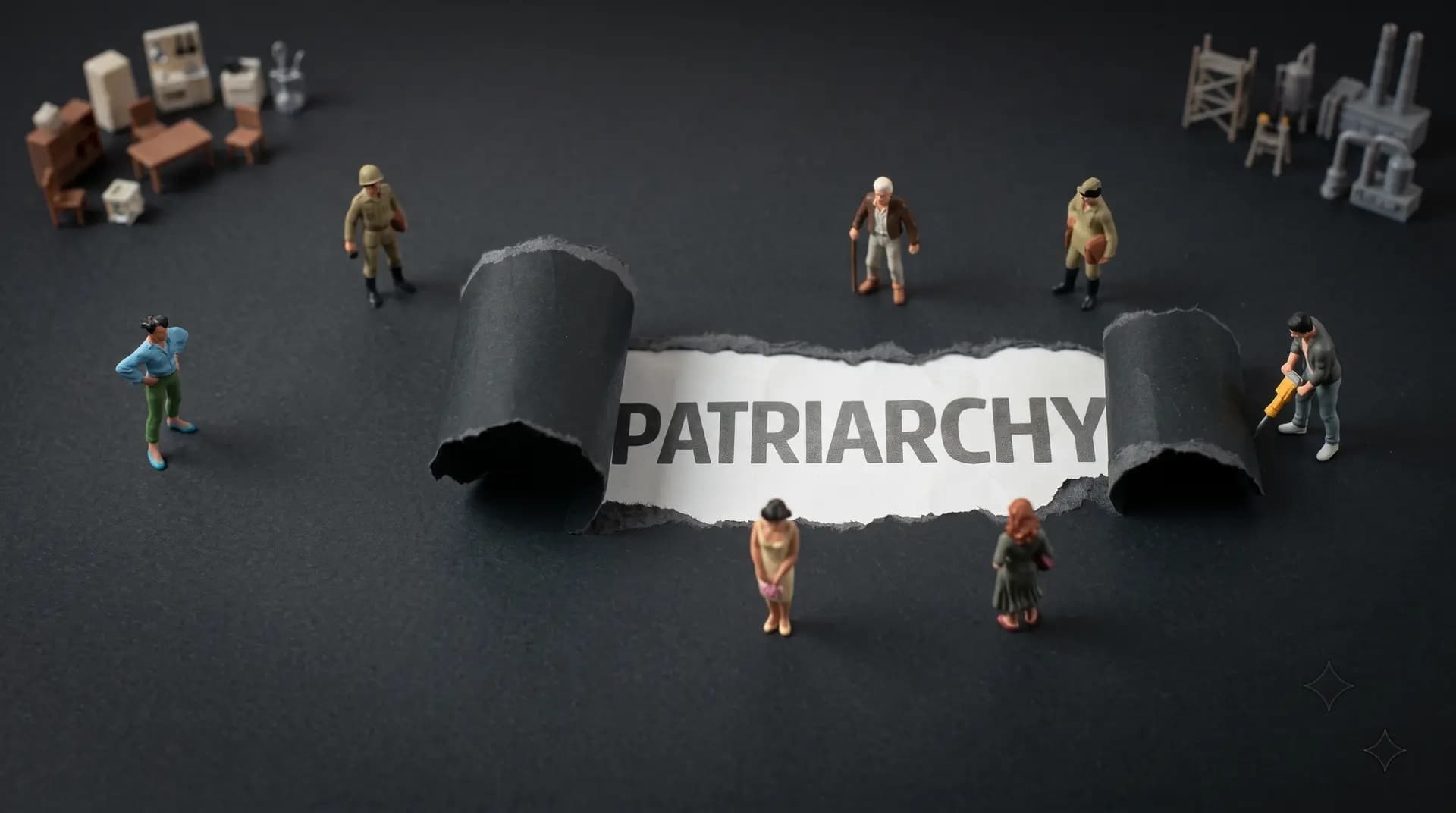
The origins of patriarchy can be seen in many different periods of human history. In a great many traditional societies men came to be closely linked with physical strength, control of land, inheritance, warfare, and political power. When communities set up systems of property and the inheritance of family estates, the roles of women were generally tied to marriage, childbirth, and domestic duties. Religious beliefs, customs, and laws at times reinforced these arrangements. Over the course of generations practices which had been influenced by specific historical circumstances could become traditions that people accepted without questioning. The family is actually one of the most important places in which people learn patriarchal ideas, since children start to grasp gender roles from an early age. In certain families boys are encouraged to be confident, independent and ambitious, while girls are taught to be obedient, careful and responsible for looking after the home. When a boy speaks assertively he may be described as confident but a girl showing the same behaviour might be labelled as rude or stubborn. The distinctions made in this way can affect the way children see themselves and the things that they think they are capable of doing. Domestic work is also a major concern. Activities such as cooking, cleaning, looking after children, and attending to elderly relatives are important kinds of labour, but have traditionally been seen as being naturally women's duties rather than as real work. Even if women have full-time jobs outside the home they might still have to take on a greater portion of the housework. This is what is usually referred to as the double burden. A woman may earn a salary by working all day and then go home to carry out another unpaid shift involving cooking, cleaning and caring.
Patriarchy also has an impact on education and the careers that people choose. In certain communities, girls are still discouraged from studying some subjects, from traveling by themselves, or from taking up careers that demand independence. Since they expect daughters to get married and move into a different household, families may put more effort into their sons' education. Even in areas where girls have equal access to education, social expectations can affect the careers they select. Jobs in engineering, technology, politics, leadership, and other fields which are generally dominated by men may be seen as unusual for women, while care-giving jobs may be regarded as more appropriate for them. The workplace also gives a clear example of this. Women may have to put up with unequal pay, fewer chances for promotion, sexual harassment, discrimination when being hired, and assumptions regarding their commitment to their careers. When employers assume that women will be less available after they have children, motherhood can turn into a disadvantage. Men, by contrast, might at times be praised for working long hours since such behaviour is seen as showing dedication and ambition. These attitudes show that workplace inequality is not simply a question of salary; it also comes down to who gets to have their time, authority, and ambitions recognised. Politics and leadership have likewise been influenced by patriarchal ideas. For a large part of history women were prevented from having the right to vote, from owning property, from receiving an education, or from being allowed to take up public office. Even though many countries have achieved considerable advances, women are still underrepresented in political institutions in many parts of the world. Leadership is generally linked with traditionally masculine characteristics such as toughness, dominance, and emotional control. Women, on the other hand, may be more severely judged when they show these qualities. This results in a difficult position in which women can be criticised for being too aggressive as well as for not being strong enough.
Patriarchy has an impact on the lives of men as well. It does not follow that every man gains from all the aspects of the system. Men can be put under pressure by patriarchal expectations to be financially successful, physically strong, emotionally restrained, and always competitive. It is possible for boys to be told that crying shows a lack of strength or that asking for help makes them less masculine. Men who take on caring roles, pursue artistic careers, or engage in other activities seen as feminine may be made fun of. It therefore follows that confronting patriarchy can also help men to live more freely by enabling them to express their emotions and in healthier ways define what masculinity means. A highly damaging result of patriarchy is gender-based violence. This kind of violence can take the form of domestic abuse, sexual violence, harassment, forced marriage, stalking, and other methods of control. Because of patriarchal beliefs, there can be situations in which a man's authority over a woman is seen as legitimate or in which the victims of the violence are made to feel responsible for it. When people ask a woman what she was wearing, where she went, or why she did not leave an abusive relationship, they shift the blame away from the abuser. A society that is committed to equality should hold the perpetrators responsible and at the same time offer support and protection to survivors. It is necessary to avoid viewing all women as belonging to the same, identical category. The system of patriarchy interacts with factors such as class, caste, race, religion, disability, age, sexuality, and economic status. For example, a rich woman and a poor woman might be subjected to gender discrimination in different ways. A woman who lives in a rural area may encounter problems that are different from those that affect a woman in a large city. These differences demonstrate the need for gender equality to take into account not only legal rights but also social and economic conditions.
Educating people and raising awareness is the first step in challenging patriarchy, but that does not mean the matter is finished. Families can share out the duties around the home more equally and help children to cultivate their interests without saying that these are masculine or feminine. Schools should teach students about consent, respect, equality, and stereotypes. In the workplace, fair systems for hiring and promotion should be established, parental leave should be provided, harassment should be taken seriously, and employees should be given the opportunity to balance their work and family lives. Governments should strengthen the laws which protect equality and make sure that these laws are actually put into practice. Men play an important role in this process. It is not necessary to hold every man responsible for social problems if one is advocating for gender equality; what is required is an acknowledgement of unfair advantages and a willingness to question behaviours that have been regarded as normal. Men can help with household chores, pay attention to women's experiences, challenge sexist jokes, support women in taking on leadership roles, and teach boys that kindness and the expression of emotions are strengths. Although these things may appear to be ordinary, social change is usually the result of ordinary decisions being made repeatedly in millions of homes and workplaces.
Women also have an essential role to play, but the responsibility for getting rid of patriarchy should not be confined to them. Asking women to become stronger, to speak out more, or to work harder without altering the unfair institutions can cause equality to become yet another burden. Genuine progress depends on changes to the surroundings of individuals. A woman should not have to be exceptional in order to get the opportunities which should be accessible to everybody. Patriarchy has been able to last for centuries due to the influence of habits, institutions, expectations, and power relations. However, just because a system is old does not mean that it will always remain so. In many areas social attitudes have changed greatly as a result of people challenging the traditions which had once appeared to be unchangeable. Contributions to greater equality have come about through women's movements, legal reforms, education, and changes in family structures. The aim of challenging patriarchy is not to set up a society in which women dominate men, but to establish one in which a person's worth, freedom, opportunities, and voice are not determined by their gender. Equality means that a girl may dream of becoming a scientist without being told that such a thing is for boys, that a boy may choose to be a caring parent without feeling ashamed of it, and that both of them can build their lives on the basis of their own abilities rather than on rigid expectations. Patriarchy is not merely a thing of the past; it can be found in family discussions, in classrooms, in offices, in advertisements, in laws, in relationships, and in the ways people set expectations for themselves. The first thing one must do in order to change it is to recognize its presence. Achieving a more equal society calls for courage, education, empathy, and a readiness to question established traditions. Only when people cease to ask whether something is traditional and begin to ask whether it is fair can real, meaningful change take place. The fight against patriarchy is therefore not a fight against men; it is a struggle against inequality itself, and its aim is to ensure that every individual, no matter their gender, has the freedom to live with dignity, opportunity, and respect. It also calls for patience since deeply rooted beliefs seldom vanish overnight. Change may start in little instances—for example, a parent giving equal treatment to his or her sons and daughters, a teacher encouraging all the students, a partner taking on the unpaid work themselves, or a manager assessing employees on the basis of their abilities rather than their gender. Once these kinds of actions become the norm, they slowly alter people's expectations. Equality is not attained by substituting one kind of power for another but instead comes about through the creation of relationships and institutions in which respect, responsibility, and opportunity are all shared.
Payal bahmania
Bpsmv Khanpur Kalan Sonipat Haryana
Sign in to join the discussion.

Indian criminal courts have, since the mid-1990s, protected survivors of sexual violence from a peculiar demand: that trauma be remembered like an invoice, in perfect order, down to the make of a car or the exact hour of an assault. Courts now accept that delay in reporting and gaps in a victim's account do not, by themselves, indicate falsehood.

Consider a criminal case where there are clear video evidence and distinct audio evidence. This kind of evidence is considered to be very credible. However, what if the evidence is a deepfake?