Swarn Keshav
30 Sept 2026 6 min read
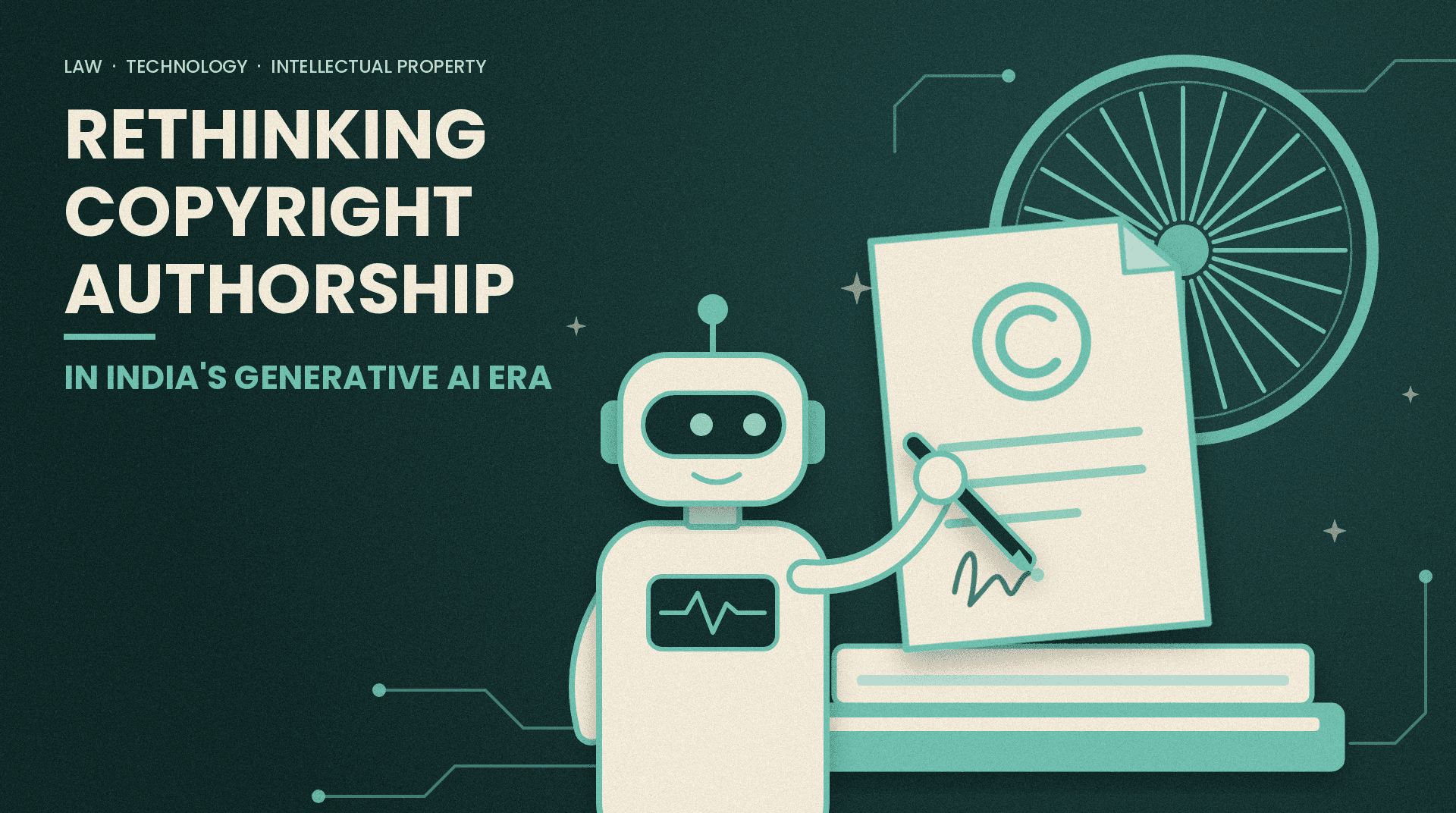
Generative artificial intelligence can now create essays, illustrations, music, and software in just a few seconds. However, this speed has raised a tough question for Indian copyright law: when a machine is mostly responsible for the creative parts, who, if anyone, can claim ownership of the final result? The Copyright Act of 1957 is a good starting point, but it was written for computer-assisted work, not for systems that can generate complex content from huge datasets. India needs a way to protect real human creativity without treating an AI system as a legal author.
The issues are not only about ownership. They also include whether it’s legal to use protected works to train AI models, what counts as originality, who is responsible for developers' and users' actions, and how AI-generated material affects creative markets. These matters should be handled by interpreting existing laws in a way that puts humans at the centre, not by automatically giving copyright to everything an AI produces.
The starting point in the law is Section 2(d)(vi) of the Copyright Act, which says that for a computer-generated work, the author is the person who causes the work to be created. This sounds flexible enough to cover technological help. But generative AI adds complexity. A user might offer just a short prompt, while the AI chooses the language, style, colour, rhythm, or visual design. The developer builds the model, the user makes the request, and the training data providers might have given the AI the material to work with. The phrase "person who causes the work to be created" is not clear enough to tell which of these people should be protected.
Sections 13 and 14 offer a broader picture. Copyright exists in original works, and the owner has exclusive rights to reproduce, distribute, adapt, and use the work in other ways. Section 51 says that doing these things without permission is infringement. Section 52(1)(a) allows for fair dealing in private use, like research. While these laws can help judges, they don’t directly tell us if training an AI is considered research, if it copies protected expressions, or if an output that looks like a training work is a copyright violation.
What matters is human contribution. Copyright is not just about getting a final file. It also rewards intellectual effort, creative thought, and responsibility. A person who develops a concept, gives detailed instructions, looks at several results, makes big changes, and decides the final arrangement contributes more than someone who just gives a simple prompt and takes the first result from the AI.
This difference creates two types of works. In an AI-assisted work, human decisions are still responsible for the creative parts of the final product. These works can be protected based on the human input. But in a work that is mostly created by the AI with little human input, giving full copyright could lead to private monopolies without any real human authorship. India’s legal situation is becoming more real. Recent cases show that this is no longer just a theory. In the Delhi High Court, there was a case between ANI Media and OpenAI, which dealt with claims that copyrighted news content was used in training ChatGPT. The court didn’t grant the requested temporary ban and looked into issues like fair dealing, using data, model training, how similar outputs are, and jurisdiction. This ruling is important because it directly addresses the relationship between copyright and large language models, but it’s only an interim decision and doesn’t settle every training data case. Another development in 2026 raised questions about whether an AI can be considered an author. Reports suggest that AI is not recognised as a legal author, which fits with how copyright law gives rights and responsibilities to recognised people. But not recognising AI as an author doesn’t automatically solve ownership. The law still needs to find the human or legal entity whose creative work justifies protection.
India’s current legal framework has three major issues. First, it doesn’t say how much human involvement is needed for a computer-generated work to be attributed to a person. Second, there is no rule requiring developers to be transparent about the material used to train AI models. Third, it doesn't clearly say whether works created entirely by AI should be protected at all. This uncertainty might lead some tech companies to claim rights they don't really have, while making it harder for writers, artists, musicians, and journalists to get the protection they deserve, especially since their work often feeds into AI systems.
A practical way to reform this - the immediate fix doesn't have to be a whole new law.
The Copyright Office and courts can come up with a test that focuses on human contribution, without relying too much on technology. The key questions should look at what the user asked for, how much they chose and edited, how much control they had over the final creative elements, and whether the work shows clear human judgment. No single factor should decide things on its own. People who want to register a work made with AI should also explain how much the AI contributed and what part humans played. This wouldn’t stop creators from using AI as a tool. It would just stop people from claiming rights over things that weren’t really made by a human. Protection could still apply to the parts of the work that were human made, like the choices, arrangement, editing, or adaptation, even if the raw AI output isn’t protected on its own. Training data also needs a similar approach. Courts should tell the difference between using protected material in a way that replaces the original and using it in ways that are temporary or change how the data is used without copying the actual expression. At the same time, developers should keep records of where their training data comes from and be transparent when required. Licensing, group deals, and options to opt out could help when using protected works has a big commercial value.
Copyright law shouldn’t stop useful technology from being used, nor should it turn every machine-made output into a protected item. AI can be a tool, a partner, or even a creator, but it can't replace the human author in the legal sense. The strongest principle for India is therefore simple: protection should follow demonstrable human creativity, while accountability for training and commercial use should follow the entities that control the system. This balance would preserve the incentive structure of copyright without allowing technological automation to erase the contribution of human creators.
SOURCES
Copyright Act, 1957 (official text): https://copyright.gov.in/documents/copyright_act_1957.pdf
Delhi High Court, CS(COMM) 1028/2024 (ANI v. OpenAI proceedings):
https://delhihighcourt.nic.in/app/showlogo/760734241732511325460_14045_10282024.pdf/2024
Swarn Keshav
Army Law College, Pune
Sign in to join the discussion.
In India the practice survives as khatna or khafz, performed mostly on six- and seven-year-old girls in the Dawoodi Bohra community. There is no official data on it: the government told the Supreme Court that no official data supported the practice’s existence
Consent should be judged by whether a person understood what they agreed to, not by whether a click was logged. Until the law asks that question, “I Agree” will stay closer to ritual than choice.