Savni Kapoor
28 Sept 2026 6 min read
Introduction
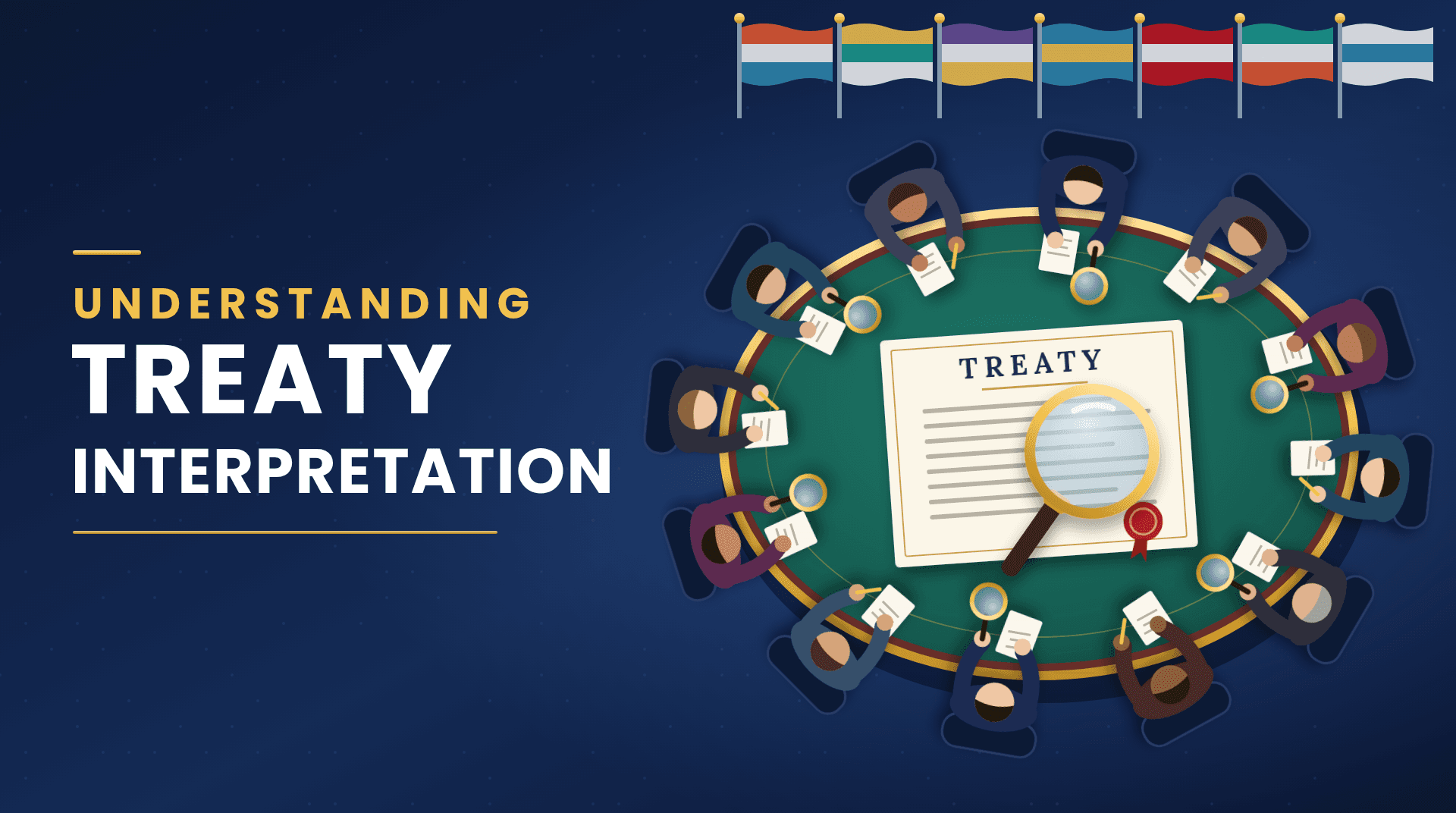
Imagine two countries signing an agreement. Both countries agree to the same words, sign the same document and promise to follow the same rules. Years later, however, they disagree about what those words actually mean. This is where treaty interpretation becomes important as it’s the core of the signed agreement.
A treaty may appear clear when it is signed. However, language can be much complicated. A single word may have different meanings, circumstances may vary, or two countries may understand the same provision in different aspect.
In simple terms, treaty interpretation means finding out what a treaty legally means.
International Law has developed certain rules for doing this. The most important rules are found in the Vienna Convention on the Law of Treaties 1969 (VCLT), particularly Articles 31, 32 and 33.¹
What Is Treaty Interpretation?
A treaty can be understood as a legal promise between States. But like any old promise, disagreements can arise about what was actually agreed in the past. The purpose of treaty interpretation is therefore to understand the agreement without changing or rewriting it.
For example, if a treaty requires two countries to "cooperate", questions may arise about what cooperation actually requires. Does it mean consultation, sharing information, financial assistance or something else?
The interpreter must find the meaning that the treaty legally supports.
Article 31: The Starting Point
The most important rule is found in Article 31 of the Vienna Convention.¹ It says that a treaty must be interpreted in good faith, according to the ordinary meaning of its words, in their context, and in light of the treaty's object and purpose.¹
This can be understood through three simple questions:
What do the words normally mean?
The ordinary meaning of the language is the starting point.
What is the context?
A provision should not be read separately without the relevant context. The surrounding provisions and relevant parts of the treaty must also be considered.
What is the core purpose of the treaty?
The interpreter should consider what the treaty was created to achieve. A useful way to remember Article 31 is: Do not read one sentence of a treaty in isolation; read the treaty as a whole.
Article 32: What If the Meaning Is Still Unclear?
Sometimes Article 31 may not be sufficient to solve the conflict. This is where Article 32 becomes relevant.² Article 32 therefore allows the use of supplementary means of interpretation, including the preparatory work of the treaty and the circumstances in which it was concluded.²
In simple terms, if the words remain unclear, The history behind the agreement becomes the focus. What were the countries discussing? What conflicts were they trying to solve? What circumstances existed when they signed the treaty? However, Article 32 is supplementary. Article 31 always remains the primary starting point.
What Happens When a Treaty Has Different Languages?
Treaties may be authenticated in more than one language. This can create a problem as there are differences in meaning between language or authentic versions.
Article 33 provides rules for interpreting treaties authenticated in multiple languages.³
This is important because translation is not always perfection. A small difference in wording can sometimes create a significant legal difference. Therefore, treaty interpretation is not simply about translating words. It is about understanding the core and differences of a treaty as a complete legal instrument.
Treaty Interpretation in Practice
The Indus Waters Treaty 1960 between India and Pakistan is a useful modern example. The treaty governs the sharing of the Indus river system and provides mechanisms for resolving disputes.⁴ Following the deterioration of India-Pakistan relations due to Pahalgam Attack, India in April 2025 placed the treaty in abeyance. This has raised questions about its continued operation and dispute resolution mechanisms. As of July 2026, India has also stated that the treaty cannot continue in its present form and that renegotiation would be required.
The India-Russia relationship provides another example. The 1971 Treaty of Peace, Friendship and Cooperation was concluded between India and the Soviet Union, while the 1993 Treaty of Friendship and Cooperation later provided a framework for relations between India and the Russian Federation.⁵⁻⁶
International courts have also dealt with treaty interpretation. In Kasikili/Sedudu Island (Botswana/Namibia), the International Court of Justice interpreted a treaty concerning a boundary between the two States.⁷
In Oil Platforms (Iran v United States), the Court interpreted provisions of the 1955 Treaty of Amity between the two countries.⁸
These treaties above mentioned demonstrate that treaty interpretation can affect serious questions involving territory, resources, State responsibility and internal conflicts.
Critical Analysis: Should We Follow the Words or the Intention?
One of the biggest questions in treaty interpretation is whether courts should focus on the words of the treaty or on what the States intended during its creation. If courts focus only on the words, they may sometimes reach a narrow interpretation that completely ignores the treaty's original purpose. However, if courts rely too heavily on intentions, they may begin assuming what States meant rather than interpreting what they actually agreed to.
The Vienna Convention attempts to balance these concerns through ordinary meaning, context, good faith and object and purpose.¹
A court should therefore interpret a treaty, not rewrite it.
This becomes particularly important with older treaties. International circumstances keeps on changing, but changing circumstances become an excuse to create obligations that States never accepted.
Conclusion: Words Can Build Bridges
Treaties are more than just agreements of ink written on paper. They create legal commitments between States and have the power to influence international relations for decades. The Vienna Convention provides a structural approach to understand these commitments. Article 31 establishes the main rule, Article 32 provides supplementary methods, and Article 33 addresses treaties authenticated in different languages.¹⁻³
The Indus Waters Treaty and India-Russia agreements clearly showcases that treaty interpretation remains relevant even when political circumstances change. Ultimately, treaty interpretation is about finding the original meaning that the law supports, rather than the meaning that a State simply prefers. A treaty begins with words. Those words become obligations and when countries disagree about those words, interpretation becomes the bridge between what was written and what the law requires
Footnotes
Vienna Convention on the Law of Treaties (adopted 23 May 1969, entered into force 27 January 1980) 1155 UNTS 331, arts 31–33.
ibid, art 32.
ibid, art 33.
Indus Waters Treaty between the Government of India and the Government of Pakistan (signed 19 September 1960, entered into force 1 April 1960) 419 UNTS 125.
Treaty of Peace, Friendship and Cooperation between the Government of India and the Government of the Union of Soviet Socialist Republics (signed 9 August 1971).
Treaty of Friendship and Cooperation between the Republic of India and the Russian Federation (signed 28 January 1993).
Kasikili/Sedudu Island (Botswana/Namibia) [1999] ICJ Rep 1045.
Oil Platforms (Islamic Republic of Iran v United States of America) [2003] ICJ Rep 161.
Savni Kapoor
Panjab University, Chandigarh
Sign in to join the discussion.
This paper argues that the amendment is itself an admission that "conditional" creditor primacy was never a fixed statutory feature and that even this correction has not settled the boundary so much as relocated it, leaving several open-ended questions.

Moots reward elaborate memorials, rhetorical flourishes and exhaustive citation. Courts often do not. Real drafting values short, clear pleadings over decorative language. Courtroom advocacy is also less theatrical; credibility built over years matters more than a polished speech. Moots also skip the unglamorous side of practice: client interviews, procedural compliance, filing defects, limitation, and the patience that repeated adjournments demand.