Anas Ahmed
22 Nov 2026 3 min read
The video that fooled millions
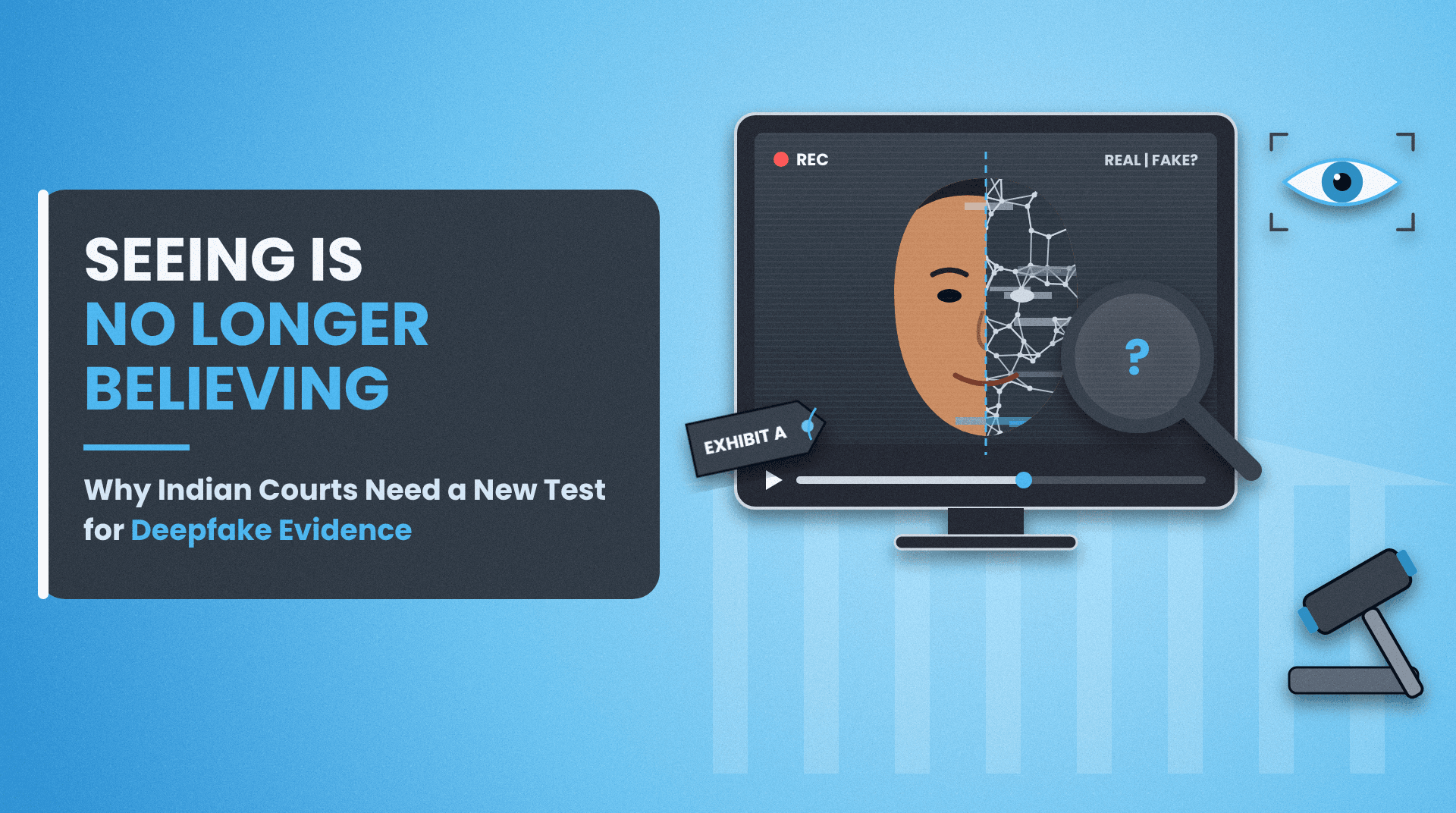
In November 2023,a video of actor Rashmika Mandanna spread across social media. It looked real. It was not.Delhi Police registered an FIR for forgery and identity offences and later arrested a 23-year-old graduate who had pasted her face onto another woman’s footage. The fake was caught because it went viral. Now imagine the same clip handed to a judge as proof in private dispute.Would our evidence law notice?
The gap: a certificate proves the file, not the facts
Since 1 July 2024, electronic evidence in India is governed by the Bhartiya Sakshya Adhiniyam,2023(BSA). Section 63 admits an electronic record only with a certificate and Section 63(4) now requires it be signed by the person in charge of the device and by an expert. Commentary on the new regime notes that the expert’s part records a hash value (such as SHA-256) of the record.
That is a real improvement, but look at which a hash can do, proves that a file has not changed since it was captured. It says nothing about whether what was captured was true. A deepfake can be hashed, certified and admitted as a perfectly intact copy of a lie. The certificate checks the pipe, not the water.
The psychological problem court ignore
Evidence law assumes that once procedure is satisfied, a judge can weigh the evidence rationally.Pyshology suggests that video is persuasive for reasons that have little to do with reason and the danger runs in both directions. Fake evidence can be believed, and real evidence can be dismissed. Chesney and Citron call the second effect the “liar’s dividend". Once everyone knows convincing fakes exist, a wrongdoer can simply say a genuine recording is fake. Recent research reported in Psychology Today found that viewers who saw politician deny a scandalous video as deepfake were more likely to believe it has been altered and rated that politician as a stronger leader than one who apologized. A certificate-based test cannot answer this problem because it was never designed to.
A better test: provenance, forensics, corroboration
I propose three modest additions to how courts apply Section 63, none of which needs a new statute.
Provenance, not just a hash: The certificate should record the original source that which device first captured the footage, who held it and its metadata. A hash of a copy proves little if the copy is the first thing anyone verified.
A forensic trigger: When authentically is credibly challenged or the recording is the decisive piece of proof, the court should order examination by a qualified expert before relying on it.The information Technology Act already allows the Central Government to appoint examiners of electronic evidence under Section 79A.
3. A corroboration rule: No finding of guilt or liability should rest on unverified video alone. To prevent the liar’s dividend, the party alleging fakery must show a credible basis, so that “it’s a deepfake” does not become an automatic defence.
Some scholars argue that existing authentication rules, which coped with photography a century ago, will cope with deepfakes too. Edward Cheng makes the case for the US. It may hold where the judges have broad discretion to demand a foundation. But Section 63 is formulaic by design: certificate inadmissibility out.That is exactly why a targeted safeguard is needed her.
Why this is a question of justice, not just procedure
Natural law thinkers have long held that law draws its authority from a moral purpose. A court that cannot separate the true from the fabricated cannot form serve that purpose, whatever its procedures say.
Conclusion
India has modernized the paperwork of electronic evidence. The next step is to modernize the judgmental certificate can prove that a file is unchanged. Only a court can decide whether it is true, and to do that, it must stop treating seeing as believing.
Author: Anas Ahmed
Sultan Ul Uloom College of Law, Osmania University Hyderabad, Telangana
Sign in to join the discussion.
A major issue in digital evidence is the difference between admissibility and reliability.
What if someone walks in and decides the dead are simply available?