Ujjawal Mishra
24 Nov 2026 7 min read
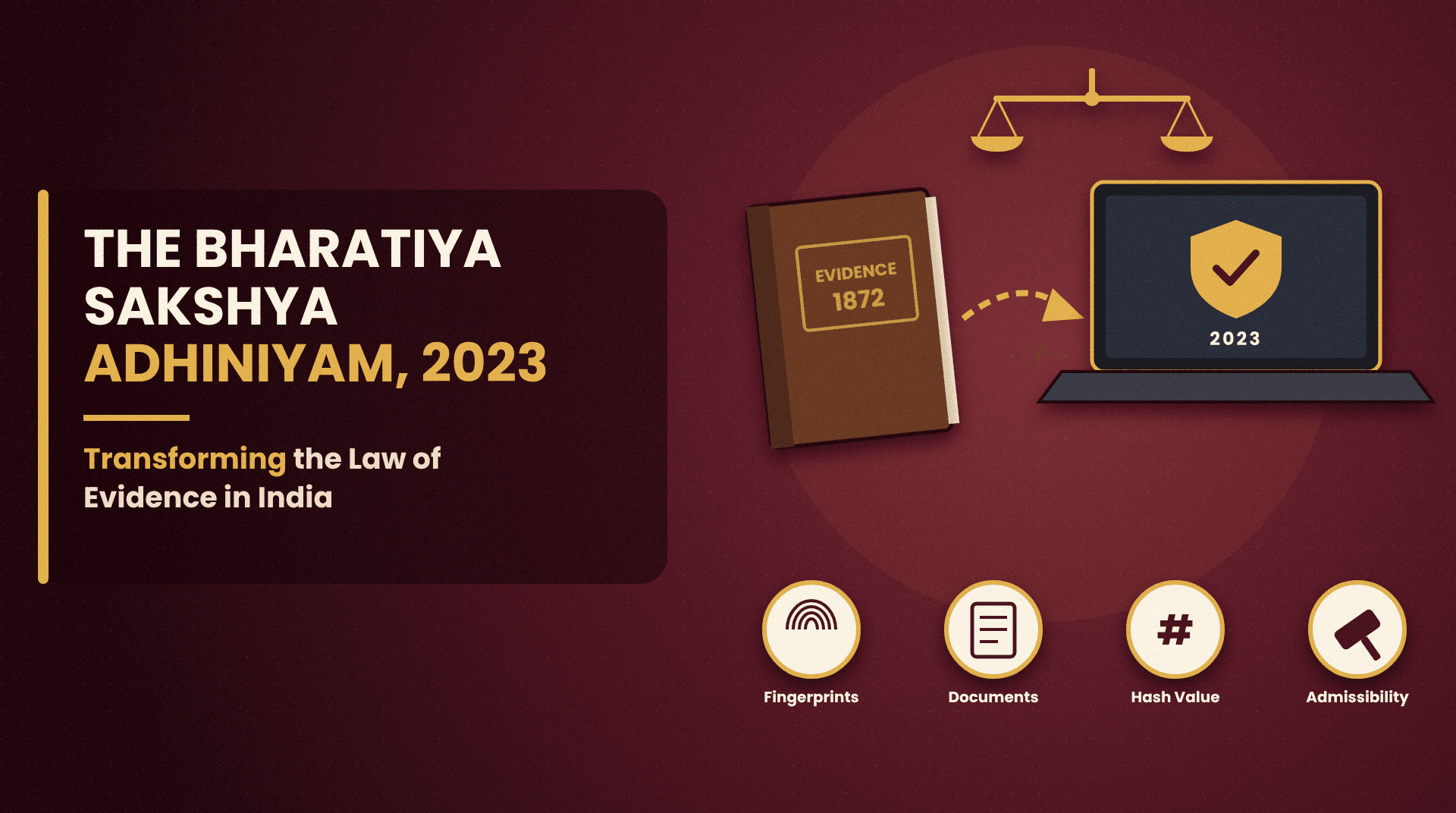
The law of evidence plays an important role in every court case. A court does not decide a dispute only on the basis of what the parties say. It has to examine the material placed before it and decide whether that material can be trusted. Evidence helps the court understand what happened and reach a fair decision. In India, the rules of evidence were mainly governed by the Indian Evidence Act, 1872 for more than a century. With changes in society, technology and the way people communicate, the need to update this law became clear. The Bharatiya Sakshya Adhiniyam, 2023 (BSA) was introduced as part of the changes made to India's criminal laws. It came into force on 1 July 2024. The new law keeps many basic principles of the earlier Act but gives greater attention to electronic and digital records. This article discusses the important changes and the practical questions that may arise while applying the new law.
The Indian Evidence Act, 1872 was drafted in a period when most records were kept on paper and communication was mainly in physical form. Over time, the use of computers, mobile phones, email, online platforms, CCTV cameras and digital payment systems became common. These developments changed the nature of evidence available in both civil and criminal cases. A large amount of information is now created and stored electronically. The BSA seeks to bring the law of evidence into line with present-day conditions. It repeals and replaces the Indian Evidence Act, 1872, while retaining several familiar rules relating to relevancy, admissions, confessions, burden of proof, witness examination and presumptions. This continuity is important because courts and lawyers already have considerable experience with these principles. At the same time, the new legislation uses updated language and gives clearer statutory attention to electronic and digital records. The official text of the Act is available on the India Code website.
One of the most important features of the BSA is its treatment of electronic and digital records. Today, relevant information may be found in text messages, emails, social media posts, call records, location data, photographs, videos, server logs and other digital material. Such records can help establish communication, presence, timing and a person's connection with an event. The BSA expressly recognises electronic and digital records within the framework of documentary evidence. Its provisions dealing with electronic records, including Sections 61 to 63, are particularly significant. Section 61 provides that an electronic or digital record cannot be denied admissibility merely because it is electronic or digital, subject to the provisions of the Adhiniyam. Section 63 deals with the conditions for admissibility of electronic records and the certificate required in the circumstances covered by that section. This recognition is useful because it reflects how people actually create and preserve information today. It can also reduce uncertainty about whether digital material may be considered by a court. However, recognition does not mean that every screenshot, recording or downloaded file must automatically be accepted as genuine. The legal requirements still have to be followed, and the court must consider the circumstances in which the record was created, stored and produced.
A major issue in digital evidence is the difference between admissibility and reliability. Admissibility concerns whether the evidence meets the legal conditions for being received by the court. Reliability concerns whether the evidence is genuine, complete and worthy of belief. A document may satisfy the formal requirements for production but still raise questions about its accuracy or meaning. For example, a screenshot of a conversation may leave out earlier messages or fail to show the identity of the person using the account. A video may have been edited. An audio recording may be unclear or manipulated. A file may have been copied from one device to another, making it important to understand its source and handling. These concerns do not mean that digital evidence should be rejected as a category. They show why proper verification is necessary. Courts may need to consider the source of the record, the device or system from which it came, the method used to preserve it and whether there are signs of alteration. Where necessary, expert assistance may help the court understand technical matters. The purpose should be to assess the evidence fairly, rather than to accept or reject it simply because it is in digital form.
The BSA is not a complete break from the earlier law. Many central principles remain familiar. The rules concerning relevancy, admissions, confessions, burden of proof and examination of witnesses continue to form the foundation of evidence law. This is important because a sudden and unnecessary change in basic principles could create confusion in courts and legal practice. The law also continues to distinguish between primary and secondary evidence. The provisions relating to primary evidence and secondary evidence are relevant when a party seeks to prove the contents of a document. In a digital setting, questions may arise about the original record, copies, the device on which information is stored and the process by which a copy is produced. Lawyers must therefore understand both the traditional principles and the specific requirements that apply to electronic records. The BSA should be read as an updated evidence framework, not as a reason to ignore the earlier body of judicial experience. Decisions under the previous Act may continue to be useful where the relevant statutory principle remains similar, although the exact provision and any change in wording must always be checked before relying on a judgment.
The success of the BSA will depend not only on its wording but also on how it is applied. One challenge is the technical knowledge required to handle electronic evidence. Police officers, advocates, prosecutors, judges and court staff may need regular training on collecting, preserving, presenting and examining digital records. Without proper handling, important information may be lost, altered or rendered difficult to verify. Another challenge is the speed at which technology changes. New forms of communication and artificial intelligence tools can make it easier to create convincing images, audio and videos that do not reflect real events. This raises questions about authenticity and the possibility of manipulation. The law must be applied carefully so that genuine evidence is not unfairly excluded, while fabricated or misleading material is not accepted without scrutiny. There may also be practical difficulties for individuals who do not have access to technical experts or resources. Courts should ensure that procedural requirements are applied consistently and that parties have a fair opportunity to challenge electronic material relied upon against them. Clear procedures, reliable forensic facilities and accessible expert assistance can make a real difference. A further concern is the preservation of privacy and sensitive information. Digital records may contain personal details unrelated to the dispute. Their collection and use should remain connected to the requirements of the case and applicable law. The need to prove a fact should not become a reason for unnecessary exposure of private information.
The Bharatiya Sakshya Adhiniyam, 2023 is an important step in updating India's law of evidence. Its recognition of electronic and digital records reflects the realities of modern life, where information is often created and stored through technology. At the same time, the Act retains many established principles that provide stability and continuity to the legal system. The real test of the new law will be its implementation. Courts must examine digital material with care, lawyers must understand the statutory requirements, and investigating agencies must preserve records properly. Training, technical support and consistent procedures will be essential. Most importantly, the focus must remain on fairness. Technology can provide valuable evidence, but it can also create new ways to mislead. The BSA will strengthen the justice system only when digital evidence is admitted and assessed through a careful process that protects both the search for truth and the rights of the parties.
Ujjawal Mishra| B.A. LL.B.

Balasaheb Thackeray Law College, Maharashtra
Sign in to join the discussion.

What if someone walks in and decides the dead are simply available?

Today found that viewers who saw politician deny a scandalous video as deepfake were more likely to believe it has been altered and rated that politician as a stronger leader than one who apologized.