Ruhani Yadav and Manan Yadav
8 Oct 2026 14 min read
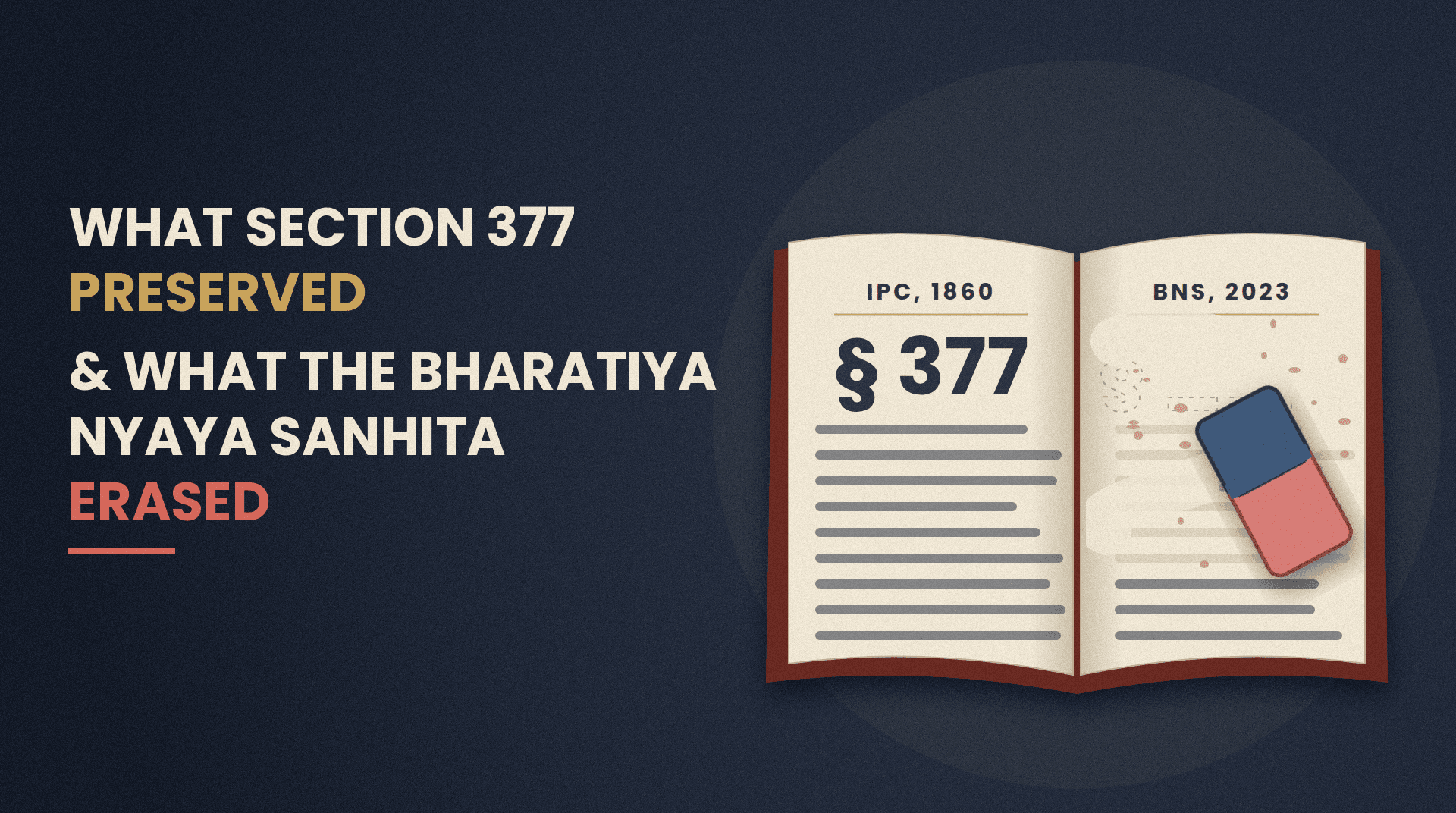
Section 377 of the Indian Penal Code 1860 was one of the most debated provisions in the criminal law in India. This was introduced in the British colonial era and has been in practice since then till various cases transformed it and it being erased in the new criminal law of land i.e. Bharatiya Nyaya Sanhita. Section 377 of the Indian Penal Code 1860 provided for an “unnatural offence” which stated that carnal intercourse against the order of nature would be punished under the provisions of IPC 1860. Section 377 provides that "Whoever voluntarily has carnal intercourse against the order of nature with any man, woman or animal, shall be punished with imprisonment for life, or with imprisonment of either description for a term which may extend to ten years, and shall also be liable to fine."
The phrase "against the order of nature" was not clearly defined in the law, which allowed it to be interpreted broadly. In practice, the provision was often used to criminalise consensual same-sex relationships between adults, despite such relationships causing no harm to others. As society evolved and constitutional values such as equality, dignity, privacy, and personal liberty gained greater importance, Section 377 increasingly came to be viewed as outdated and inconsistent with modern democratic principles. Over time, the provision became the subject of intense legal and constitutional debate. Human rights organisations, LGBTQ+ activists, legal scholars, and constitutional experts argued that criminalising consensual sexual relationships between adults violated fundamental rights guaranteed under the Constitution, particularly Articles 14, 15, 19, and 21. At the same time, many people believed that Section 377 continued to serve an important purpose because it was one of the few provisions available to punish certain forms of non-consensual sexual acts, especially against adult men and transgender persons, which were not covered by the rape provisions of the IPC. The constitutional validity of the section was questioned multiple times in the apex court of the country i.e. the Supreme Court of India. The journey of the constitutional validity of sec 377 witnessed various judicial decisions starting with Naz Foundation v. Govt of NCT of Delhi 2009 to Navtej Singh Johar v. Union of India 2018.
THE EVOLUTION OF SECTION 377 AFTER NAVTEJ SINGH JOHAR
After the Supreme Court's judgement in the landmark case of Navtej Singh Johar v. Union of India in 2018, many people believed that the section has been completely struck down. But this was not true. The main outcome from the judgement of this case was the 'Decriminalisation of consensual sex between adults', this also decriminalised homosexuality. Talking about what section 377 preserved; even after the landmark judgement by supreme court in 2018, the section continued to perform its protective role. The judgement only read down section 377 and decriminalised homosexuality and consensual sex, but it continues to criminalise non-consensual penetration sexual activities that did not fall within the legal definition of rape. It offered legal protection to adult male, transgenders from sexual offences which were otherwise not protected through the provisions of rape in IPC. It also protected homosexuality in the county to some extent as it ensured that forced sexual acts between consenting adults were punished even though consensual same-sex relations were no longer offences. It further criminalised bestiality. Thus, it can be said that this provision of the Indian Penal Code 1860 held importance to prevent and penalise the above-mentioned crimes.
WHAT BNS ERASED
Following the enactment of the Bharatiya Nyaya Sanhita, 2023, Section 377 ceased to exist as a statutory provision. The Bharatiya Nyaya Sanhita 2023 replaced the Indian Penal Code, 1860 and governs criminal offences in India. Many legal scholars and activists argue that a legal gap now exists in the criminal law of India because there is no provision available now in the statutory criminal law of India, similar to section 377 which provided protection to homosexuality and decriminalized consensual, as well as criminalized sexual offences against male, transgender and animals. The BNS did not introduce a similar gender-neutral provision. The Bharatiya Nyaya Sanhita, 2023 reflects the legislature's commitment to strengthening protections for women and children against sexual offences. Nevertheless, the absence of an equivalent gender-neutral provision for adult male and transgender victims has highlighted a significant gap in the law, raising concerns about equal protection and the need for a more inclusive approach to sexual offences.
As a result of this gap, there is no direct or indirect equivalent of sec 377 of IPC, the repeal of Section 377 has left adult male victims of non-consensual penetrative sexual assault without a dedicated statutory provision equivalent to the protection previously available under the IPC. Similar concerns have been expressed regarding transgender persons, particularly in situations where the alleged offence does not fall within the definition of rape under the Bharatiya Nyaya Sanhita, 2023. As a result, several legal scholars have argued that the omission of a gender-neutral provision has created a legislative gap, leaving certain forms of sexual violence insufficiently addressed under the current criminal law.
Although Section 377 of the Indian Penal Code has been repealed, the constitutional principles established in Navtej Singh Johar v. Union of India continue 2018 to remain valid and binding. The judgment affirmed that consensual sexual relationships between adults are protected by the fundamental rights to equality, dignity, privacy, and personal liberty. However, since the Bharatiya Nyaya Sanhita, 2023 does not contain a provision equivalent to Section 377, the statutory basis interpreted in Navtej Singh Johar v. Union of India 2018 no longer exists, giving rise to fresh legal debates regarding the protection of victims of non-consensual sexual offences. The journey of Section 377 reflects the changing nature of Indian constitutional and criminal jurisprudence. Initially introduced as a colonial provision to criminalise "unnatural offences," it was gradually reinterpreted by the judiciary to uphold the constitutional values of equality, dignity, privacy, and personal liberty. The landmark judgment in Navtej Singh Johar v. Union of India 2018 marked a historic step by decriminalising consensual same-sex relations between adults while preserving Section 377 as a safeguard against non-consensual sexual acts, offences involving minors, and bestiality. However, with the enactment of the Bharatiya Nyaya Sanhita, 2023, Section 377 has been repealed without the introduction of a comparable gender-neutral provision. Although the constitutional principles affirmed in Navtej Singh Johar continue to remain binding, the absence of an equivalent statutory provision has raised concerns regarding the protection available to adult male and transgender victims of certain forms of sexual violence. Therefore, while the BNS represents a significant reform of India's criminal laws, future legislative developments should focus on creating a more inclusive and gender-neutral legal framework that ensures equal protection for every individual, consistent with the constitutional ideals of justice, equality, and human dignity.
THREE ZONES OF LEGISLATIVE CONCERN
Section 377 (IPC): "Whoever voluntarily has carnal intercourse against the order of nature with any man, woman or animal, shall be punished with imprisonment for life, or with imprisonment of either description for a term which may extend to ten years, and shall also be liable to fine." The practical consequence of these choices is not one gap but a tripartite failure of protection.
Section 63 BNS defines rape in explicitly gendered terms, protecting only women. A man who is violently sexually assaulted cannot file an FIR for rape or sexual assault under any provision of the BNS. His only theoretical recourse lies in Section 116 (voluntarily causing grievous hurt) or Section 74 (assault or criminal force) — provisions calibrated for bodily harm, not for the gravity, specificity, or psychological dimension of sexual violence. That this remains the legislature's considered position, after three cycles of expert recommendation to the contrary, is constitutionally untenable.
Transgender Persons: A Statutory Disparity That Violates Article 14
The Transgender Persons (Protection of Rights) Act, 2019 criminalises sexual abuse against transgender persons under Section 18(d), with a maximum sentence of 6 months which can extend up to two years. If a cisgender woman is raped, Section 63 BNS mandates a minimum sentence of ten years and permits life imprisonment. If a transgender person is subjected to the same act, the maximum available sentence is two years. The harm is identical. The law's response is not.
Married women have suffered an active contraction of rights that previously existed. Under the IPC, the marital rape exception applied to 'sexual intercourse' — judicially interpreted to mean vaginal penetration. Non-consensual non-vaginal acts by a husband fell outside this exception and could be prosecuted under Section 377. The BNS has repealed Section 377 without replacement. A married woman subjected to non-vaginal sexual violence by her husband now has no criminal remedy whatsoever. The legislature did not preserve the status quo; it made it materially worse. This dimension is currently the subject of Gantavya Gulati v. Union of India. (Crl.) No.2474/2024, pending before the Delhi High Court.
Articles 14 and 21 of the Constitution of India are among the most important Fundamental Rights guaranteed by the Constitution. Article 14provides equality before the law, while article 21guarantees the right to life and personal liberty. However, the BNS raises constitutional concerns because it does not provide adequate protection against sexual assault to adult male victims, transgender persons, and married women in certain circumstances. The lack of equivalent protection for these sections under the BNS raises concerns under Article 14, which guarantees equality before the law to every person irrespective of gender. While the BNS provides extensive protection to women and children in cases of sexual offences, adult male victims, transgender persons, and married women in certain situations do not receive comparable statutory protection. Although this guarantee permits reasonable classification, such classification must satisfy two established conditions. First, there must be an intelligible differentia distinguishing one class from another. Secondly, that differentia must have a rational nexus with the object sought to be achieved by the legislation. The purpose of sexual assault law is to punish non-consensual sexual violence and protect bodily integrity. The physical, emotional, and psychological harm caused by such violence does not vary according to the victim's gender, marital status, or gender identity. Consequently, denying equivalent legal protection to adult male victims, transgender persons, or married women subjected to certain forms of sexual violence bears no rational relationship to the objective of preventing sexual offences. The classification created by the BNS therefore lacks a reasonable constitutional basis. The Supreme Court significantly strengthened Article 14 jurisprudence in Shayara Bano v. Union of India (2017), where it recognised the doctrine of manifest arbitrariness. Under this doctrine, legislation may be declared unconstitutional if it is capricious, irrational, excessive, or based on no discernible constitutional principle. The doctrine reflects the understanding that equality is violated not only through explicit discrimination but also through unreasonable legislative choices that operate unfairly against particular classes of people.
Viewed through this constitutional lens, the BNS raises difficult questions. It continues to recognise rape only where the victim is a woman, omits any gender-neutral provision replacing the protective portion of the former Section 377 IPC, preserves the marital rape exception, and leaves transgender victims with substantially lower statutory protection under separate legislation. Accordingly, these legislative distinctions raise serious questions regarding compliance with the guarantee of equality under Article 14. Article 21 has evolved considerably through judicial interpretation and now extends beyond mere protection of life to include dignity, privacy, bodily integrity, and personal autonomy. The Supreme Court has consistently held that Article 21 includes the rights to dignity, privacy, bodily integrity, and personal autonomy, recognising that these values are indispensable to meaningful human life.
In K.S. Puttaswamy v. Union of India (2017), the Supreme Court affirmed that privacy is an intrinsic part of life and liberty. The judgment recognised bodily autonomy as a fundamental constitutional value, emphasising that every individual has the right to make decisions concerning their own body without coercion or unwanted interference. The protection of bodily integrity is therefore not a privilege granted by the State but a constitutional guarantee available equally to every person.
The importance of dignity under Article 21 had already been recognised in Francis Coralie Mullin v. Administrator, Union Territory of Delhi (1981) , where the Court held that the right to life includes the right to live with dignity and not merely the right to survive. Sexual violence represents one of the gravest violations of human dignity because it attacks the individual's physical autonomy, emotional well-being, and personal identity simultaneously. A legal framework that fails to recognise or adequately punish such violations inevitably raises constitutional concerns.
The continued retention of the marital rape exception under the Bharatiya Nyaya Sanhita raises significant constitutional concerns. Although marriage creates legal rights and responsibilities between spouses, it cannot take away an individual's fundamental rights to dignity, bodily autonomy, and personal liberty guaranteed under Article 21 of the Constitution. Consent remains the foundation of every sexual relationship, regardless of marital status. By excluding certain non-consensual acts within marriage from criminal liability, the law creates a distinction that appears difficult to reconcile with constitutional values. Similarly, the absence of a comprehensive gender-neutral offence leaves adult male and transgender victims without protection equivalent to that available to women under the BNS. Constitutional rights belong equally to every person, and the seriousness of sexual violence should be assessed by the nature of the harm rather than the identity of the victim. The Supreme Court has consistently emphasised that dignity and equality must guide the interpretation of fundamental rights. Therefore, any legal framework that provides unequal protection against comparable forms of sexual violence raises serious constitutional questions regarding its compatibility with Articles 14 and 21 of the Constitution.
PARLIAMENT'S RESPONSES AND INDIA'S INTERNATIONAL OBLIGATIONS
The BNS's failures are not attributable to oversight. Parliament has considered and rejected gender-neutral sexual assault reform across three separate cycles. The 172nd Law Commission Report (2000) recommended comprehensive gender-neutral provisions. The Justice Verma Committee Report (2013), constituted after the gang rape and murder of Jyoti Singh, recommended gender-neutral assault provisions and removal of the marital rape exception. Parliament rejected both. The BNS represents a third deliberate refusal by a government that has received expert advice twice and chosen to legislate against it.
These domestic refusals are compounded by India's international obligations. India is a state party to the ICCPR (International Covenant on Civil and Political Rights), Article 7 of which prohibits cruel, inhuman or degrading treatment without exception. CEDAW (Convention on the Elimination of All Forms of Discrimination Against Women) Article 2(b) requires state parties to ensure adequate legal protection of the rights of women on an equal basis with men. While neither instrument is directly enforceable in domestic courts, the Supreme Court has consistently used them as interpretive aids — from Vishaka v. State of Rajasthan (1997) to NALSA v. Union of India (2014). They represent commitments India voluntarily undertook and has repeatedly declined to honour.
WAY FORWARD
The enactment of the Bharatiya Nyaya Sanhita, 2023 reflects India's commitment to modernising its criminal justice system. However, like any major legislative reform, its practical operation should remain open to review so that any unintended gaps can be identified and addressed through future amendments. Criminal law must continuously evolve to meet the changing needs of society while remaining faithful to the constitutional principles of equality, dignity, and justice. As India's criminal justice system continues to evolve, it is equally important to examine whether the present legal framework provides comprehensive protection to all victims of non-consensual sexual offences in a manner consistent with the constitutional provision of equality and dignity. The absence of a provision similar to the protection previously available under Section 377 has led to an important legal discussion on whether the present law adequately safeguards every victim of sexual violence. This issue should be examined through a constitutional and victim-centred approach rather than from the perspective of any particular gender.
A possible way forward would be to introduce a carefully drafted gender-neutral provision dealing exclusively with non-consensual penetrative sexual offences. Such a provision should clearly distinguish between consensual relationships between adults, which continue to enjoy constitutional protection after Navtej Singh Johar v. Union of India (2018), and acts committed without free and voluntary consent. This would preserve the rights recognised by the Supreme Court while ensuring that victims who presently fall outside the scope of existing provisions are not left without an effective legal remedy. Legislative reform should also be supported by effective implementation. Police officers, prosecutors, medical professionals, and judicial officers should receive regular training to ensure that complaints involving sexual violence are handled with sensitivity, fairness, and without prejudice. Equally important is the need to promote public awareness so that individuals understand their legal rights and are encouraged to report offences without fear of stigma or discrimination. Ultimately, the objective of criminal law should not merely be to punish offenders but also to provide equal protection to every individual. As Indian criminal jurisprudence continues to evolve, future reforms should strive to create a legal framework that is inclusive, constitutionally consistent, and responsive to the realities of all victims of sexual violence. Such an approach would strengthen public confidence in the justice system while upholding the fundamental values enshrined in the Constitution.
Ruhani Yadav and Manan Yadav
Maharshi Dayanand University Centre for Professional and Allied Studies
Sign in to join the discussion.
समानता का अधिकार केवल किताबों में सजाने के लिए नहीं है। यदि भारत को एक वास्तविक लोक कल्याणकारी राज्य बनाना है, तो हमें 'प्रशासनिक सामंतवाद' का अंत करना होगा और अधिकारियों को मिलने वाले हर एक विशेषाधिकार का हिसाब उनकी जन-सेवा में सफलता के आधार पर तय करना होगा।
In Indian laws, the rights and responsibilities of a child are primarily with the parents, but grandparents can also provide and contribute emotionally and financially to the child’s life. In legal and emotional fights, grandparents often get stuck in family disputes like divorces, separations, or death of the parents which creates difficulties for grandparents in sustaining their relationship with their grandchildren.