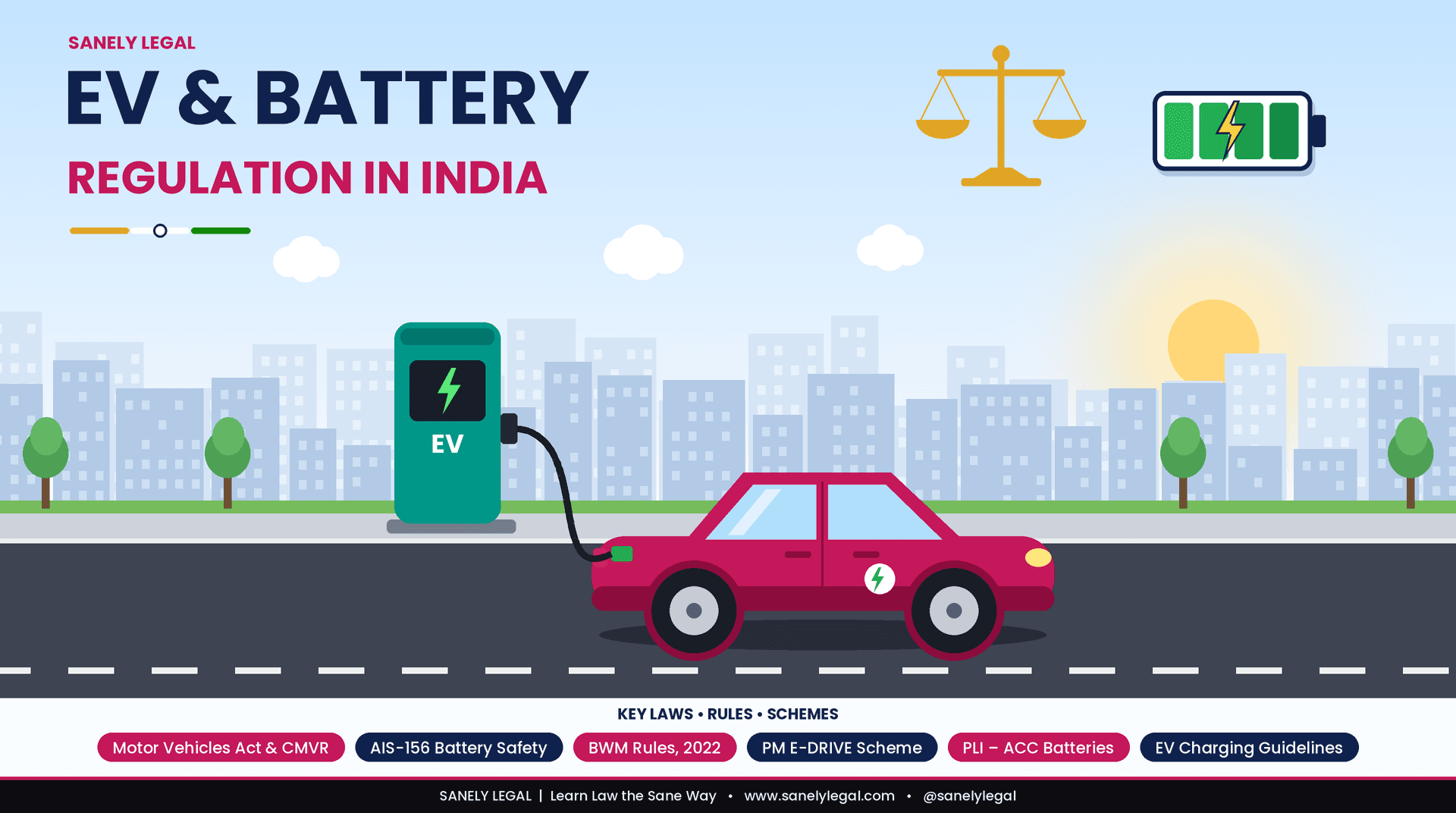
EV & BATTERY Regulation in India
Shaurya Jaiswal
7 Nov 2026 30 min read
- Introduced
- 7 Nov 2026
1. Key Findings
The central finding of this report is that the legal issues now arise at the points where these systems meet.
a A manufacturer can face both vehicle-safety and subsidy conditions.
b A charging operator can be governed by electricity rules and, separately, scheme-support conditions.
c A battery-swapping business can own the battery while another person owns the vehicle.
When that vehicle is seized or scrapped, the battery can become the subject of a separate ownership and waste-management question. India's EV framework developed in stages. The first stage was about creating a market through FAME. The second added a stronger domestic manufacturing condition through the Phased Manufacturing Programme and later production-linked schemes. The third built the technical and electricity framework around the vehicle, especially battery safety and charging. The fourth created a full end-of-life system through the Battery Waste Management Rules and EPR. PM E-DRIVE now sits across parts of that system alongside the other laws and standards.
2. Background
India's EV policy began with an approach that treated electric and hybrid mobility as a national industrial and transport question. The National Mission for Electric Mobility was approved in 2011, followed by the National Electric Mobility Mission Plan 2020, launched in January 2013. The Plan was intended to create a long-term path for adoption, domestic capability, research and development, testing, charging and supply-side support. The Government's own description of NEMMP 2020 projected a vehicle population of about 6 to 7 million electric and hybrid vehicles by 2020 and described the plan as a combination of demand incentives, R&D, charging infrastructure, supply-side incentives and retrofitment. FAME was an implementation tool within a larger policy plan. The manufacturing programmes that came later also grew out of the same concern, if India only subsidised the purchase of imported technology, the subsidy could increase sales without creating the domestic capability that the policy was trying to build. The early framework lacked the technical and infrastructure detail that later became central. Battery safety was initially dealt with through the motor vehicle type-approval system. Charging had to be fitted into the electricity framework. End-of-life batteries were dealt with under the older battery-waste regime, which was much narrower than the current EPR system. The regulatory questions existed before the modern EV market and were spread across different laws and institutions.
3. FAME-I
The Faster Adoption and Manufacturing of Hybrid and Electric Vehicles in India, or FAME-India, was launched on 1 April 2015. It was the first major national scheme to put money directly behind the adoption of electric and hybrid vehicles. The initial approval was for two years. The official FAME record shows that the scheme was subsequently extended several times and ultimately ran to 31 March 2019. FAME-I was organised around demand incentives, technology development, pilot projects and charging infrastructure. The Government later described it as a scheme for progressive induction of reliable, affordable and efficient electric and hybrid vehicles. The categories and eligibility conditions changed during the life of the scheme as the Government learned from the market.
Once the Government began paying an incentive for a vehicle, eligibility could be tied to technical standards, battery specifications, registration and, later, domestic manufacturing conditions. This becomes much stronger under FAME-II.Electric buses, three-wheelers and two-wheelers faced different market problems. Charging requirements were different. The Government therefore added categories and modified the scheme rather than treating the original 2015 rules as fixed. A 2018 parliamentary answer records that the Phase-I outlay was enhanced from ₹795 crore to ₹895 crore while the scheme was extended to 31 March 2019 or until FAME-II was notified, whichever was earlier.
4. 2018-2019 Policy Shift
By 2018 the policy question had widened. The Government was also asking where the vehicle, battery and key components would be made. The National Mission on Transformative Mobility and Battery storage, approved in March 2019, formalised this shift towards a domestic value chain and large-scale battery manufacturing. FAME changes the economics of buying an eligible vehicle, while the industrial schemes change the economics of building the supply chain in India.A charging station sits at the intersection of transport and electricity regulation. In 2018 the Ministry of Power issued the first national framework on charging infrastructure and clarified the electricity-law position of EV charging. The policy was later revised in 2019 and consolidated again in 2022 and 2024.
The 2024 guidelines are particularly clear about the breadth of the system. They apply to charging infrastructure in private parking, offices, educational institutions, hospitals, group housing, e-bus depots, commercial complexes, railway stations, petrol pumps, airports, metro stations, public parking and highways and expressways. The stated objectives include making charging safe and accessible, improving the viability of charging stations, facilitating electricity connections and preparing the grid for higher EV demand. Charging forms a core part of the EV regulatory framework. The electricity framework determines whether a station can connect and operate. MHI's EV schemes determine when a station or related infrastructure can receive scheme support.
5. FAME-II
FAME-II began on 1 April 2019. The original notified outlay was ₹10,000 crore for three years. It was later enhanced to ₹11,500 crore. The scheme was designed to support 7,000 e-buses, 5 lakh e-three-wheelers, 55,000 e-four-wheelers and 10 lakh e-two-wheelers, while allowing some flexibility between categories. Only advanced-battery and registered vehicles were eligible. The scheme was also more focused than FAME-I. It placed most of the money on demand incentives and gave special attention to public and commercial transport in the three-wheeler, four-wheeler and bus segments. Private registered two-wheelers were covered because the Government saw that segment as a mass-market route to electrification. The major legal and commercial development under FAME-II was the Phased Manufacturing Programme, or PMP. The scheme asked how much of the vehicle and its components were being made in India. The result was a direct connection between subsidy eligibility and localisation. That connection eventually became the subject of litigation. The FAME-II framework created a situation in which a manufacturer could receive support for vehicles sold into the market, followed by inspection, document requests, suspension, de-registration or recovery questions if the Government concluded that the localisation conditions had not been met.The official FAME-II repository also shows that eligibility became connected to battery safety certification. Registered OEMs were advised to have models certified to AIS-156 as amended in order to claim FAME-II subsidy.
FAME-II ran until 31 March 2024. The expiry of the scheme closed the subsidy window, while model eligibility, localisation disputes and pending administrative action continued to generate court proceedings. A scheme can expire while a dispute about an action taken under that scheme continues. The expiry of FAME-II therefore closed the subsidy window, while the administrative record created during the scheme remained relevant to continuing proceedings.
6. Industrial Policy
In September 2021 the Union Cabinet approved the Production Linked Incentive Scheme for Automobile and Auto Components with an outlay of ₹25,938 crore, originally set for five years but subsequently extended by one year to run through FY 2027-28. The scheme focuses on Advanced Automotive Technology products and is expressly aimed at deep localisation and domestic and global supply chains. It covers zero-emission vehicles, including battery electric and hydrogen fuel-cell vehicles. PLI-Auto therefore works differently from FAME. FAME reduces the effective cost of an eligible vehicle to the buyer. PLI-Auto rewards qualifying production and value creation. The two schemes can operate in the same market without doing the same job.
The Production Linked Incentive scheme for Advanced Chemistry Cell battery storage was approved in May 2021 with an outlay of ₹18,100 crore. Its objective is to create 50 GWh of domestic ACC manufacturing capacity, with an additional 5 GWh for niche technologies. Beneficiaries must meet investment and domestic-value-addition conditions. The MHI's current description requires at least 25% domestic value addition initially and 60% within five years, alongside the required investment per GWh. A vehicle can be made in India while its cells are imported. PLI-ACC addresses the cell level. PLI-Auto addresses vehicle and component manufacturing. SPMEPCI addresses a particular part of the passenger-car market.
7. Battery Waste
The Batteries (Management and Handling) Rules, 2001 were the predecessor to the present battery-waste regime. The framework was built around battery collection and recycling obligations and was closely associated with lead-acid batteries. Its structure predated today's chemistry-neutral EV battery market. That old position is important because the 2022 rules restructured responsibility beyond changes to individual percentages.
The Battery Waste Management Rules, 2022 were notified on 24 August 2022. They replaced the 2001 rules and adopted an Extended Producer Responsibility model. The definition of battery is broad and the rules apply across battery chemistries and uses. EV batteries therefore sit inside the same national EPR architecture as other covered batteries, while their specific obligations can differ by battery category. The rules create a digital compliance structure involving producer registration, recycler and refurbisher registration, EPR certificates, annual reporting, recycling and refurbishment obligations, recycled-content requirements and environmental compensation. That change also creates a new question for businesses. Who is the producer when the battery is leased, swapped or supplied under a battery-as-a-service model? The answer has to come from the definitions and the facts of the arrangement. It depends on the applicable definitions and the contractual structure where the vehicle manufacturer and battery owner are different entities.
The Battery Waste Management (Amendment) Rules, 2023, notified on 25 October 2023, changed the operational structure of the 2022 rules. Among other things, it revised the definition of battery, changed producer registration and EPR certificate provisions, and refined the rules governing the use and generation of EPR certificates. The amendment came into force on publication. EPR certificates became a more formal part of the compliance system. The rules also tied certificates to the category of battery for which the obligation arose. An EV battery obligation therefore has to be matched to the applicable battery category under the rules. The March 2024 amendment changed the price framework for EPR certificates. MoEFCC's 2024-25 annual report explains that the amendment enabled CPCB to fix the highest and lowest EPR certificate prices at 100% and 30%, respectively, of the environmental compensation applicable for non-fulfilment of EPR obligations. The June 2024 amendment changed the recycled-content schedule. For electric vehicle batteries, the minimum use of recycled material was set at 5% for FY 2027-28, 10% for FY 2028-29, 15% for FY 2029-30 and 20% from FY 2030-31 onwards. The rules came into force on publication. The December 2024 amendment followed the Jan Vishwas changes to the Environment Protection Act. It removed the earlier rule-level penalty structure and linked contraventions of the Battery Waste Management Rules to the penalty provision in section 15 of the Environment Protection Act.
The Battery Waste Management Amendment Rules, 2025 were notified on 24 February 2025 and came into force on publication. They introduced a route for producers to satisfy the requirement to display their EPR registration number through a barcode or QR code on the battery, battery-containing equipment or relevant packaging, subject to the conditions set out in the amendment. The amendment also addressed the marking requirements for cadmium and lead above specified thresholds.EPR works only if a battery can be connected to the producer responsible for it. The move towards a registration number that can be carried digitally or through a scannable code strengthens traceability. MoEFCC's 2025-26 annual report states that the battery EPR portal was fully operational and that, by the end of December 2025, around 4,100 producers and 490 recyclers were registered. The same report recorded about 64.37 lakh tonnes of battery waste recycled and 14.20 lakh tonnes of EPR certificates generated for ten recovered metals, of which 11.02 lakh tonnes had been transferred to producers.
8. Battery Safety
Battery waste rules govern the treatment of a battery when it becomes waste. Questions of whether a battery is safe to put into a vehicle arise within the Motor Vehicles Act, the Central Motor Vehicles Rules and the Automotive Industry Standards used for type approval. The Delhi High Court made this point clearly in Rajat Kapoor Advocate v. Union of India. The petitioner sought directions concerning insurance, helmets, battery reliability and EV subsidies after reports of battery fires. The Union Government pointed to the existing Motor Vehicles Act and CMVR framework, including the provisions dealing with insurance, protective headgear and battery standards. The Court held that the existing legal and technical framework already addressed the matters raised and dismissed the PIL.
AIS-156 covers the traction battery and REESS requirements for the relevant L-category electric vehicles, while AIS-038 applies to the relevant M and N category electric powertrain vehicles. The standards have been amended as battery technology and safety concerns developed. MoRTH's implementation note records that Amendment 2 to AIS-156 and AIS-038 (Rev. 2) was effective from 1 October 2022. Amendment 3 was then implemented in two phases, from 1 December 2022 and 31 March 2023. The amendments introduced or strengthened requirements relating to electrical protection, BMS controls, thermal safety and other REESS safeguards. The text of AIS-156 Amendment 3 also requires measures such as adequate cell-to-cell spacing, an additional safety fuse or circuit breaker beyond the BMS, traceability records for cells, BMS and charger information, protection during regenerative braking, and retention of critical battery parameters.
9. Charging Infrastructure
The first charging guidelines issued by the Ministry of Power in 2018 dealt with the basic electricity-law position of EV charging and the conditions for setting up charging infrastructure. The 2019 revision clarified the treatment of private charging and public charging stations and moved towards a de-licensed public charging model, subject to the technical and safety requirements of the framework. Without this clarification, a charging operator would be dealing with a much less certain electricity-law position. Once charging was treated as a distinct activity within the electricity framework, the Government could move from asking whether charging was legally possible to asking how a national charging network should be built. The 2022 consolidated guidelines brought together the earlier material and dealt with electricity connections, land, tariffs and network preparation. Later amendments refined the framework. These rules sit alongside, rather than inside, PM E-DRIVE.
The Ministry of Power issued the Guidelines for Installation and Operation of Electric Vehicle Charging Infrastructure-2024 on 17 September 2024. They expressly superseded the earlier versions. They cover private, semi-restricted and public charging locations and also apply to power utilities and central and state agencies. The objectives include safety, accessibility, faster electricity connections, better commercial viability and grid preparation. The 2024 guidelines are important because they treat charging as part of the electricity system rather than as a simple accessory to vehicle sales. That becomes more important as buses, trucks and fleets move into electric mobility. A private passenger-car charger, a depot serving hundreds of buses and a highway charging station create very different demands on land, electricity connections and network capacity. PM E-DRIVE official guidelines archive records operational guidelines for EV public charging stations issued on 26 September 2025, followed by FAQs. The Ministry of Power framework governs whether and how charging infrastructure can operate in the electricity system. PM E-DRIVE determines whether particular infrastructure qualifies for support under that scheme. The two sets of conditions operate separately.
10. Parliamentary Review
The 324th Report of the Department-related Parliamentary Standing Committee on Industry, titled Promotion of Electric Vehicles in the Country, was presented on 20 December 2023. The Committee's recommendations show where the earlier framework was under pressure. It called for a longer and broader FAME-II framework, greater support for four-wheelers, attention to the reduction in two-wheeler support, more charging infrastructure, a stable battery-swapping policy, greater attention to domestic battery and component manufacturing and measures to address the cost of EV ownership. It also raised the question of financing EVs through Priority Sector Lending and the use of solar-powered charging. The Committee's 325th Report followed as the action-taken report on the 324th Report. It was presented in Parliament in March 2025. The Parliamentary record confirms its presentation as the Government's action-taken response to the earlier EV recommendations. The first report tells us what Parliament wanted changed. The action-taken report tells us what the Government said it had done or intended to do. Reading the two together is a better way to understand the transition from FAME-II to the new policy framework.
11. 2024 Transition
FAME-II ended on 31 March 2024. EMPS 2024 was the short bridge that followed. The original scheme had an outlay of ₹500 crore for four months from 1 April to 31 July 2024. It was later extended by two months to 30 September 2024, with the outlay enhanced. The scheme focused on electric two- and three-wheelers and advanced batteries. This short period matters because it shows the Government deliberately separating continuity of demand support from the design of the next long-term scheme. PM E-DRIVE was then notified on 29 September 2024, just before EMPS-2024 ended.
On 15 March 2024 the Government notified the Scheme to Promote Manufacturing of Electric Passenger Cars in India, or SPMEPCI. It is a manufacturing scheme aimed at attracting global electric passenger-car manufacturers to establish production in India. The scheme requires an approved applicant to establish a manufacturing facility with a minimum investment of ₹4,150 crore. The facility must become operational within three years, and the applicant must achieve at least 25% domestic value addition within that period and 50% within five years. The scheme also created a reduced customs-duty route for qualifying imported electric passenger cars, subject to the scheme's conditions and limits. Guidelines were notified in June 2025, and the application window ran from 24 June to 21 October 2025. The Government stated in both December 2025 and February 2026 that no applications were received during the window. PM E-DRIVE was notified on 29 September 2024 as S.O. 4259(E). The original scheme had an outlay of ₹10,900 crore and was framed for 1 October 2024 to 31 March 2026. It was designed around faster EV adoption, charging infrastructure and the EV manufacturing ecosystem. The notification also subsumed the vehicles and expenditure under EMPS-2024 into PM E-DRIVE. The 10 August 2026 amendment subsequently increased the scheme outlay to ₹11,900 crore and extended the scheme to 31 March 2028.
The official notification archive now records amendments through 3 September 2026. Those include changes to e-two-wheelers and e-three-wheelers, the extension of the overall scheme timeline, the addition of e-trucks and e-ambulances, and repeated changes to the PMP for buses, trucks and charging infrastructure. The current official archive is therefore itself part of the law-and-policy trail. It records the following major changes: the November 2024 amendment; March 2025 amendment; July 2025 e-truck notification; July 2025 EVPCS PMP amendment; August 2025 scheme extension to 31 March 2028; August 2025 e-three-wheeler revisions; September 2025 bus and truck PMP amendments; March 2026 extensions and PMP amendments; April 2026 truck PMP amendment; June 2026 e-ambulance notification; August 2026 enhancement and e-two-wheeler timeline extension; and September 2026 fourth PMP amendments for e-buses and e-trucks. The scheme-guidelines records operational guidelines for e-two-wheelers and e-three-wheelers, e-trucks, EV public charging stations, e-ambulances and related FAQs. The latest notification archive records an amendment dated 10 August 2026 titled Enhancement of Scheme outlay and extension of timeline for e-2Ws. The official portal identifies the e-two-wheeler terminal date as 31 March 2028. The scheme now has segment-specific amendments and dates, so the latest notification for the relevant vehicle category should be checked when advising on eligibility.
12. Battery Swapping
In a conventional EV, the battery is generally installed in the vehicle and remains with it. In a swapping model, the battery can be owned by another company, leased to the vehicle user and moved between vehicles. That difference matters under the Motor Vehicles Act, the battery-waste rules and the emerging charging and swapping framework. It also raises practical questions about who bears the EPR obligation, who owns a battery that is seized with a vehicle, and when a battery becomes an end-of-life battery. The Delhi High Court had to address exactly this kind of problem in Upgrid Solutions Pvt. Ltd. v. Government of NCT of Delhi. The petitioners leased lithium-ion batteries to e-rickshaw operators through a swapping model. Delhi authorities had seized and scrapped e-rickshaws and retained the batteries. The petitioners claimed ownership and sought their return. The Court noted that the batteries had been separated and preserved and ultimately directed their release after the petitioners established ownership and undertook to supply batteries only to registered and fit e-rickshaws. The case treats the battery as a legally identifiable asset that can, in the right circumstances, be separated from the vehicle. It also shows the interaction between roadworthiness rules and battery ownership. The Court required the battery business to deal only with registered and fit vehicles. The later Sun Mobility and Magna Yuma proceedings show that the courts continued to refer to the Upgrid reasoning when similar disputes over batteries associated with seized e-rickshaws arose.
13. End-of-Life Vehicles
The Environment Protection (End-of-Life Vehicles) Rules, 2025 were notified on 6 January 2025 and came into force on 1 April 2025. They cover vehicles within the Motor Vehicles Act definition, including electric vehicles, battery-operated vehicles, e-rickshaws and e-carts. At the same time, the rules expressly exclude waste batteries covered by the Battery Waste Management Rules, 2022. That creates a clear legal split. When an electric vehicle reaches the end of its life, the vehicle is dealt with under the ELV regime. A waste battery removed from that vehicle is dealt with under the Battery Waste Management Rules. The two regimes meet at the point where the battery is separated from the vehicle. MoEFCC published a draft Environment Protection (End-of-Life Vehicles) Amendment Rules, 2026 for public comments. The draft proposed, among other things, a clearer cross-EPR structure for waste streams arising from end-of-life vehicles, including batteries. It remained a draft during the research cut-off and therefore is not part of the operative legal position.
14. Tax Treatment
GST is not part of the MHI subsidy system, but it affects the economics of an EV and therefore belongs in a complete regulatory picture. Government and CBIC material records the 5% GST treatment for electric vehicles and EV chargers/charging stations. CBIC has also clarified that the EV treatment applies whether or not the vehicle is fitted with a battery pack. This distinction becomes relevant in battery-as-a-service and battery-leasing structures. Where the vehicle and battery are supplied separately, the tax treatment requires separate analysis rather than an assumption based on the treatment of a complete vehicle. The scheme was accompanied by Department of Revenue notifications providing the reduced import-duty treatment contemplated by the manufacturing scheme. That is a scheme-specific customs concession, not a general reduction in the customs duty on all imported EVs.
15. Enforcement and Litigation
Okinawa Autotech provides one of the clearest examples of FAME-II localisation rules turning into administrative enforcement. MHI had raised questions about compliance with the PMP, suspended vehicle models from the scheme and later de-registered the company after ARAI strip-down analysis identified alleged violations concerning four components. The company challenged the de-registration order. In October 2024 the Delhi High Court's Division Bench considered an appeal concerning a later show-cause notice proposing blacklisting. The Court left the underlying merits of the de-registration dispute open. It held that a show-cause notice would ordinarily be left undisturbed at that stage unless there was a jurisdictional defect or abuse of process, and dismissed the appeal. It expressly left the parties' rights and contentions on the merits open. PMI Electro Mobility generated another set of FAME-II and PMP proceedings. ARAI and ICAT were involved in technical examination, and MHI's communications raised questions about localisation and compliance. The dispute later intersected with a public procurement tender for electric buses.
In the tender proceedings, the Delhi High Court recorded that MHI had informed the procurement authority about an ongoing inquiry concerning alleged FAME-II/PMP violations. The tender was then affected by disclosure questions. The Court's later proceedings dealt with whether the tender documents required disclosure of the inquiry and whether the Government's action was legally sustainable. The important point is that a technical compliance inquiry can have consequences outside the subsidy itself. Once a manufacturer participates in public procurement, an unresolved regulatory inquiry can become relevant to tender eligibility or disclosure. The 2023 Rajat Kapoor PIL is significant because it shows the courts being asked to create new EV safety directions even though a technical framework already existed. The Court found that EVs were already covered by the Motor Vehicles Act and CMVR, that insurance and headgear requirements already applied in the relevant circumstances, and that battery standards had already been prescribed through AIS standards. The PIL was dismissed. The regulatory questions extend beyond environmental disposal. Ownership, leasing, vehicle registration and the treatment of batteries seized with vehicles can all become legal questions. The Court's directions protected the identifiable batteries of the petitioner after verification, while also requiring future battery supply to be tied to registered and fit e-rickshaws.
16. 2026 Developments
The most obvious 2026 development is the number of amendments to PM E-DRIVE. The official archive contains notifications through 3 September 2026, including the latest PMP amendments for e-buses and e-trucks. A lawyer advising an OEM must check the latest notification and operational guideline. The relevant vehicle category, manufacturing condition, terminal date and documentation requirement may sit in a later amendment or operational guideline. The 2025 labelling amendment and the live CPCB portal point in the same direction: battery EPR is moving towards traceability. A registration number, QR code or barcode forms one part of the compliance system and makes it easier to connect a physical battery to the producer record. The reported 2025-26 registration and recycling figures also show that the system has reached a scale where compliance is no longer a small administrative exercise. Producers and recyclers are now operating inside a digital certificate market. Parliamentary questions in 2026 have raised Battery Management System cybersecurity. A Parliamentary Question shows that the issue is being examined. A claim that a cybersecurity audit is legally mandatory must be tied to the operative MoRTH, ARAI, BIS or other regulatory instrument that imposes it.
The battery policy conversation is also moving upstream. ACC manufacturing, recycling and critical-mineral policy address different parts of the same supply chain. The progression is now visible: minerals and materials, cells, battery packs, vehicle components, vehicles, charging and finally recycling. EV regulation therefore extends beyond the consumer subsidy question. The Government is building an industrial system around electric mobility while also regulating the risks created by that system.
17. Regulatory Framework
The most useful way to understand the present framework is to follow an electric vehicle through its life. Before the vehicle reaches the road, the Motor Vehicles Act, CMVR and AIS standards determine the technical and safety conditions for type approval. If the manufacturer wants support under a scheme, the relevant MHI notification adds another layer of eligibility. If the vehicle is being manufactured under a localisation programme, PMP, PLI-Auto or SPMEPCI conditions may apply. Once the vehicle is sold, the charging system becomes relevant. The Ministry of Power determines the electricity-side rules. A charging operator may need to deal with land, electricity connections, tariffs, network capacity and technical standards. If the station is seeking PM E-DRIVE support, the scheme guidelines add another set of conditions.During the vehicle's life, a battery can be repaired, refurbished, reused or swapped before it enters the waste stream. The BWM Rules define when a battery becomes waste and create obligations around collection, recycling, refurbishment and EPR. This is where the distinction between vehicle regulation and battery-waste regulation becomes important. At the end of the vehicle's life, the ELV Rules apply to the vehicle while the waste battery remains within the BWM system. A battery that is owned by a separate battery-swapping company can therefore create an additional question about ownership and responsibility.
18. Current Position
The current legal position is set out below using the latest official instruments identified in this research. The table distinguishes operative instruments, historical schemes, parliamentary recommendations and draft measures.
Area | Current legal position | Principal instrument |
Demand support | PM E-DRIVE is the current central EV incentive and infrastructure scheme. The latest 10 August 2026 amendment places the overall scheme outlay at ₹11,900 crore and extends the scheme to 31 March 2028. | PM E-DRIVE, as amended |
Vehicle manufacturing | PLI-Auto continues to support qualifying Advanced Automotive Technology products and deep localisation; SPMEPCI applies to qualifying electric passenger-car manufacturing. | PLI-Auto; SPMEPCI |
Battery manufacturing | PLI-ACC supports domestic Advanced Chemistry Cell manufacturing with domestic value-addition and investment conditions. | PLI-ACC |
Battery waste | The Battery Waste Management Rules 2022, as amended through February 2025, govern producer registration, EPR, recycling/refurbishment, certificates, recycled-content requirements and related compliance. | BWM Rules 2022 and amendments |
Battery safety | Motor vehicle type approval operates through the Motor Vehicles Act, CMVR and applicable AIS requirements, including amended AIS-156 and AIS-038 safety requirements. | MV Act; CMVR; AIS-156/AIS-038 |
Charging | The Ministry of Power's 2024 charging guidelines govern the electricity-side framework for EV charging. PM E-DRIVE adds scheme-specific support conditions for eligible charging infrastructure. | MoP EV Charging Guidelines 2024; PM E-DRIVE |
End of life | The ELV Rules 2025 govern end-of-life vehicles, while waste batteries remain within the Battery Waste Management framework. The 2026 ELV amendment remained a draft during the research period. | ELV Rules 2025; BWM Rules 2022 |
19. Timeline
Date | Event | Why it matters |
2011 | National Mission for Electric Mobility approved. | National institutional starting point for the later EV policy framework. |
January 2013 | National Electric Mobility Mission Plan 2020 launched. | Sets the longer policy direction for adoption, R&D, infrastructure and manufacturing. |
1 April 2015 | FAME-I begins. | First major national demand-support scheme. |
2017-2018 | FAME-I expanded and extended; electric buses added. | The Government broadens the scheme based on experience. |
2018 | National Mission on Transformative Mobility and Battery Storage; first national charging framework. | Policy shifts toward domestic supply chains and charging infrastructure. |
8 March 2019 | FAME-II notified. | New demand-support framework with a much stronger localisation element. |
1 April 2019 | FAME-II begins. | Subsidy and charging-support phase starts. |
12 May 2021 | PLI-ACC approved. | Domestic ACC cell manufacturing becomes a separate industrial-policy objective. |
15 September 2021 | PLI-Auto approved. | Advanced automotive technology and deep localisation receive production-linked support. |
24 August 2022 | Battery Waste Management Rules 2022 notified. | 2001 battery regime replaced by a chemistry-neutral EPR framework. |
1 October 2022 | AIS-156/AIS-038 Amendment 2 effective. | EV battery safety requirements strengthened. |
1 December 2022 / 31 March 2023 | AIS-156/AIS-038 Amendment 3 phased in. | Further battery and REESS safety requirements implemented. |
25 October 2023 | BWM Amendment Rules 2023. | EPR certificate, registration and target architecture refined. |
20 December 2023 | 324th Standing Committee Report presented. | Parliament reviews EV policy and recommends wider and more stable support. |
14 March 2024 | BWM First Amendment Rules 2024. | EPR certificate price mechanism refined. |
15 March 2024 | SPMEPCI notified. | Electric passenger-car manufacturing scheme begins. |
20 June 2024 | BWM Second Amendment Rules 2024. | Recycled-content schedule changed; EV battery targets begin from FY 2027-28. |
17 September 2024 | MoP EV Charging Guidelines 2024 issued. | Previous charging guidelines superseded. |
29 September 2024 | PM E-DRIVE notified. | National EV support scheme; later amendments changed the scheme period and segment conditions. |
3 December 2024 | BWM Third Amendment Rules 2024. | Penalty provision aligned with section 15 of Environment Protection Act. |
6 January 2025 | ELV Rules 2025 notified. | Vehicle end-of-life regime created; waste batteries excluded into BWM. |
24 February 2025 | BWM Amendment Rules 2025. | EPR registration-number labelling and related marking provisions updated. |
2 June 2025 | SPMEPCI guidelines issued. | Manufacturing scheme becomes operationally detailed. |
24 June to 21 October 2025 | SPMEPCI application window. | No applications received during the window, according to Government statements. |
7 August 2025 | PM E-DRIVE scheme extended to 31 March 2028. | The original 2026 terminal date is changed. |
26 September 2025 | PM E-DRIVE EVPCS guidelines. | Charging infrastructure receives scheme-specific operational rules. |
27 March 2026 | PM E-DRIVE e-2W/e-3W extension notification. | Further segment-specific changes. |
17 June 2026 | PM E-DRIVE e-ambulance notification. | New vehicle category added. |
10 August 2026 | PM E-DRIVE e-2W outlay/timeline amendment. | Scheme outlay increased to ₹11,900 crore; e-2W timeline extended to 31 March 2028. |
3 September 2026 | Fourth PMP amendments for e-buses and e-trucks. | Latest entries in the official PM E-DRIVE notification archive before the report date. |
5 October 2026 | Report date. | Current position stated in this report. |
20. Open Questions
The rules provide a producer-based EPR system, while swapping creates a model in which the battery owner, vehicle manufacturer, fleet operator and swapping company may be different entities. The answer depends on the definitions and contractual structure. The Upgrid litigation shows that ownership and control can matter in practice. FAME-II shows that a subsidy scheme can become an enforcement mechanism for manufacturing policy. The Okinawa and PMI proceedings show the administrative and commercial consequences. The continuing question is how future schemes will balance localisation targets with transparent testing, notice and procedural safeguards. The 324th Committee specifically identified policy changes as a source of uncertainty. PM E-DRIVE's repeated amendments show that policy has continued to move. Some changes are normal in a new market. For manufacturers and investors, however, the legal question is whether the latest conditions can be identified clearly enough at the time a commercial decision is made. The charging framework is now more developed, but the problem has shifted from legal permission to network execution. Land, grid capacity, connection time, tariffs, utilisation and the economics of public charging all affect whether a charging point is actually useful. The digital EPR system is operating, while EV battery volumes are expected to increase as the first large EV cohorts reach replacement and end-of-life stages. The legal framework therefore has to work for today's volumes and for a much larger future waste stream. BMS cybersecurity is now appearing in parliamentary scrutiny. As batteries become more connected, the boundary between physical battery safety and software security will become harder to ignore. The legal position turns on the binding standard, if and when one is notified, rather than parliamentary discussion alone.
21. Conclusion
India's EV framework has grown in layers because the problems grew in layers. The first problem was adoption. FAME addressed that. The next problem was whether India would build the vehicles and batteries it was subsidising. PMP, PLI-Auto, PLI-ACC and SPMEPCI addressed that. The next problems were safety and charging. AIS standards and the Ministry of Power's charging framework addressed those. The next problem was what would happen to the batteries after use. The Battery Waste Management Rules changed that part of the system completely. PM E-DRIVE sits in the middle of this history. It forms the current central incentive and infrastructure scheme within a much larger legal structure. The most important development in the present framework is that the different parts are beginning to meet. A vehicle can be eligible for an incentive only if it satisfies technical requirements. Its manufacturer may also have localisation obligations. The vehicle depends on a charging network governed through the electricity system. Its battery creates EPR obligations when it becomes waste. If the vehicle is scrapped, the ELV rules apply to the vehicle while the battery remains under the battery-waste regime. A swapping model can separate ownership of the battery from ownership of the vehicle. A dispute at any one of these points can therefore move across ministries and laws. The legal history matters because the present framework is best understood through PM E-DRIVE, the Battery Waste Management Rules and the other instruments that developed around them. It is the result of more than a decade of policy, notifications, amendments, technical standards, implementation decisions, parliamentary review and court proceedings. As on 5 October 2026, the framework is active and still changing. The official PM E-DRIVE archive contains amendments through September 2026. The battery EPR system is operating through CPCB. The 2024 charging guidelines remain the operative national charging framework. The ELV Rules are in force, while a further 2026 ELV amendment remained at the draft stage. The next phase of EV regulation is therefore likely to be less about creating a single new scheme and more about making these existing systems work together.
Shaurya Jaiswal
More tracked legislation
Indian Space Policy 2023
Indian model was transformed from a policy fragmented, state dominated model to a commercially open, institutionally separated and more procedural regime. The 2017 draft was an early attempt at enacting the entire sector at once. That effort stalled. The 2020 reforms, on the other hand, allowed for participation by the private sector, and ISP 2023 provided a detailed policy framework around IN-SPACe.
NBFC Scale Based Regulation (SBR) Framework RBI implementation
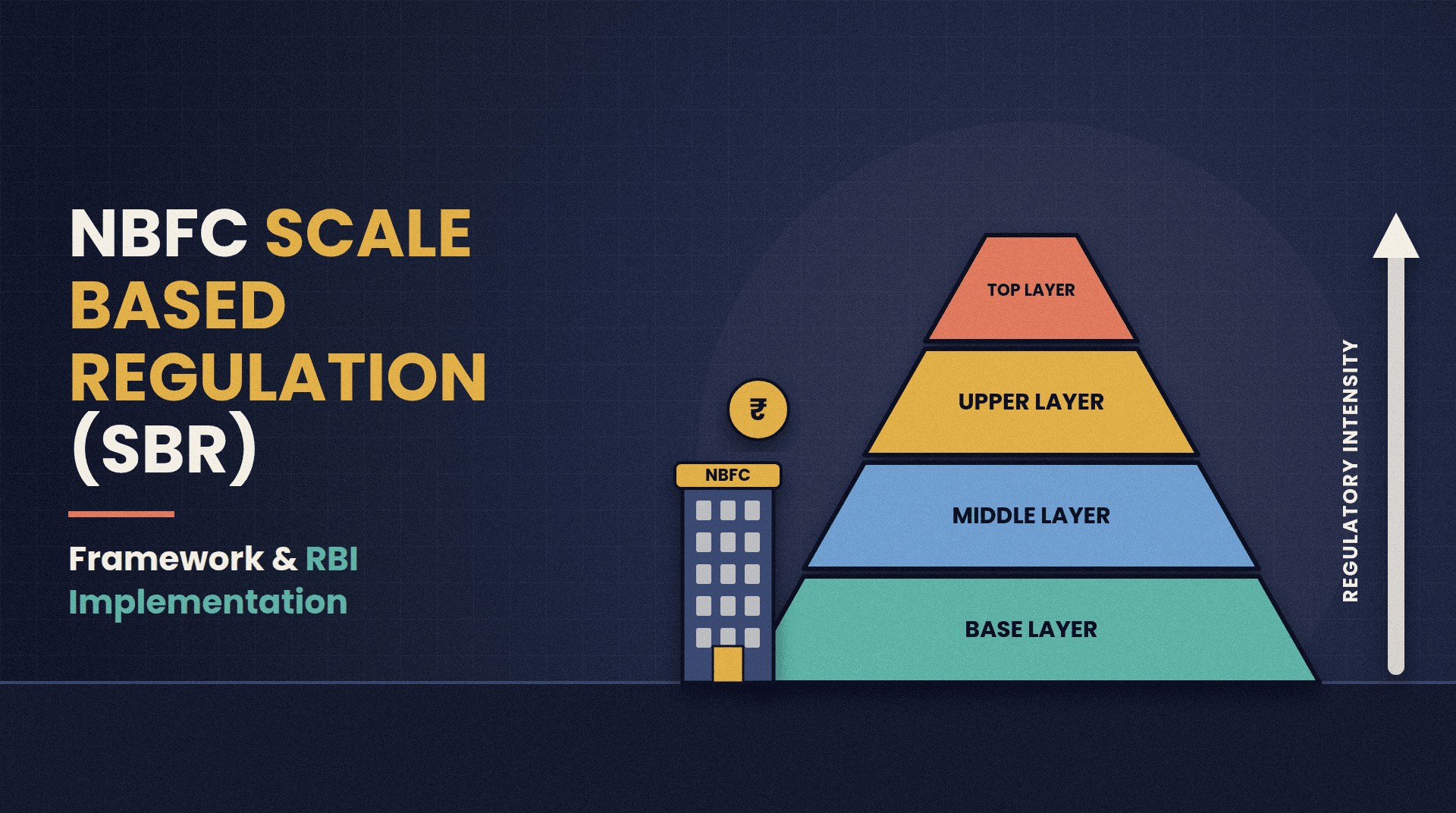
The objective was to make regulatory intensity broadly proportionate to the size, complexity and perceived risk of an NBFC.The framework became operational from 1 October 2022, while certain individual requirements had separate implementation timelines. The Upper Layer was designed for NBFCs considered to warrant enhanced regulatory requirements.

M&A – Competition Act Deal-Value Threshold Rules
This report is exploratory in nature. It traces the legislative and regulatory evolution of the 'deal-value threshold' (DVT) introduced into India's merger-control regime under Section 5(d) of the Competition Act, 2002, from its statutory origin in the Competition (Amendment) Act, 2023 through its operationalisation via Ministry of Corporate Affairs (MCA) rules .