

NBFC Scale Based Regulation (SBR) Framework RBI implementation
Anam Khan
20 Oct 2026 24 min read
- Introduced
- 20 Oct 2026
1. Executive Summary
Non-Banking Financial Companies (NBFCs) have become an important part of India’s financial system by providing credit to individuals, businesses and specialised sectors that may not always be adequately served through traditional banking channels. Their increasing size, interconnectedness and diversification, however, have also increased the possibility that financial stress in a large NBFC may affect the wider financial system. The Reserve Bank of India (RBI) responded to this changing risk profile by introducing the Scale Based Regulation (SBR) framework through its circular dated 22 October 2021. The framework moved away from a largely uniform regulatory approach and created a four-layer structure consisting of the Base Layer, Middle Layer, Upper Layer and Top Layer. The objective was to make regulatory intensity broadly proportionate to the size, complexity and perceived risk of an NBFC.The framework became operational from 1 October 2022, while certain individual requirements had separate implementation timelines. The Upper Layer was designed for NBFCs considered to warrant enhanced regulatory requirements, initially using a combination of asset size and a scoring methodology. The Top Layer was intended to remain empty except where the RBI considered that an NBFC in the Upper Layer posed substantially increased systemic risk. The framework was subsequently consolidated through the Master Direction – Reserve Bank of India (Non-Banking Financial Company – Scale Based Regulation) Directions, 2023, which superseded the principal 2016 directions applicable to NBFCs. The 2023 Directions brought the SBR structure into a more detailed and operational regulatory framework.
A further consolidation took place on 28 November 2025 through the Reserve Bank of India (Non-Banking Financial Companies – Registration, Exemptions and Framework for Scale Based Regulation) Directions, 2025. The 2025 Directions combined the registration, exemption and SBR framework into a consolidated regulatory instrument. The most significant recent development occurred in 2026. RBI first amended the framework in April 2026 to provide a specific regulatory treatment for NBFCs which neither access public funds nor have customer interface. From 1 July 2026, eligible entities below ₹1,000 crore in asset size could obtain exemption from the registration requirements under sections 45-IA and 45-IC of the RBI Act, subject to prescribed conditions. More importantly, on 24 June 2026, RBI issued the Second Amendment Directions, 2026, replacing the earlier parametric/scoring methodology for identifying Upper Layer NBFCs with a clear asset-size criterion. Under the revised framework, NBFCs having asset size of ₹1,00,000 crore or more, based on the latest audited balance sheet, constitute the Upper Layer. The threshold is to be reviewed every three years. The reform also provides for eligible government-owned NBFCs to be considered for Upper Layer classification and addresses regulatory treatment of NBFCs that are group entities of scheduled commercial banks. Accordingly, as of September 2026, the SBR framework is not merely the four-layer model introduced in 2021. It has evolved into a more consolidated and differentiated system, combining scale-based regulation with activity-based regulation, ownership-neutral treatment, specific exemptions for low-risk entities and enhanced requirements for very large NBFCs.
2. Introduction
The term NBFC covers a broad range of financial companies undertaking lending, investment and other financial activities without being banks. NBFCs perform an important credit-intermediation function in the Indian economy. They finance sectors such as housing, infrastructure, vehicle finance, microfinance, consumer credit and commercial lending. The regulatory challenge arises from the diversity within the NBFC sector itself. A small NBFC with limited public exposure does not necessarily create the same level of systemic risk as a large, interconnected financial institution with substantial assets and extensive customer relationships. The RBI therefore increasingly adopted a differentiated regulatory approach. The SBR framework was introduced against this background. The RBI’s 22 October 2021 circular expressly noted that NBFCs had undergone significant changes in terms of their size, complexity and interconnectedness and that the regulatory framework needed to reflect their changing risk profile. The framework was consequently designed to cover capital requirements, governance standards and prudential regulation through a common scale-based structure. The present report traces the development of the SBR framework from its pre-2021 regulatory background to its current position in September 2026. It focuses particularly on the structure of the four layers, the enhanced requirements applicable to larger NBFCs, implementation measures, the transition from the 2023 Directions to the consolidated 2025 Directions, and the significant 2026 reforms.
3. Regulatory Background Before the SBR Framework
Before SBR, the RBI’s regulatory framework for NBFCs relied significantly on classifications such as:
a NBFC-ND
b NBFC-ND-SI
c NBFC-D
d activity-specific categories.
The regulatory intensity was therefore connected to factors such as whether an NBFC accepted public deposits and whether it crossed the systemically important asset threshold. This approach was important in developing prudential regulation of NBFCs, but the growth of the sector created a need for greater differentiation. NBFCs were increasingly diverse in terms of size, business model, customer exposure and systemic interconnectedness. The RBI’s SBR framework therefore sought to introduce a more structured approach based upon size, activity and perceived riskiness. The change was not intended to eliminate activity-based regulation. Instead, SBR combined scale-based regulation with activity-based requirements. Certain entities, such as NBFC-P2P, NBFC-AA and NOFHCs, were assigned specific treatment because of the nature of their business, while larger and more complex NBFCs could move into higher regulatory layers.
4. Introduction of the Scale Based Regulation Framework
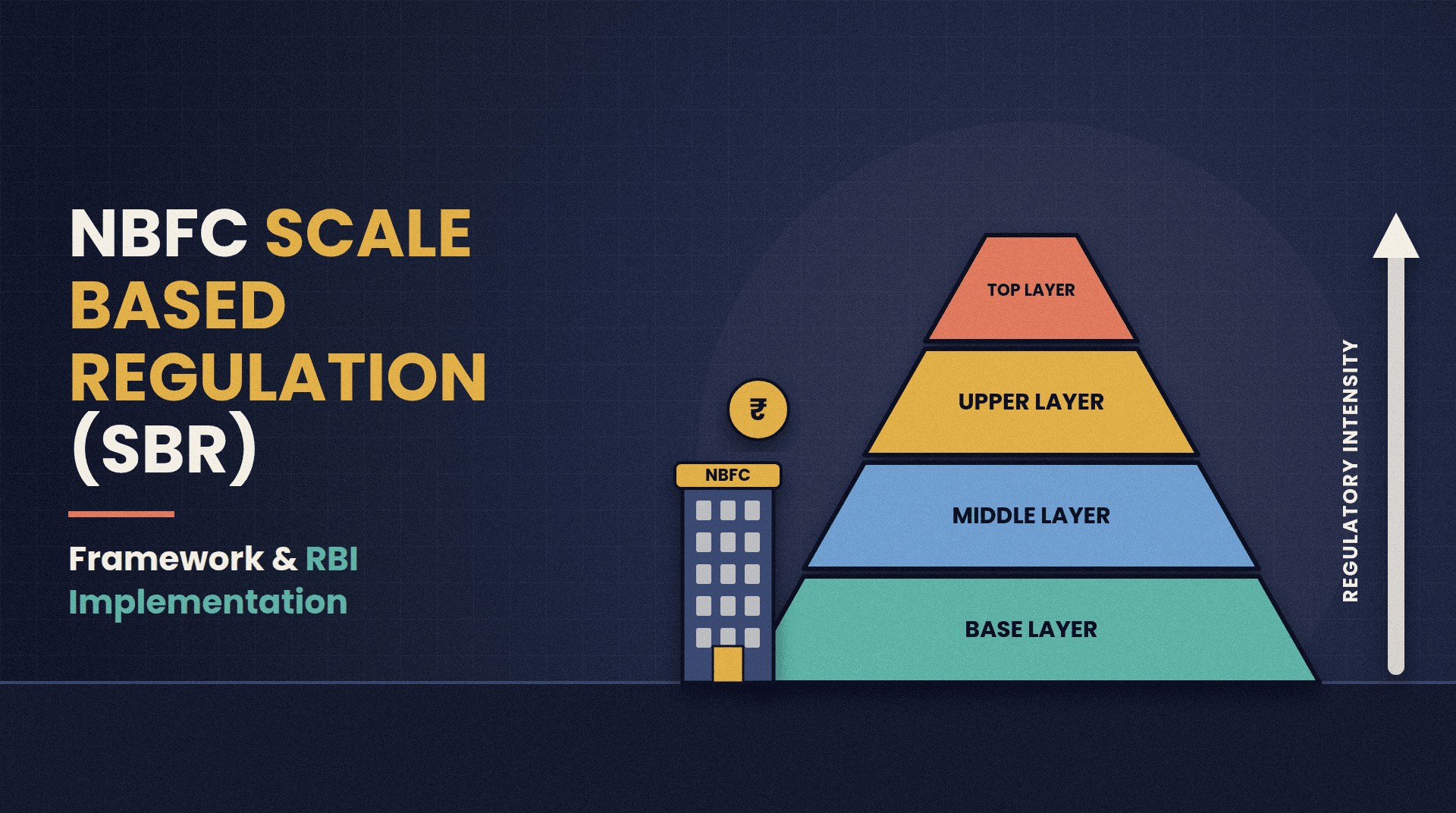
The RBI issued the Scale Based Regulation (SBR): A Revised Regulatory Framework for NBFCs on 22 October 2021.The framework became effective from 1 October 2022, except for the specified IPO-funding restriction, which came into effect earlier from 1 April 2022. The framework created four layers:
NBFC – Base Layer (NBFC-BL)
NBFC – Middle Layer (NBFC-ML)
NBFC – Upper Layer (NBFC-UL)
NBFC – Top Layer (NBFC-TL).
The fundamental idea was progressive regulation. Regulatory requirements applicable to a lower layer would generally apply to higher layers unless the RBI prescribed otherwise. Thus, the regulatory burden increased as the NBFC moved upwards in the structure. The Top Layer was deliberately designed as an exceptional category. RBI stated that it would ideally remain empty and would be used if a particular Upper Layer NBFC created a substantial increase in potential systemic risk. This structure represented an important shift from treating the NBFC sector as a relatively homogeneous group towards a system in which regulatory intensity corresponds more closely with institutional scale and risk.
5. The Four-Layer Structure
5.1 Base Layer
The Base Layer was designed for the comparatively lower-risk portion of the NBFC sector. Under the original framework, it included:
a non-deposit-taking NBFCs below ₹1,000 crore in asset size
b NBFC-P2P
c NBFC-AA
d NOFHC
e NBFCs not availing public funds and not having customer interface.
The framework therefore recognised that entities without public funds or customer interface presented a different regulatory risk profile. The 2026 amendments have significantly developed this aspect. From 1 July 2026, eligible NBFCs without public funds and customer interface and having asset size below ₹1,000 crore may qualify as Unregistered Type I NBFCs and obtain exemption from sections 45-IA and 45-IC of the RBI Act, subject to specified conditions. This is an important example of proportional regulation: the regulatory framework has become stricter for very large NBFCs while simultaneously reducing registration-related burden for certain low-risk entities.
5.2 Middle Layer
The Middle Layer includes NBFCs with greater size, activity or regulatory significance. The original framework included:
a all deposit-taking NBFCs
b non-deposit-taking NBFCs with assets of ₹1,000 crore and above
c Standalone Primary Dealers
d Infrastructure Debt Fund-NBFCs
e Core Investment Companies
f Housing Finance Companies
g Infrastructure Finance Companies.
The Middle Layer therefore represents a substantial portion of the regulated NBFC sector. The regulatory requirements applicable to the Middle Layer include enhanced prudential and governance requirements compared with the Base Layer. For example, the SBR framework requires NBFC-ML and NBFC-UL entities to undertake an Internal Capital Adequacy Assessment Process (ICAAP), requiring an internal assessment of capital requirements having regard to the risks arising from their business.
5.3 Upper Layer
The Upper Layer was the principal innovation of SBR.Under the original 2021 framework, an NBFC could enter the Upper Layer where it was identified by RBI as warranting enhanced regulatory requirements based on specified parameters and scoring methodology. The ten largest eligible NBFCs by asset size were automatically included. The Upper Layer was consequently intended for NBFCs whose size, interconnectedness, complexity or other risk characteristics warranted a level of supervision closer to that applied to systemically significant financial institutions. The original framework imposed additional requirements relating to:
capital, leverage, standard asset provisioning, corporate governance, board competence,disclosure,listing,independent directors, enhanced supervisory engagement. One of the most significant capital requirements was the requirement that NBFC-UL maintain Common Equity Tier 1 capital of at least 9 per cent of risk-weighted assets. RBI subsequently issued detailed instructions for differential provisioning and other aspects of Upper Layer regulation.
5.4 Top Layer
The Top Layer is intended for exceptional circumstances.It was designed to remain empty in normal circumstances and to become populated only if RBI formed the view that there had been a substantial increase in potential systemic risk from a particular NBFC already situated in the Upper Layer. An NBFC moved to the Top Layer would consequently face enhanced and intensive supervisory engagement and additional capital requirements. The existence of the Top Layer demonstrates that SBR is not merely a mechanical asset-size classification. It also retains a systemic-risk component at the highest end of the regulatory structure.
6. Progressive Application of Regulation
One of the important features of SBR is the principle of progressive application. The framework provides that regulatory revisions applicable to lower layers will ordinarily apply automatically to NBFCs in higher layers unless otherwise specified. This approach prevents duplication of regulatory frameworks and creates a regulatory ladder.
For example:
Base Layer
↓
Basic prudential and governance requirements
Middle Layer
↓
Enhanced capital, risk-management and governance requirements
Upper Layer
↓
Additional capital, governance, disclosure, listing and supervisory requirements
Top Layer
↓
Intensive systemic-risk supervision and additional capital requirements
The significance of this approach is that an NBFC does not simply receive a label when entering a higher layer; its regulatory obligations also become progressively more demanding.
7. Major Regulatory Requirements Under SBR
7.1 Capital Requirements
Capital adequacy is one of the central components of the SBR framework. The original framework increased the regulatory minimum Net Owned Fund for NBFC-ICC, NBFC-MFI and NBFC-Factors to ₹10 crore, subject to the prescribed transition arrangements. For NBFC-UL, the framework prescribed a minimum CET1 requirement of 9 per cent of risk-weighted assets. The purpose of these requirements is to ensure that large NBFCs maintain sufficient high-quality capital to absorb losses.
7.2 Internal Capital Adequacy Assessment
NBFCs in the Middle and Upper Layers are required to undertake an internal assessment of their capital requirements. The assessment should consider:
credit risk, market risk, operational risk, other residual risks. The methodology must be proportionate to the scale and complexity of the NBFC’s operations and should be supported by a Board-approved policy. This represents a movement away from purely rule-based capital requirements towards a more risk-sensitive supervisory framework.
7.3 Prudential and Concentration Risk Regulation
The SBR framework also strengthened concentration-risk management. The original framework consolidated certain credit and investment exposure limits into common exposure limits applicable to NBFC-ML and NBFC-UL.The RBI subsequently developed a separate NBFC – Concentration Risk Management framework.In June 2026, RBI further amended this framework in connection with the revised treatment of government-owned NBFCs and the recognition of certain State Government guarantees as credit-risk-transfer instruments.
7.4 Corporate Governance
The Upper Layer framework introduced enhanced governance requirements.
These included requirements relating to:
board competence, appropriate mix of education and experience, specialised expertise corresponding to the NBFC’s business, reporting relating to early removal or resignation of independent directors, enhanced disclosures. The regulatory objective is to ensure that a large NBFC’s governance structure is capable of dealing with its increased operational and systemic complexity.
7.5 Compliance Function and Chief Compliance Officer
RBI separately issued its April 2022 circular on the Compliance Function and Role of Chief Compliance Officer (CCO) – NBFCs.The circular applied to NBFC-ML and NBFC-UL and required an independent compliance function and a Chief Compliance Officer. This is significant because compliance under SBR is not limited to financial ratios. RBI also seeks institutional mechanisms capable of identifying and managing regulatory risk.
7.6 Disclosure and Listing
The original SBR framework required NBFC-UL to be mandatorily listed within three years of identification as Upper Layer, subject to the applicable framework. The Upper Layer also had disclosure requirements aligned more closely with those applicable to listed companies. The rationale was that an institution subject to enhanced regulation should also provide a higher degree of transparency to investors and other stakeholders. The 2026 amendments, however, introduced a specific distinction for certain fully government-owned and controlled NBFC-UL entities by modifying the application of certain governance and disclosure requirements. This reflects the need to reconcile the enhanced Upper Layer framework with the ownership and accountability structure of government entities.
8. Timeline of Major Developments
Date | Development | Significance |
4 December 2020 | RBI announced review towards a scale-based regulatory approach | Policy foundation for SBR |
22 January 2021 | Discussion Paper on Revised Regulatory Framework for NBFCs – A Scale-Based Approach | Stakeholder consultation |
22 October 2021 | SBR: A Revised Regulatory Framework for NBFCs issued | Four-layer SBR framework introduced |
1 April 2022 | Certain IPO funding restrictions became effective | First specified implementation date |
19 April 2022 | CET1 capital requirements for NBFC-UL issued | 9% CET1 requirement for NBFC-UL |
11 April 2022 | Compliance Function and CCO framework issued | Enhanced compliance governance for ML/UL |
6 June 2022 | Differential provisioning for NBFC-UL issued | Enhanced prudential requirements |
1 October 2022 | SBR framework became operational | Four-layer structure formally implemented |
30 September 2022 | First Upper Layer list identified | Initial implementation of UL classification |
14 September 2023 | 15 NBFCs identified in Upper Layer | Continued annual UL identification |
19 October 2023 | SBR Master Directions, 2023 issued | Earlier NBFC regulatory directions consolidated |
16 January 2025 | 2024-25 Upper Layer list released | 15 NBFCs identified |
28 November 2025 | Consolidated SBR/registration Directions, 2025 issued | Registration, exemptions and SBR consolidated |
6 February 2026 | RBI announced review relating to low-risk NBFC registration exemptions | Basis for subsequent April amendment |
29 April 2026 | First Amendment Directions, 2026 issued | Type I NBFC/exemption framework introduced |
10 April 2026 | Draft proposal for revising Upper Layer methodology issued | Proposed replacement of scoring methodology |
24 June 2026 | Second Amendment Directions, 2026 issued | ₹1 lakh crore absolute UL threshold introduced |
24 June 2026 | Related concentration-risk, governance and disclosure amendments issued | Government-owned NBFC framework modified |
1 July 2026 | April 2026 amendments relating to Type I NBFCs became effective | Low-risk registration exemption operational |
September 2026 | Current position | Revised SBR framework in operation |
9. The 2023 Master Direction
The 2023 Master Direction was an important stage in the implementation of SBR.Issued on 19 October 2023, it superseded the principal 2016 directions concerning non-systemically important non-deposit-taking NBFCs and systemically important non-deposit-taking/deposit-taking NBFCs.It placed the four-layer SBR structure into a consolidated regulatory document and incorporated the detailed prudential, governance and regulatory provisions that had been issued following the 2021 framework. This was significant from a compliance perspective because regulated entities no longer needed to treat the 2021 framework as an isolated policy statement. The SBR structure had become embedded within the operative Master Direction framework.
10. Consolidation Through the 2025 Directions
On 28 November 2025, RBI issued the Reserve Bank of India (Non-Banking Financial Companies – Registration, Exemptions and Framework for Scale Based Regulation) Directions, 2025. The 2025 Directions contain separate chapters dealing with:
a preliminary matter
b SBR framework
c registration requirements
d exemptions from the RBI Act
e reporting requirements
f repeal and other provisions.
The Directions apply to NBFCs registered with RBI according to their classification under the SBR structure. They also address government companies according to their classification. This represented a further consolidation of the regulatory architecture.
11. 2026 Reform: Exemption for Low-Risk NBFCs
One of the important 2026 developments concerned NBFCs that do not access public funds and do not have customer interface. RBI’s April 2026 amendment created the concept of:
1 Type I NBFC
2 Type II NBFC
3 Unregistered Type I NBFC.
An eligible NBFC below ₹1,000 crore in asset size, which operates without public funds and without customer interface as a conscious and long-term business model, can qualify for exemption from sections 45-IA and 45-IC of the RBI Act, subject to conditions. The framework also provides for group-level aggregation in certain situations. If multiple unregistered Type I NBFCs within a group collectively reach the ₹1,000 crore threshold, the relevant registration requirements become applicable. The exemption is not absolute. Even an unregistered Type I NBFC continues to remain subject to the applicable provisions of Chapter IIIB of the RBI Act, and RBI retains supervisory and enforcement powers in relation to violations. This is an important point because the reform should not be understood as removing such entities completely from RBI oversight.
12. 2026 Reform: New Upper Layer Criterion
The most important development for SBR implementation in 2026 was the replacement of the earlier Upper Layer identification methodology. Previously, RBI used a two-pronged mechanism involving the largest eligible NBFCs and a parametric scoring methodology. On 10 April 2026, RBI proposed replacing that approach with an absolute asset-size threshold of ₹1,00,000 crore. Following stakeholder consultation, RBI issued the Second Amendment Directions, 2026 on 24 June 2026.The revised provision states that the Upper Layer shall consist of NBFCs having an asset size of ₹1,00,000 crore or above, based on the latest audited balance sheet for the financial year. The criteria are to be reviewed periodically, and the asset-size threshold is to be reviewed every three years. This change has two practical consequences. First, the criterion is substantially easier to understand and verify. An NBFC can determine its potential Upper Layer status principally by reference to an objective asset-size threshold rather than a multi-factor scoring exercise. Secondly, the change represents a move towards regulatory predictability. The earlier methodology allowed a combination of size and other systemic indicators to influence classification. The revised methodology provides a more straightforward quantitative trigger. However, the Top Layer continues to preserve a separate systemic-risk safety valve. Therefore, the move to a simpler Upper Layer criterion does not mean that RBI has abandoned risk-based supervision altogether.
13. Government-Owned NBFCs
The original 2021 framework specifically stated that government-owned NBFCs would be placed in the Base or Middle Layer and would not be placed in the Upper Layer until further notice. The position changed in 2026.The April 2026 draft proposed that eligible government-owned NBFCs should also be considered for Upper Layer classification under the revised asset-size criterion. The proposal was based on an ownership-neutral regulatory approach RBI subsequently issued the final amendment on 24 June 2026.The significance of this reform is that the regulatory layer is increasingly determined by the institution’s size and risk profile rather than by whether the entity is government-owned or privately owned. The June 2026 regulatory package also introduced related changes concerning concentration-risk requirements, governance and financial disclosures applicable to government-owned NBFC-ULs.
14. NBFCs That Are Group Entities of Scheduled Commercial Banks
The June 2026 amendment also introduced specific treatment for NBFCs that are group entities of Scheduled Commercial Banks. Such NBFCs are required to comply with applicable provisions under the RBI’s Commercial Banks – Undertaking of Financial Services framework where the same business or activity is being undertaken by both the NBFC and its parent bank. Importantly, the amendment clarifies that such an NBFC continues to be classified in its SBR layer according to the NBFC framework. Thus, the rule creates an additional layer of activity-based regulatory alignment without mechanically changing the NBFC’s SBR classification.
15. Implementation Status
As of September 2026, the SBR framework can be described as operational and substantially implemented, rather than being a pending or proposed regulatory framework. This conclusion is supported by several developments:
The original framework became effective on 1 October 2022.
Upper Layer NBFCs have been identified annually.
Detailed capital, governance, compliance and prudential requirements have been issued.
The 2023 Master Direction consolidated the framework.
The 2025 Directions further consolidated registration and SBR requirements.
The 2026 amendments have modified the operative framework rather than merely proposing future changes.
The revised Upper Layer threshold has been brought into force from 24 June 2026.
The Type I exemption framework became operational from 1 July 2026.
The implementation is therefore best understood as an evolving regulatory framework rather than a one-time reform.
16. Upper Layer Identification in Practice
The RBI’s January 2025 list contained 15 NBFCs in the Upper Layer for 2024-25. These included entities such as LIC Housing Finance, Bajaj Finance, Shriram Finance, Tata Sons, Cholamandalam Investment and Finance, L&T Finance, Mahindra & Mahindra Financial Services, Aditya Birla Finance, Tata Capital, Piramal Capital & Housing Finance, PNB Housing Finance, HDB Financial Services, Sammaan Capital, Muthoot Finance and Bajaj Housing Finance. The RBI also clarified that an NBFC identified as Upper Layer would remain subject to enhanced regulatory requirements for at least five years from classification even if it subsequently ceased to meet the relevant criteria. The 2026 amendment, however, materially changes the methodology going forward. Therefore, the 2024-25 list should not simply be reproduced as though it were the final expression of the September 2026 framework. The important legal distinction is between historical identification under the earlier methodology and future identification under the revised ₹1 lakh crore criterion. A tracking report must preserve that distinction.
17. Enforcement and Compliance Developments
The SBR framework is supported by several regulatory measures beyond the basic four-layer classification.
RBI has issued detailed directions relating to: capital adequacy,provisioning,compliance function,governance,concentration risk, financial reporting, fraud risk management, responsible business conduct, other prudential requirements. The regulatory approach is therefore not dependent on one SBR circular. A significant example is the April 2022 compliance-function circular requiring NBFC-ML and NBFC-UL to maintain an independent compliance function and appoint a Chief Compliance Officer. Similarly, the 2024 Fraud Risk Management Directions apply to NBFCs in the Upper and Middle Layers and to Base Layer NBFCs above the specified asset-size threshold. These developments show how the SBR philosophy has gradually been incorporated into the broader supervisory framework.
18. Judicial Developments
18.1 Golam Sabir v. Piramal Capital & Housing Finance Ltd.
A relevant judicial development is the litigation concerning Piramal Capital & Housing Finance Ltd. and Golam Sabir before the Calcutta High Court. In the judgment dated 24 December 2025, the Single Judge considered whether a Housing Finance Company could be treated as an NBFC for the purposes of the relevant SARFAESI threshold. The Court examined the RBI’s regulatory treatment of HFCs, including the SBR framework and the 2023 Master Direction. The judgment noted that the 2023 Master Direction placed HFCs within the regulatory structure of NBFCs and treated them within the relevant SBR framework. The matter was subsequently considered in appeal by a Division Bench of the Calcutta High Court on 9 April 2026. This case is useful for the present report because it demonstrates how SBR classification has consequences beyond internal RBI compliance. The classification of an entity as an NBFC can affect the application of other statutory regimes. Importantly, this litigation was not a direct constitutional challenge to the validity of the SBR framework. Its relevance is instead interpretative: it illustrates the practical legal significance of the RBI’s classification of HFCs within the NBFC regulatory structure.
18.2 Chhavi Investment Pvt. Ltd. v. Reserve Bank of India
In Chhavi Investment Private Limited v. Reserve Bank of India & Anr., decided by the Delhi High Court on 30 April 2026, the petitioner sought restoration of its NBFC registration and referred to the RBI’s 2023 Master Directions. The Court noted that the earlier cancellation of the petitioner’s Certificate of Registration had attained finality and held that the petitioner could apply afresh for registration if it claimed to be compliant with the applicable regulatory requirements. This case is relevant to the implementation side of NBFC regulation, particularly the relationship between registration and compliance with RBI directions. Again, it is not a direct challenge to SBR itself, but it demonstrates that the registration framework continues to generate litigation at the operational level.
19. Regulatory Outlook
The 2026 reforms indicate three broad directions in RBI’s approach. First: Greater proportionality The exemption for certain low-risk NBFCs without public funds or customer interface shows that RBI is willing to reduce regulatory burden where the underlying risk is comparatively limited.
Second: Greater regulatory intensity for very large NBFCs
The ₹1 lakh crore Upper Layer threshold focuses enhanced regulation on the largest NBFCs.This reflects the underlying idea that the regulatory consequences of institutional failure increase with scale and interconnectedness.
Third: Greater ownership neutrality
The removal of the earlier exclusion of government-owned NBFCs from Upper Layer classification indicates a move towards applying the regulatory framework more consistently across ownership categories. At the same time, RBI has retained specific provisions for government-owned NBFCs where their ownership structure justifies differentiated treatment. The overall direction is therefore not simply deregulation or tightening. It is a combination of differentiation: lighter treatment for certain low-risk entities and stronger requirements for very large or systemically relevant institutions.
20. Legal and Regulatory Issues Emerging from the 2026 Framework
20.1 Effect of the ₹1 lakh crore threshold
The revised threshold is simpler than the previous scoring methodology, but its effectiveness will depend upon how accurately asset size captures systemic importance. An NBFC may have a smaller asset base but substantial interconnectedness or concentration in a particular financial market. The continuing role of the Top Layer provides a mechanism for dealing with exceptional systemic-risk situations.
20.2 Three-year review of the threshold
The ₹1 lakh crore threshold is not permanently fixed. RBI is required to review the threshold every three years. This provides flexibility to adapt the regulatory perimeter to changes in the size of the financial sector.
20.3 Treatment of government-owned NBFCs
The inclusion of eligible government-owned NBFCs in the Upper Layer marks a significant policy shift. The practical effect will depend upon which government-owned entities satisfy the revised asset-size criterion and how the related governance and disclosure exemptions operate in individual cases.
20.4 Low-risk NBFC exemption
The Type I exemption framework reduces regulatory burden but introduces a continuing obligation to maintain the conditions of exemption. An entity that begins accepting public funds or establishes customer interface cannot simply continue under the exemption. It must obtain the appropriate registration.
20.5 Group-level risk
The 2026 amendments also show RBI’s concern that regulatory risk should not be assessed entirely on a standalone basis. The treatment of multiple Type I entities within a group and the special rules for NBFCs belonging to banking groups indicate greater attention to group structures and regulatory arbitrage.
21. Overall Assessment of the Evolution of SBR
The development of the SBR framework can be understood in four stages.
Stage | Period | Description |
Stage I – Conceptual transition | 2020–2021 | RBI recognised that the NBFC sector had become larger, more complex and more interconnected and developed the scale-based approach. |
Stage II – Implementation | 2022 | The four-layer structure became operational and detailed prudential and governance requirements were issued. |
Stage III – Consolidation | 2023–2025 | The 2023 Master Direction and 2025 consolidated Directions transformed the framework into a more comprehensive regulatory architecture. |
Stage IV – Refinement | 2026 | RBI moved towards: a simpler Upper Layer criterion; ownership-neutral classification; exemptions for certain low-risk NBFCs; more explicit treatment of banking-group NBFCs; and corresponding changes to governance, concentration and disclosure requirements. |
Thus, the SBR framework has evolved from a broad policy reform into a detailed and continuously updated supervisory framework.
22. Conclusion
The Scale Based Regulation framework represents a significant development in the regulation of India’s NBFC sector. Its central principle is that regulatory intensity should broadly correspond to the size, activities and risk profile of the regulated entity. The four-layer structure introduced in 2021 created the foundation for this approach, while subsequent RBI directions progressively converted the framework into operational requirements. The 2023 Master Direction consolidated the regulatory structure. The 2025 Directions further integrated registration, exemptions and SBR requirements. The 2026 amendments have now introduced another important stage in the framework’s evolution. The shift from the earlier Upper Layer scoring methodology to an objective ₹1,00,000 crore asset-size threshold is particularly significant. It simplifies the classification mechanism and makes the regulatory trigger more predictable. At the same time, RBI has extended the possibility of Upper Layer treatment to eligible government-owned NBFCs and has created specific rules for NBFCs associated with banking groups.At the other end of the spectrum, the Type I exemption framework demonstrates proportionality by reducing registration-related requirements for qualifying entities that neither access public funds nor maintain customer interface. The current SBR framework should therefore not be understood as a static four-tier classification system. It is a continuing regulatory architecture in which the RBI adjusts the intensity and scope of supervision according to changes in institutional size, business activity, ownership structure and systemic considerations. As of September 2026, the framework is operational and has moved well beyond its original 2021 formulation. Its future development will depend particularly upon the three-year review of the ₹1 lakh crore Upper Layer threshold, annual identification of Upper Layer NBFCs, implementation experience with Type I exemptions and RBI’s continuing assessment of systemic risk in the NBFC sector.
Anam Khan
More tracked legislation

M&A – Competition Act Deal-Value Threshold Rules
This report is exploratory in nature. It traces the legislative and regulatory evolution of the 'deal-value threshold' (DVT) introduced into India's merger-control regime under Section 5(d) of the Competition Act, 2002, from its statutory origin in the Competition (Amendment) Act, 2023 through its operationalisation via Ministry of Corporate Affairs (MCA) rules .

Online Gaming - Promotion and Regulation of Online Gaming Act, 2025 (Act No. 32 of 2025)
the Promotion and Regulation of Online Gaming Rules, 2026. Enacted by the Parliament of India under the purview of the Ministry of Electronics and Information Technology (MeitY), this legislation marks a complete paradigm shift transitioning India from an era of fragmented, state-level anti-gambling statutes and contested judicial 'skill versus chance' jurisprudence into a unified, centralized, strict regulatory regime.

Digital Competition Bill: Ex-Ante Regulation of Big Tech in India
The Indian Digital Competition Bill (DCB) is a paradigm shift in regulation from ex-post to ex-ante regulation, regulating "Systemically Significant Digital Enterprises" (SSDEs), which offer core digital services. The regime adds to the existing Competition Act of 2002 (amended in 2023)1 by introducing pre-determined conduct rules for large digital platforms before any anti-competitive injury is done.