

M&A – Competition Act Deal-Value Threshold Rules
Nandini Vats
16 Oct 2026 19 min read
- Introduced
- 16 Oct 2026

Scope Note
This report is exploratory in nature. It traces the legislative and regulatory evolution of the 'deal-value threshold' (DVT) introduced into India's merger-control regime under Section 5(d) of the Competition Act, 2002, from its statutory origin in the Competition (Amendment) Act, 2023 through its operationalisation via Ministry of Corporate Affairs (MCA) rules and Competition Commission of India (CCI) regulations notified on 9–17 September 2024, up to the most recent enforcement action and judicial pronouncement located as of the date of this report. As directed under the internship guidelines, the report establishes the pre-amendment baseline, maps the dated legislative/regulatory timeline, identifies subordinate rules and forms, tracks implementation and rollout status, logs enforcement action, notes judicial developments, and closes with a comparative angle and dated source log.
Baseline: The Position Prior to the 2023 Amendment
Prior to the Competition (Amendment) Act, 2023, Section 5 of the Competition Act, 2002 defined a 'combination' solely by reference to asset and turnover thresholds of the acquirer, target, and their respective groups, calculated on both an India and a worldwide basis. Section 5, as it then stood, contained clauses (a) to (c) covering acquisitions, mergers and amalgamations measured against these asset/turnover thresholds, with periodic upward revision by the Central Government under Section 20(3) based on the wholesale price index and exchange-rate movement (the last such revision before the 2023 Amendment being effected by notification dated 4 March 2016, enhancing thresholds by 100%). The Competition Commission of India (Procedure in regard to the transaction of business relating to combinations) Regulations, 2011 governed notification, and the review timeline stood at 210 working days. The regulator, the Competition Commission of India (Commission), was established under Section 7 of the Competition Act, 2002. The Ministry of Corporate Affairs administers the Act and issues rules under Section 63, while the Commission issues regulations under Section 64. A structural gap in this regime, repeatedly flagged by the Competition Law Review Committee and industry commentary, was that transactions involving high-value but asset-light or loss-making targets characteristic of digital-economy acquisitions (e.g., a large technology acquirer purchasing a nascent but strategically significant start-up with negligible assets or turnover) could escape CCI scrutiny altogether despite substantial economic value and potential market impact
The Statutory Amendment: Competition (Amendment) Act, 2023
The Competition (Amendment) Bill, 2022 was introduced in the Lok Sabha in August 2022, following the Competition Law Review Committee's report and a prior 2020 draft bill. The Bill was passed by the Lok Sabha on 29 March 2023 and by the Rajya Sabha shortly thereafter, and received the assent of President Droupadi Murmu on 11 April 2023, becoming the Competition (Amendment) Act, 2023 (Act 9 of 2023). Section 7 of the 2023 Amendment Act inserted a new clause (d) into Section 5 of the principal Act, providing that a combination shall also arise where 'any acquisition of any control, shares, voting rights or assets of an enterprise... or any merger or amalgamation... where the value of the transaction... exceeds such value as may be prescribed', subject to the enterprise having 'substantial business operations in India'. This is the statutory root of the deal-value threshold.
Key ancillary amendments introduced by the 2023 Act, relevant to DVT implementation, are summarised below:
a Section 6(2A): introduced a standstill obligation prohibiting parties from consummating a combination before CCI approval, tightening the gun-jumping regime that DVT-triggered transactions must also observe.
b Section 6(4)/6(5): enabled 'Green Channel' combinations meeting prescribed criteria to be deemed approved on filing.
c Section 6A: introduced a carve-out for open offers and stock-exchange acquisitions, permitting implementation subject to notice and a restriction on exercising ownership/beneficial rights pending approval.
d Section 20(1) proviso: introduced a one-year limitation period, from the date a combination takes effect, within which the Commission may inquire into an unnotified combination on its own motion a provision central to the Supreme Court's 2026 ruling in the Amazon–Future Coupons matter (see Section 6 below).
e Section 29/29A: revised the show-cause and statement-of-objections procedure, and shortened intermediate timelines (e.g., a 30-day period for forming a prima facie opinion).
f Section 31: reduced the overall outer review timeline from 210 days to 150 days.
g Section 43A: retained and reinforced penalty for failure to notify (gun-jumping), pegged at up to 1% of the total turnover, assets, or value of transaction, whichever is higher.
Section 8 of the Amendment Act inserted clauses (ac), (ad), (cb)–(cc), (fc), (gd)–(gg) etc. into Section 63(2) (rule-making power) and Section 64(2) (regulation-making power), specifically empowering the Central Government to prescribe (i) the value of assets/turnover for de minimis exemption under clause (e) of Section 5 [rule-making power under clause (a)]; (ii) the criteria of 'substantial business operations in India' and value of transaction under clause (d) [rule-making power under clauses (ac), (ad)]; and empowering the CCI to frame procedural regulations for combinations, including criteria for Green Channel notices. Section 33 of the Amendment Act (amending Section 46, the lesser-penalty/leniency provision) was separately notified by the MCA on 20 February 2024, illustrating the staggered, provision-by-provision commencement strategy adopted for the 2023 Act the DVT-related provisions being held back specifically pending completion of subordinate rule-making and public consultation, as flagged contemporaneously by law-firm commentary at the time of Presidential assent
Subordinate Legislation Operationalising the DVT: The 9 September 2024 Rules Package
Operationalisation of Section 5(d) required the Central Government to prescribe (i) the monetary value of the transaction threshold, and (ii) the criteria for 'substantial business operations in India', together with consequential adjustments to the de minimis exemption and Green Channel framework. This was achieved through a coordinated package of five MCA notifications and one CCI notification, all published in the Gazette of India on 9 September 2024 and brought into force on 10 September 2024:
Instrument | Substance | Notifying Authority / Date |
Competition (Amendment) Act, 2023 commencement of merger-control provisions | Sections 6, 6A, 20, 29, 29A, 31, 43A (as amended) brought into force, activating Section 5(d) DVT and the 150-day timeline. | MCA notification, 9 September 2024, effective 10 September 2024 |
Competition (Minimum Value of Assets or Turnover) Rules, 2024 ('De Minimis Rules') | Fixes de minimis asset value at Rs 450 crore and turnover value at Rs 1,250 crore for the purposes of Section 5(e); does not apply where the DVT is independently breached. | MCA, G.S.R. 547(E), 9 September 2024 |
Competition (Criteria of Combination) Rules, 2024 ('Green Channel Rules') | Prescribes criteria under Section 6(4) for combinations eligible for the Green Channel (no horizontal/vertical/complementary overlap between parties, their group entities and affiliates), enabling deemed approval on filing. | MCA, G.S.R. 548(E), 9 September 2024 |
Competition (Criteria for Exemption of Combinations) Rules, 2024 | Exempts specified categories of combinations (e.g., intra-group reorganisations without change in control, bonus issues, underwriting devolvement, portfolio investments up to prescribed shareholding caps) from the Section 6(2)/(2A)/(4) notification requirement, per the Schedule. | MCA, G.S.R. 549(E), 9 September 2024 |
Competition Commission of India (Combinations) Regulations, 2024 (No. 07 of 2024) | Repeals and replaces the 2011 Combination Regulations; Regulation 4 defines 'value of transaction' and 'substantial business operations in India'; Regulation 9 addresses interconnected transactions and anti-avoidance; Regulations 5–34 restate notice, fee, timeline and modification procedure under the 150-day regime. | CCI, F.No.CCI/CD/Comb.Regl./2024, 9 September 2024 |
Competition Commission of India (General) Regulations, 2024 (No. 08 of 2024) | Repeals the 2009 General Regulations; consolidates procedural provisions (confidentiality, signatories, service) cross-referenced throughout the Combination Regulations. | CCI, 17 September 202 |
The Deal-Value Threshold Figure and Its Basis
Regulation 4(1) of the CCI (Combinations) Regulations, 2024 defines 'value of transaction' for the purposes of Section 5(d) expansively, to include every valuable consideration direct or indirect, immediate or deferred, cash or otherwise including consideration for separately agreed covenants/non-competes, all inter-connected steps under Regulation 9(4)-(5), forward-looking arrangements (technology assistance, IP licensing, branding, supply arrangements) payable within two years of the transaction's effective date, the full exercise value of call options, and best estimates of contingent/earn-out payments based on the transaction documents. Future payments are not discounted to present value, and if the value cannot be established with reasonable certainty, the transaction is deemed to exceed the threshold. Although the statutory ceiling for the DVT figure is not fixed in the Act itself and is left to delegated rule-making, secondary commentary uniformly records the operative figure notified as Rs 2,000 crore (approximately USD 240 million), read together with the 'substantial business operations in India' (SBOI) qualifier under Regulation 4(2). The SBOI test, as set out in Regulation 4(2) of the Combinations Regulations, 2024, is a three-limbed alternative test: (a) for digital services, the target's Indian business/end-users constitute 10% or more of its global user base (with no independent rupee floor); (b) the target's gross merchandise value (GMV) in India for the preceding 12 months is 10% or more of global GMV and exceeds Rs 500 crore; or (c) the target's turnover in India for the preceding financial year is 10% or more of global turnover and exceeds Rs 500 crore, the Rs 500 crore floor being expressly disapplied to digital services under Explanation 1 to Regulation 4(2). The de minimis exemption under the Minimum Value of Assets or Turnover Rules, 2024 (assets below Rs 450 crore or turnover below Rs 1,250 crore in India) is not available where the DVT is independently triggered meaning a target that is asset-light but crosses the SBOI/DVT test cannot rely on de minimis to escape notification, closing precisely the regulatory gap the 2023 Amendment was designed to address
Implementation and Rollout Status
The DVT regime, together with the accompanying 150-day outer timeline, 30-day prima facie opinion window, Green Channel codification, and Section 6A open-offer standstill carve-out, has been fully in force since 10 September 2024 with no announced phased rollout beyond the Transition Provision in Regulation 34 of the Combinations Regulations, 2024, which clarifies that the new regime applies to acquisitions/mergers taking effect wholly or partly on or after 10 September 2024, and that Section 43A gun-jumping liability does not attach to any part of a transaction that had already taken effect before that date where no prior notification obligation existed. The CCI's merger-control caseload since commencement confirms active enforcement of the regime across sectors including energy, infrastructure, data centres, insurance and consumer services, with several deemed approvals recorded (e.g., Aviva International Holdings' acquisition of an additional 26% stake in Aviva Life Insurance Company India, and Hornbill Tech Investments' acquisition in Innovation Tech Solutions/Krayzie Services). No specific compliance grace period or backlog-clearance deadline analogous to those in other Task-4 subject areas (e.g., GSTAT backlog appeals) applies to the DVT regime; the operative compliance obligation is transaction-specific parties must assess DVT applicability at signing/board-approval stage and file before consummation, given the mandatory and suspensory character of the regime reaffirmed by the CCI in its May 2026 Manipal order (discussed below).
Enforcement and Compliance Actions
CCI Order in Re: Manipal Health Systems / Manipal Education and Medical Group (20 May 2026)
In its order dated 20 May 2026 (Combination Registration No. C-2025/05/1283), the CCI imposed a Section 43A gun-jumping penalty of Rs 50 lakh on Manipal Health Systems Private Limited and Manipal Education and Medical Group India Private Limited for consummating a Share Purchase Agreement (dated 30 April 2025) acquiring approximately 11.03% shareholding in Aakash Educational Services Limited, prior to filing notice with the CCI. The Commission treated this acquisition as inter-connected with an earlier February 2025 acquisition of 7.75% shareholding by an affiliate (MNI Ventures, the 'Blackstone Acquisition') and with Articles of Association amendments conferring additional rights, holding that the cumulative shareholding increase to approximately 58.39% required prior notification under Sections 6(2) and 6(2A). The CCI rejected reliance on Item 4 of the Competition (Criteria for Exemption of Combinations) Rules, 2024 and reiterated that India's merger-control regime is 'mandatory and suspensory in nature', requiring prior approval irrespective of whether the transaction in fact produces an appreciable adverse effect on competition. Mitigating factors voluntary disclosure and cooperation were taken into account in fixing the penalty at the lower end of the statutory ceiling (up to 1% of turnover/assets/transaction value).
While this enforcement action did not itself concern a Section 5(d) deal-value-threshold breach (it was assessed as a share/control acquisition under the ordinary asset-turnover gateway and Regulation 9's interconnected-transaction principle), it is instructive because Regulation 9(4)-(5) the anti-avoidance and single-notice-for-interconnected-steps rule is the same regulatory architecture that Regulation 4(1)(b) expressly imports into DVT value-of-transaction computation. The order therefore signals the CCI's continuing willingness to aggregate structured, multi-step acquisitions (a technique often used to stay below both the asset/turnover and the Rs 2,000 crore DVT figure) and treat them as a single notifiable combination
Judicial Developments
6.1 Supreme Court: Amazon.com NV Investment Holdings LLC v. Competition Commission of India & Ors. (Civil Appeal No. 4974 of 2022, decided 27 May 2026)
This is the most significant recent judicial pronouncement bearing on the gun-jumping and disclosure architecture that underpins the DVT regime, even though the underlying transaction (Amazon's 2019 investment of approximately Rs 1,431 crore in Future Coupons Private Limited, acquiring a 49% stake) predates the 2023 Amendment and was assessed under the pre-DVT asset/turnover gateway. Background: The CCI had approved the Amazon–FCPL transaction on 28 November 2019 under Form II. In December 2021, acting on complaints from the Future Group (triggered by Future Retail's proposed sale of its retail business to Reliance Retail), the CCI reopened the matter, held that Amazon had failed to disclose that the FCPL Shareholders' Agreement, the Future Retail Limited Shareholders' Agreement, and certain business commercial arrangements (BCAs) formed part of a 'single integrated transaction', kept its 2019 approval in abeyance, directed Amazon to file a fresh Form II notice, and imposed penalties of Rs 200 crore under Section 43A (gun-jumping) and Rs 2 crore under Sections 44/45 (false statement/suppression of material information) a cumulative Rs 202 crore penalty, then the largest ever imposed by the CCI in a combination matter. The NCLAT upheld this order on 13 June 2022.
Supreme Court holding: A Bench of Justices Vikram Nath and Sandeep Mehta allowed Amazon's appeal in its entirety, setting aside both the CCI's 17 December 2021 order and the NCLAT's 13 June 2022 judgment, and directing refund of any amount recovered from Amazon within eight weeks (with interest at 6% p.a., escalating to 9% p.a. on default). The principal holdings, as reported in contemporaneous secondary sources, were:
1 On a proper construction of Section 6(2) read with Regulations 9(4)-(5) of the erstwhile 2011 Combination Regulations, a Form I/Form II filing that had in fact placed the relevant transaction documents (the FCPL SHA, the FRL SHA, and the BCAs) before the Commission could not retrospectively be treated as a 'failure to notify' merely because the CCI later preferred a different characterisation of the inter-connection between those disclosed arrangements.
2 Section 43A, being a penal gun-jumping provision triggered by failure to give notice under Section 6(2), cannot be invoked where a notice was admittedly filed, processed (including through requests for further information), and approved under Section 31(1) the deficiency alleged being one of under-characterisation rather than non-notification.
3 Sections 44 and 45 require the Commission to make specific, penal-standard findings on (i) the identified false statement or omitted material particular, (ii) its materiality to the Commission's appreciable-adverse-effect assessment, and (iii) the requisite knowledge or wilfulness findings the Court held were not made out merely because the Commission later disagreed with a disclosed characterisation.
4 The proviso to Section 20(1), imposing a one-year limitation from the date a combination takes effect for the Commission to inquire into it on its own motion, operates as a genuine jurisdictional bar and cannot be circumvented by re-labelling a limitation-barred re-opening of the merger review as a 'disclosure' or 'non-furnishing of information' proceeding.
5 Neither Section 45(2), nor Regulation 5(5) of the erstwhile Regulations, nor any condition attached to the original approval order conferred power on the CCI to keep a Section 31(1) approval 'in abeyance' or to compel a fresh Form II filing after approval had already been granted the Commission's post-approval powers do not extend to unilateral suspension or revocation.
6 The proceedings were independently vitiated by a breach of natural justice, since the CCI's final order rested on a materially sharper case (including the abeyance direction and compelled re-filing) than had been foreshadowed in the show-cause notice.
Significance for the DVT regime: Although decided on the pre-2023 statutory text, the ruling is directly relevant to deal-value-threshold enforcement for at least three reasons. First, it confines Section 43A strictly to true non-notification, reinforcing that a bona fide Form I/Form II filing even one whose value-of-transaction computation under Regulation 4 the CCI later contests is not, without more, a gun-jumping event; the Commission must instead pursue Sections 44/45 with penal-standard proof of a specific, material, and knowing/wilful misstatement or omission. Second, it confirms that the CCI possesses no free-standing power to place an approved combination 'in abeyance' or to demand a fresh Form II after Section 31(1) approval, a principle equally applicable where a transaction is approved on an asset/turnover basis but later suspected of having also crossed the Rs 2,000 crore DVT (given the elaborate 'inter-connected transaction' aggregation rules in Regulation 9 read with Regulation 4(1)(b)-(c)). Third, the one-year limitation under the proviso to Section 20(1) constrains the CCI's ability to revisit DVT notifiability determinations long after a combination has taken effect, placing a premium on getting the value-of-transaction and SBOI analysis right at the notification stage. Secondary commentary published contemporaneously with the judgment (May–June 2026) has noted that the ruling exposes a 'gap' in the CCI's post-approval enforcement toolkit and has called for legislative augmentation either an enhanced, deal-size-linked gun-jumping penalty, or a narrowly tailored revocation power modelled on the European Commission's power to revoke clearance obtained through incorrect or misleading information (up to 1% of aggregate turnover) though no such amendment has, as of the date of this report, been introduced.
NCLAT: CCI v. Grasim Industries Limited (order dated May 2026)
In a related appellate development from the same reporting period, the NCLAT set aside a CCI order imposing a Rs 301.61 crore penalty on Grasim Industries for alleged abuse of dominance (a Section 4 matter, not a combination/DVT matter), on the ground that the Commission had departed from the Director General's findings favourable to Grasim without first issuing a show-cause notice on the point of departure, in violation of natural justice and of the proviso to Section 26(9) (in force from 19 September 2024). The Tribunal relied on BCCI v. CCI and InterGlobe Aviation Ltd. v. CCI. While this case does not concern the DVT specifically, it forms part of the same emerging judicial trend reinforced by the Amazon ruling of appellate and constitutional courts insisting on procedural rigour and adequate notice before the CCI departs from its own investigative record or a party's disclosed position, a trend with direct implications for how the Commission may in future contest value-of-transaction or SBOI computations under Regulation 4 of the Combinations Regulations, 2024.
Comparative and Connected Angle (Optional)
The Indian deal-value threshold is structurally modelled on comparable transaction-value tests in Germany (Section 35(1a), Act Against Restraints of Competition GWB, transaction value exceeding EUR 400 million plus domestic activity threshold), Austria, South Korea, and the United States (Hart-Scott-Rodino thresholds, though the U.S. test is asset/turnover-based rather than transaction-value-based in the European sense), positioning India alongside a small set of jurisdictions that supplement conventional size-of-transaction/size-of-person tests with a value-based catch-all designed for asset-light, high-value digital acquisitions. A connected domestic angle is the interplay between the DVT/Combination Regulations regime and the SEBI (Substantial Acquisition of Shares and Takeovers) Regulations, 2011, expressly addressed in Section 6A of the Competition Act (inserted by the 2023 Amendment) and Regulation 6 of the Combinations Regulations, 2024, which permit an acquirer to implement an open offer or acquire shares through a series of stock-exchange transactions upon filing notice, while restraining exercise of ownership/beneficial rights (save for specified economic benefits) pending CCI approval thereby harmonising the SEBI takeover timeline with the CCI's mandatory, suspensory merger-control clock, including where the open-offer consideration itself triggers the Rs 2,000 crore DVT.
A further connected development, still at the pre-legislative stage, is the proposed Digital Competition Bill (ex-ante regulation of large digital enterprises), on which the Parliamentary Standing Committee on Finance, in its August 2025 report on the evolving role of the CCI, has specifically recommended a review of the existing deal-value threshold so that acquisitions of micro, small and medium enterprises by larger corporations do not escape regulatory scrutiny, and has urged the Ministry of Corporate Affairs to refine the Digital Competition Bill's own quantitative thresholds to avoid inadvertently capturing fast-growing domestic (rather than dominant) firms indicating that the Rs 2,000 crore/SBOI formula notified in September 2024 is already under legislative-level review only two years after commencement.
Evolution Summary (Chronological Narrative)
In brief chronological terms: the Competition Act, 2002 (in force in stages 2003–2011) originally regulated combinations solely by reference to asset/turnover thresholds under the unamended Section 5(a)-(c), periodically revised under Section 20(3) (last pre-2023 revision, 4 March 2016, +100%; interim revision, 7 March 2024, +150%, ahead of the September 2024 DVT rules). The Competition (Amendment) Act, 2023 (assented 11 April 2023, various commencement dates through September 2024) inserted Section 5(d), the statutory basis for the DVT, alongside a suite of merger-control reforms (standstill obligations, Green Channel, shortened timelines, one-year limitation, enhanced Section 43A penalty base). The DVT provisions specifically were held back from the first (18 May 2023) commencement tranche pending rule-making; the CCI published Draft Combination Regulations for consultation in September 2023; and the entire package the Minimum Value of Assets or Turnover Rules, the Criteria of Combination (Green Channel) Rules, the Criteria for Exemption of Combinations Rules, and the CCI (Combinations) Regulations, 2024 (repealing the 2011 Regulations) was notified together on 9 September 2024 and brought into force on 10 September 2024, fixing the operative DVT figure at Rs 2,000 crore coupled with the three-limbed 'substantial business operations in India' test in Regulation 4(2). Since commencement, the regime has generated at least one gun-jumping enforcement order squarely applying the inter-connected-transaction aggregation principle underlying DVT computation (Manipal/Aakash, May 2026), while the Supreme Court's May 2026 ruling in the Amazon–Future Coupons matter though arising under the pre-amendment regime has authoritatively narrowed the CCI's post-approval enforcement powers and clarified the evidentiary threshold for penal gun-jumping and non-disclosure findings, developments of direct interpretive relevance to the DVT-triggered notifications now being processed by the Commission. A parliamentary panel has, in turn, flagged the current DVT calibration for legislative review, particularly regarding its interaction with MSME acquisitions and the pending Digital Competition Bill.
Nandini Vats
More tracked legislation
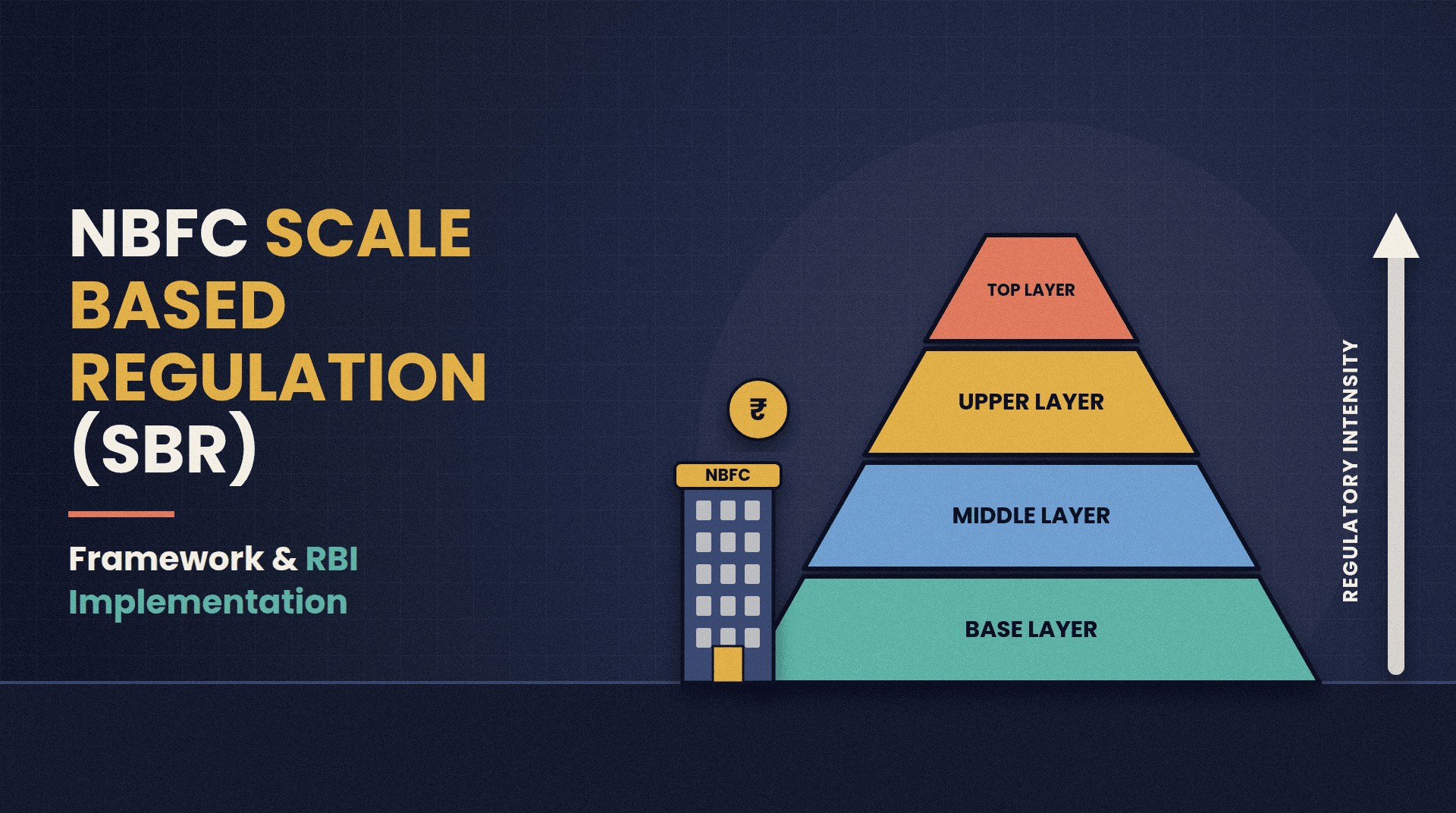
NBFC Scale Based Regulation (SBR) Framework RBI implementation
The objective was to make regulatory intensity broadly proportionate to the size, complexity and perceived risk of an NBFC.The framework became operational from 1 October 2022, while certain individual requirements had separate implementation timelines. The Upper Layer was designed for NBFCs considered to warrant enhanced regulatory requirements.

Online Gaming - Promotion and Regulation of Online Gaming Act, 2025 (Act No. 32 of 2025)
the Promotion and Regulation of Online Gaming Rules, 2026. Enacted by the Parliament of India under the purview of the Ministry of Electronics and Information Technology (MeitY), this legislation marks a complete paradigm shift transitioning India from an era of fragmented, state-level anti-gambling statutes and contested judicial 'skill versus chance' jurisprudence into a unified, centralized, strict regulatory regime.
Digital Competition Bill: Ex-Ante Regulation of Big Tech in India
The Indian Digital Competition Bill (DCB) is a paradigm shift in regulation from ex-post to ex-ante regulation, regulating "Systemically Significant Digital Enterprises" (SSDEs), which offer core digital services. The regime adds to the existing Competition Act of 2002 (amended in 2023)1 by introducing pre-determined conduct rules for large digital platforms before any anti-competitive injury is done.