

The New Income Tax Act, 2025 — Implementation & Transition from the Income-tax Act, 1961; Income-tax Rules, 2026; and CBDT Transition Clarifications
Credit: -Shashwat Prashar
6 Oct 2026 14 min read
- Introduced
- 6 Oct 2026
1 Executive Summary
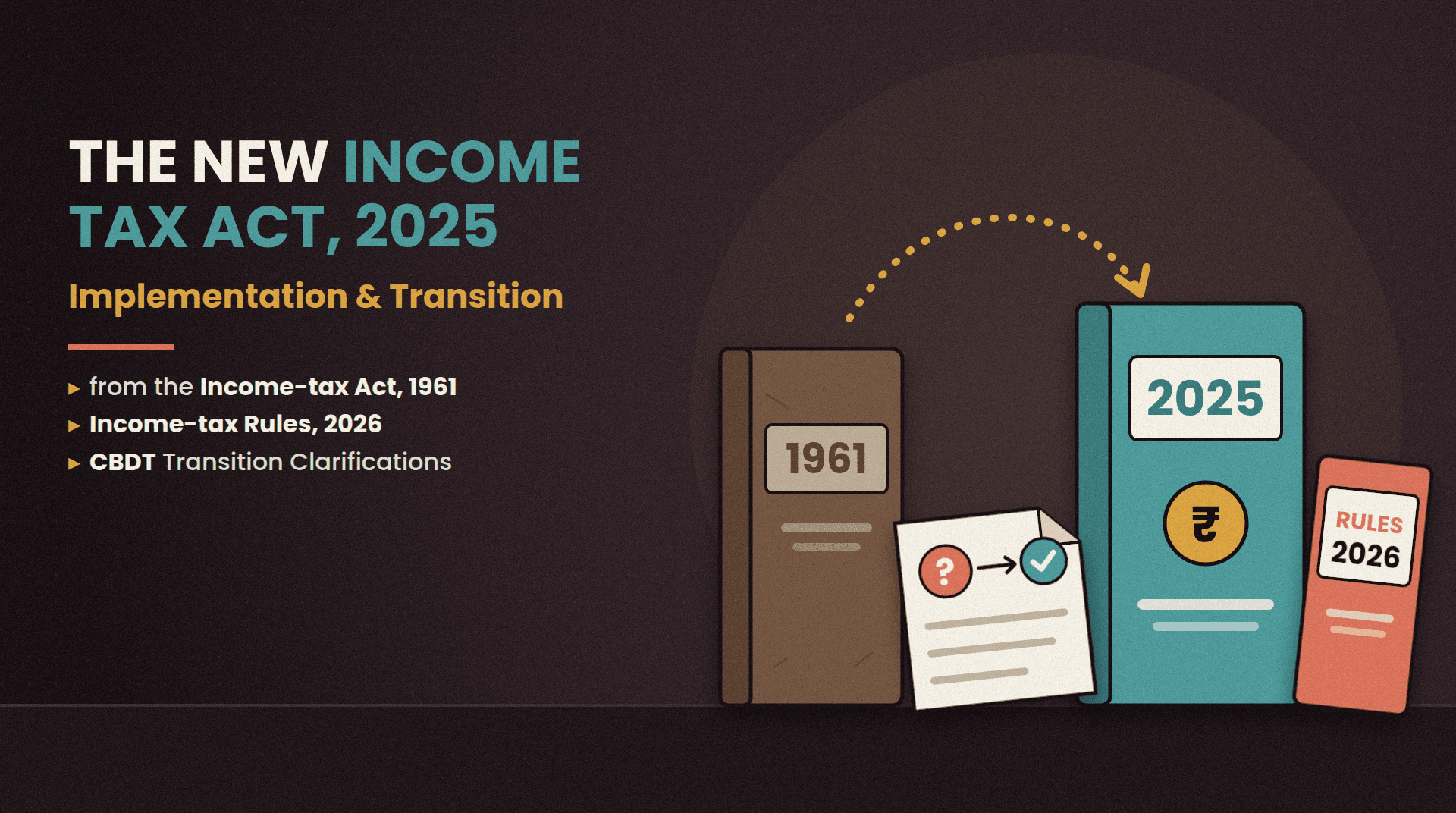
It may be noted that the tax law of India with respect to income tax has had its first ever overhaul since the country gained its independence. The old Income-tax Act, 1961 has been rendered void with effect from 1 April 2026 and has been replaced by the new Income-tax Act, 2025 along with new Income-tax Rules, 2026. The overhaul in question is essentially one of structure without any substantive change in the rates, tax base, and other definitions, although there are changes with respect to numbering, draft structure, and a number of procedural mechanisms involved. This process is being handled through an elaborate statutory saving provision in Section 536, together with extensive guidance in the form of CBDT FAQs, among others.
2 Baseline, The Income-tax Act, 1961 (Pre-Repeal Position)
Parent statute: Income Tax Act, 1961 (Act 43 of 1961), assented to on 13th September 1961, and came into effect from 1st April 1962. This act consolidated the laws regarding income tax and super tax and repealed the Indian Income Tax Act, 1922.
Regulator/Administering authority: Central Board of Direct Taxes (CBDT), under the Ministry of Finance (Department of Revenue).
Structure before repeal: Approximately 819 provisions through 47 Chapters and 14 Schedules, augmented through nearly 4,000 amendments in the span of six decades, were administrated by Income-tax Rules, 1962.
Objective of reform: Announced in Budget July 2024 was a time-bound comprehensive review to make the Act concise and lucid for easy reading while maintaining the tax policy and rate without any increase in compliance cost.
3 Legislative & Regulatory Timeline
Date | Event |
|---|---|
13 Feb 2025 | Income Tax Bill, 2025 is tabled in Lok Sabha and referred to a Select Committee comprising 31 members, headed by Member of Parliament Baijayant Panda. |
21 Jul 2025 | Select Committee places its report before the Lok Sabha – approximately 285 recommendations (around 84 substantial recommendations and 201 corrections to draft). |
8 Aug 2025 | Original Income-tax Bill, 2025 formally withdrawn by the Finance Minister to allow a single consolidated redraft. |
11 Aug 2025 | Income-Tax (No. 2) Bill, 2025 introduced and passed in Lok Sabha without discussion, accepting most recommendations made by Select Committee. |
12 Aug 2025 | Bill passed by Rajya Sabha. |
21 Aug 2025 | Presidential assent received; Act notified as the Income-tax Act, 2025 (Act 30 of 2025). |
20 Mar 2026 | CBDT notifies the Income-tax Rules, 2026 (Notification No. 22/2026), replacing the Income-tax Rules, 1962. |
1 Apr 2026 | Income-tax Act, 2025 and Income-tax Rules, 2026 come into force; Income-tax Act, 1961 and Rules, 1962 stand repealed (subject to savings). |
16 Apr 2026 | CBDT Notification No. 64/2026 corrects 76 drafting errors across Rules 165–243 of the 2026 Rules. |
~Jul 2026 | CBDT comes up with a detailed (~99-page) FAQ on the interface/transition from one Act to the other, dealing with return, payment, refund, form and reassessment. |
15 Aug 2026 | Supplementary FAQs are issued by CBDT for the Section 536 (Repeals & Savings) with respect to summons, search proceedings, transfer of jurisdictions, penalty and exemptions. |
17 Sep 2026 | CBDT issues Notification No. 120/2026 – Income-tax (Fourth Amendment) Rules, 2026 – amending recovery, valuer registration, and electronic communication rules; partially retrospective from April 1, 2026. |
4 Key Structural Changes Introduced (What Changed, Beyond Renumbering)
Re-codification is clearly what the reform is, not re-taxation; this has been stated time and again by the CBDT and the finance ministry that tax rates, slabs, exemption limits, and the entire tax base remain the same. The 2025 Act does nothing except restructuring, consolidation, and digitization of the same policy. The main structural changes include:
Single "Tax Year" concept: Dual “Previous Year” and “Assessment Year” system of the Act of 1961 is now replaced by a single “Tax Year”. This will come into effect from Tax Year 2026-27 onwards; income earned till 31 March 2026 will still be referred to as “Previous Year/Assessment Year income” through the savings clause.
TDS/TCS consolidation: Approximately 30-60 different TDS sections in the 1961 Act (from Sections 192 to 194T) pertaining to separate types of payments (like 194C contractors, 194J professional fees, 194I rent, 194Q electronic commerce, etc.) have been clubbed in a single table form Section 393 (TDS) based on numeric codes of the payment/nature (approximately from 1001 to 1067). The TCS provisions have been rewritten in Section 394 (instead of 206C). Definitions which used to be part of separate TDS sections have now been placed in Section 402 (Definitions). Rate and threshold values remain the same. The only change is in the citation/reporting system. Section 194LD has been repealed after 31 March 2026. New numbering of TDS/TCS return forms (e.g., Form 143 for Form 27EQ).
Deduction provisions regrouped: Deductions which were dispersed in Chapter VI-A and other portions of the 1961 Act have been arranged in simpler sections; the deduction for NPS, health insurance and other such benefits remains available, with the change being in the section number only.
Virtual Digital Assets (VDAs): The definition of VDAs (cryptocurrencies, NFTs, etc.) has been revised and refined, and VDA transactions have been specifically included in the TDS payment code table.
Digital-first, faceless administration: The Act enshrines the use of the “digital first” and “faceless” process as the primary means of administering the Act (as opposed to a “delegated scheme” sitting above a paper-based Act), as a continuation of the Faceless Assessment Scheme previously provided for in Section 144B).
Simplified charging and dispute-resolution provisions: Simplification of the charging provisions is another reform, and the Act unifies the assessment, appeal, and alternative dispute resolution provisions in order to minimize litigations – one of the objectives of the reforms since the previous Act led to a huge number of tax litigations during the years.
Faster processing, reduced penalty for late filing: The Act facilitates a speedy process of return filing and reduces/remove some of the penalties imposed in case of delay in filing tax returns, as part of the taxpayer-friendly approach outlined in the Statement of Objects and Reasons in the Act.
In addition to this, the Income Tax Department has also issued an official section mapping tool that assists individuals to map the old sections under the 1961 Act with the new sections under the 2025 Act in light of how vital this process is to the challenge at hand.
5 Rules, Forms & Subordinate Legislation
Income-tax Rules, 2026 (Notification No. 22/2026, G.S.R. 198(E), dated 20 Mar 2026): subordinate legislation made pursuant to Section 533 of the 2025 Act; which became effective with the Act on 1 April 2026 and will replace the Income-tax Rules, 1962 completely.
Corrigendum — Notification No. 64/2026 (G.S.R. 286(E), 16 Apr 2026): corrects 76 errors in the drafting and typesetting (including definitions and references for transfer-pricing methods) within Rules 165-243.
Income-tax (Fourth Amendment) Rules, 2026 — Notification No. 120/2026 (G.S.R. 822(E), 17 Sep 2026): eliminates tax recovery through arrest/detention under Rule 225, improves the disclosure guidelines for Registered Valuers, amends Forms 169 and 171, and moves the valuer/practitioner registration compliance period up to 31 March 2027. Adopted through the two-tiered application process – some of the sub-rules being applicable retrospectively from 1 April 2026, and the others from gazettal onwards.
Periodic notifications: The CBDT is continuously coming out with numbered notifications during the year (Notifications Nos. 114 & 121 of 2026) providing guidance about the form and procedure (for example, registration of reporting entities under Rule 160 (Form 98) and TDS on non-resident transactions on property (Form 132 & 141)) to implement certain provisions of the new Act.
Saved subordinate instruments: In accordance with 536(2)(j), all circulars, notifications, instructions, and approvals made under the 1961 Act will remain valid to the extent that they are not inconsistent with the 2025 Act, preventing regulatory void.
6 Implementation & Rollout Status
Current status: Since 1st April 2026 for the Tax Year 2026-27 onwards; the notions of “Previous Year” and “Assessment Year” have been combined as one “Tax Year.”
Dual track / transition window: Income and other proceedings for periods prior to 1 April 2026 remain wholly covered under the provisions of the 1961 Act, while there is no dual filing system; every year will have one filing process, according to the applicable law (CBDT has specifically stated that there is "no missing year and no overlap").
Pending proceedings: Proceedings initiated as of 1 April 2026 shall continue under the 1961 Act while refund cases or defaults from 1 April 2026 relating to the pre-transition period shall be governed by the 2025 Act during the post-transition period.
Protective/limitation clause: If the deadline for applying, appealing, making references or revising had expired by 1 April 2026, then the 2025 Act will not extend the deadline merely on account of its extending the limitation period.
Extended compliance deadlines: Registration Deadline for Registered Valuers and Authorised Income-tax Practitioners Extended till 31st March 2027 (Notification No. 120/2026); Similarly Reporting Norms for TDS on Non-Resident Property Transactions.
Continuity of schemes: The existing schemes (such as the "faceless assessment scheme") will go on unabated and will be considered to have been made pursuant to the relevant 2025 Act provision or, in its absence, Section 532.
7 Enforcement, Compliance Actions & CBDT Clarifications
CBDT has adopted an FAQ-driven approach rather than case-by-case enforcement orders during the transition year, given the absence of any change in the tax base:
July 2026 Transition FAQ (~99 pages, 10 thematic parts): This includes general philosophy on transition, tax payable or refund, return, forms, assessment, TDS, appeal/review/ADR, set off and carry forward of losses, non-resident provisions, and miscellaneous matters. It is clarified that PAN, TAN, and existing TDS certificates are still valid without being reissued.
15 August 2026 FAQ on Section 536 (Repeals & Savings): released by the TPL Division in response to practitioner consultations; provides guidance on summons (deemed to fall under the savings provision), searches and post-search actions, information requests (TEP/STR/CRS/FATCA), transfer of jurisdiction, recovery, prosecution, and ongoing 12AB/80G and low/nill deduction certificate applications.
Compliance-system impact: It has been pointed out by practitioners that challans submitted for TDS from 1 April 2026 onwards should include the new section numbering system; wrong section numbers may cause delays in credit of deductees.
No new enforcement/penalty regime: The CBDT has clarified several times that the 2025 Act has no new tax element or any increased penal provision; rather, the revised provisions are basically the same as that in the 1961 Act, but only in simpler form. For example, the CBDT has made public clarifications that the interest provisions of Section 234A/234B/234C are separate from penalty provisions, which has been kept the same in the new Act.
Compulsory scrutiny guidelines (4 June 2026, Circular F.No.225/56/2026/ITA-II): issued under Section 536(2)(c) of the 2025 Act (following the annual compulsory scrutiny guidelines tradition of the 1961 Act period), which specifies that which categories of returns for FY 2026-27 are subject to compulsory scrutiny of the entire return — such as those involving search/requisition under (former) Section 132, survey under Section 133A, and those having verified tax evasion intelligence from law enforcement or regulatory authorities. Routine cases detected solely through AIS/SFT/NMS/CPC-TDS mismatch alerts are explicitly excluded from compulsory scrutiny unless they satisfy the tax evasion condition on their own.
Continuity of the Faceless Assessment Scheme: The NaFAC continues its assessment processes electronically, with no need for any person’s presence, now directly incorporated in the 2025 Act as opposed to being a delegated scheme under the erstwhile Section 144B; the escalation procedure remains unaltered (Verification Unit referral where there is no digital trace of a case or where physical verification is required). Cases involving international taxation and the Central Circle continue to be exempt from the faceless system.
8 Judicial & Legislative Challenges
While no constitutional challenge to the Income-tax Act, 2025, per se, has been recorded as yet, a related issue, viz., that of the reassessment regime during the transition period is now pending in the Supreme Court and different High Courts:
Section 147A reassessment jurisdiction dispute: The Punjab & Haryana High Court decision (July 19, 2024, on the basis of the 1961 Act scheme) had declared that the division of power between the JAO and the NFAC in the reassessment jurisdiction scheme was unlawful. This was contested in the Supreme Court via Special Leave Petition.
Retrospective legislative response: Before the conclusion of the SLP, Section 147A was introduced retrospectively with effect from 1 April 2021 through the Finance Bill, 2026 – legislation adopted in response to the judicial decision and not waiting for its final resolution.
Supreme Court remand (10 Apr 2026 / 15 May 2026 orders): Considering the newly amended Section 147A, the Supreme Court has held that the impugned judgment of the High Courts needs to be set aside and has ordered that the matter be remanded to the respective High Courts. It has been left to the discretion of the assessee to file an amended writ petition with regard to the legality of Section 147A.
Centre's fresh SLP (Sep 2026): The Centre has since moved the Supreme Court after at least one High Court struck down Section 147A, seeking an urgent hearing; the matter concerning the JAO/NFAC jurisdictional split remains sub judice as of the reporting date.
Since this case involves the reassessment process that is applicable to the transitional provisions of the new legislation, the results of this case have an impact on the treatment of reassessment notices during the 2025-2027 transition period.
9 Comparative Analysis
The Income-tax Act, 2025 follows the same rule of repeal and saving as other Indian statutory re-codifications which are currently being undertaken through the repeal and saving approach provided in the General Clauses Act, 1897 (Section 6). According to the repeal and saving rule, there is no intention of changing the existing rights, liabilities, and proceedings unless stated otherwise. The GST (appellate tribunal scheme) and the Companies Act scheme are current examples of the trend.
International comparator: The method is similar to that adopted in the Tax Law Rewrite Project in the United Kingdom (1996-2010), where income tax, corporation tax, and other related tax laws were rewritten only for purposes of clarity and organization without any changes to tax policy—a precedent cited by Indian commentators in analyzing the impact of the 2025 Act.
ERP/compliance-system angle: Due to the fact that the reform is based on a code, not policy, the primary practical effect of the reform has been felt by accounting and payroll software (Zoho Books, Tally, and other ERP tools), which have had to re-categorize TDS/TCS section codes, obsolete old sections post March 31, 2026, and re-issue their form templates, demonstrating the potential for risk created by a mere structural reform.
10 Evolution — How the Law Reached Its Current Form
The Income Tax Act, 1961 had been used as the basis of direct taxation in India for more than 60 years and during that period collected more than 4,000 amendments, thus resulting in structural disintegration. Time-bound review of this law was envisaged in the budget for July 2024. The first attempt through legislation came with the introduction of the Income-tax Bill, 2025 on 13 February 2025. Subsequent to the July 2025 recommendations of the Select Committee with respect to about 285 amendments, the government found it easier to scrap the original Bill on 8 August 2025 and introduce a fresh consolidation under Income-tax (No. 2) Bill, 2025 on 11 August 2025. This new Bill passed the Houses in quick succession and was given assent on 21 August 2025, and became the Income-tax Act, 2025 – taking down the legislation from its earlier 819 sections/47 chapters to 536 sections/23 chapters/16 schedules, but not changing anything in the rates of taxes, the basis of taxability and majority of the definitions. The implementation of the Income-tax Act, 2025 was achieved through the Income-tax Rules, 2026 (notified on 20 March 2026, clarified in April 2026 and amended again in September 2026) and became effective from 1 April 2026. This repealed the earlier 1961 Act and 1962 Rules with savings provisions and CBDT FAQs on transitional provisions.
11 Outlook
Amending activity under the CBDT rules will continue until FY 2026-27 as practical considerations arise (as was evident from the Fourth Amendment Rules of September 2026).
Reassessments under Section 147A are an important consideration for monitoring – the outcome of this litigation, which is expected on an accelerated time frame, will establish the validity of notices issued during the transition period.
Concessions in terms of further extensions of compliance and registration deadlines (for valuers and practitioners) are very possible, in light of the precedents set by the 31 March 2027 extension.
Finance Act 2026 and subsequent Finance Acts will henceforth amend the 2025 Act directly and not the repealed 1961 Act, rendering the 2025 Act the only document for future direct-tax legislation monitoring.
Credit: -Shashwat Prashar
More tracked legislation

EV & BATTERY Regulation in India
India's EV policy began with an approach that treated electric and hybrid mobility as a national industrial and transport question. The National Mission for Electric Mobility was approved in 2011, followed by the National Electric Mobility Mission Plan 2020, launched in January 2013. The Plan was intended to create a long-term path for adoption, domestic capability, research and development, testing, charging and supply-side support.
Indian Space Policy 2023
Indian model was transformed from a policy fragmented, state dominated model to a commercially open, institutionally separated and more procedural regime. The 2017 draft was an early attempt at enacting the entire sector at once. That effort stalled. The 2020 reforms, on the other hand, allowed for participation by the private sector, and ISP 2023 provided a detailed policy framework around IN-SPACe.
NBFC Scale Based Regulation (SBR) Framework RBI implementation
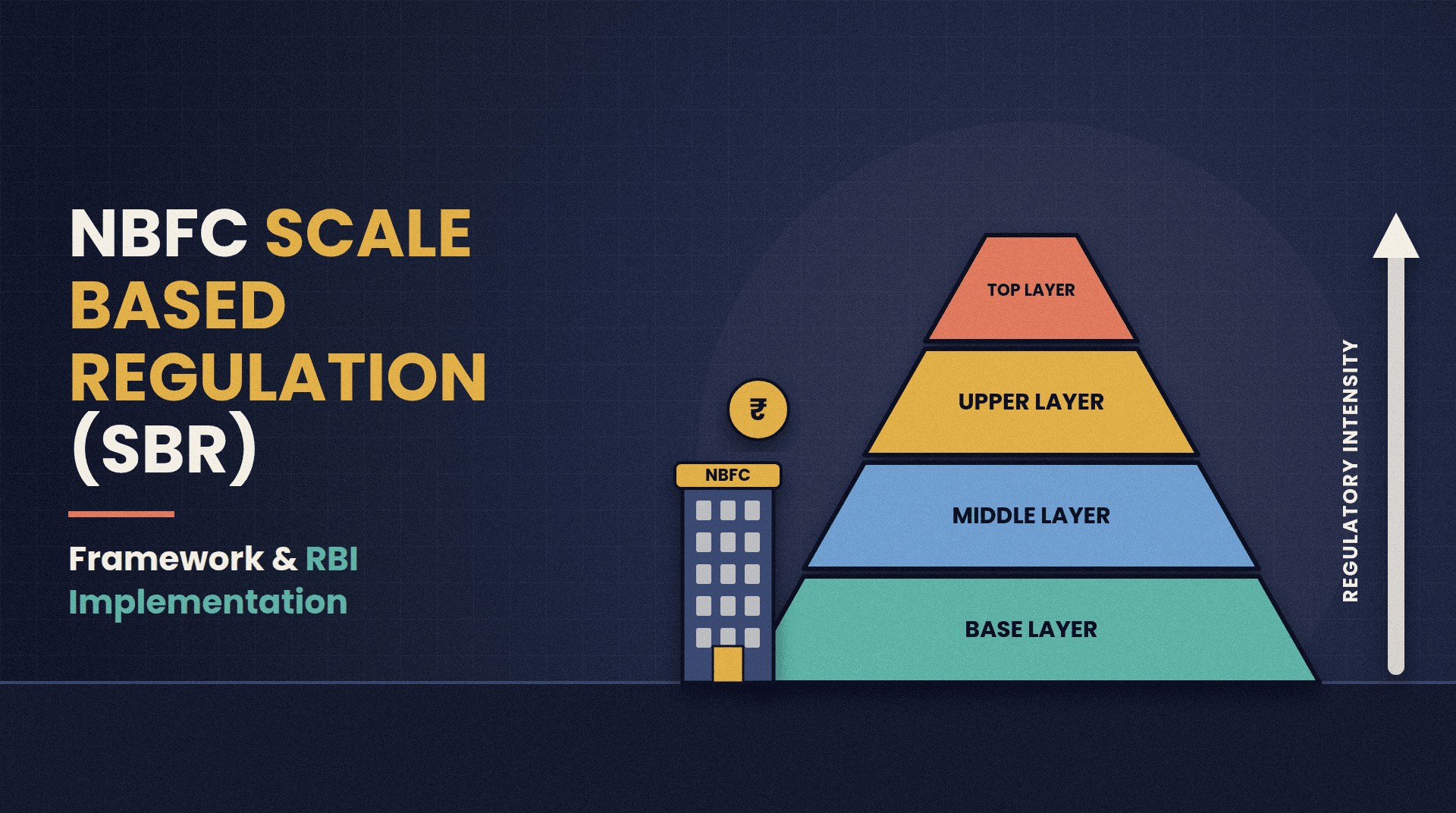
The objective was to make regulatory intensity broadly proportionate to the size, complexity and perceived risk of an NBFC.The framework became operational from 1 October 2022, while certain individual requirements had separate implementation timelines. The Upper Layer was designed for NBFCs considered to warrant enhanced regulatory requirements.