

Bail as the Rule,Jail as the exception:Regular,Default and anticipatory Bail under the Bhartiya Nagrik Suraksha Sanhita,2023
Anas Ahmad and Mohammad Sufaid
7 Nov 2026 63 min read
- Decided
- 7 Nov 2026
Introduction
The idea that bail is rule and jail is the exception was started by the supreme court for the first time in clear terms State of Rajasthan v. Balchaand (1977) 4 SCC 308[Case1.1],and it has since become the starting point of every bail discussion. It is a rule that comes from Article 21 of the constitution. A person who is accused but not convicted is presumed innocent in taking away is liberty before trial can be justified only by the needs of the trail and of as punishment. The BNSS,2023 did not change this philosophy. It re-numbered and in some places re-worded the provisions of the CRPC, but the courts continue to read them in the light of the cases decided under the old code. This memo deals with five questions ,the factors for regular bail and the duty to give reasons(Q1),default bail under Section 187(3)(Q2),anticipatory bail under Section 482 (Q3),the rights of under trail prisoners under Section 479(Q4) and the law on cancellation of bail and the twin conditions in special statutes(Q5).A Cordance of the old and new section numbers is given before this memo.
The principle that “bail is the rule and jail is the exception”,factors for regular bail under sections 480 and 483,and the need to record reasons
(a)The Principle
In Blachaand [Case 1.1] Krishna Iyer J. held that the basic rule is bail and not jail, except where there are circumstances suggesting that the accused will flee from justice, interfere with the course of justice or repeat the offence. In Gudikanti Narasimhulu v. Public Prosecutor(1978) 1SCC 240[Case1.2],the court added that deprivation of liberty before the trail is a serious matter touching Article 21 and that is must be shown to be necessary. In Sanjay Chandra v. CBI(2012) 1 SCC 40[Case 1.5],the court said that the object of bail is to secure the attendance of the accused at trail and that detention before conviction should not become a punishment. This was reaffirmed in Manish Sisodia v. Directorate of Enforcement,2024 INSC 595 [Case 1.7],where the court said the principle holds good even in cases under special laws such as the PMLA and that courts should not play ‘play safe’ by refusing bail in appropriate cases.
(b) The statutory frame
Section 480 BNSS(formerly Section 437 CrPC) deals with bail is non-bailable offences when the accused is before a Magistrate or a court other than the High Court or the Court of Session. Bail should not be granted where there is appear reasonable grounds for believing that the accused has been guilty of an offence punishable with death or life imprisonment ,or where he earlier been convicted of certain serious offences, but the proviso allowed release of a person under sixteen years,a woman,or a person who is sick or infirm.Section 480(3) allows condition to be imposed to secure attendance,to prevent the repetition of the offence and to prevent the accused from tampering with evidence.Section 480(6) provides that where the trial of a non-bailable offence before,before a Magistrate is not concluded within sixty days from the first date fixed or takin evidence,the accused who has been in custody throughout shall ordinarily be released on bail.Section 483 of BNSS (formerly Section 439 CrPC ) gives special powers to the High Court and the Court of Session to grant bail to impose or modify conditions and to cancel bail already granted[see Section 483(3)].
(c) Factors a court must weigh
Putting together Gudkanti [Case 1.2],Kalyan Chndra Srakar v. Rajesh Ranjan(2004)7 SCC 528[Case1.4],Sanjay Chandra[Case1.5] and Mhipal v.Rajesh Kumar,(2020) 2 SCC 118 [Case 1.6] the following considerations come out.
1 The nature and the gravity of the accusation and the seriousness of the punishment on conviction.Gravity is relevant ,but it cannot be the only ground(Sanjay Chandra).
2 The nature and strength of the prima facie material.Adetained appraisal of evidence is not done,the court must be satisfied then there is prima facie case (Kalyan Chandra Sarkar).
3 The liklihood of the accused absconding or being unavailable for trial.
4 The danger of tampering with evidence or threatening or influencing witnesses and the complainant.
5 The likelihood of the accused absconding or being unavailable for trial.
6 The danger of tampering with evidence or threatnening or influencing witnesses and the complainant.
7 The likelihood of repeating the offence and the criminal antecedants,character,standing and circumstances of the accused.
8 The danger of justice being thwarted and the larger interest public and the state (Gudkanti).
9 The length of custody already undergone and the likely time the trial will take,which are relevant under Article 21(Sanjay Chandra,Sisodia).
(d) Must the order record reasons?
Yes,In Kalyan Chandra Sarkar[Case1.4] the Supreme Court held that although elaborate reasonsare not needed at the bail stage,since detailed discussion of evidence may prejudice the trial,the order must show the application of mind.A cryptic order that grants bail in a serious bcse without any reason is liable to set aside.Mahipal [case1.6] applied this and set aside a bail order that does not show that relevant considerations were weighted.The same duty applies to an order refusing bail,because a refusal also effects liberty.The result is that reasons must be recorded in both directions,bried but real.
Default (statutory) bail under Section 187(3)BNSS 9 (formerly Section 167(2) CrPC)
(a)The Provision
When a person is arrested and the investigation cannot be completed in twenty-four hours,he is produced before the Magistrate,who may authorise his detention.Under Section 187(3) the total period of detention(judicial and police)during investigation cannot exceed ninety days where the offence is punishable with death,life imprisonment or prisonment for 10 years or more and sixty days in other cases.On expiry of the period of accused ‘shall be released on bail if he is prepared to and does furnish bail’.The BNSS also lays down that police custody,up to fifteen days in all,can be authorized only within forty or sixty days of the sixty or ninety day period respectively,so that the period of investigationis not stretched by late requests for police remand.
(b)Is it undefeasible right?
The Supreme Court calls it an ‘indefensible right’.The Constitution Bench in Sanjay Dutt v. State(1994) 5 SCC 410 [Case 2.2],held that right accures when the priod expires without a charge-sheet and withot a valid extension,and that is linked to Article 21.Rakesh Kumar Paul v.State of Assam(2017) 15 SCC 67[Case 2.4],stresses that the provision is to be read in favour of liberty and by a majority,fixes 60 days (not 90) where the punishment is 10 years and there is no minimum of 10 years.Section 187(3) BNSS now uses the words ‘ten years or more’ in more’in place of ‘not less than ten years’ and the Karnataka High Court has read this as a minimum-threshold test,a view that the Supreme Court declined to interfere with Bikramjit Singh v. State of Punjab (2020) 10 SCC 616 [Case 2.5] went further and held that default bail is not only a statutory right but part of the procedure established by law under Article 21,so that it is fundamental right once the condition of the proviso are met and that the application need not even be in writing M.Ravindran v. Intelligence Officer,DRI (2021) 2 SCC 485[Case2.6] holds that the prosecution cannot defeat the right of filing a final report,additional complaint or request for extension after the accused has applied.
(c)When is it lost?
The right is undefeasible only in the sense that the prosecution cannot taken away by its own act after the accused has availed of it.It is lost if the accused does not apply for bail before the charge-sheet is filed.Sanjay Dutt[Case 2.2] held that after the filing of charge sheet the right is extinguished and the accused has to apply for regular bail on merits.Uday Mohanlal Acharya v. State of Maharastra (2001) 5 SCC 453 [Case 2.3] explained that rights is availed once accused filed an application and offers to furnish bail,even if the court has not decided the application and the bail has not been furnished.M.Ravindra[Case 2.6] holds that a later charge sheet,additional complaint or application for extension does not defeat the right of an accused has already applied,but the actual release depends on court’s direction on the accused being willing to furnish bail.
(d)Effect of an incomplete charge-sheet or a request for extension of time
A request for extension of time must be made before the period of expires,on a report of the Public Prosecutor showing progress of the investigation and specific reasons for further detention,and it must be decided by the competent court after notice to the accused.In Bikramjit Singh[Case 2.5] the extension from 90 to 180 days under the UAPA had been granted by a Magistrate;The Supreme held that only the session court of the Special court is ‘the Court’ that can extend time ,so the extension was without jurisdiction and the accused,who had applied on expiry of 90 days,was entitled to default bail.As for complete charge-sheets,the traditional position is that a charge-sheet filed within time,even if further investigation continues under section 193(3)BNSS (formerly Section 173(8) CrPC,extinguishes the right.In Ritu Chabra v.Union of India (26 April 2023,2023 LiveLaw (SC) 352),a two Judge bench(Krishna Murari and C.T.Ravikumar,JJ)held that a charge-sheet filed without completing the investigationonly to defeat default bail,does not extinguish the right.The Union then sought recall of the Judgement and bench headed by the chief Justice directed that default bail application should not be decided by relying on Ritu Chabaria while recall application was pending.A later decision of January 2024 (CBI v. Kapil Wadhwan) held that pendency of further investigation against other accused or for some documents does not make a charge-sheet ‘incomplete’ so as to give default bail.So Ritu Chabaria cannot safely be treated as settled law and should be cited only with history.
Anticipatory bail under Section 482(formerly Section 438 CrPC)
Section 482 allows a person who has reason to believe that he may be arrested on an accusation of a non-bailable offences to the high court or Court of Session for a direction that he be released on bail in the event of arrest.The leading case is Gurbaksh Singh Sibbia v. State of Punjab(1980) 2 SCC 565[Case3.1] where a constitution Bench held that the section must be read liberally in the light of Article 21 and refused to read into it restrictions such as the rule that is to be used only in exceptional cases.
(a)Can it be limited in time?
As a rule no. Sibbia [Case 3.1] said that there is no need to limit the order to a short period.Later Salauddin Abdulsamad Sheikh v.State of Maharastra(1996) 1 SCC 667 ,took the view that anticipatory bail should be limited period after which is accused should seek regular bail,and some later decisions followed it.Siddhiram Satingappa Mhetre (2011) went that other way and said that the life of order cannot be curtailed.The constitution Bench is Sushila Aggarwal v.State (NCT of Delhi),(2020) 5 SCC 1 [Case 3.5],rejected both extremes;the protection should not be invariably be limited or fixed period,but the court may limit it or tie it to an event,where specific facts or features of the offence call for it.Salauddin and the cases following it were overruled.
(b) Can it be made subject to condition?
Yes,Sibbia and Sushila Aggarwal both accepts that conditions can be imposed,in line with those for regular bail under Section 480(3)(for example,co operating with the investigation,not leaving the country,not contacting the witnesses).The conditions must be reasonable and connected with the facts and they should not be so onerous,that they defeat the protection .Siddhiram Sttingappa Mhetre v. State of Mmaharastra(2011) 1 SCC 694[Case3.2] gives a lsit of factors for thr exercise of the discretion but it was overruled in Sushila Aggarwal to the extent it held that no restrictive conditions at all can be imposed,so that it should be cited only for the factors.
(c)Does it continue till the end of the trial?
In Sushila Aggarwal[Case3.5], it can.The order does not normally nd when the accused is summoned or charges are framed ,and it can continue till the end of the trial,until the court foe special or peculiar features limits it, or it is cancelled or set aside.The Constitution Bench also said that the police can move the court that granted the order for the direction under Section 439(2) CrPC(now Section 483(3) BNSS) if the accused violates a condition,absconds,or intimatdates witnesses.
(d)Can it be granted after the charge-sheet is filed?
Yes. Sibbia (para 38) said that anticipatory bail can be granted even after an FIR is filed so long as the applicant has not been arrested, and the Constitution Bench in Sushila Aggarwal (para 7.1 of the lead judgment) said that an application can be moved before the FIR, after the FIR while the investigation is going on, or even after the investigation is concluded. The court will of course look at the material in the charge-sheet when it considers whether to grant it. The BNSS has carried the language of Section 438 into Section 482 with only limited changes, so the decisions under the CrPC are still valid. Some special statutes expressly bar anticipatory bail (for example, Section 43D(4) UAPA and Section 18 of the SC/ST (Prevention of Atrocities) Act), and in such cases the bar must be considered along with Article 21.
Rights of undertrial prisoners under Section 479 BNSS (formerly Section 436A CrPC)
(a) The provision
Section 479 provides that an undertrial prisoner (other than one accused of an offence punishable with death or life imprisonment) who has been detained for a period extending up to one-half of the maximum imprisonment specified for the offence shall be released on bail by the court. The BNSS adds a special provision for a first-time offender, that is, a person who has never been convicted of any offence in the past:he is to be released on bail after he has undergone detention for one-third of the maximum period. Under Section 479(2), the benefit is not available where more than one investigation, inquiry or trial is pending against the accused in other cases, and under Section 479(3) the Superintendent of the jail must make a written application to the court once the accused becomes eligible. The Act also contains provisos on continued detention for reasons recorded and on excluding delay caused by the accused, which should be read from the text of Section 479(1).
(b) Constitutional background and directions of the Supreme Court
The statutory right is rooted in Hussainara Khatoon (I) v. Home Secretary, State of Bihar, (1980) 1 SCC 81[Case 2.1], which held that speedy trial is part of Article 21 and ordered the release of undertrials who had been in jail for periods longer than the maximum sentence for their offences. Section 436A was added to the CrPC in 2005. In Bhim Singh v. Union of India, (2015) 13 SCC 605, the Court directed Magistrates and Sessions Judges to identify and release undertrials who completed half the maximum sentence, and to monitor the matter. In Satender Kumar Antil v. CBI, (2022) 10 SCC 51 [Case 2.7], the Court classified offences into four categories (A to D) and prescribed the approach to bail for each: for offences punishable up to seven years,arrest should be exceptional and bail ordinarily given; for offences punishable with death or life, ordinary bail principles apply; for special statutes with stringent conditions the conditions must be met; and economic offences outside the special statutes are considered separately. It directed that bail applications should ordinarily be decided within two weeks and anticipatory bail applications within six weeks, except where the statute provides otherwise, and that Section 436A be implemented fully. The Court also asked the Union to consider enacting a separate Bail Act. After the BNSS came into force, the Supreme Court in In Re: Inhuman Conditions in 1382 Prisons, WP (C)No. 406 of 2013, order dated 23 August 2024 [Case 2.8], held that Section 479 BNSS is beneficial and applies to all undertrial prisoners in pending cases regardless of the date of registration of the FIR, and directed jail authorities to identify eligible prisoners and put their cases before the courts.
Cancellation of bail, setting aside of a bail order, and twin conditions underspecial statutes versus the right to a speedy trial under Article 21
(a)Cancellation versus setting aside
Cancellation of bail means that bail which was validly granted is withdrawn because of events after the grant.Under Section 480(5) and Section 483(3) BNSS (formerly Sections 437(5) and 439(2) CrPC) a court can direct that a person released on bail be arrested and committed to custody. The usual grounds are misuse of liberty, tampering with evidence or witnesses, threatening the complainant, committing a fresh offence,absconding, or breach of the conditions. Dolat Ram v. State of Haryana, (1995) 1 SCC 349 [Case 1.3], holds that very cogent and overwhelming circumstances are needed for cancellation, that refusal of bail at the initial stage and cancellation are two different matters, and that the recognised grounds are interference with the course of justice, evasion of justice, abuse of the concession and the possibility of absconding.Setting aside an order granting bail is different. Here the court (usually an appellate court or the High Court)does not rely on supervening events but holds that the order itself is bad, for example because it is perverse,ignores relevant material, is not supported by reasons or relies on irrelevant factors. Mahipal v. Rajesh Kumar[Case 1.6] explains the difference clearly: the test for cancellation is misconduct or supervening circumstances, and the test for setting aside is the legality and propriety of the original order. The Constitution Bench in Sushila Aggarwal [Case 3.5] likewise said that setting aside an order granting bail for non-consideration of material facts does not amount to ‘cancellation’ under Section 439(2). Kalyan Chandra Sarkar [Case 1.4] is an example of setting aside for want of reasons. Deepak Yadav v. State of U.P., (2022) 8 SCC 559, adds that cancellation is not confined to supervening circumstances, so the line between the two is not rigid.
(b) Twin conditions in special statutes
Several special statutes restrict bail by ‘twin conditions’: Section 45 PMLA (court must be satisfied that there are reasonable grounds for believing that the accused is not guilty and that he is not likely to commit any offence on bail), Section 37 NDPS Act, and Section 43D(5) UAPA (bail to be refused if, on the case diary and the charge-sheet, there are reasonable grounds for believing that the accusation is prima facie true).Nikesh Tarachand Shah v. Union of India, (2018) 11 SCC 1 [Case 3.3], struck down the then Section 45(1) PMLA as arbitrary; the section was amended in 2018 and later upheld in Vijay Madanlal Choudhary v. Union of India (2022). In UAPA matters, NIA v. Zahoor Ahmad Shah Watali, (2019) 5 SCC 1 [Case 3.4], set a strict test: the court must look at the totality of the material at face value and not weigh evidence.
(c) How the twin conditions yield to Article 21
Union of India v. K.A. Najeeb, (2021) 3 SCC 713 [Case 3.6], a three-Judge Bench decision (Ramana, SuryaKant and Bose JJ.), held that Section 43D(5) does not take away the power of constitutional courts to grant bail on the ground of violation of Part III, and that once a timely trial is not possible and the accused has suffered incarceration for a significant period, courts would ordinarily be obliged to grant bail. Vernon v. State of Maharashtra, 2023 SCC Online SC 885 [Case 3.7], read Watali so as to permit the court to examine the quality of the material and granted bail. Manish Sisodia [Case 1.7] applied the speedy-trial reasoning in a PMLA case. Satender Kumar Antil [Case 2.7] had earlier placed special statutes with twin conditions in a separate category (C), saying that the conditions must be satisfied but the court must still look at the liberty of the accused.
There is, however, a counter-line. In Gurwinder Singh v. State of Punjab, (2024) 5 SCC 403 [Case 3.8], the Court refused bail, treated Section 43D(5) as a rigorous standalone limitation and distinguished Najeeb as turning on its own facts. This line continued in Gulfisha Fatima v. State (Govt. of NCT of Delhi), 2026 INSC 2 (5 January 2026) [Case 3.9], where the Court granted bail to five accused but denied it to Umar Khalid and Sharjeel Imam, holding that delay is not a ‘trump card’. On 18 May 2026 another Division Bench (Nagarathna and Bhuyan JJ.) in Syed Iftikhar Andrabi v. NIA [Case 3.10] expressed serious reservations about Gulfisha Fatima and Gurwinder, holding that Najeeb, being a three-Judge Bench decision, binds smaller benches. On 22 May 2026, in Tasleem Ahmed v. State (NCT of Delhi) [Case 3.11], a Division Bench referred the question to a larger bench to be constituted by the Chief Justice. As of the sources we could find, that larger bench has not yet decided the matter, so the law is presently unsettled and the memo should be read with that in mind.
Conclusion
The cases show a steady line from Balchand to Sisodia in which liberty is treated as the norm. The BNSS puts the old law in a new numbering and adds a few new features, such as the one-third rule for first-time offenders in Section 479 and the stricter time structure for police custody under Section 187. The main open areas are: the exact scope of default bail where the charge-sheet is allegedly incomplete (Ritu Chhabaria and what followed it), the reconciliation of Najeeb and Vernon with Gurwinder and Gulfisha Fatima now before a larger bench, and the application of Section 479 to cases involving special statutes. These should be tracked a new decision come out.
Leading judgement are arranged chronologically within each category.Each is Digested on the same porforma.Ratio Decendi and obiter dicta are kept apart: the ratio is the rule is necessary for the decision,while the obiter column records remarks that carry only persuasive value.The year is the year of citation,as in the reporter.
Case 1: Regular Bail and cancellation of bail
Case 1.1
Case Name & Year | State of Rajasthan v. Balchand @ Baldev (1977) |
Citation & Coram | (1977) 4 SCC 308. Bench: V.R. Krishna Iyer, J. (Division Bench). |
Issue before the Court | Whether bail should ordinarily be granted to an accused in a non-bailable case, and what the true scope of the court's discretion is when the State challenges a bail order. |
Brief Facts | The Rajasthan High Court released the accused on bail in a serious criminal case. The State came to the Supreme Court contending that bail ought to have been refused because of the seriousness of the charge. The Court used the occasion to lay down the general approach to bail. |
Ratio Decidendi | The basic rule is bail, not jail. Bail can be refused only where there are circumstances suggesting that the accused will flee from justice, thwart the course of justice (e.g. by tampering with evidence or threatening witnesses), or commit further offences while at large. The gravity of the offence is relevant, but it is not by itself a ground to deny bail; the court must look at the whole picture, including the nature of the accusation, the severity of the punishment and the character of the evidence. |
Obiter Dicta | Krishna Iyer J. observed that refusal of bail is in effect a curtailment of personal liberty before conviction and must therefore be justified by the facts. He also commented on the social realities of poor accused persons who cannot furnish heavy sureties, a theme that he developed further in Gudikanti. |
Significance / Link to other cases in the list | The starting point of the modern bail jurisprudence. Every later case in this list (Gudikanti, Sanjay Chandra, Sisodia) quotes or builds on the 'bail, not jail' formulation first set out here. |
Case 1.2
Case Name & Year | Gudikanti Narasimhulu v. Public Prosecutor, High Court of Andhra Pradesh (1978) |
Citation & Coram | (1978) 1 SCC 240. Bench: V.R. Krishna Iyer, J. |
Issue before the Court | What considerations must guide a court deciding bail, and can personal liberty under Article 21 be curtailed before trial on the basis of the mere seriousness of the allegation? |
Brief Facts | The accused was refused bail by the Andhra Pradesh High Court and approached the Supreme Court under Article 136. The Court examined how the High Court had exercised its discretion. |
Obiter Dicta | The Court stressed that bail decisions should be made in a humane and socially sensitive way and that the ‘bail or jail’ question touches Article 21 even though the Code does not use constitutional language. It also criticised the practice of insisting on heavy money bonds from the poor. |
Significance / Link to other cases in the list | Builds directly on Balchand by converting the rule into a list of factors. Its factor-based approach is repeated in Kalyan Chandra Sarkar (2004) and Sanjay Chandra (2012). |
Case 1.3
Case Name & Year | Dolat Ram v. State of Haryana (1995) |
Citation & Coram | (1995) 1 SCC 349 (Supreme Court of India). Bench: to be added from the SCC report. |
Issue before the Court | Is the standard for cancelling bail already granted the same as the standard for refusing bail at the first stage, and on what grounds can granted bail be cancelled? |
Brief Facts | The accused persons had been granted (anticipatory) bail by the Additional Sessions Judge, Rohtak on 12 November 1993. The State of Haryana moved the Punjab and Haryana High Court for cancellation of that bail, the High Court cancelled it and the accused appealed to the Supreme Court. |
Ratio Decidendi | Rejection of bail in a non-bailable case at the initial stage and cancellation of bail already granted have to be considered and dealt with on different basis. Very cogent and overwhelming circumstances are necessary for an order directing cancellation of bail already granted. Broadly (the list being illustrative and not exhaustive) the grounds are interference or attempt to interfere with the due course of administration of justice, evasion or attempt to evade the course of justice, and abuse of the concession granted to the accused. Satisfaction of the court that the accused may abscond is another ground. Bail once granted should not be cancelled mechanically without considering whether supervening circumstances have made it no longer conducive to a fair trial to let the accused retain his liberty. |
Obiter Dicta | The Court observed that the court must be slow to take away a liberty already conferred and that cancellation cannot be used as a way of re-examining the original grant on the merits. |
Significance / Link to other cases in the list | First clear statement of the ‘cancellation is different from refusal’ principle used in Q5 of the memo. Relied on by the Constitution Bench in Sushila Aggarwal (2020) and developed in Mahipal v. Rajesh Kumar (2020) and Deepak Yadav v. State of U.P. (2022) 8 SCC 559. |
Case 1.4
Case Name & Year | Kalyan Chandra Sarkar v. Rajesh Ranjan @ Pappu Yadav (2004) |
Citation & Coram | (2004) 7 SCC 528. Bench: Division Bench of the Supreme Court. |
Issue before the Court | Must an order granting bail in a serious offence give reasons, and how detailed must they be? |
Brief Facts | The accused was charged in connection with the murder of a sitting MLA. The Patna High Court granted him bail by a short order. The complainant side challenged it in the Supreme Court, arguing that the High Court had not looked at the material. |
Ratio Decidendi | At the stage of bail a detailed examination of evidence and elaborate reasoning is not required, but the order must show that the court has applied its mind to the relevant considerations. An order granting bail in a serious case that is cryptic and gives no reason at all is liable to be set aside. Courts must not ignore the nature and seriousness of the offence, the prima facie material and the likelihood of tampering with evidence. |
Obiter Dicta | The Court cautioned that the observation of the court on merits at the bail stage should be brief so that the trial is not prejudiced. |
Significance / Link to other cases in the list | Authority for the proposition that a bail order must record reasons (memo Q1). Together with Gudikanti it forms the 'factors plus reasons' framework. Applied in Mahipal (2020). |
Case1.5
Case Name & Year | Sanjay Chandra v. Central Bureau of Investigation (2012) |
Citation & Coram | (2012) 1 SCC 40. Bench: G.S. Singhvi and H.L. Dattu, JJ. (judgment by Dattu, J.). |
Issue before the Court | Can bail be refused in an economic offence simply because the offence is grave and the accused is influential, when the investigation is complete and the trial is likely to take a long time? |
Brief Facts | The accused were businessmen and corporate officials arrested in the 2G spectrum allocation case. The charge-sheet had been filed and the High Court still refused bail on the ground of the gravity of the allegations and the huge financial loss alleged. |
Ratio Decidendi | The object of bail is to secure the presence of the accused at trial and not to punish him before conviction. Where the investigation is over, documentary evidence is with the CBI and there is no real risk of the accused fleeing or tampering with witnesses, keeping him in custody only because of the seriousness of the charge is not justified. Seriousness of the charge is relevant, but the severity of the punishment and the nature of the evidence must also be seen. Bail was granted with conditions. |
Obiter Dicta | The Court said that grant of bail is the rule and refusal the exception, and that refusing bail on the ground of ‘public opinion’ or because a crime is economic in nature, without specific reasons, would amount to punishment before trial. It also observed that the courts must not decide bail on the basis of the personality of the accused alone. |
Significance / Link to other cases in the list | Modern restatement of Balchand and Gudikanti for economic offences. Frequently relied on by trial courts and High Courts. Followed in Manish Sisodia (2024). |
Case 1.6
Case Name & Year | Mahipal v. Rajesh Kumar @ Polia (2020) |
Citation & Coram | (2020) 2 SCC 118. Bench: Dr D.Y. Chandrachud and Hrishikesh Roy, JJ. (judgment by Chandrachud, J.). |
Issue before the Court | What is the difference between cancelling bail and setting aside an order granting bail, and on what grounds can an appellate court interfere with a bail order? |
Brief Facts | The Allahabad High Court granted bail to the accused in a murder case. The informant's side appealed to the Supreme Court contending that the High Court had ignored relevant material and had not given proper reasons. |
Ratio Decidendi | Cancellation of bail under Section 439(2) CrPC (now Section 483(3) BNSS) rests on supervening circumstances such as misuse of liberty, tampering and interference with the trial. Setting aside an order of bail is different: it is done when the bail order itself is perverse, illegal or unjustified because the court failed to consider relevant factors or took into account irrelevant ones. In such a case the court examines whether the original order was legally sustainable. The Supreme Court found that the High Court order did not show that relevant factors had been weighed and set it aside. |
Obiter Dicta | The Court listed the relevant considerations for bail (nature and gravity of the accusation,possibility of the accused fleeing, repetition of the offence,tampering and the danger of justice being thwarted) and said the reasons need not be elaborate but must be visible. |
Significance / Link to other cases in the list | Gives the clearest test for the distinction asked in Question 5 of Part A. It follows Dolat Ram and Kalyan Chandra Sarkar and develops them into a two-track approach. |
Case 1.7
Case Name & Year | Manish Sisodia v. Directorate of Enforcement / Central Bureau of Investigation (2024) |
Citation & Coram | 2024 INSC 595 (decided 9 August 2024); SLP (Crl) Nos. 8781/2024 and 8772/2024.Bench: B.R. Gavai and K.V. Viswanathan, JJ. |
Issue before the Court | Whether an accused who had spent about 17 months in custody, with the trial not even close to starting, could be denied bail in cases under the Prevention of Corruption Act and the PMLA. |
Brief Facts | Manish Sisodia, former Deputy Chief Minister of Delhi, was arrested by the CBI on 26 February 2023 in the Delhi excise policy case and was later also arrested by the ED. His earlier bail pleas had been declined when the agencies said that the charge-sheet would be filed soon. After the charge-sheet was filed, the trial court and the Delhi High Court again rejected bail. By the time of the Supreme Court hearing he had spent about 17 months in custody, the trial had not started and the prosecution had named 493 witnesses. |
Ratio Decidendi | The right to a speedy trial is a facet of Article 21 and long incarceration without the trial being likely to conclude soon turns pre-trial detention into punishment. The Court held that the principle 'bail is the rule and jail is the exception' must be followed and that it applies to cases under special laws (the PMLA) as well. The trial court's finding that the accused had delayed the trial was rejected. The Court refused to send the accused back to the trial court and itself granted bail on conditions. |
Obiter Dicta | The Court remarked that trial courts and High Courts appear to be playing safe by refusing bail even in fit cases, and that they should remember the principle that bail is the rule. It reminded courts that the principle is not diluted merely because the offence is serious or the accused is politically influential. |
Significance / Link to other cases in the list | Reaffirms Sanjay Chandra in the present era and applies it to special-statute cases, linking Part B Case 1 with Case 3 (Najeeb, Vernon). Decided after the BNSS came into force, so it is useful for reading Sections 480 and 483 BNSS. |
Case 2: Default bail and the rights of undertrial prisoners
Case 2.1
Case Name & Year | Hussainara Khatoon (I) v. Home Secretary, State of Bihar (1980) |
Citation & Coram | (1980) 1 SCC 81 (decided 1979). Bench: P.N. Bhagwati, J. |
Issue before the Court | Whether the continued detention of undertrial prisoners for periods longer than the maximum sentence for their alleged offences violates Article 21, and whether speedy trial is a fundamental right. |
Brief Facts | A newspaper report revealed that thousands of undertrials in Bihar jails had been waiting for trial for years, many for longer than the maximum punishment of the offence. A public interest writ petition was filed by an advocate on their behalf. The Court called for particulars of prisoners and ordered their release. |
Ratio Decidendi | A procedure that keeps a poor person in jail for years awaiting trial is not ‘reasonable, fair and just’under Article 21. Speedy trial is an essential part of the fundamental right to life and liberty. Undertrials who had been in custody for longer than the maximum term of the offence were directed to be released on personal bonds without sureties. |
Obiter Dicta | The Court criticised the money bail system as unfair to the poor, and urged the legislature to rethink bail in a way that does not discriminate on the basis of financial capacity. It also stressed the need for legal aid at the stage of remand. |
Significance / Link to other cases in the list | Start of the ‘rights of undertrial prisoners’ line. Section 436A (now Section 479 BNSS) was added to the Code in 2005 to give statutory form to this idea. Cited again in Antil (2022) and in the 2024 Inhuman Conditions order. |
Case 2.2
Case Name & Year | Sanjay Dutt v. State through CBI, Bombay (II) (1994) |
Citation & Coram | (1994) 5 SCC 410. Bench: Constitution Bench (five Judges). |
Issue before the Court | Is the right to default bail on non-filing of the charge-sheet within the statutory time indefeasible, and until when can it be exercised? |
Brief Facts | The actor Sanjay Dutt was arrested in the 1993 Bombay blasts case and detained under the TADA Act. The proviso to Section 20(4)(bb) of TADA, similar to Section 167(2) CrPC, was invoked on the ground that the charge-sheet was not filed on time. The Constitution Bench considered several issues on the interplay of TADA and the Code. |
Ratio Decidendi | The right to be released on bail on default is an ‘indefeasible’ right; that accrues when the period expires without the charge-sheet and without a valid extension. But it is enforceable only before the charge-sheet is filed. If the accused does not apply for bail before the filing, the right is extinguished and he can be released only under the ordinary bail provisions. Once the accused files an application and offers to furnish bail, he is deemed to have ‘availed’ the right. |
Obiter Dicta | The Court noted that the right under Section 167(2) is linked to Article 21, and that an accused is not to be kept in custody beyond the statutory period merely because of the seriousness of the offence. |
Significance / Link to other cases in the list | Leading authority for ‘indefeasible but conditional’. Followed in Uday Mohanlal Acharya (2001) and Rakesh Kumar Paul (2017), and later explained in M. Ravindran (2021). |
Case 2.3
Case Name & Year | Uday Mohanlal Acharya v. State of Maharashtra (2001) |
Citation & Coram | (2001) 5 SCC 453 (decided 29 March 2001). Bench: Three-Judge Bench (B.N. Agrawal,J. among the Judges). |
Issue before the Court | When is the ‘indefeasible right’ to default bail ‘availed of’, and does it survive if the charge-sheet is filed after the accused has applied? |
Brief Facts | The accused was held under the Maharashtra Control of Organised Crime Act, 1999(MCOCA) in connection with the failure of a financial institution. He sought default bail on the ground that the charge-sheet had not been filed in time, and the issue was pending in the Bombay High Court when the charge-sheet was filed on 30 August 2000. The matter was heard by a three-Judge Bench because of conflicting views on the effect of the later filing. |
Ratio Decidendi | The Court laid down guidelines on default bail. The right accrues when the period under Section 167(2) expires without a charge-sheet. The expression ‘if not already availed of’ in Sanjay Dutt means that the accused has availed of the right when, after the period expires, he files an application and offers to furnish bail. He has availed the right even though the court has not decided the application and he has not actually furnished the bail.The Magistrate must dispose of such an application forthwith on being satisfied that the period has run and no charge-sheet has been filed. The proviso to Section 167(2) applies to MCOCA cases as the Act does not exclude it. |
Obiter Dicta | The Court noted that the right is meant to ensure speedy investigation and that it ceases only when the accused fails to apply before the charge-sheet is filed. |
Significance / Link to other cases in the list | Clarifies Sanjay Dutt and settles the 'filed on the same day' controversy. Applied in M.Ravindran (2021) which relied on this reading. |
Case 2.4
Case Name & Year | Rakesh Kumar Paul v. State of Assam (2017) |
Citation & Coram | (2017) 15 SCC 67 (decided 16 August 2017). Bench: Madan B. Lokur, Prafulla C. Pant and Deepak Gupta, JJ. (Lokur and Gupta JJ. in the majority; Pant J. dissenting on the 60/90 day point). |
Issue before the Court | For an offence punishable with a maximum of 10 years (no minimum of 10 years), is the period for default bail 60 days or 90 days? Was the accused entitled to default bail although he had asked for ‘regular bail’ in form? |
Brief Facts | Rakesh Kumar Paul, a former Chairman of the Assam Public Service Commission, was arrested on an FIR of 27 October 2016 under the Prevention of Corruption Act, 1988 and the IPC. After 60 days he applied to the Gauhati High Court, which rejected the application on 11 January 2017, and the charge-sheet was filed on 24 January 2017, after 60 days but before 90 days. His contention was that no charge-sheet had been filed within 60 days. |
Ratio Decidendi | Section 167(2) is to be construed in favour of personal liberty. Where the offence is punishable with a maximum of 10 years and not with a minimum term of 10 years, the period for investigation is 60 days and not 90 days (Lokur and Gupta JJ.; Pant J. dissented and held that it is 90 days). Since the charge-sheet had not been filed within 60 days and the accused had urged his entitlement before the High Court, he was entitled to default bail on furnishing bail. |
Obiter Dicta | The Court dealt with the legislative purpose of the proviso as a safeguard against indefinite detention during investigation, referring to Article 21 and to earlier decisionssuch as Uday Mohanlal. |
Significance / Link to other cases in the list | Important for reading Section 187(3) BNSS, whose 60 and 90 day structure follows Section 167(2). The question of 60 versus 90 days was dealt with again in later decisions, so confirm the present position when citing. |
Case 2.5
Case Name & Year | Bikramjit Singh v. State of Punjab (2020) |
Citation & Coram | 2020) 10 SCC 616 (decided 12 October 2020). Bench: R.F. Nariman, Navin Sinha and K.M. Joseph, JJ. (judgment by Nariman, J.). |
Issue before the Court | Who can extend the period of investigation from 90 to 180 days under Section 43D(2)(b) of the UAPA, and what is the effect of an extension granted by a court having no jurisdiction on the accused's right to default bail? |
Brief Facts | Bikramjit Singh was arrested by the Punjab police on 22 November 2018 under the UAPA. The period of 90 days expired and the charge-sheet was not filed. The extension to 180 days had been granted by a Magistrate (the Sub-Divisional Judicial Magistrate).The accused’s application for default bail was refused and the Punjab and Haryana High Court upheld the refusal on the view that the Magistrate could extend the period where the State police were investigating. |
Ratio Decidendi | The right to default bail is not merely statutory but is part of the procedure established by law under Article 21 and is therefore a fundamental right once the conditions of the proviso to Section 167(2) are met. ‘The Court’ in the proviso to Section 43D(2)(b) UAPA means the Sessions Court (where no Special Court is notified) or the Special Court, as all UAPA offences are triable by Special Courts under the NIA Act. A Magistrate has no jurisdiction to extend time. The extension was therefore invalid and, since the application for default bail was made on expiry of 90 days before any valid extension or charge-sheet, the accused was entitled to be released. The application need not be in writing. |
Obiter Dicta | The Court stressed that the prosecutor must show progress of the investigation and specific reasons for detaining the accused beyond 90 days. |
Significance / Link to other cases in the list | Shows that the extension of time must come from the right forum and in the right manner.Gives content to the 'extension of time’ limb of Question 2 in the memo. |
Case 2.6
Case Name & Year | M. Ravindran v. Intelligence Officer, Directorate of Revenue Intelligence (2021) |
Citation & Coram | (2021) 2 SCC 485 (decided 26 October 2020). Bench: U.U. Lalit, J. and Mohan M. Shantanagoudar, J. (and a third Judge). |
Issue before the Court | Does the right to default bail under Section 167(2) CrPC read with Section 36A(4) NDPS Act survive if the prosecution files an additional complaint or seeks extension after the accused has applied for bail? |
Brief Facts | M. Ravindaran was arrested by the DRI under the NDPS Act. The 180-day period expired without a complaint. During the hearing of his bail application the DRI filed a complaint.The trial court (the Special Court at Chennai) granted default bail on 5 February 2019, but the Madras High Court, on the application of the DRI, cancelled it on the ground that the additional complaint had been filed before the bail application was decided. |
Ratio Decidendi | Section 167(2) is linked to Article 21. If the accused applies for bail under Section 36A(4) NDPS Act on expiry of 180 days (or the extended period), the court has to release him forthwith. The prosecution cannot defeat the right by subsequently filing a final report, an additional complaint or an application for extension. The accused is deemed to have availed of the right when he files the application and offers to abide by the bail conditions, but actual release is contingent on a direction by the court and on his furnishing bail; the court cannot grant bail suo motu without his willingness. The High Court's order cancelling the bail was set aside. |
Obiter Dicta | The Court said that the State cannot take advantage of its own default in not completing the investigation in time. |
Significance / Link to other cases in the list | Latest detailed restatement of Sanjay Dutt and Uday Mohanlal. Useful for the ‘incomplete charge-sheet and request for extension’ discussion in Question 2. |
Case 2.7
Case Name & Year | Satender Kumar Antil v. Central Bureau of Investigation (2022) |
Citation & Coram | (2022) 10 SCC 51. Bench: Sanjay Kishan Kaul and M.M. Sundresh, JJ. (judgment by Kaul, J.). |
Issue before the Court | What guidelines are required to reduce unnecessary arrests and bail delays, and how should courts treat different categories of offences? |
Brief Facts | The case arose from a CBI matter in which the accused sought bail. The Court noticed that a large share of the prison population consisted of undertrials, that its own earlier direction in Arnesh Kumar on arrests was often ignored, and that bail applications stayed pending for a long time. |
Ratio Decidendi | The Court grouped offences into four categories (A to D) and laid down how bail should be treated for each: for offences up to seven years, arrest should be sparing and bail ordinarily given; for offences punishable with death or life, ordinary bail principles apply;for special statutes with twin conditions, the conditions must be satisfied; economic offences not covered by special acts are considered case by case. It directed that bail applications should be decided within two weeks and anticipatory bail applications within six weeks, except where a statute provides otherwise. Section 436A CrPC (Section 479 BNSS) is to be applied in letter and spirit. |
Obiter Dicta | The Court recommended that Parliament consider enacting a separate Bail Act, and said that the statutory provisions on bail are to be read together with the constitutional principle of liberty. |
Significance / Link to other cases in the list | Master direction on timelines and categories. It is the case linking Part B Cases 1, 2 and 3, and was applied directly to Section 479 BNSS in the 2024 order |
Case 2.8
Case Name & Year | In Re: Inhuman Conditions in 1382 Prisons (2024) |
Citation & Coram | Writ Petition (Civil) No. 406 of 2013, order dated 23 August 2024†. Bench: Hima Kohli and Sandeep Mehta, JJ. |
Issue before the Court | Does Section 479 BNSS apply to undertrial prisoners whose cases were registered before 1 July 2024, and what steps must jail authorities take to implement it? |
Brief Facts | The long-running matter on prison conditions and overcrowding was before the Court,with the Amicus Curiae reporting that the new Section 479 BNSS gives a more liberal rule for undertrial release than Section 436A CrPC, but that it was not being applied to old cases. |
Ratio Decidendi | Section 479 BNSS, being a beneficial provision, is to be applied to all undertrial prisoners in pending cases irrespective of the date of registration of the FIR or the date on which the Code came into force. Jail superintendents were directed to identify prisoners who had completed the stipulated portion of the maximum sentence (one-third for first-time offenders and one-half for others) and to move the court for their release. |
Obiter Dicta | The Court stressed that overcrowding is itself a human rights problem and that the benefit of the section should not be lost because of delay or administrative inaction. |
Significance / Link to other cases in the list | Gives practical effect to Hussainara and to Antil under the new Code. It is the key authority on how Section 479 BNSS works for pending cases. |
Case 3: Anticipatory bail and bail under special statutes (twin conditions)
Case 3.1
Case Name & Year | Gurbaksh Singh Sibbia v. State of Punjab (1980) |
Citation & Coram | (1980) 2 SCC 565. Bench: Constitution Bench (five Judges; Y.V. Chandrachud, C.J. |
Issue before the Court | Whether the grant of anticipatory bail under Section 438 CrPC should be limited in time or hedged with rigid conditions, and whether it can be given only in exceptional cases. |
Brief Facts | Gurbaksh Singh Sibbia, a Minister in the Punjab Government, apprehended arrest on allegations of corruption and misuse of office and applied for anticipatory bail. The High Court of Punjab and Haryana, reading Section 438 narrowly, refused relief. He appealed to the Supreme Court and the matter was heard by a Constitution Bench because of the importance of the question and differing High Court views. |
Ratio Decidendi | Section 438 is to be read liberally because it is connected with Article 21, and the High Court’s propositions (power to be used sparingly, only in exceptional cases, a ‘special case’ to be made out, and the limitations of Section 437 to be read into it) were rejected.The court should not read in conditions that the legislature did not enact. A reasonable belief of arrest founded on specific facts is needed, 'mere fear' is not enough and a 'blanket order' should not generally be passed (paras 35 to 41). The filing of an FIR is not a condition for applying, and the section can be invoked even after an FIR so long as the person has not been arrested. The order need not be limited in time: the normal rule is not to limit its operation (para 42). Conditions under Section 438(2) can be imposed and the police keep their right to investigate. The appeals of the accused were allowed. |
Obiter Dicta | The Court said that a person’s liberty should not be lost simply because of an accusation,and that it is wrong to presume that Section 438 will be misused by influential persons. It also said that fear of misuse by influential persons is not a ground to read the section narrowly, since the courts can guard against misuse in individual cases. |
Significance / Link to other cases in the list | Foundation of anticipatory bail law in India. Later narrowed in practice by High Court decisions and Salauddin (1996), then restored in Sushila Aggarwal (2020). |
Case 3.2
Case Name & Year | Siddharam Satlingappa Mhetre v. State of Maharashtra (2011) |
Citation & Coram | (2011) 1 SCC 694. Bench: Dalveer Bhandari and K.S. Radhakrishnan, JJ. |
Issue before the Court | What are the considerations for granting anticipatory bail, and is it correct to say that the power is rarely used? |
Brief Facts | The appellant, a political leader, was named in a serious criminal case in Maharashtra.His application for anticipatory bail was rejected by the High Court and he went to the Supreme Court. |
Ratio Decidendi | Relying on Sibbia, the Court held that Section 438 serves to protect the liberty of the individual and should be exercised on factors such as the nature and gravity of the accusation, the antecedents of the applicant, the possibility of fleeing, the likelihood of repeating the offence and whether the accusation is made to injure or humiliate the applicant. The Court also stressed that arrest is not mandatory and that custodial interrogation is not to be insisted upon unless it is really needed. Anticipatory bail was granted. |
Obiter Dicta | The Court spoke of the importance of liberty in a democracy and cautioned that arrest and detention should not be used as a tool for harassment. It also discussed the comparative position in foreign jurisdictions |
Significance / Link to other cases in the list | Gave a detailed list of factors for anticipatory bail and stressed liberty. Partly overruled in Sushila Aggarwal (2020) (by the Constitution Bench) to the extent it held that no restrictive conditions can be imposed and that the life of an order cannot be curtailed. It should be cited for the factors, not for those two propositions. |
Case 3.3
Case Name & Year | Nikesh Tarachand Shah v. Union of India (2018) |
Citation & Coram | (2018) 11 SCC (decided 23 November 2017),Bench R.F.Nariman and Sanjay Kishan Kaul,JJ.(Judgement by Nariman.J). |
Issue before the Court | Whether the twin conditions for bail in Section 45(1) of the Prevention of Money Laundering Act, 2002 violate Articles 14 and 21. |
Brief Facts | The petitioner was arrested under the PMLA and challenged Section 45(1), which required that the court be satisfied (i) that there are reasonable grounds to believe that the accused is not guilty and (ii) that he is not likely to commit any offence while on bail, and that the Public Prosecutor be heard. |
Ratio Decidendi | The twin conditions as then worded were struck down as arbitrary and violative of Articles 14 and 21, since they applied even to offences with a low sentence and had no rational nexus with the object of the Act. The Court held that the conditions could not be imposed in a manner which makes bail virtually impossible. |
Obiter Dicta | The Court observed that a reverse burden at the bail stage must be tested against the right to life and liberty and that the legislature cannot make bail unreachable by imposing impossible conditions. |
Significance Link to other cases in the list | First major constitutional challenge to twin conditions. Parliament amended Section 45 by the Finance Act, 2018 and the amended provision was upheld in Vijay Madanlal Choudhary v. Union of India (2022). A good example of a case whose effect was modified by later legislation and later case law. |
Case 3.4
Case Name & Year | National Investigation Agency v. Zahoor Ahmad Shah Watali (2019) |
Citation & Coram | (2019) 5 SCC 1. Bench: A.M. Khanwilkar and Ajay Rastogi, JJ. (judgment by Khanwilkar, J.). |
Issue before the Court | What is the extent of examination of evidence at the stage of bail under Section 43D(5) UAPA, where bail is to be refused if there are reasonable grounds to believe that the accusation is prima facie true? |
Brief Facts | Watali, a businessman from Jammu and Kashmir, was charged by the NIA with funding separatist and terror activities through hawala channels. The Delhi High Court granted him bail after a detailed analysis of the material. The NIA appealed. |
Ratio Decidendi | At the bail stage under Section 43D(5), the court must consider the case diary and the charge-sheet on the totality of the material and decide whether there are reasonable grounds to believe that the accusation is prima facie true. It is not meant to weigh the evidence, to examine its admissibility or to make a detailed probe into its probative value.The High Court's detailed examination was held to be wrong and bail was set aside. |
Obiter Dicta | The Court observed that the degree of satisfaction is lighter than that for conviction and that the material should be taken at face value for this purpose. |
Significance Link to other cases in the list | Created a strict ‘prima facie true’ test which made bail under the UAPA very difficult.Later softened in Najeeb (2021) and Vernon (2023), while Gurwinder Singh (2024)shows that Watali is still good law. |
Case 3.5
Case Name & Year | Sushila Aggarwal v. State (NCT of Delhi) (2020) |
Citation & Coram | (2020) 5 SCC 1 (decided 29 January 2020). Bench: Constitution Bench of five Judges: Arun Mishra, Indira Banerjee, Vineet Saran, M.R. Shah and S. Ravindra Bhat, JJ. (lead judgment by M.R. Shah, J.; concurring opinion by Bhat, J.). |
Issue before the Court | (i) Must anticipatory bail be limited in time (e.g. till the filing of the charge-sheet or the summoning of the accused)? (ii) Does it end on the court taking cognizance or at the end of the trial? (iii) Can the court impose conditions? |
Brief Facts | Conflicting decisions of benches of the Supreme Court (Sibbia on one hand and Salauddin Abdulsamad Shaikh (1996) and later cases on the other) led to a reference to a Constitution Bench on the question of the life of an anticipatory bail order. |
Ratio Decidendi | (1) Protection under Section 438 should not invariably be limited to a fixed period; it should inure without restriction as to time, with the normal conditions of Section 437(3) read with Section 438(2). If there are specific facts or features of an offence, the court may impose appropriate conditions, including a fixed-period or event-linked relief. (2)The life of the order does not normally end when the accused is summoned or charges are framed and can continue till the end of the trial, though the court may limit the tenure for special reasons. An anticipatory bail application can be moved before the FIR, after the FIR during investigation, or even after the investigation is concluded (para 7.1 of Shah J.), and anticipatory bail can continue after the charge-sheet is filed depending on the accused's conduct. (3) The correctness of a bail order can be examined by a superior court at the instance of the State and set aside if material facts were not considered, which is not ‘cancellation’ under Section 439(2). (4) Blanket orders are to be avoided and the order must be confined to the specific offence. |
Obiter Dicta | Bhat J. in his concurring opinion said that the right of citizens to seek anticipatory bail should not be curtailed by judicial interpretation where Parliament has not done so (except for the offences excluded by Section 438(4)), and he made wider remarks on the history of the provision and the need to protect liberty against arbitrary arrest. |
Significance Link to other cases in the list | Final word on Q3 of the memo. It overruled Salauddin Abdulsamad Shaikh (1996) 1 SCC 667 and the cases following it, and overruled Siddharam Satlingappa Mhetre (2011) to the extent that it said that no restrictive conditions at all can be imposed and the life of the order cannot be curtailed. It restores Sibbia. Applies to Section 482 BNSS as that section carries forward the language of Section 438. |
Case 3.6
Case Name & Year | Union of India v. K.A. Najeeb (2021) |
Citation & Coram | (2021) 3 SCC 713 (decided 1 February 2021). Bench: Three-Judge Bench of N.V. Ramana, Surya Kant and Aniruddha Bose, JJ. (judgment by Surya Kant, J.). |
Issue before the Court | Whether the statutory restriction on bail in Section 43D(5) UAPA prevents a constitutional court from granting bail to an accused who has been in custody for a very long time with no prospect of early trial. |
Brief Facts | Najeeb was an accused in the case of the chopping of a professor’s hand in Kerala, which was investigated by the NIA. He had spent more than five years in custody and the trial of the main accused had been completed separately, while the trial relating to him had a large number of witnesses left. The Kerala High Court granted him bail and the Union appealed. |
Ratio Decidendi | Section 43D(5) does not oust the power of constitutional courts to grant bail on the ground of violation of Part III of the Constitution. The statutory bar is relevant at the stage of the pre-trial but, when there is long incarceration and the trial is unlikely to finish soon, the right to speedy trial under Article 21 prevails and bail may be granted. The Supreme Court upheld the order of the High Court. |
Obiter Dicta | The Court said that the gravity of the offence and the statutory restrictions cannot be used to keep a person in jail indefinitely and that the prosecution must also share the responsibility for delay. |
Significance / Link to other cases in the list | Basis of the ‘Article 21 overrides twin conditions after prolonged delay’ principle, which Question 5 explores. Followed in Vernon (2023) and Sisodia (2024) and distinguished in Gurwinder Singh (2024). |
Case 3.7
Case Name & Year | Vernon v. State of Maharashtra (2023) |
Citation & Coram | 2023 SCC OnLine SC 885 (decided 28 July 2023). Bench: Aniruddha Bose and Sudhanshu Dhulia, JJ. |
Issue before the Court | How should the ‘prima facie true’ test in Watali be applied at the stage of bail, and can the material relied upon by the NIA in a UAPA case be tested for its quality? |
Brief Facts | Vernon Gonsalves and Arun Ferreira, accused in the Bhima Koregaon–Elgar Parishad case under the UAPA, had been in custody for about five years. They were denied bail by the Bombay High Court and appealed to the Supreme Court. |
Ratio Decidendi | The court is not barred from examining the nature of the material at the bail stage. Watali does not require the court to accept the prosecution’s case blindly; the court should see whether the evidence, taken at its highest, discloses the offence alleged. Mere possession of literature or association with persons without proof of involvement in a terrorist act is not enough. Along with the long period of custody, the Court granted bail with conditions. |
Obiter Dicta | The Court noted that the length of incarceration, though not by itself a ground, is a factor along with the nature of the evidence, and it made remarks on the need for balance between national security and individual liberty. |
Significance / Link to other cases in the list | Clarifies and narrows Watali and builds on Najeeb. It is the main counter-example to Gurwinder Singh. |
Case 3.8
Case Name & Year | Gurwinder Singh v. State of Punjab (2024) |
Citation & Coram | (2024) 5 SCC 403 (decided 7 February 2024). Bench: Bela M. Trivedi and Satish Chandra Sharma, JJ. |
Issue before the Court | Whether bail should be given to an accused under the UAPA who relies on Najeeb and the period of custody, when the prima facie case is strong. |
Brief Facts | The appellant was alleged to be part of a conspiracy involving a terror organisation and was charged under Sections 17, 18, 18B and 20 UAPA along with the IPC. He had been in custody for some time and asked for bail relying on the delay in the trial and on Najeeb. |
Ratio Decidendi | The Court read Watali as binding and held that the prima facie test is to be applied on the totality of material without weighing it. It treated Section 43D(5) as a standalone and rigorous limitation on the ordinary power to grant bail (a ‘two-pronged test), contrasting the usual rule that bail is the rule with the UAPA scheme. Since there was material to show involvement, the statutory bar applied. Najeeb was distinguished as a case that turned on its own facts (long incarceration and unlikelihood of an early trial). Bail was refused. |
Obiter Dicta | The Court said that the length of detention alone is not enough and that in each case the court must see the facts, gravity and the material. It also stressed the seriousness of offences against the sovereignty of the country. |
Significance / Link to other cases in the list | Shows the narrow reading of Najeeb and keeps Watali alive. In May 2026 a bench of Nagarathna and Bhuyan JJ. in Syed Iftikhar Andrabi v. NIA expressed reservations on Gurwinder and Gulfisha Fatima as diluting the three-Judge Bench ruling in Najeeb; the question has gone to a larger bench (see Cases 3.9 to 3.11). |
Case 3.9
Case Name & Year | Gulfisha Fatima v. State (Govt. of NCT of Delhi) (2026) |
Citation & Coram | 2026 INSC 2; 2026 SCC OnLine SC 10 (decided 5 January 2026). Bench: Aravind Kumar and N.V. Anjaria, JJ. (judgment by Aravind Kumar, J.). |
Issue before the Court | How are the bar in Section 43D(5) UAPA and prolonged incarceration under Article 21 to be balanced for different accused in the same case? |
Brief Facts | A batch of appeals arose from the Delhi High Court’s refusal of bail in the 2020 Delhi riots ‘larger conspiracy’ case (FIR 59/2020) under the IPC and the UAPA. The appellants were Gulfisha Fatima, Meeran Haider, Shifa-ur-Rehman, Saleem Khan, Shadab Ahmed, Umar Khalid and Sharjeel Imam, all in custody since 2020. |
Ratio Decidendi | The Court granted bail with strict conditions to five appellants and denied it to Umar Khalid and Sharjeel Imam after an individual assessment of their roles, saying that they could renew their pleas after the protected witnesses were examined or after one year, whichever was earlier. It held that where the prosecution material shows a prima facie case, the bar in Section 43D(5) applies; that prolonged incarceration engages Article 21 and calls for constitutional review but that delay is not a 'trump card' and does not by itself require bail; and that persons with a lesser, facilitative role may be released on the principle of proportionality. |
Obiter Dicta | The Court said that its bail orders for the co-accused were not to operate as precedents and that the notion of 'terrorist act' is not confined to conventional violence. |
Significance / Link to other cases in the list | Gives a narrow reading to Najeeb along the lines of Gurwinder Singh. Criticised in Syed Iftikhar Andrabi v. NIA (May 2026) and made the subject of the reference to a larger bench in Tasleem Ahmed (22 May 2026). It is the most recent decision for the purposes of Q5. |
Case 3.10
Case Name & Year | Syed Iftikhar Andrabi v. National Investigation Agency, Jammu (2026) |
Citation & Coram | Decided 18 May 2026 (citation to be added from the reported judgment). Bench: B.V.Nagarathna and Ujjal Bhuyan, JJ. |
Issue before the Court | Whether a two-Judge Bench can dilute a three-Judge Bench decision (Najeeb) on prolonged incarceration as a ground for bail under the UAPA. |
Brief Facts | A UAPA accused who had been in custody for a long period sought bail. The Bench considered how Najeeb had been read in Gurwinder Singh and in Gulfisha Fatima. |
Ratio Decidendi | Najeeb is a decision of a three-Judge Bench and is binding. A smaller bench cannot dilute, circumvent or disregard the ratio of a larger bench; if it disagrees, the only course is to refer the matter to the Chief Justice for a larger bench. Prolonged incarceration without trial can independently justify bail despite Section 43D(5). The Court granted relief to the appellant on that basis. |
Obiter Dicta | The Bench expressed ‘serious reservations’ on Gulfisha Fatima, including the bar on Umar Khalid and Sharjeel Imam seeking bail for one year, and referred to UAPA conviction data (rates between about 1.5% and 4% in 2019 to 2023) in discussing the effect of long pre-trial detention. |
Significance / Link to other cases in the list | Re-asserts Najeeb and criticises Gurwinder and Gulfisha. It led directly to the reference in Tasleem Ahmed (3.11). |
Case 3.11
Case Name & Year | Tasleem Ahmed v. State (Govt. of NCT of Delhi) (2026) (reference order) |
Citation & Coram | SLP (Crl) No. 2867 of 2026, order dated 22 May 2026†. Bench: Aravind Kumar and P.B. Varale, JJ. |
Issue before the Court | What is the proper constitutional approach to prolonged incarceration and delay as grounds for bail in the face of the statutory bar in Section 43D(5) UAPA, given the divergence in the reading of Najeeb? |
Brief Facts | Tasleem Ahmed and Khalid Saifi, accused in the Delhi riots conspiracy case, sought bail on the ground of delay. The bench was told of the perceived divergence between Gulfisha Fatima (and Gurwinder) and Andrabi. |
Ratio Decidendi | The Bench held that the issue requires an authoritative decision by a larger bench to be constituted by the Chief Justice of India, and that the reference is not limited to the correctness of Gulfisha Fatima or Andrabi. It also granted six months’ interim bail to the two accused, noting substantial incarceration and that the trial would not conclude soon. (This is a reference order and not a decision on the merits.) |
Obiter Dicta | The Bench defended Gulfisha Fatima, saying it had recognised Najeeb and that Najeeb is neither a charter for indefinite incarceration under Section 43D(5) nor a mathematical command that passage of time must automatically result in bail. |
Significance / Link to other cases in the list | The law on UAPA bail and delay is therefore unsettled. The outcome of the larger bench (and whether it has been constituted or decided) must be checked on the Supreme Court website before the memo is finalised. |
CHRONOLOGY OF LANDMARK JUDGMENTS
The table below arranges the main judgments in order of date, earliest to latest, and shows how each case follows, modifies, distinguishes or overrules the earlier ones. Ratio and obiter are given in brief; the full proforma for each case is in Part B.
Case Name & Year | Ratio Decidendi | Obiter Dicta / Important Observation Connection | / Significance to the next case in the sequence |
Balchand (1977) | Bail is the rule and jail the exception; refusal only where there is a risk of fleeing,tampering or repetition of offence. | Refusal of bail is a curtailment of liberty before conviction;concern for poor accused. | Starting point of the bail principle. Developed in Gudikanti. |
Gudikanti Narasimhulu (1978) | Bail is decided on factors: nature of accusation,severity of punishment, risk of absconding,tampering, character and public interest. | Bail decisions should be humane and socially aware; heavy money bonds hurt the poor. | Followed Balchand and turned the rule into a list of factors,used in later cases. |
Hussainara Khatoon (I) (1980) | Speedy trial is part of Article 21; undertrials detained beyond the maximum sentence are to be released. | Criticism of the money bail system;need for legal aid. | Opened the undertrial line. Basis of Section 436A (now 479 BNSS). |
Gurbaksh Singh Sibbia (1980) | Section 438 is to be read liberally; no rigid rules or fixed time limit; conditions are allowed. | Fear of misuse by influential persons is no ground for a narrow reading. | Foundation of anticipatory bail law. Narrowed by Salauddin(1996), restored by Sushila Aggarwal (2020). |
Sanjay Dutt (II) (1994) | Default bail is an indefeasible right on expiry of the period, but is lost if not availed before the charge- sheet is filed. | Right is linked to Article 21. | Leading authority on default bail. Clarified by Uday Mohanlal (2001). |
Dolat Ram (1995) | Cancellation of bail needs cogent and overwhelming circumstances and is different from refusal of bail. | Discretion to cancel is to be used with caution. | Starting point of the cancellation line, later developed in Mahipal (2020). |
Salauddin Abdulsamad Shaikh (1996) | Anticipatory bail to be for a limited period, after which regular bail is to be sought. | None of note | Departed from Sibbia. Overruled in Sushila Aggarwal (2020). . |
Uday Mohanlal Acharya (2001) | Default bail right is availed when the accused applies and offers bail; later filing of the charge-sheet does not defeat it. | A pending application is enough;physical release is not required. | Followed and explained Sanjay Dutt. Applied in M.Ravindran (2021). |
Kalyan Chandra Sarkar (2004) | A bail order in a serious case must show application of mind; a cryptic order can be set aside. | Comments on merits at bail stage should be brief. | Added the duty to give reasons to Gudikanti’s factors.Followed in Mahipal (2020). |
Siddharam Mhetre (2011) | Factors for anticipatory bail: gravity,antecedents, flight risk, repetition, and mala fide accusation; arrest is not mandatory. | Importance of liberty;comparative position abroad. | Applied Sibbia in detail; re-examined by Sushila Aggarwal (2020). |
Sanjay Chandra (2012) | Bail is not punishment; gravity alone does not justify custody once investigation is complete. | Bail is the rule even in economic offences. | Modern restatement of Balchand and Gudikanti. Followed in Sisodia (2024). |
Rakesh Kumar Paul (2017) | Default bail is an indefeasible right; period is 60 days where the offence has a maximum of 10 years and no 10-year minimum (majority; one Judge dissented). | Liberty prevails in reading Section 167(2). | Applied Sanjay Dutt to the 60/90-day question. Section 187(3) BNSS later changed the wording to 'ten years or more'. |
Nikesh Tarachand Shah (2018) | Twin conditions in Section 45(1) PMLA were struck down as violating Articles 14 and 21. | Impossible bail conditions are not acceptable. | Legislature re-enacted the condition in 2018; upheld in Vijay Madanlal Choudhary (2022). |
Watali (2019) | Under Section 43D(5) UAPA the court looks at the totality of the material, at face value, and does not weigh evidence. | Satisfaction at bail stage is lighter than for conviction | Strict test for UAPA bail. Softened by Najeeb and Vernon; reaffirmed in Gurwinder Singh. |
Mahipal v. Rajesh Kumar (2020) | Cancellation(supervening circumstances) and setting aside (illegality of the original order) are different | Reasons for bail orders need not be elaborate but must be visible. | Developed Dolat Ram and Kalyan Chandra Sarkar into a two-track test. |
Bikramjit Singh (2020) | Default bail is part of Article 21; extension of time under the UAPA can be granted only by the Sessions or Special Court and not by a Magistrate; otherwise default bail is due. | Extension needs a specific report of the Public Prosecutor. | Applied Sanjay Dutt to special-statute extensions. |
Sushila Aggarwal (2020) | Anticipatory bail is not time-limited by rule; it may continue to the end of trial; conditions are allowed;can be sought even after the investigation is concluded. | Blanket orders without facts are to be avoided; bail order set aside is no ‘cancellation’. | Overruled Salauddin and, in part, Siddharam Mhetre; restored Sibbia. Authority for Section 482 BNSS. |
Najeeb (2021) | Three-Judge Bench: Section 43D(5) UAPA does not bar constitutional courts from granting bail after long custody and unlikely early trial. | Prosecution shares responsibility for delay. | Article 21 over statutory bar. Followed in Vernon; distinguished in Gurwinder; reasserted in Andrabi (2026). |
M. Ravindran (2021) | Default bail is not defeated by a later charge-sheet,additional complaint or request for extension once the accused has applied; actual release depends on the court and on willingness to furnish bail. | State cannot take advantage of its owndefault. | Restated Sanjay Dutt and Uday Mohanlal |
Satender Kumar Antil (2022) | Offences grouped in categories A to D; time limits for bail applications; Section 436A to be applied fully. | Parliament should consider a separate Bail Act. | Brings together regular, default and special-statute bail.Applied to Section 479 BNSS in 2024. |
Vernon (2023) | Watali does not bar a look at the quality of material;mere possession of literature is not enough; bail given. | Length of custody is one factor in the balance. | Narrowed Watali and relied on Najeeb. |
Gurwinder Singh (2024) | Watali is binding; Najeeb turns on its facts; bail refused where prima facie material exists. | Delay alone is not enough. | Shows limits of Najeeb; in tension with Vernon. Questioned in Andrabi (2026). |
Manish Sisodia (2024) | Right to speedy trial applies in PMLA cases; long custody without trial turns detention into punishment. | Courts should not ‘play safe’ on bail. | Applied Sanjay Chandra and Najeeb’s idea to the PMLA. In Re Inhuman Conditions in 1382 |
Prisons (2024) | Section 479 BNSS applies to all pending undertrial cases irrespective of date of FIR; jail authorities must move courts. | Prison overcrowding is a human rights concern. | Gives effect to Hussainara and Antil under the BNSS. |
Gulfisha Fatima (2026) | Section 43D(5) bar applies where prima facie case is shown; delay is not a ‘trump card'; bail is decided accused by accused. | Co-accused bail orders not to operate as precedents. | Narrow reading of Najeeb, like Gurwinder. Criticised in Andrabi. |
Syed Iftikhar Andrabi (2026) | Najeeb is binding; smaller benches cannot dilute it;prolonged incarceration can justify UAPA bail. | Serious reservations on Gulfisha Fatima. | Led to the reference in Tasleem Ahmed. |
Tasleem Ahmed (reference order, 22 May 2026) | Reference to a larger bench on how Article 21 applies against Section 43D(5); interim bail for six months. | Najeeb is neither a charter for indefinite detention nor a mathematical command. | Law on UAPA bail and delay is unsettled until the larger bench decides. |
Anas Ahmad and Mohammad Sufaid
More precedents

Freedom of Religion and the Essential Religious Practices Doctrine under Articles 25 and 26 of the Constitution of India
Religious liberty in India is not framed as an unqualified institutional privilege. Articles 25 and 26 protect both individual conscience and collective religious autonomy, while making that protection subject to express constitutional limits and, in different ways, to other provisions of Part III. Article 25 speaks of "all persons"; Article 26 speaks of "every religious denomination or any section thereof".

Pre-Litigation Practice in Civil Law: Legal Notices, Rent Agreements and Non-Disclosure Agreements in India
The importance of the pre-litigation stage becomes clearer when different statutory requirements are considered. Section 80 of the Code of Civil Procedure, 1908 imposes a specific notice requirement in suits against the Government or public officers. In commercial disputes, Section 12A of the Commercial Courts Act, 2015 introduces a separate statutory pre-institution mediation requirement for suits that do not contemplate urgent interim relief.
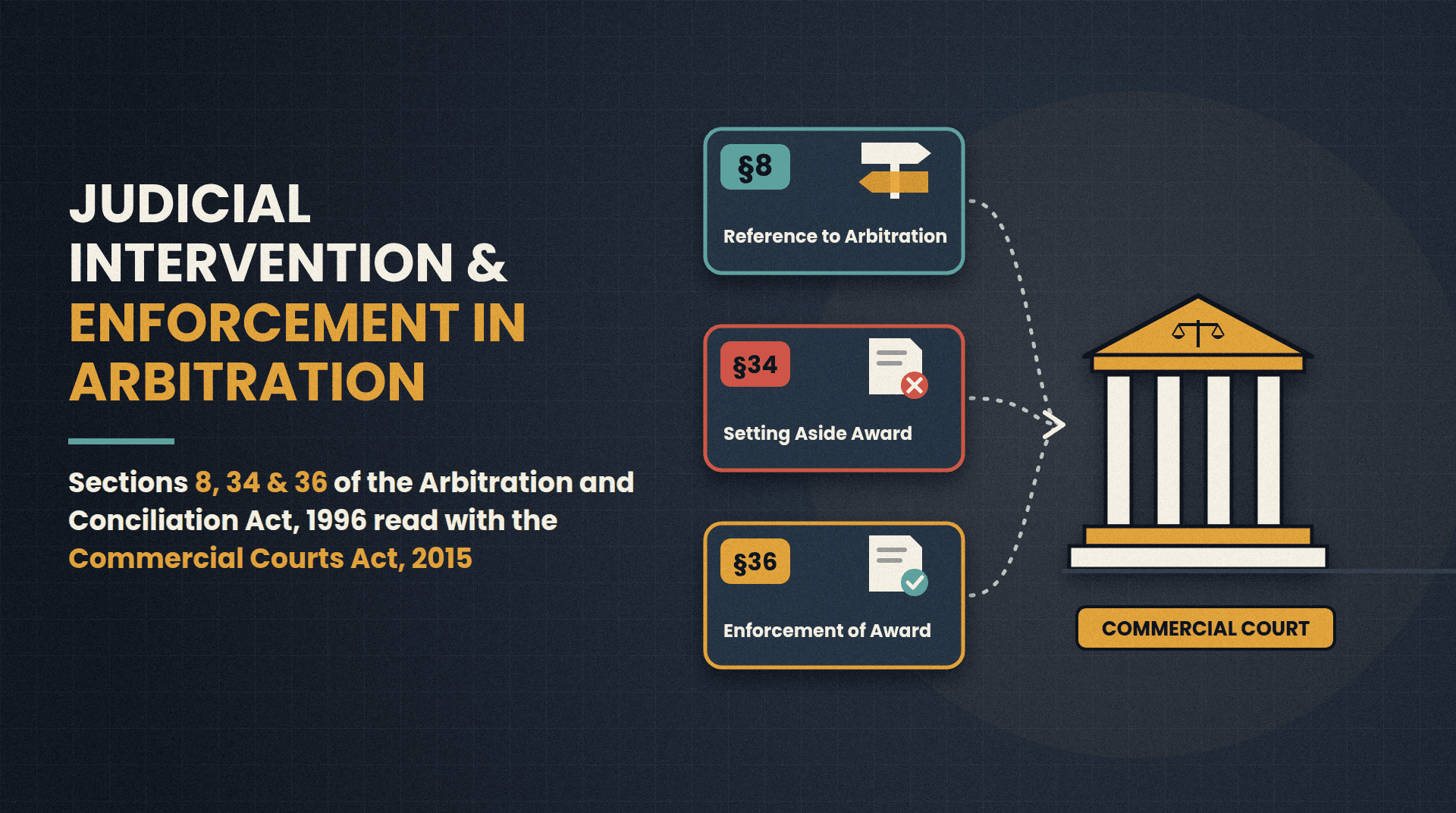
Judicial Intervention and Enforcement in Arbitration: Sections 8, 34 and 36 of the Arbitration and Conciliation Act, 1996 read with the Commercial Courts Act, 2015
ection 8 of the Arbitration and Conciliation Act, 1996 casts a positive, mandatory obligation on a judicial authority to refer parties to arbitration where the subject matter of the action before it is covered by a valid arbitration agreement, provided an application is made not later than the date of submitting the first statement on the substance of the dispute.