

Judicial Intervention and Enforcement in Arbitration: Sections 8, 34 and 36 of the Arbitration and Conciliation Act, 1996 read with the Commercial Courts Act, 2015
Nandini Vats
16 Oct 2026 30 min read
- Decided
- 16 Oct 2026
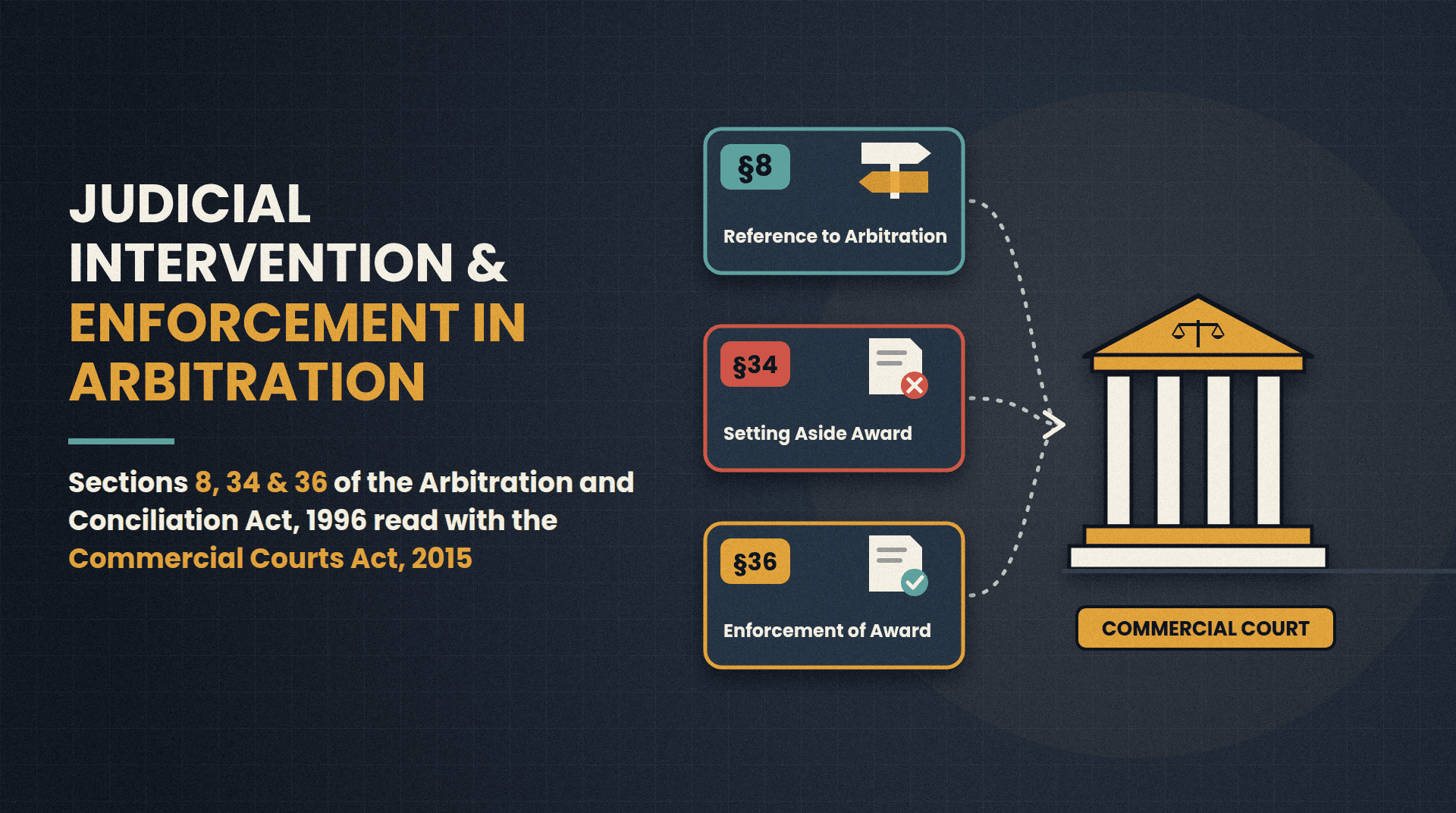
Question 1 Scope of Section 8 — the ‘prima facie existence’ test and the doctrine of arbitrability
Section 8 of the Arbitration and Conciliation Act, 1996 casts a positive, mandatory obligation on a judicial authority to refer parties to arbitration where the subject matter of the action before it is covered by a valid arbitration agreement, provided an application is made not later than the date of submitting the first statement on the substance of the dispute. Prior to the 2015 Amendment, the provision permitted a judicial authority to decline reference only if the agreement was ‘null and void, inoperative or incapable of being performed’; the 2015 Amendment substituted a negatively worded formula requiring reference ‘unless it finds that prima facie no valid arbitration agreement exists’, and simultaneously introduced Section 11(6A) confining the referral court, at the Section 11 stage, to an ‘examination of the existence of an arbitration agreement’.
The three judge Bench in Vidya Drolia v. Durga Trading Corporation undertook the authoritative post amendment restatement of both the standard of scrutiny and the doctrine of arbitrability. Khanna, J. held that Sections 8 and 11 occupy an identical, extremely limited and restricted ambit of judicial review at the referral stage; a court can decline reference only where it is ‘manifestly and ex facie certain’ that the arbitration agreement is nonexistent, invalid, or the dispute is non arbitrable. Ramana, J., writing separately, summarised the governing rule as ‘when in doubt, do refer’, and confined the referral court's prima facie enquiry to four narrow inquiries: whether the agreement is in writing; whether it is contained in an exchange of letters or telecommunication; whether the core contractual ingredients of an arbitration agreement are fulfilled; and, only in rare cases, whether the subject matter is arbitrable on its face.
On the doctrine of arbitrability, Vidya Drolia formulated a fourfold test of non-arbitrability: disputes relating to actions in rem (as opposed to subordinate rights in personam arising from rights in rem); disputes affecting third-party/erga omnes rights requiring centralised adjudication; disputes touching the State's inalienable sovereign or public interest functions; and disputes expressly or by necessary implication barred from arbitration by mandatory statute. The Court overruled Himangni Enterprises v. Kamaljeet Singh Ahluwalia and held that landlord tenant disputes governed by the Transfer of Property Act, 1882 are arbitrable, save where rent control legislation confers exclusive jurisdiction on a specified forum. The judgment also entrenched the separability and competence -competence principles under Section 16: an arbitration clause survives invalidity of the underlying contract, and the arbitral tribunal is primarily, though not exclusively, the first forum to rule on its own jurisdiction, subject to the court's limited ‘second look’ at the Section 34/48 stage. This restated and clarified, without formally overruling, the earlier position under SBP & Co. v. Patel Engineering Ltd., which had treated Sections 8 and 11 as complementary and permitted a more searching enquiry into jurisdictional facts. Subsequently, a seven judge Constitution Bench in In Re: Interplay Between Arbitration Agreements and the Indian Stamp Act, 1899 clarified that the 2015 Amendment Act has legislatively overruled the Patel Engineering position that Sections 8 and 11 lay down an identical standard; since Section 37 permits an appeal from an order under Section 8 refusing reference but not from an order under Section 11, the two provisions are not truly complementary, and the Section 11(6A) enquiry is confined even more narrowly to the existence of an arbitration agreement satisfying Section 7, drawing upon Duro Felguera S.A. v. Gangavaram Port Ltd. and Mayavati Trading (P) Ltd. v. Pradyuat Deb Burman. The correct position today is therefore that the referral court's enquiry under Section 8 is prima facie and summary, arbitrability being determined by the arbitral tribunal in the first instance except in clear cases of ‘deadwood’.
Question 2 Grounds of challenge under Section 34 — ‘patent illegality’ versus ‘public policy’ post2015
Prior to the 2015 Amendment, the ‘public policy of India’ ground under Section 34(2)(b)(ii) had been progressively widened. Renusagar Power Co. Ltd. v. General Electric Co. (decided under the predecessor Foreign Awards Act) confined public policy to (i) the fundamental policy of Indian law, (ii) the interest of India, and (iii) justice or morality. ONGC Ltd. v. Saw Pipes Ltd. added a fourth, domesticawardspecific ground of ‘patent illegality’, holding that illegality going to the root of the matter, or an award so unfair and unreasonable as to shock the conscience of the court, would be opposed to public policy. ONGC Ltd. v. Western Geco International Ltd. expanded ‘fundamental policy of Indian law’ still further to import Wednesbury standards of reasonableness, effectively permitting merits review, a position explained (without expressly overruling Western Geco) in Associate Builders v. DDA.
The Arbitration and Conciliation (Amendment) Act, 2015 narrowed this considerably. Explanation 1 to Section 34(2)(b)(ii) now confines ‘public policy of India’ to three categories: (a) fraud or corruption in the making of the award or violation of Sections 75/81; (b) contravention with the fundamental policy of Indian law (Explanation 2 clarifying that this shall not entail a review on the merits); and (c) conflict with the most basic notions of morality or justice. A wholly new, additional ground of ‘patent illegality appearing on the face of the award’ was inserted as Section 34(2A), applicable only to purely domestic awards and expressly not to international commercial arbitrations seated in India, with the proviso that an award shall not be set aside merely for an erroneous application of law or reappreciation of evidence.
In Ssangyong Engineering & Construction Co. Ltd. v. NHAI, Nariman, J. held that the amended Section 34 governs only Section 34 petitions filed on or after 23 October 2015, regardless of when arbitral proceedings commenced, because the change is substantive and not a mere clarificatory removal of doubt. The Court held that the Western Geco expansion of ‘fundamental policy of Indian law’ stands legislatively overruled by Explanation 2; ‘public policy of India’ is now confined to the Renusagar understanding of fundamental policy and to conduct shocking the conscience of the court. ‘Patent illegality’ under Section 34(2A) survives only for illegality going to the root of the matter — for instance, an arbitrator wandering outside the contract (a jurisdictional error), a perverse finding based on no evidence, or a finding based on material taken behind the parties' backs (also actionable under Section 34(2)(a)(iii) for inability to present one's case) but does not permit reappreciation of evidence or correction of a mere erroneous application of law. On the facts, the Court set aside the majority award for reliance on extraneous government guidelines never placed in evidence, and invoked Article 142 to restore the minority award. This narrowing has been consistently applied, including in Patel Engineering Ltd. v. NEEPCO, which reiterates that ‘patent illegality’ is unavailable both to international commercial arbitrations seated in India and to enforcement of New York Convention foreign awards under Section 48, since Section 48 contains no equivalent of Section 34(2A). The overall post2015 trajectory therefore substantially curtails judicial interference: public policy is limited to fundamental policy/morality justice/fraud, while patent illegality is a narrow, domesticawardonly backstop excluding merits review.
Question 3 Effect of a Section 34 application on enforceability under Section 36 — abolition of automatic stay and conditions for grant of stay
Under the unamended Section 36, an award became enforceable as a decree only once the time for filing a Section 34 application expired, or a Section 34 application, once filed, was refused; the mere filing of objections operated as an automatic stay, a position criticised by the Supreme Court itself in National Aluminium Co. Ltd. v. Pressteel & Fabrications and by the 246th Law Commission Report as defeating the object of speedy dispute resolution. The 2015 Amendment substituted Section 36 to provide that the filing of a Section 34 application does not by itself render the award unenforceable; a stay must be sought and granted on a separate application, upon reasons recorded in writing and subject to such conditions as the court deems fit, with the proviso that the court shall, in the case of a money award, have due regard to the provisions for stay of a money decree under the Code of Civil Procedure, 1908.
In Board of Control for Cricket in India v. Kochi Cricket (P) Ltd., the Court held that Section 26 of the Amendment Act is prospective as to arbitral proceedings, but that the substituted Section 36 — being a purely procedural provision governing execution rather than substantive rights — applies even to Section 34 applications filed before 23 October 2015, given the sheer unfairness of continuing an automatic stay regime. Consequently, from that date, no awarddebtor enjoys an automatic stay merely by filing Section 34 objections; a separate, reasoned application for stay is indispensable.
The conditions on which such a stay may be granted were considered in Pam Developments (P) Ltd. v. State of West Bengal. The Court held that the phrase ‘have due regard to’ in the proviso to Section 36(3) is directory, not mandatory, so that CPC provisions on stay of money decrees (Order XLI Rule 5, Order XXVII Rule 8A) serve only as general guidance and cannot override the self-contained Arbitration Act. Section 18 of the Act mandates equal treatment of parties; hence, the State/Government enjoys no special exemption from a conditional stay merely because Order XXVII Rule 8A of the CPC exempts Government litigants from furnishing security in ordinary civil suits — that Rule, framed in 1937 to protect the colonial Crown, has no application to arbitration seated in a democratic constitutional order, and even if applied, only exempts furnishing security, not deposit of the awarded sum. The court retains full discretion under Order XLI Rule 5 CPC to direct full or partial deposit as a condition of stay, whether the awarddebtor is a private party or the State. A subsequent decision in the same litigation (2024) confirms that once granted, a Section 34/37 court cannot casually disturb the arbitrator's reasoned findings on interest and quantum absent perversity or conflict with public policy, reinforcing that the stay/enforcement architecture under Section 36 operates independently of the merits review under Sections 34 and 37.
Question 4 Appellate remedy under Section 13(1A) of the Commercial Courts Act, 2015 and its interplay with Section 37 of the Arbitration Act
Section 13(1) of the Commercial Courts Act, 2015 permits an appeal to the Commercial Appellate Division of the High Court from a decision of a Commercial Court or Commercial Division, but the proviso confines such appeals to orders specifically enumerated under Order XLIII of the CPC and Section 37 of the Arbitration Act. In Kandla Export Corporation v. OCI Corporation, the Court held that Section 50 of the Arbitration Act (which permits an appeal only against refusal to refer to arbitration under Section 45 or refusal to enforce a foreign award under Section 48 and is silent — and hence exclusionary — where enforcement is granted) is a self-contained code; being a special provision, it prevails over the general appellate remedy in Section 13(1) of the Commercial Courts Act. Applying the doctrine of harmonious construction and the ratio of Fuerst Day Lawson Ltd. v. Jindal Exports Ltd., the Court held that where an appeal is not maintainable under the Arbitration Act, Section 13(1) of the Commercial Courts Act cannot independently confer one, since both statutes share the object of speedy resolution and a further appeal would frustrate that shared object. The mention of Section 37 in the proviso to Section 13(1) merely supplies the forum for appeals already permitted under Section 37; it does not create fresh grounds of appeal. Correspondingly, only the orders enumerated in Section 37(1) refusing to refer parties to arbitration under Section 8, granting or refusing interim measures under Section 9, and setting aside or refusing to set aside an award under Section 34 and in Section 37(2) accepting a Section 16(2)/(3) jurisdictional plea, or granting/refusing interim measures under Section 17 are appealable; an order referring parties to arbitration under Section 8, or rejecting a Section 16 plea, is not appealable under Section 37 and hence not under Section 13(1) either. Section 37(3) expressly bars a second appeal, preserving only a further appeal to the Supreme Court under Article 136.
On the scope of interference and the limitation architecture, Deep Industries Ltd. v. ONGC Ltd. held that although Article 227 of the Constitution being a constitutional power is untouched by the nonobstante clause in Section 5 of the Arbitration Act, a High Court exercising supervisory jurisdiction over an order passed in a Section 37 appeal must exercise extreme circumspection, intervening only where the impugned order is patently lacking in inherent jurisdiction; the statutory policy of speedy, minimally interventionist arbitration (reinforced by the time limits in Sections 29A and 34(6)) must inform the exercise of that jurisdiction, and a second look at findings already examined under Section 16 is impermissible. As to limitation, appeals under Section 13(1) of the Commercial Courts Act must be filed within sixty days of the judgment or order, and the Commercial Appellate Division is statutorily enjoined to endeavour disposal within six months; this is markedly shorter than the general appellate limitation under the Limitation Act, 1963, reflecting the shared object of expedition underlying both statutes.
Question 5 Determinable contracts under Section 14 of the Specific Relief Act, 1963 and enforceability of arbitration clauses
Section 14(1)(c) of the Specific Relief Act, 1963 bars specific performance of a contract that is, in its nature, determinable that is, terminable by either party without the other's default, typically by notice. The leading authority on the arbitral consequence of such a bar is Indian Oil Corporation Ltd. v. Amritsar Gas Service, where the Supreme Court itself had earlier referred a distributorship dispute to arbitration. The arbitrator held that the Corporation had wrongfully terminated the distributorship and granted the distributor restoration of the distributorship. On objections under Section 30 of the Arbitration Act, 1940, the Court held that since the agreement was terminable by either party on thirty days' notice under Clause 28 (an express contractual right independent of the disputed Clause 27 terminationforcause power), it was a contract ‘determinable in its nature’ within Section 14(1) of the Specific Relief Act; the grant of restoration/specific performance was accordingly an error of law apparent on the face of the award, and the only permissible relief was compensation for the thirty day notice period. Critically, the arbitration clause itself was neither invalidated nor rendered unenforceable by the determinable character of the substantive distributorship agreement the Court proceeded to determine the dispute (and confine the relief) through the arbitral reference; only the substantive remedy of specific performance/restoration was barred. This reflects the separability principle later crystallised in Vidya Drolia: the arbitration agreement is an independent, procedural bargain to have disputes including a dispute about whether specific performance is available resolved by arbitration, and Section 14(1)(c) operates only as a substantive law constraint on the relief an arbitrator (or court) may grant, not as a bar on arbitrability of the dispute itself. In other words, a determinable contract remains fully arbitrable; what is barred is a decree (or award) of specific performance or restoration in respect of it, the injured party being left to a remedy in damages/compensation referable to the applicable notice period.
This distinction was reaffirmed in Indian Oil Corporation Ltd. v. Nilofer Siddiqui, where the Court declined to apply Amritsar Gas Service and upheld restoration of an LPG distributorship because, on the facts and conduct of the parties, the letter of allotment did not disclose a contract that was, in substance, revocable/determinable at will; an unconscionable, one-sided termination clause inserted into a standard form contract with a party lacking bargaining power, tested against Article 14 of the Constitution given the Corporation's public-sector character, did not convert the arrangement into a ‘determinable contract’ for Section 14(1)(c) purposes. The composite principle is therefore: (i) whether a contract is ‘determinable in its nature’ is a mixed question of fact and construction of the specific termination clause relied upon; (ii) if it is so determinable, Section 14(1)(c) bars a decree of specific performance/restoration, whether sought in a suit or awarded in arbitration; but (iii) the bar does not touch the arbitration clause's validity or the arbitrability of the underlying dispute the arbitrator (or referral court under Section 8) must still refer/decide the dispute, confining any relief that may ultimately be granted to damages or compensation consistent with Section 14(1)(c).
The following digest sets out, for each category, the leading Supreme Court judgments arranged in chronological order, sourced from the primary reports (Supreme Court Reports / SCC as indexed in the india.sci database). For each case, the Ratio Decidendi (binding rule necessary to the decision) is stated separately from the Obiter Dicta (persuasive observations not necessary to the decision).
Category 1 Section 8: Reference to Arbitration & Arbitrability
Case 1
Case Name & Year | SBP & Co. v. Patel Engineering Ltd. (2005) referred to and analysed at length within Vidya Drolia (2020) |
Citation & Coram | (2005) 8 SCC 618; Seven Judge Constitution Bench |
Issue before the Court | Whether the power of the Chief Justice/designate under Section 11 to appoint an arbitrator is administrative or judicial, and the extent of permissible enquiry at the reference/appointment stage. |
Brief Facts | Reference arose from conflicting views on whether an order under Section 11 was amenable to appeal and what threshold enquiry the appointing authority could undertake into the existence and validity of the arbitration agreement. |
Ratio Decidendi | The power exercised under Section 11 is judicial, not administrative; the Chief Justice/designate can determine his own jurisdiction and decide preliminary questions such as the existence of a valid arbitration agreement and whether the claim is a dead/long barred claim before appointing an arbitrator; no appeal lies from such an order except under Article 136. |
Obiter Dicta | Observations on the desirability of a comprehensive threshold scrutiny to avoid wasteful arbitrations were treated in later case law as guidance rather than an inflexible mandate, since the ratio itself was held (in Chloro Controls) to be confined to what is stated in paragraph 39 of the judgment, cautioning against elevating stray observations to the status of ratio decidendi. |
Significance / Links | Legislatively overruled in material part by the 2015 insertion of Section 11(6A) and clarified/narrowed in In Re: Interplay (2023) and Vidya Drolia (2020), which confine the Section 11/8 enquiry to a prima facie/existence standard. |
Case 2
Case Name & Year | Vidya Drolia v. Durga Trading Corporation (2020) |
Citation & Coram | (2021) 2 SCC 1; [2020] 11 S.C.R. 1001; Three Judge Bench (N.V. Ramana, Sanjiv Khanna and Krishna Murari, JJ.) |
Issue before the Court | (i) Standard of judicial review under Sections 8 and 11 post2015 Amendment; (ii) whether landlord tenant disputes under the Transfer of Property Act are arbitrable; (iii) who decides no arbitrability and at what stage. |
Brief Facts | A tenancy agreement containing an arbitration clause was attorned to the respondent landlord, who sought vacant possession and, on refusal, invoked arbitration. The Calcutta High Court appointed an arbitrator under Section 11 over the tenants' objection that landlord tenant disputes were no arbitrable per Himangni Enterprises. |
Ratio Decidendi | Sections 8 and 11 have an identical, extremely limited ambit of judicial interference at the reference stage; the court can decline reference only where it is manifestly and ex facie certain that no valid arbitration agreement exists or the dispute is demonstrably no arbitrable ‘when in doubt, do refer’. A fourfold test determines no arbitrability (rights in rem; erga omnes/third-party effect requiring centralised adjudication; inalienable sovereign/public functions; express or implied statutory bar). Landlord tenant disputes under the Transfer of Property Act are arbitrable unless a special rent control statute confers exclusive jurisdiction on a specified forum; Himangni Enterprises overruled. |
Obiter Dicta | Extensive comparative law discussion of the competence competence doctrine in Germany, the UK, the USA and Singapore; observations on the negative effect of competence competence and on the meaning of ‘prima facie’ in evidentiary jurisprudence generally, none of which were necessary to the disposal of the specific appeals; the discussion of allegations of fraud (A. Ayyasamy) was likewise not directly in issue on the facts. |
Significance / Links | Builds on and refines SBP & Co. v. Patel Engineering (Case 1) and Duro Felguera/Mayavati Trading; subsequently itself clarified by the seven judge Bench in In Re: Interplay (Case 3) on the precise relationship between Sections 8 and 11 and on the confinement of the Section 11(6A) enquiry to Section 7 formal existence. |
Case 3
Case Name & Year | In Re: Interplay Between Arbitration Agreements under the A&C Act, 1996 and the Indian Stamp Act, 1899 (2023) |
Citation & Coram | [2023] 15 S.C.R. 1092; Seven Judge Constitution Bench (Dr. D.Y. Chandrachud, C.J., Sanjay Kishan Kaul, B.R. Gavai, Surya Kant, J.B. Pardiwala, Manoj Misra and Sanjiv Khanna, JJ.) |
Issue before the Court | Whether an arbitration agreement contained in an unstamped/insufficiently stamped instrument is void/unenforceable at the Section 8/11 stage, and clarification of the correct standard of review under Sections 8 and 11 post2015 Amendment. |
Brief Facts | Curative petition arising from N.N. Global Mercantile (P) Ltd. v. Indo Unique Flame Ltd. (2023) 7 SCC 1, which had held that an unstamped agreement containing an arbitration clause could not be acted upon at the referral stage; the correctness of that view, and its consequences for speedy arbitration, fell for reconsideration. |
Ratio Decidendi | Arbitration agreements are separable from the underlying contract; the doctrine of competence competence under Section 16 empowers the arbitral tribunal to rule on objections including insufficiency of stamping; N.N. Global (majority) is overruled. On Sections 8 and 11, the 2015 Amendment has legislatively overruled Patel Engineering's holding that the two provisions are complementary/identical, since Section 37 permits appeal from a Section 8 order refusing reference but not from a Section 11 order; the Section 11(6A)/Section 8 enquiry is confined to the existence of an arbitration agreement satisfying Section 7, formal validity only, leaving substantive existence/validity to the tribunal under Section 16. |
Obiter Dicta | Extensive discussion, in Sanjiv Khanna, J.'s separate opinion, of the mechanics of Sections 33, 35 and 36 of the Indian Stamp Act, 1899 and comparative procedural practice for impounding instruments, which, while persuasive, is not the operative ratio on the Sections 8/11 arbitrability question. |
Significance / Links | The most authoritative and current statement on the Section 8/11 standard, refining Vidya Drolia (Case 2) and definitively distinguishing the analysis of Sections 8 and 11; also cites and approves Kandla Export Corpn. (Category 3, Case 1) on the self-contained nature of arbitration specific appellate provisions. |
Category 2 Section 34: Grounds of Challenge to Arbitral Awards
Case 1
Case Name & Year | ONGC Ltd. v. Saw Pipes Ltd. (2003) |
Citation & Coram | (2003) 5 SCC 705; Two Judge Bench |
Issue before the Court | Whether an award contrary to the substantive provisions of law or the terms of the contract could be set aside as being in conflict with the ‘public policy of India’ under the then Section 34(2)(b)(ii). |
Brief Facts | Dispute over liquidated damages for delayed supply of equipment under a contract with ONGC; the arbitral tribunal's award on interpretation of the liquidated damages clause was challenged under Section 34. |
Ratio Decidendi | The three Renusagar heads of ‘public policy of India’ (fundamental policy of Indian law; interest of India; justice or morality) were supplemented with a fourth ground: ‘patent illegality’. An award contravening the substantive law of India, the terms of the contract, or containing illegality going to the root of the matter is in conflict with public policy and liable to be set aside; trivial illegality would not suffice. |
Obiter Dicta | Broader observations equating any contravention of a contractual term with an error of jurisdiction, and suggesting a fairly wide reexamination of the arbitrator's construction of contractual terms, went beyond what was strictly necessary and were substantially curtailed by the 2015 Amendment (Section 28(3)) and by Ssangyong (Case 3, infra). |
Significance / Links | The starting point of the expansive ‘patent illegality’ jurisprudence; expressly legislatively overruled/narrowed for domestic awards to Section 34(2A) with the proviso against reappreciation of evidence, per Ssangyong. |
Case 2
Case Name & Year | Associate Builders v. Delhi Development Authority (2015) |
Citation & Coram | (2015) 3 SCC 49; Two Judge Bench |
Issue before the Court | Consolidation and restatement of the pre2015Amendment grounds for setting aside a domestic award under Section 34, including the scope of ‘fundamental policy of Indian law’, ‘patent illegality’ and ‘perversity’. |
Brief Facts | Challenge to a construction contract award; the DDA contended the award was perverse, based on no evidence, and contrary to the fundamental policy of Indian law and to basic notions of justice. |
Ratio Decidendi | Systematised the grounds under Section 34 preamendment into: (i) fundamental policy of Indian law (encompassing the Wednesbury principle per Western Geco); (ii) interest of India; (iii) conflict with justice or morality (shocking the conscience of the court); and (iv) patent illegality (perversity a finding based on no evidence or ignoring vital evidence and failure to give reasons under Section 31(3)). A court cannot sit in appeal or reappreciate evidence; the arbitrator is the final judge of the quality and quantity of evidence. |
Obiter Dicta | The endorsement, in paragraphs 2829, of Western Geco's Wednesburyreasonableness gloss on ‘fundamental policy of Indian law’ was subsequently held in Ssangyong to no longer represent the law after the 2015 Amendment, illustrating how what was central reasoning at the time later came to be treated as superseded by statutory change rather than as continuing ratio. |
Significance / Links | The principal doctrinal bridge between Saw Pipes/Western Geco and the post2015 regime; its paragraphs 42.142.3 and 3132 are expressly carried forward, in modified form, into Section 34(2A) ‘patent illegality’ by Ssangyong (Case 3). |
Case 3
Case Name & Year | Ssangyong Engineering & Construction Co. Ltd. v. National Highways Authority of India (2019) |
Citation & Coram | (2019) 15 SCC 131; [2019] 7 S.C.R. 522; Two Judge Bench (R.F. Nariman and Vineet Saran, JJ.) |
Issue before the Court | Correct post2015Amendment scope of ‘public policy of India’ and ‘patent illegality’ under Section 34(2)(b)(ii) and Section 34(2A), and the temporal applicability of the 2015 Amendment to Section 34. |
Brief Facts | A price adjustment dispute under a highway construction contract; the majority award applied a unilaterally issued Government circular never placed in evidence, using it to derive a ‘linking factor’ between old and new Wholesale Price Index series not found in the contract; the minority arbitrator dissented. |
Ratio Decidendi | (i) Section 34, as amended, applies only to Section 34 applications filed on/after 23.10.2015, irrespective of when arbitration commenced, since the changes are substantive, not merely clarificatory. (ii) ‘Public policy of India’ post amendment is confined to Renusagar's ‘fundamental policy of Indian law’ and ‘most basic notions of morality or justice’; the Western Geco expansion is legislatively overruled by Explanation 2. (iii) ‘Patent illegality’ under Section 34(2A) applies only to purely domestic awards (not international commercial arbitration/Section 48 foreign awards), covers illegality going to the root of the matter including perversity (nonevidence findings, findings based on material taken behind a party's back) and failure to give reasons, but excludes mere erroneous application of law or reappreciation of evidence. (iv) Reliance on documents/guidelines never placed before the parties' breaches Section 34(2)(a)(iii) (inability to present one's case). On facts, the majority award was set aside and, invoking Article 142, the minority award was upheld. |
Obiter Dicta | Observations on the theoretical distinction between ‘most basic notions of justice’ under the New York Convention jurisprudence (Parsons & Whittemore) and Indian domestic law, and general comparative remarks on Article V of the New York Convention, were not strictly necessary to the disposal of the appeal but offer persuasive interpretive guidance for future public policy challenges to foreign awards under Section 48. |
Significance / Links | The definitive post amendment restatement, expressly building on and narrowing Saw Pipes (Case 1) and Associate Builders (Case 2); followed in Patel Engineering Ltd. v. NEEPCO on the inapplicability of ‘patent illegality’ to international commercial arbitration and Section 48 enforcement. |
Category 3 Section 36 Enforcement & Appeals under the Commercial Courts Act, 2015
Case 1
Case Name & Year | Kandla Export Corporation v. OCI Corporation (2018) |
Citation & Coram | (2018) 14 SCC 715; [2018] 1 S.C.R. 915; Two Judge Bench (R.F. Nariman and Navin Sinha, JJ.) |
Issue before the Court | Whether an appeal not maintainable under Section 50 of the Arbitration Act (which excludes appeal against an order enforcing, as opposed to refusing to enforce, a foreign award) is nonetheless maintainable under Section 13(1) of the Commercial Courts Act, 2015. |
Brief Facts | A GAFTA foreign award against Indian sellers was sought to be enforced under Section 48; the Gujarat High Court's Commercial Division allowed enforcement, and the judgment debtors sought to appeal that order under Section 13(1) of the Commercial Courts Act, there being no appeal available under Section 50. |
Ratio Decidendi | Section 50 is a provision of a self-contained code (following Fuerst Day Lawson) and carries the negative import that appeals not provided for are impermissible; being a special statute, it prevails over the general appellate provision in Section 13(1) of the Commercial Courts Act. An interpretation permitting an additional appeal under Section 13(1) where Section 50 excludes one would frustrate the shared object of both statutes speedy resolution of arbitration/commercial disputes and would perversely make enforcement of high value awards (above the Rs. 1 crore specified value threshold) slower than low value awards. No appeal therefore lies under Section 13(1) of the Commercial Courts Act from an order enforcing a foreign award. |
Obiter Dicta | Observations on why Section 37 of the Arbitration Act (itself a special appellate provision) is nonetheless expressly mentioned in the proviso to Section 13(1) treated as inserted ex abundant cautela, or because Section 37 was contemporaneously amended in 2015 were exploratory reasoning on legislative drafting rather than necessary to the ratio. |
Significance / Links | Establishes the general interpretive principle approved in In Re: Interplay (Category 1, Case 3) that special appellate regimes under the Arbitration Act prevail over the general appellate regime in Section 13(1) of the Commercial Courts Act; directly informs the analysis of which Section 37 orders alone can found a Section 13(1) appeal. |
Case 2
Case Name & Year | Board of Control for Cricket in India v. Kochi Cricket (P) Ltd. (2018) |
Citation & Coram | (2018) 6 SCC 287; [2018] 2 S.C.R. 829; Two Judge Bench (R.F. Nariman and Navin Sinha, JJ.) |
Issue before the Court | Whether the substituted Section 36 (abolishing automatic stay) applies to Section 34 applications filed before the 2015 Amendment came into force on 23.10.2015, given Section 26 of the Amendment Act's prospective application clause. |
Brief Facts | Several batches of appeals concerned Section 34 applications filed both before and after 23.10.2015; award debtors argued that the preamendment automatic stay regime under the unamended Section 36 continued to govern applications filed before that date, resisting execution of the awards. |
Ratio Decidendi | Section 26 of the Amendment Act renders the Amendment Act prospective only as to ‘arbitral proceedings’ (i.e., proceedings before the arbitrator) commenced on or after 23.10.2015, but Section 36 (dealing with enforcement/execution) is a procedural provision distinct from arbitral proceedings; being procedural, the substituted Section 36 applies even to Section 34 applications made before the amendment's commencement, since a court proceeding for enforcement is separate from and consequent upon the arbitral reference itself. The automatic stay under the unamended Section 36 is abolished across the board from 23.10.2015 onward, regardless of when the underlying Section 34 petition was filed. |
Obiter Dicta | The Court's extended discussion of hypothetical anomalies that would arise from choosing Section 21 (date of notice invoking arbitration) as the trigger date, and comparative analysis of Section 85 of the principal Act as a repealandsavings analogy, illustrate but were not essential to the narrow proceduralversussubstantive classification that decided the case. |
Significance / Links | The foundational authority for the current, noautomaticstay regime under Section 36; directly applied and extended in Pam Developments (Case 3) on the conditions for a discretionary stay, and referenced in Ssangyong (Category 2, Case 3) on the general principle governing temporal applicability of the 2015 Amendment. |
Case 3
Case Name & Year | Pam Developments Private Limited v. State of West Bengal (2019) |
Citation & Coram | (2019) 8 SCC 112; [2019] 9 S.C.R. 252; Two Judge Bench (R.F. Nariman and Vineet Saran, JJ.) |
Issue before the Court | Whether the State, as awarddebtor, can obtain an unconditional stay of a money award under Section 36(3) by invoking Order XXVII Rule 8A CPC (exemption of Government from furnishing security), and the effect of the ‘have due regard to’ proviso. |
Brief Facts | A road construction contractor obtained a money award against the State of West Bengal; the executing court attached State funds; the State's Section 34 petition remained pending, and it belatedly obtained an unconditional stay of the award from the High Court relying on Order XXVII Rule 8A CPC (Government exemption from furnishing security). |
Ratio Decidendi | The words ‘have due regard to’ the CPC provisions in the proviso to Section 36(3) are directory/guiding, not mandatory, since the Arbitration Act is a self-contained code; CPC applies only insofar as consistent with the Arbitration Act's object of speedy resolution. Section 18 (equal treatment of parties) precludes any special dispensation for the Government in stay applications under Section 36; the archaic colonial era Order XXVII Rule 8A CPC, at most, exempts the Government from furnishing security (as under Order XLI Rule 5(3)(c)) but does not restrain the court's independent power under Order XLI Rule 5(5) to direct deposit, in full or part, of the awarded sum as a condition of stay. An unconditional stay granted solely on the basis of Order XXVII Rule 8A CPC is unsustainable. |
Obiter Dicta | The Court's historical excursus into the colonial provenance of Order XXVII Rule 8A CPC (framed in 1937 to protect the British Crown) and its incompatibility with republican constitutional equality, while rhetorically significant, was ancillary to the narrower textual point that Rule 8A addresses only security, not deposit. |
Significance / Links | Completes the post BCCI v. Kochi Cricket (Case 2) enforcement architecture by fixing the conditions on which a discretionary Section 36(3) stay may be granted; a related 2024 decision in the same litigation further confirms the limited scope of Section 37 interference with an arbitrator's reasoned findings on quantum and interest. |
Case 4
Case Name & Year | Deep Industries Limited v. Oil and Natural Gas Corporation Limited (2019) |
Citation & Coram | (2020) 15 SCC 706; [2019] 17 S.C.R. 995; Three Judge Bench (R.F. Nariman, Aniruddha Bose and V. Ramasubramanian, JJ.) |
Issue before the Court | Whether, and to what extent, a High Court may exercise supervisory jurisdiction under Article 227 of the Constitution over an order passed in a first appeal under Section 37 of the Arbitration Act. |
Brief Facts | ONGC terminated a supply contract and blacklisted the contractor; the arbitrator stayed the blacklisting order under Section 17 pending arbitration; a Section 16 application by ONGC challenging the tribunal's jurisdiction over the blacklisting issue was dismissed; the first appeal under Section 37 upheld the Section 17 order, whereupon ONGC filed a writ petition under Article 227, which the Gujarat High Court allowed, reexamining the very issue already decided under Section 16. |
Ratio Decidendi | Article 227 is a constitutional power untouched by the non obstante clause in Section 5 of the Arbitration Act and is therefore not barred as a matter of jurisdiction; however, given the Act's self contained, speedy resolution policy (Section 5's minimal intervention mandate, Section 37's constricted right of ‘one bite at the cherry’ with no second appeal, and the time limits in Sections 29A and 34(6)), a High Court must exercise Article 227 jurisdiction over Section 37 orders with extreme circumspection, confining interference to orders patently lacking inherent/jurisdictional competence. Reagitating a Section 16 jurisdictional finding, or entering the general merits thicket of the dispute, is impermissible under Article 227; a mere error of law (e.g., an arguable misapplication of Section 41(e) of the Specific Relief Act) is not a jurisdictional error. |
Obiter Dicta | The Court's analogy to the amended Section 115 CPC revisional jurisdiction regime (no revision where an alternative appeal exists, and no revision against interlocutory orders) was offered as reinforcing legislative policy rather than as a binding statutory constraint on Article 227, which remains a constitutional, not merely statutory, power. |
Significance / Links | Fixes the outer limit of judicial review beyond the Section 37 appellate tier itself, complementing Kandla Export Corporation (Case 1) and BCCI v. Kochi Cricket (Case 2) in delineating a narrow, self-contained appellate/supervisory architecture for arbitration related orders passed by Commercial Courts/Divisions. |
Nandini Vats
More precedents
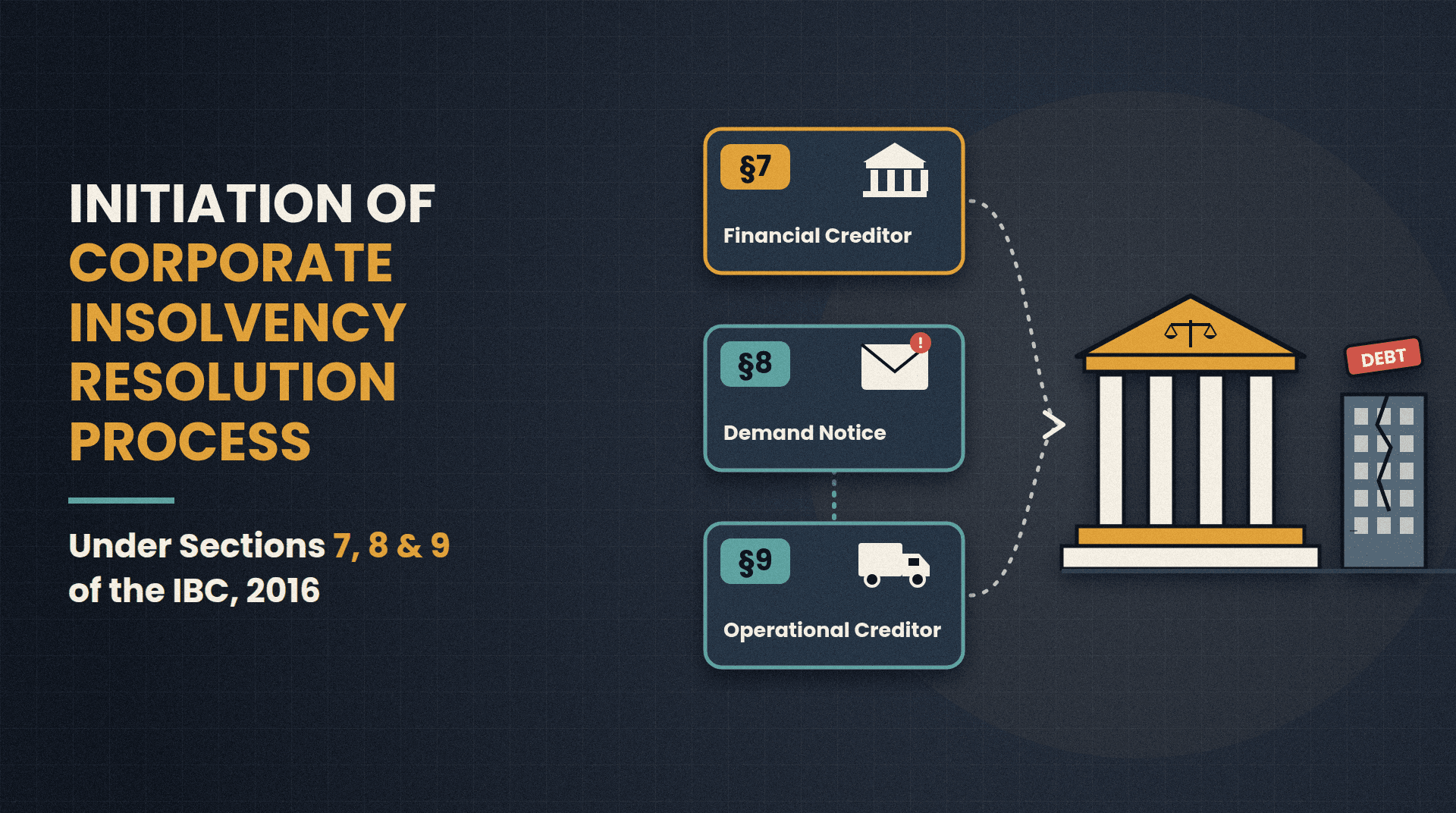
Initiation of Corporate Insolvency Resolution Process under Sections 7, 8 and 9 of the IBC, 2016
The Insolvency and Bankruptcy Code, 2016 (IBC) establishes a creditor in control, trigger-based mechanism for resolving corporate distress. However, the architecture governing initiation differs fundamentally depending on the class of applicant, Financial Creditors under Section 7, Operational Creditors under Section 9 (preceded by a mandatory demand notice under Section 8), and Corporate Applicants under Section 10.

Sports Law in India: Governance of National Sports Federations, Athlete Rights and Dispute Resolution
A fundamental right of participation in games or representing India in certain competitions cannot be derived from the provisions of the Constitution. Even so, the governance of sports is governed by constitutional principles where it impinges upon equality, dignity, livelihood, reputation, or access to public opportunities.

Service Jurisprudence and the Law of Summary Suits: Judicial Review of Employment Disputes under Article 311 and Recovery of Money under Order XXXVII CPC, 1908
This rule became the basis of today's review test in B.C. Chaturvedi v. Union of India (1995), according to which judicial review is concerned not with the decision but with the process of making the decision, checking whether the inquiry was conducted within official statutory framework and in accordance with the basic requirements of fairness.