

Pre-Litigation Practice in Civil Law: Legal Notices, Rent Agreements and Non-Disclosure Agreements in India
Anam Khan
20 Oct 2026 25 min read
- Decided
- 20 Oct 2026

Introduction
Civil litigation in India often begins before a plaintiff is presented before a court. The first formal step may be a legal notice demanding payment, terminating a contractual relationship, calling upon a tenant to vacate premises, or warning a party against disclosure of confidential information. Such communications are sometimes treated merely as procedural formalities. In practice, however, a carefully drafted notice can define the dispute, identify the alleged breach, provide an opportunity for settlement and create an important documentary record for subsequent proceedings. The importance of the pre-litigation stage becomes clearer when different statutory requirements are considered. Section 80 of the Code of Civil Procedure, 1908 imposes a specific notice requirement in suits against the Government or public officers. In commercial disputes, Section 12A of the Commercial Courts Act, 2015 introduces a separate statutory pre-institution mediation requirement for suits that do not contemplate urgent interim relief. The Mediation Act, 2023 has also created a broader framework for voluntary pre-litigation mediation in civil and commercial disputes, while retaining the special regime applicable to specified-value commercial disputes.
In landlord-tenant matters, the pre-litigation stage commonly involves a demand for rent or a notice determining tenancy. The legal consequences depend upon the nature of the tenancy, the governing rent-control statute, the terms of the agreement and whether the lease required registration. Similarly, in confidentiality disputes, an NDA can establish the contractual framework governing information, permitted use, disclosure restrictions and remedies, although the enforceability of individual clauses remains subject to the Indian Contract Act and other applicable law. The present memo examines these three areas together because they illustrate an important feature of civil practice: good drafting is not merely about language; it is about identifying the legal relationship, the cause of action, the relief sought and the consequences that follow if the dispute reaches court.
1. LEGAL SIGNIFICANCE OF A NOTICE BEFORE FILING A CIVIL SUIT
1.1 Notice as a pre-litigation opportunity
A legal notice ordinarily serves several functions. First, it informs the opposite party about the grievance. Secondly, it identifies the alleged contractual or legal default. Thirdly, it specifies what the sender expects the recipient to do. Finally, it creates a record showing that the dispute was raised before litigation commenced. A notice may therefore perform both a substantive and evidentiary function. It can establish that a demand was made, that the recipient was given an opportunity to comply, and that the claimant did not approach the court without first communicating the grievance where such communication is legally required. However, not every civil suit requires a general statutory notice. The requirement depends upon the governing statute, the contractual arrangement and the nature of the relief.
1.2 Section 80 CPC
Section 80 CPC is particularly important where the proposed defendant is the Government or a public officer being sued for an act purportedly done in official capacity. Ordinarily, a suit cannot be instituted until the statutory notice period has expired. Section 80(1) requires the notice to contain, among other things, the name, description and residence of the plaintiff, the cause of action and the relief claimed. Section 80(2) creates an exception for suits seeking urgent or immediate relief. With the leave of the court, such a suit may be instituted without first waiting for the ordinary notice period, although the court cannot grant relief without giving the Government or public officer an opportunity to show cause. Section 80(3) further provides protection against dismissal merely because of an error or defect in the notice where the plaintiff can be identified and the cause of action and relief have been substantially indicated. The Supreme Court’s jurisprudence therefore demonstrates an important balance: the statutory requirement is mandatory, but the notice is not to be examined with unnecessary technicality where its essential purpose has been fulfilled.
1.3 Development from strict compliance to substantial compliance
The early approach to Section 80 was strict. The Supreme Court subsequently recognised that strict compliance does not mean a court should adopt an excessively technical interpretation.
In Dhian Singh Sobha Singh v Union of India, the Court held that although Section 80 must be complied with, its terms should not be interpreted in a manner completely divorced from common sense. The principle was developed further in Ghanshyam Dass v Dominion of India. The Court emphasised that procedural provisions are intended to facilitate justice and that the object of Section 80 is to give the Government sufficient warning of the proposed litigation so that it may consider settlement or restitution without litigation. The Court also discussed the significance of the 1976 amendment introducing Section 80(3), which expressly recognises substantial compliance. The position was reaffirmed in Y. Savarimuthu v State of Tamil Nadu, where the Supreme Court considered whether the notices served upon the State substantially complied with Section 80. The Court reproduced Section 80(3) and stressed that the provision itself prevents dismissal merely because of an error or defect when the essential information has been substantially communicated.
1.4 Consequences of a defective notice
The consequences depend upon the kind of notice involved. A failure to comply with a mandatory statutory notice requirement can affect maintainability. For example, non-compliance with Section 80 may make a suit against the Government or public officer liable to rejection or dismissal, subject to the statutory exceptions and the doctrine of substantial compliance. This is different from a private contractual notice. In such cases, the consequences depend on:
a the contract;
b the statute governing the relationship;
c the purpose of the notice;
d whether notice is a condition precedent;
e and whether the defect actually prejudice the opposite party. A notice should therefore not merely state that “legal action will be taken.” It should identify the agreement or transaction, the relevant breach, the factual basis of the claim, the amount or relief sought, the time allowed for compliance and the consequence of non-compliance.
1.5 Pre-institution mediation in commercial disputes
Modern civil practice has also expanded the concept of pre-litigation procedure beyond traditional legal notices.
In Patil Automation Pvt Ltd v Rakheja Engineers Pvt Ltd, the Supreme Court held that Section 12A of the Commercial Courts Act is mandatory for commercial suits which do not contemplate urgent interim relief. Non-compliance attracts the consequence provided by the judgment, including rejection of the plaint under Order VII Rule 11 CPC. The Mediation Act, 2023 now provides a broader framework under which parties may voluntarily undertake pre-litigation mediation in civil and commercial disputes. However, specified-value commercial disputes continue to be governed by the special Section 12A mechanism. Therefore, when preparing a civil litigation strategy today, an advocate should ask not merely whether a notice is required, but whether any other statutory pre-institution requirement applies.
2. RENT AND LEASE AGREEMENTS IN INDIA
2.1 Essential elements A properly drafted rent or lease agreement should ordinarily identify:
a full detail of the lessor and lessee; accurate description of the premises; nature and purpose of use; duration of tenancy; rent and payment dates; security deposit; maintenance and utility obligations; repairs; subletting restrictions; alteration and construction restrictions; renewal; termination; notice period; consequences of default; possession and handover; dispute-resolution mechanism; jurisdiction; registration and stamp-duty requirements.
2.2 Lease and licence are different legal relationships
Section 105 of the Transfer of Property Act, 1882 defines a lease in terms of transfer of a right to enjoy immovable property. A licence, on the other hand, is governed principally by Section 52 of the Indian Easements Act, 1882 and ordinarily permits the use of property without creating an interest in the property. The distinction is not determined simply by the title of the document.
In Associated Hotels of India Ltd v R.N. Kapoor, the Supreme Court examined the substance and intention of the transaction rather than merely its label. The case became an important foundation for subsequent lease-versus-licence jurisprudence. This principle was reaffirmed in Delta International Ltd v Shyam Sunder Ganeriwalla. The Court explained that exclusive possession is an important consideration but is not by itself conclusive. The real question is the nature of the rights created and the operative intention of the parties. Thus, describing an agreement as a “licence agreement” does not automatically prevent a court from finding that it creates a lease.
2.3 Registered and unregistered leases
Registration becomes particularly important under Section 107 of the Transfer of Property Act and Sections 17 and 49 of the Registration Act, 1908. A lease from year to year, for a term exceeding one year, or reserving yearly rent generally requires a registered instrument. The Supreme Court’s decision in Anthony v K.C. Ittoop & Sons demonstrates the distinction between the document and the underlying relationship. An unregistered instrument cannot itself create the type of long-term lease for which registration is mandatory. Nevertheless, the court may examine other evidence and conduct to determine whether a landlord-tenant relationship in fact existed. This is an important practical distinction. An unregistered agreement may fail to establish all the terms that the parties intended to create, but that does not necessarily mean that the person occupying the premises has no legal relationship with the owner.
2.4 Recent clarification in Paul Rubber Industries
The Supreme Court’s decision in M/s Paul Rubber Industries Pvt Ltd v Amit Chand Mitra is particularly useful for this assignment because it addresses the evidentiary consequences of an unregistered lease deed. The Court held that where a lease for a period exceeding one year is compulsorily registrable, an unregistered deed cannot be relied upon to establish substantive terms that the law requires to be contained in a registered instrument. At the same time, the fact of tenancy may be established through other evidence. The decision therefore illustrates an important distinction: Failure to register the document does not necessarily erase every factual consequence of possession, but it substantially limits the use of the document itself for proving the terms of the intended long-term lease. This is especially relevant when drafting agreements because registration should not be treated as a technical afterthought.
2.5 Interaction with State Rent Control laws
The Transfer of Property Act does not operate in isolation. State rent-control legislation may provide:
special grounds for eviction; protection against arbitrary eviction; restrictions on rent enhancement; procedures for recovery of possession; rights relating to subletting; protection to certain categories of tenants. The applicable State statute must therefore be identified before advising a landlord or tenant. An advocate should first determine:
3. REMEDIES OF LANDLORDS AND TENANTS
3.1 Landlord’s remedies
Depending upon the governing law and facts, a landlord may pursue: recovery of possession; recovery of arrears of rent; damages/mesne profits; termination of tenancy; eviction on statutory grounds; injunction against unauthorised use or subletting; other contractual or statutory remedies. The remedy must correspond to the legal status of the occupant.A landlord cannot safely assume that the mere expiry of an agreement automatically gives an unrestricted right to dispossess an occupant. The applicable rent-control statute, nature of tenancy and manner of termination must be examined.
3.2 Protection against illegal eviction
Indian law does not generally permit a person to take the law into their own hands merely because they claim ownership. In Maria Margarida Sequeira Fernandes v Erasmo Jack de Sequeira, the Supreme Court stressed the importance of lawful possession and the need for courts to protect possession through appropriate legal processes rather than permitting forcible self-help. Accordingly, a landlord facing a tenant who refuses to vacate should normally proceed through the legally available mechanism rather than physically removing the tenant or interfering with possession through coercive means. Similarly, a tenant who faces threatened illegal dispossession may seek appropriate civil relief depending upon the facts, including injunction or restoration of possession where legally available.
4. NON-DISCLOSURE AGREEMENTS IN INDIA
4.1 No standalone trade-secret statute
India does not presently have a comprehensive standalone statute specifically codifying trade-secret protection in the manner seen in some jurisdictions. Protection of confidential information therefore operates through a combination of:
contract law; equity and the law of confidence; intellectual-property principles; employment obligations; copyright law where applicable; injunction jurisdiction; and other statutory remedies depending on the information and conduct involved. The absence of a single statute does not mean that confidential information is legally unprotected.
4.2 Essential clauses of an NDA A carefully drafted NDA should normally address:
Definition of confidential information
The agreement should identify what information is protected. An excessively vague definition may create difficulty because the recipient must be able to understand what information is actually subject to confidentiality.
Purpose limitation
The recipient should use the information only for the purpose for which it was disclosed.
Non-disclosure obligation
The recipient should not disclose the information to unauthorised persons.
Permitted disclosures
The agreement should deal with disclosure required by law, court order or regulatory authority.
Exclusions
Information that is already public, independently developed or lawfully obtained from another source should ordinarily be dealt with expressly.
Security obligations
Where information is digital, the NDA should address reasonable security measures, access controls and handling of electronic copies.
Return/destruction
The agreement should specify what happens to documents and electronic material when the relationship ends.
Duration
Confidentiality obligations should have a clearly drafted duration, with appropriate treatment of information that remains confidential beyond the commercial relationship.
Remedies
The agreement can identify the remedies sought in case of breach, including injunctive relief where legally appropriate.
4.3 Judicial protection of confidential information
One of the foundational Indian cases is John Richard Brady v Chemical Process Equipments Pvt Ltd.
The Delhi High Court considered confidential technical information, know-how, specifications and drawings that had been disclosed in a commercial relationship. The Court found that the plaintiffs had established a strong prima facie case regarding confidentiality and granted interim protection. The case is important because it illustrates that protection may arise from the circumstances in which information was communicated, not merely from the existence of a perfectly drafted standalone NDA.
4.4 Zee Telefilms v Sundial Communications
In Zee Telefilms Ltd v Sundial Communications Pvt Ltd, the Bombay High Court dealt with allegations concerning confidential material and misuse of a concept. The Court explained the basic structure of a confidence claim: the information must possess a confidential character, it must have been communicated in circumstances creating an obligation of confidence, and there must be unauthorised use or threatened use. The Court granted injunctive protection where the circumstances justified such intervention. This is useful for drafting because it shows why simply inserting the words “confidential information” into a contract is not enough. The information should actually be identifiable and treated as confidential in practice.
4.5American Express Bank v Priya Puri
The Delhi High Court’s decision in American Express Bank Ltd v Priya Puri is particularly relevant to employee confidentiality. The dispute concerned customer information and alleged use of confidential data after the employee moved to another bank. The Court treated customer and financial information as capable of constituting confidential information and considered the possibility of injunctive relief. At the same time, NDA drafting must be distinguished from a general post-employment restraint. Section 27 of the Indian Contract Act creates significant limitations on agreements restraining lawful trade or employment after termination.
The Supreme Court in Niranjan Shankar Golikari v Century Spinning & Manufacturing Co Ltd recognised the enforceability of certain negative obligations operating during the subsistence of employment, particularly where they protect legitimate interests such as specialised know-how. The Supreme Court later treated post-employment restraints much more strictly in Superintendence Company of India (P) Ltd v Krishan Murgai. Therefore, an NDA should protect confidentiality, rather than being drafted as a disguised prohibition on a person’s future profession.
5. COMPARATIVE DRAFTING CONSIDERATIONS
Although a legal notice, rent agreement and NDA perform different functions, certain drafting principles are common to all three.
Issue | Legal Notice | Rent Agreement | NDA |
Primary purpose | Communicate grievance/demand | Create and regulate tenancy | Protect confidential information |
Parties | Claimant and recipient | Lessor and lessee | Disclosing and receiving parties |
Essential factual clarity | Cause of action and relief | Property and tenancy terms | Protected information |
Time element | Compliance period/statutory period | Lease term/notice period | Confidentiality period |
Major statutory concern | Section 80 where applicable | TPA, Registration Act, Rent Control law | Contract Act, IP/confidentiality principles |
Common remedy | Suit/appropriate proceeding | Possession/rent/eviction | Injunction/damages/contractual relief |
Major drafting risk | Unclear demand or defective service | Unregistered/ambiguous terms | Overbroad confidentiality clause |
Evidence value | Shows prior demand | Establishes agreed terms | Establishes confidentiality obligation |
5.1 Common principles of enforceability
I ~Identify the parties correctly
An incorrect party description can create serious difficulties in enforcement.
II~Define the subject matter precisely
The legal notice must identify the dispute; a rent agreement must identify the premises; an NDA must identify the protected information.
III~Identify the legal obligation
A document should make clear what obligation has arisen and why.
IV~Specify the consequence of breach
A document that creates an obligation without addressing the consequence of non-performance may create avoidable uncertainty.
V~Avoid contradictory clauses
Internal inconsistencies are particularly dangerous in legal drafting.
VI~Comply with statutory formalities
Stamping, registration, notice requirements and prescribed procedures should be checked before relying on the document.
VII~Preserve evidence of service and execution
A well-drafted document is of limited practical value if its execution or service cannot subsequently be proved.
5.2 Common drafting errors
CONCLUSION
Pre-litigation civil practice is not merely a preliminary stage before the “real” litigation begins. In many disputes, the quality of the pre-litigation work determines the clarity of the eventual case. A legal notice should identify the dispute and provide a meaningful opportunity for compliance or settlement. Section 80 CPC demonstrates that statutory notice requirements can directly affect maintainability, while the modern law of commercial disputes adds another layer through mandatory pre-institution mediation in appropriate cases. The jurisprudence also shows that courts distinguish between genuine statutory non-compliance and defects that do not defeat the substantive purpose of notice. In landlord-tenant disputes, careful drafting must be combined with an understanding of the Transfer of Property Act, Registration Act and applicable State rent-control legislation. The distinction between lease and licence depends upon the substance and legal effect of the arrangement rather than the label chosen by the parties. Recent Supreme Court jurisprudence concerning unregistered leases further demonstrates the importance of distinguishing the existence of a tenancy from the evidentiary use of an unregistered instrument. NDAs operate differently. Their central function is to define and protect confidential information and regulate its use. Indian courts have protected confidential information through contract, equity and injunctive relief even in the absence of a comprehensive standalone trade-secrets statute. At the same time, confidentiality obligations must be carefully separated from impermissible restraints on future employment or trade. The common lesson across all three documents is therefore straightforward: effective legal drafting requires the lawyer to anticipate the dispute that may arise later. Precision about parties, rights, obligations, time periods, statutory requirements, remedies and evidence is what converts a document from a formal piece of writing into a legally useful instrument.
CATEGORY I — LEGAL NOTICES & PRE-LITIGATION REQUIREMENTS
CASE 1
PARTICULARS | DETAILS |
Case Number & Name | CASE 1 — Dhian Singh Sobha Singh & Anr v Union of India |
Citation | AIR 1958 SC 274; (1958) SCR 781 |
Coram | N.H. Bhagwati, J.; Syed Jaffer Imam, J.; P.B. Gajendragadkar, J. |
Issue | Whether a notice under Section 80 CPC should be interpreted so technically that a claim is defeated despite the Government having received sufficient information regarding the claimant’s grievance and relief. |
Brief Facts | The appellants had hired two trucks to the respondent. After the arrangement ended, the trucks were not returned. A Section 80 notice was served claiming return of the trucks or their value and damages for wrongful detention. The dispute eventually concerned whether the amount mentioned in the notice restricted the amount that could subsequently be recovered. |
Ratio Decidendi | Section 80 CPC requires compliance, but its language should not be interpreted in a pedantic manner divorced from common sense. The notice must be understood reasonably and in light of the purpose for which the provision exists. The Court therefore rejected an overly technical approach to the notice. |
Obiter Dictum | The judgment contains broader observations concerning the importance of reading procedural provisions in a manner consistent with their purpose rather than using procedure as an instrument to defeat substantive justice. |
Significance | This case establishes an important foundation for later cases dealing with substantial compliance. It can be connected directly with Raghunath Dass and later with Ghanshyam Dass. |
CASE 2
PARTICULARS | DETAILS |
Case Number & Name | CASE 2 — Ghanshyam Dass & Ors v Dominion of India & Ors |
Citation | (1984) 3 SCC 46; AIR 1984 SC 1004 |
Coram | A.P. Sen, J.; D.A. Desai, J.; V. Balakrishna Eradi, J. |
Issue | Whether a Section 80 notice served by the original claimant could benefit his legal heirs who subsequently instituted the suit. |
Brief Facts | A contractor had served a notice upon the Government but died before institution of the suit. His legal heirs brought the claim relying upon the earlier notice. |
Ratio Decidendi | The Court held that the essential purpose of Section 80 is to give the Government sufficient warning of the claim and an opportunity to consider settlement. Where the cause of action and relief correspond and the statutory purpose has been fulfilled, the notice should not be invalidated merely because of a technical objection. The decision also recognised the importance of the 1976 amendment, particularly Section 80(3), which expressly embodies substantial compliance. |
Obiter Dictum | The Court made wider observations about procedural law being intended to facilitate justice rather than frustrate legitimate claims. |
Significance | This case develops Dhian Singh and provides a stronger doctrinal basis for the modern substantial-compliance approach. |
CASE 3
PARTICULARS | DETAILS |
Case Number & Name | CASE 3 — State of Andhra Pradesh v M/s Pioneer Builders |
Citation | (2006) / decided 25 September 2006 |
Coram | H.K. Sema, J.; D.K. Jain, J. |
Issue | Whether a plaintiff seeking urgent relief against the Government can institute a suit without first serving the ordinary Section 80 notice. |
Ratio Decidendi | Section 80(1) is mandatory in ordinary cases. Section 80(2), however, permits institution of a suit seeking urgent or immediate relief with the leave of the court. Even then, the Government must be given an opportunity of being heard before relief is granted. |
Obiter Dicta | The Court discussed the legislative purpose underlying Section 80 and the relationship between the ordinary notice requirement and the urgent-relief exception. |
Significance | The case complements the substantial-compliance line of cases by explaining that substantial compliance does not mean that the statutory requirement can simply be ignored. The exception for urgent relief must itself be invoked in accordance with Section 80(2). |
CATEGORY II — LANDLORD-TENANT LAW
CASE 4
PARTICULARS | DETAILS |
Case Number & Name | CASE 4 — Associated Hotels of India Ltd v R.N. Kapoor |
Citation | AIR 1959 SC 1262; (1960) 1 SCR 368 |
Coram | S.K. Das, J.; A.K. Sarkar, J.; Subba Rao, J. |
Issue | Whether the transaction created a lease or merely a licence. |
Brief Facts | R.N. Kapoor occupied spaces in the Imperial Hotel and conducted a hairdressing business there. The document used terminology suggesting a licence, but the legal character of the arrangement was disputed. |
Ratio Decidendi | The character of an arrangement cannot be determined solely from the label used by the parties. The substance and operative intention of the transaction must be examined. The judgment became a leading authority on distinguishing a lease from a licence. |
Obiter Dictum | The judgment contains important observations concerning exclusive possession, intention of the parties and the distinction between creation of an interest in property and mere permission to use property. |
Significance | This case provides the starting point for the lease-versus-licence analysis. Later cases, including Delta International, developed the principles further. |
CASE 5
PARTICULARS | DETAILS |
Case Number & Name | CASE 5 — Anthony v K.C. Ittoop & Sons |
Citation | (2000) 6 SCC 394 |
Issue | Whether an unregistered lease deed for a period requiring registration could nevertheless establish a landlord-tenant relationship. |
Ratio Decidendi | An unregistered instrument cannot create the registered lease contemplated by Section 107 of the Transfer of Property Act where registration is mandatory. However, the court can examine other evidence and conduct to determine whether a lease relationship otherwise existed. Thus, the invalidity of the instrument does not necessarily mean that no tenancy relationship can ever be established. |
Obiter Dictum | The Court explained the distinction between the invalidity of the instrument as a registered lease and the factual existence of a landlord-tenant relationship. |
Significance | This case is directly relevant to the assignment’s question concerning unregistered rent agreements and connects the formal requirements of Section 107 TPA with factual proof of tenancy. |
CASE 6
PARTICULARS | DETAILS |
Case Number & Name | CASE 6 — Sevoke Properties Pvt Ltd v West Bengal State Electricity Distribution Co Ltd |
Citation | AIR 2019 SC 2664 |
Coram | Hemant Gupta, J.; D.Y. Chandrachud, J. |
Issue | What is the evidentiary consequence of an unregistered lease where registration is compulsory? |
Ratio Decidendi | Where a lease for a period exceeding one year requires registration, an unregistered lease deed cannot be used to establish the substantive terms of the lease in the manner contemplated by law. However, the document may still be relevant for the limited purpose of understanding the nature and character of possession. |
Obiter Dictum | The Court’s discussion illustrates the distinction between using an unregistered document to prove the transaction itself and using it for a collateral purpose. |
Significance | The decision strengthens the evidentiary aspect of Anthony and provides a bridge to the later reasoning in Paul Rubber Industries. |
CASE 7
PARTICULARS | DETAILS |
Case Number & Name | CASE 7 — M/s Paul Rubber Industries Pvt Ltd v Amit Chand Mitra |
Citation | 2023 INSC 854; (2024) 13 SCC 219 |
Coram | Aniruddha Bose, J.; Vikram Nath, J. |
Issue | To what extent can an unregistered lease deed be relied upon to establish the purpose and terms of a lease exceeding one year? |
Ratio Decidendi | A compulsorily registrable lease cannot be established through an unregistered instrument for purposes for which the document is legally inadmissible. However, the existence of tenancy may still be established through other evidence. The Court also clarified that the nature and purpose of possession cannot automatically be proved from an unregistered deed when that issue constitutes the principal dispute. |
Significance | This is a particularly useful modern authority for the assignment because it clarifies the limits of an unregistered rent/lease agreement and demonstrates the evolution from Anthony toward a more precise evidentiary analysis. |
CASE 8
PARTICULARS | DETAILS |
Case Number & Name | CASE 8 — John Richard Brady v Chemical Process Equipments Pvt Ltd |
Citation | AIR 1987 Delhi 372 |
Court | Delhi High Court |
Judge | Arun B. Saharya, J. |
Issue | Whether confidential technical information, know-how, drawings and specifications disclosed in a commercial relationship could be protected through injunction. |
Brief Facts | The plaintiffs alleged that technical material, drawings and know-how relating to their fodder production unit had been disclosed to the defendants under conditions of confidentiality and subsequently misused. |
Ratio Decidendi | The Court found a strong prima facie basis for protecting confidential technical information and granted interim protection against its use. |
Obiter Dictum | The judgment contains broader discussion of the equitable protection of confidential information and the importance of the circumstances in which information is disclosed. |
Significance | This is one of the foundational Indian authorities for protection of confidential information in the absence of a comprehensive trade-secret statute. |
CASE 9
PARTICULARS | DETAILS |
Case Number & Name | CASE 9 — Zee Telefilms Ltd v Sundial Communications Pvt Ltd |
Citation | Decided 27 March 2003 |
Court | Bombay High Court |
Issue | Whether confidential concepts and material communicated in a commercial relationship could be protected through an injunction. |
Ratio Decidendi | A claimant seeking protection of confidential information must establish the confidential nature of the information, circumstances giving rise to an obligation of confidence, and unauthorised use or threatened use. The Court considered injunctive protection appropriate where these elements were sufficiently established. |
Obiter Dictum | The Court discussed the developing equitable doctrine of confidentiality and the distinction between confidentiality protection and ordinary intellectual-property rights. |
Significance | The case develops the principle from John Richard Brady by articulating the elements that a claimant should establish when seeking protection for confidential information. |
CASE 10
PARTICULARS | DETAILS |
Case Number & Name | CASE 10 — American Express Bank Ltd v Priya Puri |
Citation | 2006, Delhi High Court |
Court | Delhi High Court |
Judge | Anil Kumar, J. |
Issue | Whether confidential customer information could be protected against use by a former employee who joined a competing bank. |
Brief Facts | The defendant had worked for the plaintiff bank and was alleged to possess confidential information concerning customers and their portfolios after leaving the plaintiff’s employment. |
Ratio Decidendi | The Court recognised that customer information and related financial information can constitute confidential information deserving legal protection where the facts establish the requisite confidentiality and risk of misuse. |
Obiter Dictum | The judgment also discusses the nature of customer information and the distinction between legitimate protection of confidential information and restraints on competition. |
Significance | This case is particularly relevant for drafting employment-related NDAs. It demonstrates why an NDA should precisely identify the information that is genuinely confidential rather than attempting to prevent ordinary competition. |
CHRONOLOGICAL JUDICIAL JOURNEY
Year | Case | Core Principle | Connection |
1958 | Dhian Singh Sobha Singh v Union of India | Section 80 must be complied with but not interpreted pedantically | Foundation for reasonable construction |
1959 | Associated Hotels v R.N. Kapoor | Substance and intention matter in lease/licence distinction | Foundation of later tenancy jurisprudence |
1968 | Raghunath Dass v Union of India | Purpose of Section 80 is to provide Government an opportunity to reconsider the claim | Develops notice jurisprudence |
1984 | Ghanshyam Dass v Dominion of India | Section 80 should advance justice; substantial compliance recognised | Develops Dhian Singh and later amendment |
1987 | John Richard Brady v Chemical Process Equipments | Confidential information can receive injunctive protection | Foundation of Indian confidence jurisprudence |
1999 | Delta International v Shyam Sunder Ganeriwalla | Lease/licence determined by substance and intention; exclusive possession is not conclusive | Develops Associated Hotels |
2000 | Anthony v K.C. Ittoop & Sons | Unregistered instrument cannot create compulsory registered lease, but tenancy may be established otherwise | Develops registration jurisprudence |
2003 | Zee Telefilms v Sundial Communications | Confidentiality requires confidential information, obligation of confidence and unauthorised use | Develops Brady |
2006 | State of AP v Pioneer Builders / American Express Bank v Priya Puri | Section 80 urgent-relief exception / protection of confidential customer information | Modern application of two branches |
2019–2023 | Sevoke Properties → Paul Rubber Industries | Increasingly precise limits on use of unregistered lease deeds | Clarifies evidentiary consequences |
Anam Khan
More precedents
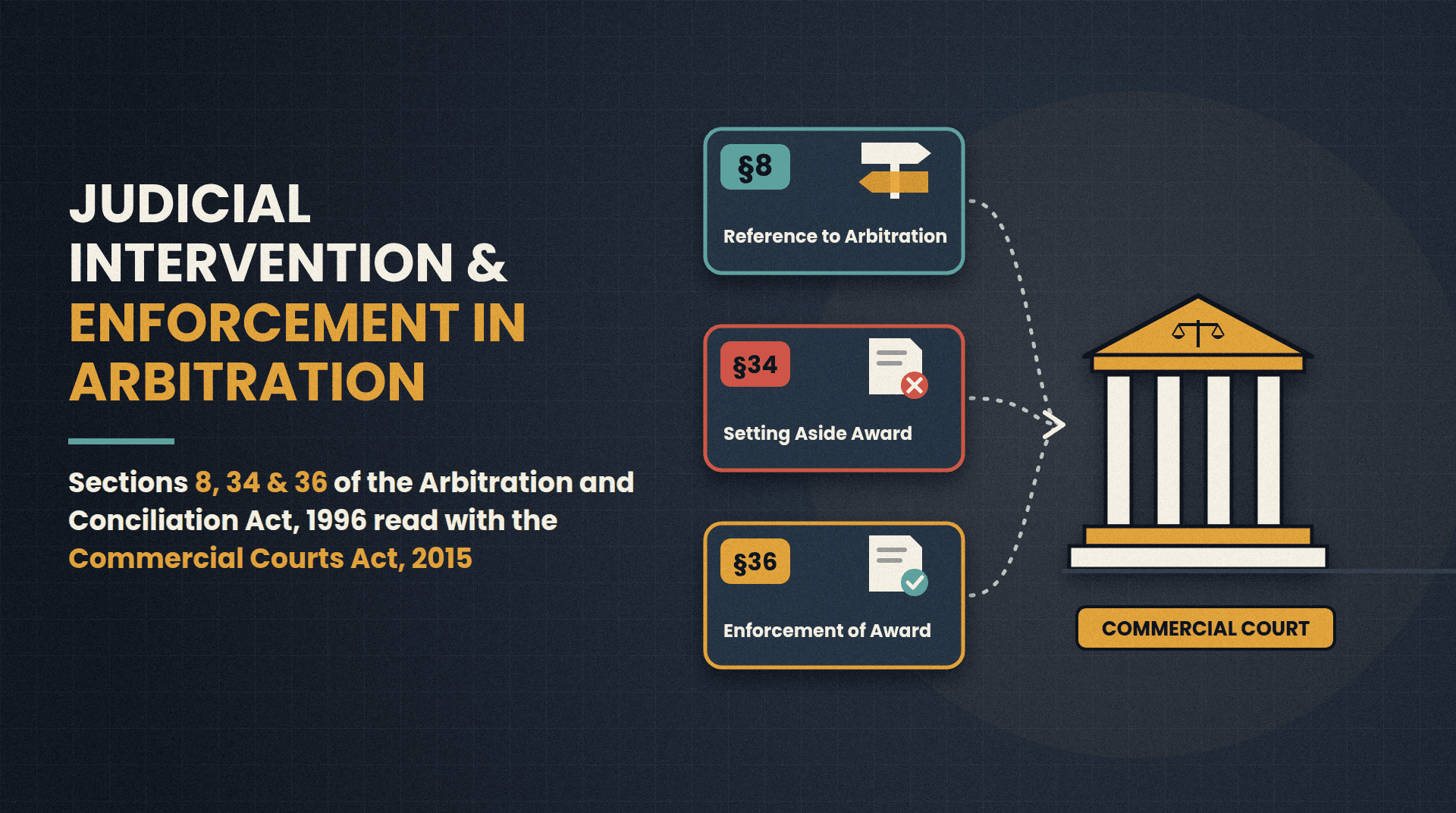
Judicial Intervention and Enforcement in Arbitration: Sections 8, 34 and 36 of the Arbitration and Conciliation Act, 1996 read with the Commercial Courts Act, 2015
ection 8 of the Arbitration and Conciliation Act, 1996 casts a positive, mandatory obligation on a judicial authority to refer parties to arbitration where the subject matter of the action before it is covered by a valid arbitration agreement, provided an application is made not later than the date of submitting the first statement on the substance of the dispute.
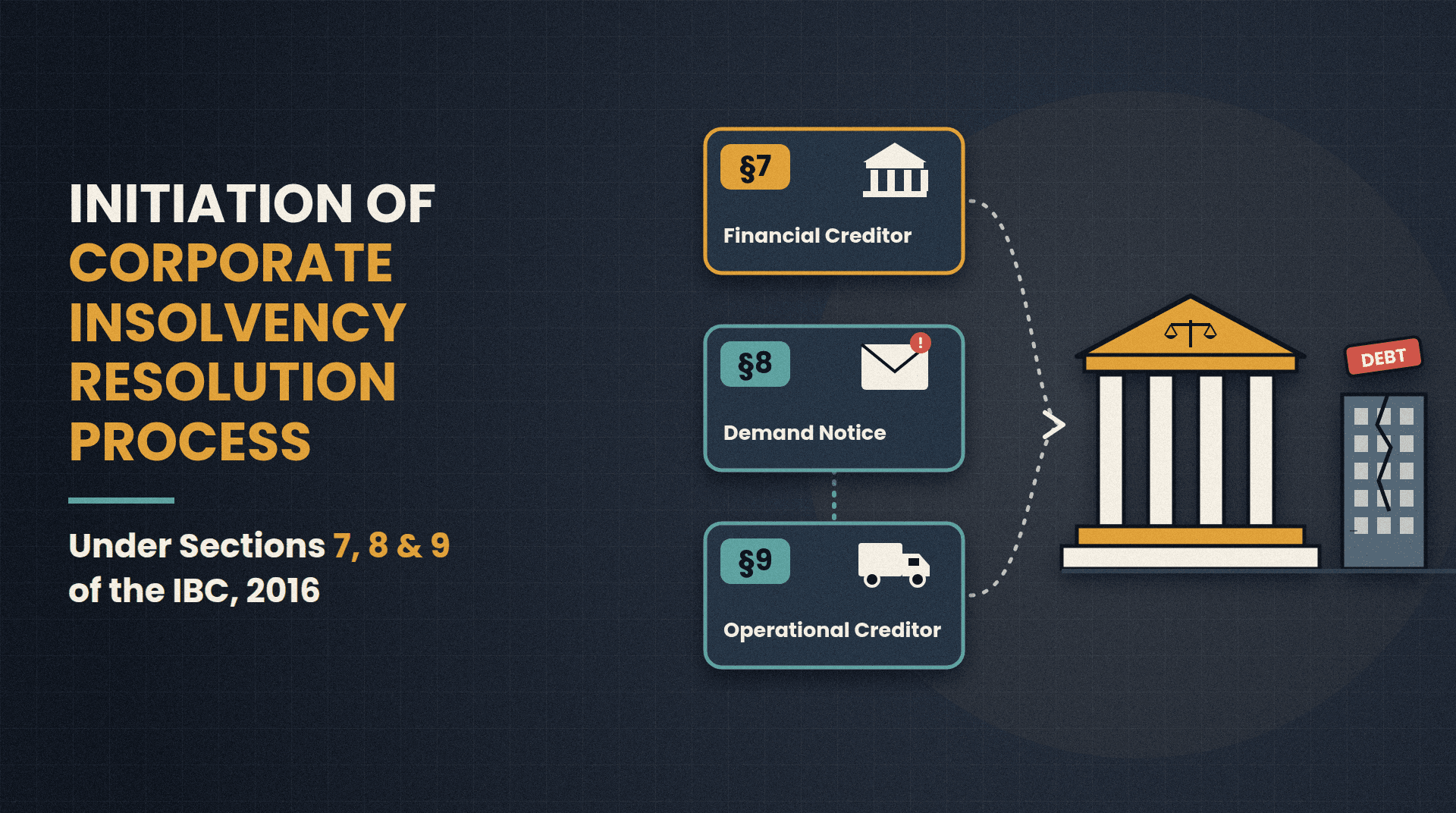
Initiation of Corporate Insolvency Resolution Process under Sections 7, 8 and 9 of the IBC, 2016
The Insolvency and Bankruptcy Code, 2016 (IBC) establishes a creditor in control, trigger-based mechanism for resolving corporate distress. However, the architecture governing initiation differs fundamentally depending on the class of applicant, Financial Creditors under Section 7, Operational Creditors under Section 9 (preceded by a mandatory demand notice under Section 8), and Corporate Applicants under Section 10.

Sports Law in India: Governance of National Sports Federations, Athlete Rights and Dispute Resolution
A fundamental right of participation in games or representing India in certain competitions cannot be derived from the provisions of the Constitution. Even so, the governance of sports is governed by constitutional principles where it impinges upon equality, dignity, livelihood, reputation, or access to public opportunities.