

Freedom of Religion and the Essential Religious Practices Doctrine under Articles 25 and 26 of the Constitution of India
Credit: Hasnain Sheikh and Atika Khan
4 Nov 2026 59 min read
- Court
- Supreme court & High Courts
- Citation
- Verified Citations
- Decided
- 3 Nov 2026
CONSTITUTIONAL AND STATUTORY FRAMEWORK
Religious liberty in a constitutional democracy: a guarantee held by "all persons", subject to public order. morality, health and the other fundamental rights.
Religious liberty in India is not framed as an unqualified institutional privilege. Articles 25 and 26 protect both individual conscience and collective religious autonomy, while making that protection subject to express constitutional limits and, in different ways, to other provisions of Part III. Article 25 speaks of "all persons"; Article 26 speaks of "every religious denomination or any section thereof". The distinction matters: an individual's freedom to believe, not to believe, change belief or decline a religious act is not identical to a denomination's claim to manage its internal affairs.
Provision | Relevance |
|---|---|
Article 14 | Equality before the law and equal protection of the laws. It informs challenges to arbitrary or discriminatory State action affecting religious liberty, including vague or over-broad offences in conversion statutes. |
Article 15 | Prohibits State discrimination on grounds including religion and sex, and in clause (2) addresses exclusion from public places. Its interaction with religious institutions arose in temple-entry and Sabarimala litigation. |
Article 21 | Life and personal liberty, read with privacy, dignity and decisional autonomy. It protects an adult's choice of faith and partner without removing the State's power to investigate genuine coercion or fraud. |
Article 25(1) | All persons are equally entitled to freedom of conscience and the right freely to profess, practise and propagate religion, subject to public order, morality, health and the other provisions of Part III. |
Article 25(2)(a) | Saves laws regulating or restricting any economic, financial, political or other secular activity associated with religious practice. |
Article 25(2)(b) | Saves laws for social welfare and reform and for throwing open Hindu religious institutions of a public character to all classes and sections of Hindus. Explanation II reads "Hindus" to include Sikhs, Jains and Buddhists; Explanation I protects the wearing and carrying of kirpans by Sikhs. |
Article 26 | Subject to public order, morality and health, every religious denomination may (a) establish and maintain institutions for religious and charitable purposes, (b) manage its own affairs in matters of religion, (c) own and acquire property, and (d) administer such property in accordance with law. |
Article 27 | No person can be compelled to pay taxes whose proceeds are specifically appropriated for the promotion or maintenance of a particular religion or denomination. A fee for secular regulation is not such a tax. |
Article 28 | No religious instruction in institutions wholly maintained out of State funds; attendance at religious instruction or worship in recognised or aided institutions cannot be compelled. |
M.P. Freedom of Religion Act, 2021 | Prohibits conversion by specified improper means, creates offences, places the burden of proof on the accused and prescribes advance declarations and notices in Section 10. Its validity is examined against Article 25, Article 21 privacy and autonomy, the binding rule in Rev. Stainislaus and the pending challenges (Question 5). |
The words "religion", "practice", "matters of religion" and "religious denomination" are not defined in the Constitution. The Supreme Court has developed judicial tests to apply them. Those tests have protected institutional independence, permitted regulation of secular administration, facilitated social reform, and generated sustained debate about the competence of courts to decide what is essential to a faith. That debate is now before a nine-Judge Bench, whose judgment had not been pronounced when this memo was finalised.
Question 1 Examine the scope of the freedom of conscience and the right to freely profess, practise and propagate religion under Article 25, and the rights of religious denominations under Article 26. What is a "religious denomination", and what is meant by "matters of religion"?
Article 25 protects every person's faith; Article 26 protects the collective autonomy of a denomination.
Article 25 is an individual right of "all persons" to freedom of conscience and to profess, practise and propagate religion. Article 26 is a group right of a religious denomination to manage its own affairs in matters of religion and to own and administer property in accordance with law. Both yield to public order, morality and health; Article 25 is additionally subject to the rest of Part III and to State regulation under Article 25(2). A "religious denomination" is a body with a common faith, a common organisation and a distinctive name; "matters of religion" are the rites, observances and practices the faith itself treats as religious, as distinct from secular administration. |
1.1 Article 25: the individual right
Article 25(1) guarantees two related freedoms. The inner freedom is conscience: the freedom to hold, revise, reject or adopt a belief, which is conceptually prior to any outward act. The outer freedom has three limbs. To profess is to declare one's faith openly; to practise is to perform the rituals, observances and ceremonies associated with it; to propagate is to transmit or spread its tenets. The Supreme Court held in Shirur Mutt that religion is not confined to doctrine or belief: it extends to rituals, observances, ceremonies and modes of worship regarded as integral to it, and it need not be theistic, as Buddhism and Jainism show. A month earlier, in Ratilal Panachand Gandhi, a Constitution Bench had confirmed that Article 25 protects acts done in pursuance of religion and not merely belief. Conscience also protects the freedom not to participate. In Bijoe Emmanuel, three Jehovah's Witness children who stood respectfully but did not sing the National Anthem could not be expelled, because their conscientious objection was genuinely held and no law compelled them to sing. The guarantee is nonetheless qualified in three ways:
by "public order, morality and health", which apply to both Articles 25 and 26;
by "the other provisions of this Part", so that Articles 14, 15, 17, 19 and 21 can limit a religious claim under Article 25; and
by Article 25(2), which saves laws regulating secular activities associated with religion (clause (a)) and laws for social welfare and reform, including laws throwing open Hindu religious institutions of a public character to all classes and sections of Hindus (clause (b)).
1.2 Article 26: the denominational right
Every religious denomination or section of it may (a) establish and maintain institutions for religious and charitable purposes, (b) manage its own affairs in matters of religion, (c) own and acquire movable and immovable property, and (d) administer such property in accordance with law. The text subjects Article 26 only to public order, morality and health, and not to "the other provisions of this Part". In Sri Venkataramana Devaru, however, the Court harmonised Article 26(b) with Article 25(2)(b): a denomination's right to manage its religious affairs must yield to a law throwing open public temples to all classes of Hindus, although the denomination may still exclude outsiders from purely denominational ceremonies. Whether Article 26 is subject to other Part III rights is one of the questions now pending before the nine-Judge Bench.
Point of comparison | Article 25 | Article 26 |
|---|---|---|
Right-holder | All persons, citizens and non-citizens | A religious denomination or any section of it |
Content | Conscience; freedom to profess, practise and propagate religion | Establish institutions; manage affairs in matters of religion; own, acquire and administer property |
Express limits | Public order, morality, health and the other provisions of Part III | Public order, morality and health |
State power | Article 25(2)(a) secular regulation; Article 25(2)(b) social welfare and reform | Property administered "in accordance with law"; harmonised with Article 25(2)(b) (Devaru) |
Leading authorities | Ratilal; Shirur Mutt; Bijoe Emmanuel; Stainislaus | Shirur Mutt; Devaru; S.P. Mittal; Sidheswar Shai |
1.3 What is a "religious denomination"?
Shirur Mutt borrowed the dictionary sense of the word: a collection of individuals classed together under the same name, a religious sect or body having a common faith and organisation and designated by a distinctive name. In S.P. Mittal the Court distilled this into a working test with three indicators:
a collection of individuals who have a system of beliefs or doctrines which they regard as conducive to their spiritual well-being, that is, a common faith;
a common organisation; and
designation by a distinctive name.
Applying the test, the Court held that the Sri Aurobindo Society and Auroville were not a religious denomination, because Sri Aurobindo's teachings were presented as a philosophy and not a religion; the Auroville (Emergency Provisions) Act, 1980 therefore did not violate Article 26. By contrast, in Bramchari Sidheswar Shai the followers of the Ramakrishna Mission were held to be a religious denomination within Hinduism entitled to Article 26, though not a separate religious minority for Article 30. The Ananda Marga was similarly treated as a denomination within the Hindu fold. In Sastri Yagnapurushdasji, the Swaminarayan followers were held to be part of the Hindu religion, so a temple-entry law applied to their temples. In Sabarimala (2018) the majority held that devotees of Lord Ayyappa did not constitute a separate denomination; Indu Malhotra J. dissented on this point. The test does not require a separate world religion: Maths, sects and sub-sects may qualify, but the inquiry is evidence-driven and a bare assertion of spiritual identity is not enough.
1.4 What are "matters of religion"?
Shirur Mutt held that "matters of religion" in Article 26(b) include practices which the community regards as part of its religion, and gave the denomination autonomy to decide which rites and ceremonies are essential according to its tenets; no outside authority can interfere in such matters save on grounds of public order, morality and health. The Court drew a clear line between Article 26(b), religious affairs, and Article 26(d), the administration of property, which may be regulated by law. The State may regulate administration but may not take it away from the denomination altogether.
Later cases applied the line functionally. In Tilkayat Shri Govindlalji, the right to manage the property of the Nathdwara temple was held to be a secular matter, and the Court cautioned that purely secular practices clothed in a religious form do not become matters of religion. In Seshammal, the appointment of an archaka was held to be a secular act of the trustee, though the rituals the archaka performs are religious. A.S. Narayana Deekshitulu held that hereditary tenure and emoluments of temple office-holders are not immune from reform merely because the office is located in a temple, and N. Adithayan refused to treat caste as an indispensable qualification for priesthood when the appointee could perform the prescribed rites.
Article 25 protects the belief and practice of every person; Article 26 protects qualified collective autonomy only for a body that satisfies the denomination test of common faith, common organisation and a distinctive name. "Matters of religion" cover religious rites and observances, while economic, financial, administrative and other secular activities remain open to regulation. Neither individual nor denominational freedom is absolute, and the precise relationship between the two Articles is presently before a nine-Judge Bench. |
Question 2 Trace the origin and evolution of the essential religious practices test. How do courts decide whether a practice is "essential" or "integral" to a religion, and what is the role of religious texts and the views of the community in that inquiry?
The Essential Religious Practices (ERP) doctrine asks whether a practice is so integral to a faith that it attracts constitutional protection.
The test began in Shirur Mutt (1954) as a shield: what is essential to a religion is to ascertained primarily from the doctrines of that religion itself. From Hanif Quareshi (1958) and Durgah Committee (1961) onwards, courts took on the task of deciding essentiality themselves, and the Ananda Marga cases (1983 and 2004) narrowed protection to the "core" of a religion without which its fundamental character would change. Courts look first at scripture and tenets, treat history and community belief as evidence but not as conclusive, and, in recent cases, have asked whether the practice is consistent with constitutional values. |
2.1 Stage 1 (1954): deference to the community
In Shirur Mutt a seven-Judge Bench, speaking through B.K. Mukherjea J., held that "what constitutes the essential part of a religion is primarily to be ascertained with reference to the doctrines of that religion itself". The word "essential" was used to widen protection: if the tenets prescribe that offerings of food be given to the idol at particular hours, or that sacred texts be recited, those acts are religious practices even though they involve expenditure and the employment of priests. Ratilal had held, a month earlier, that religious practices and performances are as much a part of religion as faith or belief. Classroom summary of the ERP test as introduced in Shirur Mutt (1954). Source: Vision IAS, News Today, 26 and 27 January 2025.
2.2 Stage 2 (1958 to 1964): the court as arbiter
In Mohd. Hanif Quareshi, the Court held that the sacrifice of a cow on Bakr-Id was not an obligatory overt act for a Muslim, since the religion permitted other animals; a ban on cow slaughter therefore did not violate Article 25. The "obligatory or optional" distinction became a recurring tool. In Durgah Committee, Gajendragadkar J. added what is often called the "clog": only practices that are an essential and integral part of religion are protected, and even practices religious in form may be denied protection if they spring from merely superstitious beliefs and are extraneous and unessential accretions to the religion. In Saifuddin (1962) the majority held that excommunication to preserve the discipline of the Dawoodi Bohra denomination was a matter of religion and struck down the Bombay Prevention of Excommunication Act, 1949. Tilkayat (1963) then confirmed that whether a practice is religious and essential is a question the court decides on evidence, with the community's own understanding relevant but not conclusive.
2.3 Stage 3 (1983 to 2004): the "core" test
In the first Ananda Marga case, the Court accepted the order as a denomination but held that the public performance of the tandava dance with skulls, tridents and knives was not an essential rite, since the faith had existed without it. When the founder later inserted the practice into the order's scripture, the majority in the 2004 sequel, speaking through S. Rajendra Babu J., defined the essential part of a religion as "the core beliefs upon which a religion is founded": a practice is essential only if its removal would bring about a fundamental change in the character of the religion, and such essentials cannot be added or altered later. Dr. A.R. Lakshmanan J. dissented, holding that the community's own scripture should be respected.
2.4 Application in modern cases
Case | Practice claimed | Holding |
|---|---|---|
Ismail Faruqui (1994) | Offering namaz at a particular mosque | A mosque is not an essential part of the practice of Islam and namaz can be offered anywhere; acquisition upheld. The observation is confined to the context of acquisition. |
Shayara Bano (2017) | Talaq-ul-biddat (instant triple talaq) | Set aside by 3:2. For Kurian Joseph J., a practice disapproved in the Quran cannot be an essential practice protected by Article 25. |
Sabarimala (2018) | Exclusion of women aged 10 to 50 years | Not an essential practice; Ayyappa devotees not a denomination; Rule 3(b) struck down by 4:1. |
Aishat Shifa (2022) | Wearing hijab in government pre-university classrooms | Split verdict: Hemant Gupta J. upheld the restriction; Sudhanshu Dhulia J. held the ERP inquiry unnecessary and treated the matter as one of choice and conscience. Referred to a larger Bench. |
2.5 How courts decide "essential", and the role of texts and the community
Scripture and tenets. Courts begin with the religion's own texts and doctrines (Shirur Mutt; Ananda Marga 2004).
Obligatory or optional. A practice that the faith permits but does not require is rarely treated as essential (Hanif Quareshi).
The "core" inquiry. The question is whether the religion would be fundamentally altered without the practice, judged at the time the faith was founded (Ananda Marga 2004).
History and community belief as evidence. Antiquity, continuity and the belief of adherents are relevant but not decisive; superstitious accretions may be excluded (Durgah Committee; Tilkayat).
Constitutional consistency. In Sabarimala, Chandrachud J. added that a practice claimed as essential must also be consistent with constitutional values of dignity, equality and liberty, while Indu Malhotra J. held that only the community can decide what is essential to its faith.
The test has moved from a community-defined, protective inquiry (Shirur Mutt) to a judicially defined, restrictive one (Durgah Committee onwards), refined into the "core" test of the 2004 Ananda Marga decision. Religious texts are the primary evidence, and community belief is relevant but not conclusive. That tension between the community's voice and the judge's assessment is exactly what the nine-Judge Bench has been asked to resolve. |
Question 3 Examine the criticism of the essential religious practices test, including the view that courts should not decide questions of theology. How has the doctrine been reconsidered in the questions referred to a larger Bench, and what alternatives (such as the anti-exclusion or constitutional morality approaches) have been proposed?
The ERP test is criticised for turning secular judges into theologians, for selective use of scripture, for privileging textual orthodoxy over lived faith, and for asking the wrong question when the real issue is harm to dignity or equality. After Sabarimala (2018), a review Bench referred wider questions to a larger Bench in 2019; a nine-Judge Bench framed seven questions in 2020, heard arguments from 7 April to 14 May 2026 and reserved judgment. As on the date of this memo, no verdict had been pronounced. The main alternatives proposed are the anti-exclusion test, a constitutional morality reading, deference to the faithful, and a sincerity-and-harm approach. |
3.1 The main criticisms
Courts deciding theology. Since Durgah Committee, judges rather than believers decide what is "essential". This sits uneasily with Shirur Mutt, which left that question to the community. At the 2026 hearing the Solicitor General himself argued that the test has no textual basis in Articles 25 and 26, which do not use the word "essential".
Selective use of texts. Courts read scripture without expert evidence and often on affidavits. Ismail Faruqui was criticised for deciding the essentiality of a mosque without a full examination of Islamic sources.
Privileging the doctrinal over the lived. Practices that are popular or customary but not textually "core" lose protection, which tends to favour a reformist, scriptural version of a faith over its lived form.
Inconsistency. Saifuddin protected excommunication as essential, while the Ananda Marga cases rejected a practice the founder had written into scripture.
The wrong question. Essentiality says little about whether a practice harms the dignity or equality of individuals, which is often the real issue in dispute. Empirical work shows that High Courts apply the test unevenly and often decide cases on other grounds.
Weak precedential foundation. Recent scholarship argues that the test grew out of observations that were not necessary to the decisions in which they appeared.
3.2 The reference to a larger Bench
Date | Event |
|---|---|
28 September 2018 | Sabarimala: a 4:1 majority strikes down the exclusion of women aged 10 to 50 years. |
14 November 2019 | Kantaru Rajeevaru (review): a 3:2 majority (Gogoi CJI, Khanwilkar and Indu Malhotra JJ.) keeps the review pending and refers wider questions to a larger Bench; Nariman and Chandrachud JJ. dissent. |
10 February 2020 | A nine-Judge Bench (Bobde CJI and eight Judges) holds that questions of law may be referred while exercising review jurisdiction and re-frames seven questions; reasons follow on 11 May 2020. |
7 April to 14 May 2026 | A nine-Judge Bench presided over by Surya Kant CJI (with B.V. Nagarathna, M.M. Sundresh, Ahsanuddin Amanullah, Aravind Kumar, A.G. Masih, P.B. Varale, R. Mahadevan and Joymalya Bagchi JJ.) hears arguments over 16 days and reserves judgment. |
1 October 2026 | Reports indicate that the judgment had not been pronounced and no date had been fixed. |
The seven questions framed on 10 February 2020 are, in substance:
What is the scope and ambit of the right to freedom of religion under Article 25?
What is the inter-play between the rights of persons under Article 25 and the rights of a religious denomination under Article 26?
Are the rights of a religious denomination under Article 26 subject to the other provisions of Part III, apart from public order, morality and health?
What is the scope and extent of the word "morality" in Articles 25 and 26, and does it include constitutional morality?
What is the scope and extent of judicial review with regard to a religious practice referred to in Article 25?
What is the meaning of the expression "sections of Hindus" in Article 25(2)(b)?
Can a person who does not belong to a religious denomination or group question a practice of that denomination by filing a PIL?
The 2019 order also tagged related matters: the entry of Muslim women into mosques, the status of Parsi women married outside the community, female genital cutting among Dawoodi Bohras, and the correctness of Saifuddin, already referred to a larger Bench in 2005. The 2026 hearing examined, among other things, the validity of Parsi excommunications under Articles 25 and 26.
3.3 Alternatives proposed
Approach | Source | Core idea |
|---|---|---|
Anti-exclusion | Chandrachud J., Sabarimala | Ask whether a practice excludes or subordinates individuals, for example through untouchability-like exclusion under Article 17, rather than whether it is essential. |
Constitutional morality | Misra CJI and Chandrachud J., Sabarimala | "Morality" in Articles 25 and 26 means the morality of the Constitution (dignity, equality, liberty), not popular or religious morality. |
Deference to the faithful | Indu Malhotra J. (dissent), Sabarimala | Only the community can decide what is essential; courts intervene only against practices that are pernicious, oppressive or a social evil like sati. |
Existence, not essentiality | Solicitor General, 2026 hearing | Courts may examine whether a practice exists and is genuinely religious, but not whether it is essential. |
Sincerity and harm | Academic proposals | Protect sincerely held practices unless they cause demonstrable harm to the rights of others, applying a proportionality analysis. |
Question 4 Discuss the restrictions on religious freedom on grounds of public order, morality and health, and the power of the State to regulate secular activities associated with religious practice and to provide for social welfare and reform under Article 25(2). How have courts balanced these against individual rights to equality and dignity?
Religious freedom yields to public order, morality and health, and the State may regulate the secular side of religion and legislate for social reform. A restriction must have a real connection with the stated ground; the label alone is not enough. Where a collective religious practice collides with equality or dignity, the courts increasingly let the individual right prevail, while protecting individual conscience against State compulsion. |
4.1 Public order
The Ananda Marga cases upheld police conditions forbidding the tandava procession with knives, tridents and skulls on public streets: the right to perform a ritual does not extend to doing so in a manner that endangers public order. In Rev. Stainislaus, conversion by force, fraud or inducement was treated as a public-order matter within State legislative competence. Ismail Faruqui accepted the maintenance of public order and communal harmony as a legitimate ground for acquiring a place of worship.
4.2 Health
In Church of God (Full Gospel) the Court held that no religion prescribes that prayers be performed by disturbing the peace of others through voice amplifiers or the beating of drums, and upheld noise limits against a church. The right to religion cannot override the neighbours' health and their right to a peaceful life under Article 21. The Court regulated the external effects of the activity without ruling on the validity of the faith itself.
4.3 Morality
For decades "morality" meant public or social morality. In Sabarimala, Misra CJI and Chandrachud J. read it as constitutional morality: the values of dignity, equality and liberty in the Constitution itself. Whether that reading is correct is one of the questions now reserved before the nine-Judge Bench.
4.4 Article 25(2)(a): regulating secular activities
Administration of temple property and finances is secular and may be regulated, but may not be taken away from a denomination entirely (Shirur Mutt, Ratilal).
The right to manage temple property is not a matter of religion (Tilkayat).
The appointment of a priest is secular, though the rituals the priest performs are religious (Seshammal); hereditary rights to office may be abolished (A.S. Narayana Deekshitulu).
A custom limiting priesthood to Malayala Brahmins cannot be enforced against a trained and qualified non-Brahmin; a usage that violates human dignity or equality cannot be a source of law (N. Adithayan).
A ban on cow slaughter does not violate Article 25 because the sacrifice of a cow is not obligatory (Hanif Quareshi).
4.5 Article 25(2)(b): social welfare and reform
This clause underpins temple-entry legislation. Sri Venkataramana Devaru held that a denomination's Article 26(b) right yields to a law throwing open public temples to all classes of Hindus. Sastri Yagnapurushdasji upheld the Bombay Hindu Places of Public Worship (Entitlement to Entry) Act, 1956 against the Swaminarayan sect's claim to be outside Hinduism, describing temple entry as a social reform of the first importance. In Shayara Bano, the practice of instant triple talaq was set aside, the plurality holding it manifestly arbitrary under Article 14.
4.6 Balancing against equality and dignity
Case | Right claimed | Competing right | Outcome |
|---|---|---|---|
Bijoe Emmanuel (1986) | Jehovah's Witnesses' refusal to sing the National Anthem | School discipline by executive circular | Conscience prevailed; expulsion set aside |
Church of God (2000) | Amplified worship | Health and Article 21 rights of neighbours | Health prevailed; noise limits apply to all |
N. Adithayan (2002) | Brahmin-only priesthood as custom | Equality and dignity (Articles 14, 15, 17) | Equality prevailed |
Shayara Bano (2017) | Talaq-ul-biddat as personal law | Equality of Muslim women (Article 14) | Equality prevailed |
Sabarimala (2018) | Exclusion of women aged 10 to 50 | Equality and dignity (Articles 14, 15, 17, 25(1)) | Equality prevailed; under review reference |
Shafin Jahan (2018) | Family and court control over an adult's marriage | Adult choice of faith and partner (Article 21) | Autonomy prevailed |
A disciplined balancing method follows from these cases: first, identify the right asserted and who holds it; second, characterise the practice and the effect of the law (religious observance, secular administration, external public effect, or exclusion of a class of persons); third, identify the precise constitutional source of the limitation or regulatory power; fourth, examine the evidence for the restriction, its scope and whether a narrower measure would serve the legitimate aim; and finally, explain how the outcome respects both conscience and the rights of others. "Public order", "social reform" and "constitutional morality" are legal standards, not substitutes for analysis. Articles 27 and 28 complete the scheme by preventing religious taxation and compelled religious instruction in State institutions.
The State's power is wide on the secular side of religion and on reform, and the grounds of public order, morality and health are applied practically. Devaru and Adithayan show that religious institutions are not outside equality-oriented reform; Church of God illustrates neutral regulation of noise; Bijoe Emmanuel and Shafin Jahan protect individual conscience and autonomy. The direction of the case law is that collective religious claims yield where they exclude or subordinate individuals, while an individual's conscience is protected against State compulsion. |
Question 5 Does the right to "propagate" religion include a right to convert another person? Examine the constitutional validity of State anti-conversion laws, including the Madhya Pradesh Freedom of Religion Act, 2021, and the challenges pending against them.
No. Under Rev. Stainislaus (1977) the right to propagate is a right to transmit or spread one's religion by an exposition of its tenets, not a right to convert another person. But a person's own choice to change faith is protected under Articles 21 and 25. Laws against conversion by force, fraud or allurement are valid in principle; specific provisions of the newer statutes, including the prior-declaration requirement in Section 10 of the M.P. Freedom of Religion Act, 2021, have been prima facie doubted by the M.P. High Court and remain under challenge in the Supreme Court without a final decision. |
5.1 The Constituent Assembly and "propagate"
The word "propagate" was retained in draft Article 19 (now Article 25) after debate. Members such as K.M. Munshi and L.K. Maitra explained that its inclusion was a compromise to protect missionary preaching, while noting that the freedom of conscience of every person would remain protected. The Assembly did not, however, write in an express right to convert others.
5.2 The binding rule: Rev. Stainislaus
A five-Judge Bench, speaking through A.N. Ray CJI, upheld the Madhya Pradesh Dharma Swatantrya Adhiniyam, 1968 and the Orissa Freedom of Religion Act, 1967. It held:
what Article 25(1) grants is not the right to convert another person to one's own religion, but to transmit or spread one's religion by an exposition of its tenets;
there is no fundamental right to convert another, because the freedom of conscience belongs equally to every person, and a deliberate attempt to convert would impinge on the conscience of the person sought to be converted;
conversion by force, fraud or inducement disturbs public order, so the States had legislative competence under Entry 1 of List II.
The decision must be read accurately. It rejects a right to convert another person, particularly by the objectionable means targeted by the statutes; it does not deny that an individual can choose, adopt, change or reject a religious belief. Commentators, H.M. Seervai among them, have long criticised its reasoning, but it remains binding until a larger Bench reconsiders it.
5.3 The individual's own right to choose faith
In Shafin Jahan, the Court restored the marriage of an adult woman who had converted to Islam, holding that the choice of faith and of a life partner lies within personal autonomy under Article 21, and that investigation into genuine criminality could continue in accordance with law. The nine-Judge Bench in K.S. Puttaswamy placed such choices within the zone of privacy and decisional autonomy. Conversion must, however, be genuine: in Sarla Mudgal, a Hindu husband who converted to Islam only to contract a second marriage was held not to have dissolved the first marriage, and the second marriage was void. A voluntary change of faith by an adult is constitutionally different from conversion produced by coercion, deception or undue influence, and the law must be able to tell them apart without treating interfaith marriage as proof of misconduct.
5.4 The M.P. Freedom of Religion Act, 2021
The Act (M.P. Act No. 5 of 2021) replaced the 1968 Adhiniyam. Its main features are:
Section 2 defines "allurement", "coercion", "force", "fraudulent means", "religious priest" and "undue influence";
Section 3 prohibits conversion or attempted conversion by misrepresentation, allurement, threat or force, undue influence, coercion, marriage or any other fraudulent means, and also prohibits conspiracy or abetment; re-conversion to one's ancestral religion is not deemed conversion;
Section 4 limits who may complain: the person converted, a parent or sibling, or, with the leave of the court, another relative or guardian;
Section 5 prescribes graded imprisonment and fines, enhanced where the person converted is a minor, a woman or a member of a Scheduled Caste or Scheduled Tribe, and for mass conversion;
Section 6 treats a marriage performed in contravention of Section 3, or for the sole purpose of unlawful conversion, as null and void;
Section 10 requires a person wishing to convert to give a declaration to the District Magistrate sixty days in advance, and requires the religious priest or organiser to give prior notice; a priest who contravenes this faces imprisonment of three to five years and a fine of not less than fifty thousand rupees;
Section 12 places the burden of proving that a conversion was not effected by prohibited means on the person who caused the conversion.
The Madhya Pradesh Freedom of Religion Rules, 2022 prescribe the forms and procedure for these declarations.
The trend continues: Maharashtra's Freedom of Religion Act, 2026 received Presidential assent on 31 July 2026 and also requires sixty days' prior notice of conversion.
5.5 The pending challenges
Forum | Matter | Status |
|---|---|---|
M.P. High Court | Rev. Suresh Carleton v. State of M.P., W.P. No. 6263 of 2021, with Samuel Daniel v. State of M.P., W.P. No. 12238 of 2021 and five connected petitions | 14 November 2022: Sujoy Paul and P.C. Gupta JJ. found Section 10 ex facie unconstitutional at the interim stage and directed that, till further orders, the State shall not prosecute adults who marry of their own volition and shall take no coercive action for violation of Section 10. The Act as a whole was not stayed. |
Supreme Court | State of M.P. v. Samuel Daniel, SLP (C) No. 22733 of 2022 | 3 January 2023: M.R. Shah and C.T. Ravikumar JJ. issued notice on the SLP and on the prayer for interim relief; the High Court order was not stayed. |
Supreme Court | Batch led by Citizens for Justice and Peace (writ petitions filed from 2020) against the laws of nine States, including Madhya Pradesh | 16 September 2025: States directed to reply to stay applications. 28 January 2026: not reached and adjourned. 2 February 2026: notice issued to the Union and twelve States on a fresh NCCI petition, tagged with the batch for hearing by a three-Judge Bench. No final judgment located as on 11 October 2026. |
The main grounds urged are: prior-declaration requirements violate privacy and autonomy (Puttaswamy, Shafin Jahan); reversal of the burden of proof is disproportionate; third-party complaints invite harassment of interfaith couples; and "allurement" and "undue influence" are vague. The States defend the laws as public-order measures within Stainislaus, arguing that Section 10(2) is pari materia with Section 5 of the 1968 Act upheld in that case. The Himachal Pradesh High Court had earlier struck down a similar prior-notice provision in Evangelical Fellowship of India (2012), and the Gujarat High Court stayed parts of the Gujarat amendment in its application to interfaith marriages in 2021. Maharashtra has since enacted a comparable statute in 2026.
5.6 Analysis
Stainislaus is binding on the proposition that Article 25 confers no fundamental right to convert another person and that States may legislate against improper means of conversion. It does not foreclose challenges based on later privacy doctrine, materially different statutory language, over-breadth, reverse burdens or mandatory prior disclosure of a voluntary act. Conversely, privacy and autonomy do not invalidate every anti-conversion provision without examining its wording, the public interest invoked and the means chosen. The proper inquiry is provision-specific: whether "allurement" captures only improper inducements or ordinary religious persuasion and charity; whether the declaration procedure preserves confidentiality; whether complaint mechanisms protect the convert from vigilantism or family pressure; whether the law distinguishes adult consent from coercion; and whether sanctions and advance procedures are proportionate to the harm addressed.
Stainislaus still governs: there is no fundamental right to convert another person, and anti-conversion laws aimed at force, fraud or allurement are valid in principle. Provisions that require prior disclosure of, or State scrutiny over, an adult's own change of faith stand on much weaker ground after Puttaswamy and Shafin Jahan. The M.P. High Court's interim protection of 14 November 2022 continues while the State's SLP and the nationwide batch remain pending; their final outcome must be verified before submission. |
Leading judgments were selected for each of the three categories and arranged chronologically within each category. Each judgment was located from a primary or full-text source, linked in the footnote to the case name. Ratio decidendi is the binding rule necessary to the decision; obiter dicta are observations not necessary to the decision, which carry only persuasive value.
CATEGORY 1: SCOPE OF ARTICLES 25 AND 26 AND RELIGIOUS DENOMINATIONS
Case 1.1 | |
Case Name & Year | Ratilal Panachand Gandhi v. State of Bombay (1954) |
Citation & Coram | AIR 1954 SC 388; [1954] SCR 1055; decided 18 March 1954. Five-Judge Constitution Bench; opinion by B.K. Mukherjea J. |
Issue before the Court | Whether the Bombay Public Trusts Act, 1950 validly regulated public religious and charitable trusts or violated Articles 25, 26 and 27. |
Brief Facts | Trustees of Jain temples and of a Parsi Panchayat challenged the Act, which introduced registration, official supervision and a contribution levied on public trusts, including the power to divert surplus trust funds through the cy-pres doctrine. |
Ratio Decidendi | Article 25 protects acts done in pursuance of religion, not merely belief; religious practices are as much a part of religion as faith. The State may regulate the secular administration of trust property, but provisions that permit diversion of trust property from the purposes intended by the founder, or that take away the right of administration altogether, are invalid. The contribution levied was a fee for regulation, not a tax under Article 27. |
Obiter Dicta | Broad observations that no outside authority can say that religious practices are not essential parts of a religion if the community regards them as such; these must be read with the express limits of Article 25. |
Significance / Link to other cases in the list | Decided a month before Shirur Mutt, it lays down the same boundary between protected practice and regulable administration. Followed in Shirur Mutt and Tilkayat. |
Case 1.2 | |
Case Name & Year | Commissioner, Hindu Religious Endowments, Madras v. Sri Lakshmindra Thirtha Swamiar of Sri Shirur Mutt (1954) |
Citation & Coram | AIR 1954 SC 282; [1954] SCR 1005; decided 16 April 1954. Seven-Judge Bench; opinion by B.K. Mukherjea J. |
Issue before the Court | Whether provisions of the Madras Hindu Religious and Charitable Endowments Act, 1951 violated Articles 19(1)(f), 25, 26 and 27. |
Brief Facts | The Mathadhipati of Shirur Mutt challenged the powers given to the Commissioner and his officers to frame schemes for, enter, inspect and control the affairs of the Mutt, and the levy of a contribution on its income. |
Ratio Decidendi | Religion is not confined to belief; it covers rituals, observances and modes of worship integral to it, and what is essential is to be ascertained primarily from the doctrines of the religion itself. A denomination's right under Article 26(b) is free from State control save on grounds of public order, morality and health. Administration of property under Article 26(d) may be regulated but not taken away. Several provisions of the Act were struck down. |
Obiter Dicta | Religion need not be theistic (Buddhism and Jainism); illustrations such as offerings of food at fixed hours and recitation of sacred texts as protected religious practices; adoption of the dictionary meaning of "denomination". |
Significance / Link to other cases in the list | Source of the essential religious practices test and of the definition of a denomination; followed in S.P. Mittal, qualified in Durgah Committee, and at the centre of the 2026 nine-Judge reference. |
Case 1.3 | |
Case Name & Year | Sri Venkataramana Devaru v. State of Mysore (1957) |
Citation & Coram | AIR 1958 SC 255; [1958] SCR 895; decided 8 November 1957. Five-Judge Constitution Bench presided over by S.R. Das CJI; opinion by T.L. Venkatarama Aiyar J. |
Issue before the Court | Whether a denominational temple of the Gowda Saraswath Brahmins could be compelled to admit all classes of Hindus under the Madras Temple Entry Authorisation Act, 1947. |
Brief Facts | The trustees of the Sri Venkataramana temple at Moolky claimed a right under Article 26(b) to exclude Hindus outside their community from worship, relying on the Agamas and the denominational character of the temple. |
Ratio Decidendi | Articles 26(b) and 25(2)(b) must be harmonised. A denomination's right to manage its religious affairs yields to a law throwing open a public temple to all classes of Hindus, though the denomination may exclude outsiders from purely denominational ceremonies and occasions. |
Obiter Dicta | Historical account of the Agamas and temple worship; exclusion of classes of Hindus from public temples described as a social evil which the Constitution sought to end. |
Significance / Link to other cases in the list | Foundation of Article 25(2)(b) reform jurisprudence; followed in Yagnapurushdasji and relied on in Sabarimala. |
Case 1.4 | |
Case Name & Year | Tilkayat Shri Govindlalji Maharaj v. State of Rajasthan (1963) |
Citation & Coram | AIR 1963 SC 1638; [1964] 1 SCR 561; decided 21 January 1963. Five-Judge Constitution Bench (B.P. Sinha CJI, P.B. Gajendragadkar, K.N. Wanchoo, K.C. Das Gupta and J.C. Shah JJ.); opinion by P.B. Gajendragadkar J. |
Issue before the Court | Whether the Nathdwara Temple Act, 1959, which vested management of the Shrinathji temple in a statutory Board, violated Articles 25 and 26. |
Brief Facts | The Tilkayat (spiritual head of the Vallabha sect) claimed that the temple and its properties were his private property and that State management interfered with religious affairs of the Vallabhi denomination. |
Ratio Decidendi | The Nathdwara temple is a public temple. The right to manage its property is a secular matter and may be regulated by law; it is not a matter of religion under Article 26(b). Whether a practice is religious and essential is decided by the court on evidence of what the community regards as an integral part of its faith. |
Obiter Dicta | Caution that practices which are purely secular but clothed in a religious form, or which spring from superstition, do not become protected matters of religion. |
Significance / Link to other cases in the list | Makes the court the arbiter of essentiality on evidence; builds on Shirur Mutt and Durgah Committee, and is followed in Seshammal and later ERP cases. |
Case 1.5 | |
Case Name & Year | Sastri Yagnapurushdasji v. Muldas Bhudardas Vaishya (1966) |
Citation & Coram | AIR 1966 SC 1119; [1966] 3 SCR 242; decided 14 January 1966. Five-Judge Constitution Bench; opinion by P.B. Gajendragadkar CJI. |
Issue before the Court | Whether followers of the Swaminarayan sect are a religion distinct from Hinduism so that their temples fall outside the Bombay Hindu Places of Public Worship (Entitlement to Entry) Act, 1956. |
Brief Facts | The Satsangis sought to prevent the entry of Harijans into their temples, arguing that the Swaminarayan sampradaya was not part of the Hindu religion. |
Ratio Decidendi | The Swaminarayan followers are a sect within the Hindu religion; their temples are Hindu places of public worship within the Act. The temple-entry law, enacted under Article 25(2)(b), applies to them. |
Obiter Dicta | A wide-ranging discussion of the nature of Hinduism, its tolerance of diverse beliefs and the difficulty of defining it; temple entry described as a social reform of the first importance. |
Significance / Link to other cases in the list | Applies Devaru; shows how the "denomination" and "religion" questions interact with Article 25(2)(b); followed in Sidheswar Shai on separate-religion claims. |
Case 1.6 | |
Case Name & Year | S.P. Mittal v. Union of India (1982) |
Citation & Coram | (1983) 1 SCC 51; AIR 1983 SC 1; (1983) 1 SCR 729; decided 8 November 1982. Five-Judge Constitution Bench (Y.V. Chandrachud CJI, P.N. Bhagwati, O. Chinnappa Reddy, R.B. Misra and V. Balakrishna Eradi JJ.); majority opinion by R.B. Misra J., with a separate opinion by O. Chinnappa Reddy J. |
Issue before the Court | Whether the Sri Aurobindo Society and Auroville constitute a religious denomination protected by Article 26, and whether the Auroville (Emergency Provisions) Act, 1980 was valid. |
Brief Facts | The Union took over the management of Auroville for a limited period after complaints of mismanagement and diversion of funds. The Society claimed protection as a religious denomination. |
Ratio Decidendi | A religious denomination requires (i) a collection of individuals with a system of beliefs regarded as conducive to their spiritual well-being, (ii) a common organisation and (iii) a distinctive name. Sri Aurobindo's teachings were held out as a philosophy and not a religion, so the Society was not a religious denomination and the Act did not violate Article 26. |
Obiter Dicta | Observations on the meaning of "religion" and on universal philosophies that disclaim being a religion. |
Significance / Link to other cases in the list | Leading test for a denomination; applied in Sidheswar Shai and in Sabarimala to hold that Ayyappa devotees are not a separate denomination. |
Case 1.7 | |
Case Name & Year | Bramchari Sidheswar Shai v. State of West Bengal (1995) |
Citation & Coram | (1995) 4 SCC 646; AIR 1995 SC 2089; decided 2 July 1995. Three-Judge Bench (Kuldip Singh, N. Venkatachala and S. Saghir Ahmad JJ.); opinion by N. Venkatachala J. |
Issue before the Court | Whether followers of the Ramakrishna Mission profess a religion distinct from Hinduism so as to be a minority under Article 30(1), and whether they are a religious denomination under Article 26. |
Brief Facts | The Ramakrishna Mission sought minority status to keep its educational institution outside the West Bengal law governing aided colleges, contending that "Ramakrishna religion" was distinct from Hinduism. |
Ratio Decidendi | Persons owing allegiance to the Ramakrishna Math and Mission are a religious denomination within the Hindu religion and may claim Article 26 rights, applying the Shirur Mutt and S.P. Mittal tests. They are not a separate religious minority and cannot claim Article 30(1). |
Obiter Dicta | Discussion of the teachings of Sri Ramakrishna and Swami Vivekananda as Vedanta within Hinduism; whether Article 26(a) extends to educational institutions was left open. |
Significance / Link to other cases in the list | Distinguishes a denomination within a religion from a separate religion; applies S.P. Mittal and follows Yagnapurushdasji. |
CATEGORY 2: THE ESSENTIAL RELIGIOUS PRACTICES TEST AND ITS CRITIQUE
Case 2.1 | |
Case Name & Year | Durgah Committee, Ajmer v. Syed Hussain Ali (1961) |
Citation & Coram | AIR 1961 SC 1402; [1962] 1 SCR 383; decided 17 March 1961. Five-Judge Constitution Bench; opinion by P.B. Gajendragadkar J. |
Issue before the Court | Whether the Durgah Khwaja Saheb Act, 1955 violated the rights of the Khadims under Articles 25 and 26. |
Brief Facts | The Khadims of the shrine of Khwaja Moinuddin Chishti at Ajmer challenged statutory management of the Durgah by a committee and its control over offerings. |
Ratio Decidendi | The Act is valid. Management of the Durgah had never vested in a Chishti denomination, the offerings belonged to the Durgah, and the Act itself required observance of Chishti tenets, so there was no violation of Articles 25 or 26. |
Obiter Dicta | The "clog": even practices religious in form may lose protection if they spring from merely superstitious beliefs and are extraneous and unessential accretions to religion; only essential and integral practices are protected. |
Significance / Link to other cases in the list | Moves the question of essentiality from the community to the court; its tension with Shirur Mutt was argued before the nine-Judge Bench in 2026. |
Case 2.2 | |
Case Name & Year | Sardar Syedna Taher Saifuddin Saheb v. State of Bombay (1962) |
Citation & Coram | AIR 1962 SC 853; 1962 Supp (2) SCR 496; decided 9 January 1962. Five-Judge Constitution Bench, 4:1. K.C. Das Gupta J. (for himself, A.K. Sarkar and J.R. Mudholkar JJ.); N. Rajagopala Ayyangar J. concurring; B.P. Sinha CJI dissenting. |
Issue before the Court | Whether the Bombay Prevention of Excommunication Act, 1949 violated Articles 25 and 26(b). |
Brief Facts | The Dai-ul-Mutlaq, head of the Dawoodi Bohra community, challenged a law that invalidated excommunication of members of the community. |
Ratio Decidendi | Excommunication on religious grounds to preserve the discipline and integrity of the denomination is a matter of religion under Article 26(b). The Act is not saved by Article 25(2)(b) and is void. |
Obiter Dicta | Sinha CJI's dissent (persuasive only): the Act was a measure of social welfare and reform protecting members' civil rights, and civil consequences of excommunication are secular. |
Significance / Link to other cases in the list | A strong form of denominational autonomy. Its correctness was referred to a larger Bench in Central Board of Dawoodi Bohra Community (2005) and tagged with the Sabarimala reference. |
Case 2.3 | |
Case Name & Year | Acharya Jagdishwaranand Avadhuta v. Commissioner of Police, Calcutta (1983) |
Citation & Coram | (1983) 4 SCC 522; (1984) 1 SCR 447; decided 20 October 1983. Three-Judge Bench (P.N. Bhagwati, Ranganath Misra and A.N. Sen JJ.); opinion by Ranganath Misra J. |
Issue before the Court | Whether the public performance of the tandava dance by Ananda Margis was an essential religious practice protected by Articles 25 and 26, and whether prohibitory orders under Section 144 CrPC were valid. |
Brief Facts | Members of Ananda Marga sought to perform the tandava dance in public processions carrying skulls, tridents and knives. The police repeatedly prohibited such processions. |
Ratio Decidendi | Ananda Marga is a religious denomination, but the public performance of the tandava dance is not an essential rite of the faith, which was founded in 1955 while the dance was introduced only in 1966. Public-order restrictions were therefore valid. |
Obiter Dicta | Observations that the order could exist without the practice and that repeated Section 144 orders require a factual basis. |
Significance / Link to other cases in the list | Separates denominational status from essentiality; continued in Commissioner of Police (2004). |
Case 2.4 | |
Case Name & Year | Dr. M. Ismail Faruqui v. Union of India (1994) |
Citation & Coram | (1994) 6 SCC 360; AIR 1995 SC 605; decided 24 October 1994. Five-Judge Constitution Bench, 3:2. J.S. Verma J. (for himself, M.N. Venkatachaliah CJI and G.N. Ray J.); S.P. Bharucha J. (for himself and A.M. Ahmadi J.) dissenting in part. |
Issue before the Court | Whether the Acquisition of Certain Area at Ayodhya Act, 1993 and the Presidential Reference under Article 143 were valid, and whether acquisition of a mosque violated Article 25. |
Brief Facts | After the demolition of 6 December 1992, Parliament acquired the disputed area and adjoining land at Ayodhya. Muslim petitioners challenged the acquisition as a violation of religious freedom. |
Ratio Decidendi | The Act was upheld except Section 4(3), which abated pending suits; the Presidential Reference was returned unanswered. A place of worship, including a mosque, may be acquired by the State in exercise of sovereign power. |
Obiter Dicta | A mosque is not an essential part of the practice of the religion of Islam and namaz can be offered anywhere, even in the open. In M. Siddiq v. Mahant Suresh Das (2018) a three-Judge Bench clarified that this observation was confined to the context of acquisition. |
Significance / Link to other cases in the list | A central illustration of how the ERP test intrudes into theological characterisation; cited by critics and in the 2026 reference. |
Case 2.5 | |
Case Name & Year | Commissioner of Police v. Acharya Jagadishwarananda Avadhuta (2004) |
Citation & Coram | (2004) 12 SCC 770; AIR 2004 SC 2984; decided 11 March 2004. Three-Judge Bench, 2:1. S. Rajendra Babu J. (for himself and G.P. Mathur J.); Dr. A.R. Lakshmanan J. dissenting. |
Issue before the Court | Whether the inclusion of the tandava dance in the revised Carya Carya (scripture) of Ananda Marga in 1986 made its public performance an essential religious practice. |
Brief Facts | After the 1983 decision, the founder's revised scripture prescribed the tandava dance. The Calcutta High Court held the practice essential; the Commissioner of Police appealed. |
Ratio Decidendi | An essential part of a religion means the core beliefs upon which the religion is founded; a practice is essential only if its removal would fundamentally change the character of the religion. Essential parts are fixed at the foundation and cannot be added later, so the subsequent inclusion did not make the practice essential. |
Obiter Dicta | Lakshmanan J.'s dissent (persuasive only): the community's own scripture should govern, and carrying the trishul, conch or skull is integral to the practice subject to State regulation for law and order. |
Significance / Link to other cases in the list | States the "core" test in its most influential form; criticised as freezing religion in time. Feeds directly into Sabarimala and the 2026 reference. |
Case 2.6 | |
Case Name & Year | Shayara Bano v. Union of India (2017) |
Citation & Coram | (2017) 9 SCC 1; decided 22 August 2017. Five-Judge Constitution Bench, 3:2. R.F. Nariman J. (with U.U. Lalit J.) and Kurian Joseph J. in the majority; J.S. Khehar CJI and S. Abdul Nazeer J. dissenting. |
Issue before the Court | Whether talaq-ul-biddat (instant, irrevocable triple talaq) is valid and protected by Article 25. |
Brief Facts | Shayara Bano, divorced by instant triple talaq after fifteen years of marriage, challenged the practice along with other petitioners. |
Ratio Decidendi | Talaq-ul-biddat is set aside. Nariman and Lalit JJ. held it manifestly arbitrary and violative of Article 14 as recognised by the Muslim Personal Law (Shariat) Application Act, 1937; Kurian Joseph J. held that a practice disapproved in the Quran cannot be an essential religious practice. |
Obiter Dicta | The minority view that personal law is part of Article 25 and that Parliament should legislate; recognition of "manifest arbitrariness" as a ground for invalidating legislation. |
Significance / Link to other cases in the list | Shows the ERP test used against a practice within a community, and the turn to equality analysis that Sabarimala developed. |
Case 2.7 | |
Case Name & Year | Indian Young Lawyers Association v. State of Kerala (Sabarimala) (2018) |
Citation & Coram | (2019) 11 SCC 1; 2018 INSC 908; decided 28 September 2018. Five-Judge Constitution Bench, 4:1. Dipak Misra CJI (for himself and A.M. Khanwilkar J.), R.F. Nariman and D.Y. Chandrachud JJ. concurring; Indu Malhotra J. dissenting. |
Issue before the Court | Whether excluding women aged 10 to 50 years from the Sabarimala temple violates Articles 14, 15, 17 and 25, and whether Rule 3(b) of the 1965 Rules is valid. |
Brief Facts | Rule 3(b) of the Kerala Hindu Places of Public Worship (Authorisation of Entry) Rules, 1965 permitted exclusion of women by custom. A public interest petition challenged the exclusion. |
Ratio Decidendi | Devotees of Lord Ayyappa are not a separate religious denomination; the exclusion is not an essential religious practice; Rule 3(b) is ultra vires the 1965 Act and violates women's right to worship under Article 25(1). |
Obiter Dicta | Chandrachud J.'s reasoning on Article 17, anti-exclusion and constitutional morality, not shared by all Judges; Indu Malhotra J.'s dissent on deference to the faithful and on PIL standing. |
Significance / Link to other cases in the list | Review referred in Kantaru Rajeevaru (2019); the nine-Judge Bench reserved judgment on 14 May 2026. Applies the S.P. Mittal denomination test. |
Case 2.8 | |
Case Name & Year | Kantaru Rajeevaru v. Indian Young Lawyers Association (2019 and 2020) |
Citation & Coram | (2020) 2 SCC 1 (review, 14 November 2019; Ranjan Gogoi CJI, A.M. Khanwilkar and Indu Malhotra JJ.; R.F. Nariman and D.Y. Chandrachud JJ. dissenting); (2020) 9 SCC 121 (nine Judges, S.A. Bobde CJI presiding; order of 10 February 2020, reasons of 11 May 2020). |
Issue before the Court | Whether, while hearing review petitions against Sabarimala, the Court could refer wider questions of law on Articles 25 and 26 to a larger Bench. |
Brief Facts | Over 60 review petitions were filed against the 2018 judgment. Similar questions were pending on entry of Muslim women into mosques, Parsi women married outside the community and female genital cutting among Dawoodi Bohras. |
Ratio Decidendi | A Bench exercising review jurisdiction may refer questions of law to a larger Bench in the interest of an authoritative pronouncement. Seven questions on the scope of Articles 25 and 26, constitutional morality, judicial review of religious practices, "sections of Hindus" and PIL standing were framed. |
Obiter Dicta | Nariman J.'s dissent (2019) stressing that the 2018 judgment binds all authorities and must be implemented pending the reference. |
Significance / Link to other cases in the list | Places the ERP doctrine itself under reconsideration. The nine-Judge Bench led by Surya Kant CJI heard arguments from 7 April to 14 May 2026 and reserved judgment; no verdict had been pronounced as on 11 October 2026. |
Case 2.9 | |
Case Name & Year | Aishat Shifa v. State of Karnataka (2022) |
Citation & Coram | (2023) 2 SCC 1; decided 13 October 2022. Two-Judge Bench; Hemant Gupta J. and Sudhanshu Dhulia J. delivered differing opinions (split verdict). |
Issue before the Court | Whether a Government Order permitting colleges to prescribe uniforms, and thereby barring the hijab in pre-university classrooms, violated Articles 14, 19, 21 and 25. |
Brief Facts | Muslim students challenged the Karnataka High Court's decision (Resham v. State of Karnataka, 2022) holding that wearing the hijab is not an essential practice of Islam. |
Ratio Decidendi | No majority ratio. Hemant Gupta J. upheld the restriction as a reasonable uniform rule and found it unnecessary to treat the hijab as protected; Sudhanshu Dhulia J. held that the ERP inquiry was not necessary, that the matter was one of choice, conscience and access to education, and set aside the High Court judgment. The matter was placed before the Chief Justice for a larger Bench. |
Obiter Dicta | Dhulia J.'s observations that courts need not enter theological questions where a claim rests on sincere belief and conscience. |
Significance / Link to other cases in the list | Illustrates the critique of the ERP test in practice and the shift towards conscience and choice; awaits a larger Bench alongside the Sabarimala reference. |
CATEGORY 3: RESTRICTIONS, SOCIAL REFORM AND RELIGIOUS CONVERSION
Case 3.1 | |
Case Name & Year | Seshammal v. State of Tamil Nadu (1972) |
Citation & Coram | (1972) 2 SCC 11; AIR 1972 SC 1586; Five-Judge Constitution Bench; opinion by D.G. Palekar J. |
Issue before the Court | Whether the Tamil Nadu Hindu Religious and Charitable Endowments (Amendment) Act, 1970, which abolished hereditary succession to the office of archaka, violated Articles 25 and 26. |
Brief Facts | Hereditary archakas of Agamic temples argued that the abolition of hereditary succession would allow persons not qualified under the Agamas to perform worship. |
Ratio Decidendi | The appointment of an archaka is a secular act of the trustee; the hereditary principle is a usage, not a religious mandate, and may be abolished under Article 25(2)(a). The Act was upheld, subject to the requirement that appointees be qualified under the Agamas to perform the rituals. |
Obiter Dicta | Observations on the importance of the Agamas in temple worship and that the State cannot interfere with the rituals themselves. |
Significance / Link to other cases in the list | Applies the secular-religious divide of Shirur Mutt; followed in A.S. Narayana Deekshitulu and N. Adithayan. |
Case 3.2 | |
Case Name & Year | Rev. Stainislaus v. State of Madhya Pradesh (1977) |
Citation & Coram | (1977) 1 SCC 677; AIR 1977 SC 908; (1977) 2 SCR 611; decided 17 January 1977. Five-Judge Constitution Bench (A.N. Ray CJI, M.H. Beg, R.S. Sarkaria, P.N. Shinghal and Jaswant Singh JJ.); opinion by A.N. Ray CJI. |
Issue before the Court | Whether the right to "propagate" religion under Article 25(1) includes a right to convert, and whether States could enact anti-conversion laws. |
Brief Facts | Rev. Stainislaus was prosecuted under the M.P. Dharma Swatantrya Adhiniyam, 1968; the Orissa Freedom of Religion Act, 1967 was challenged in connected appeals. |
Ratio Decidendi | "Propagate" means to transmit or spread one's religion by an exposition of its tenets; there is no fundamental right to convert another person. Laws prohibiting conversion by force, fraud or inducement are public-order laws within State competence under Entry 1, List II. |
Obiter Dicta | Freedom of conscience belongs equally to every person, so one person's effort to convert cannot override another's conscience. |
Significance / Link to other cases in the list | Still binding; relied on by Madhya Pradesh to defend Section 10 of the 2021 Act. Contrast the protection of individual conscience in Bijoe Emmanuel and of autonomy in Shafin Jahan. |
Case 3.3 | |
Case Name & Year | Bijoe Emmanuel v. State of Kerala (1986) |
Citation & Coram | (1986) 3 SCC 615; AIR 1987 SC 748; decided 11 August 1986. Two-Judge Bench (O. Chinnappa Reddy and M.M. Dutt JJ.); opinion by O. Chinnappa Reddy J. |
Issue before the Court | Whether expelling students who stood respectfully but did not sing the National Anthem violated Articles 19(1)(a) and 25. |
Brief Facts | Three Jehovah's Witness children were expelled from school under departmental circulars for not singing the National Anthem, although they stood in respect. |
Ratio Decidendi | No law compels anyone to sing the National Anthem; executive circulars are not "law" within Articles 19(2) or 25. The expulsion violated the children's freedom of conscience and of speech, which includes the right to remain silent. |
Obiter Dicta | The test is whether a belief is genuinely and conscientiously held, not whether the court finds it reasonable; "our tradition teaches tolerance; our philosophy preaches tolerance; our constitution practices tolerance; let us not dilute it". |
Significance / Link to other cases in the list | Shows Article 25 protecting a minority's conscience against State compulsion, while Church of God shows its limits where others' rights are affected. |
Case 3.4 | |
Case Name & Year | Sarla Mudgal v. Union of India (1995) |
Citation & Coram | (1995) 3 SCC 635; AIR 1995 SC 1531; decided 10 May 1995. Two-Judge Bench (Kuldip Singh and R.M. Sahai JJ.); opinion by Kuldip Singh J., R.M. Sahai J. concurring. |
Issue before the Court | Whether a Hindu husband married under Hindu law can, by converting to Islam, solemnise a second marriage without dissolving the first. |
Brief Facts | Several petitions showed Hindu husbands converting to Islam solely to contract a second marriage while the first subsisted. |
Ratio Decidendi | A Hindu marriage can be dissolved only on grounds available under the Hindu Marriage Act, 1955. Conversion does not dissolve it; a second marriage after conversion is void and the husband is liable for bigamy under Section 494 IPC. |
Obiter Dicta | Directions urging the Government to consider a uniform civil code under Article 44; conversion must be a genuine change of faith and not a device to evade law. |
Significance / Link to other cases in the list | Shows that the legal consequences of conversion depend on its bona fides; reaffirmed in Lily Thomas (2000). Relevant to the "conversion for marriage" provisions in Section 6 of the M.P. Act. |
Case 3.5 | |
Case Name & Year | Church of God (Full Gospel) in India v. K.K.R. Majestic Colony Welfare Association (2000) |
Citation & Coram | (2000) 7 SCC 282; AIR 2000 SC 2773; decided 30 August 2000. Two-Judge Bench (M.B. Shah and S.N. Phukan JJ.); opinion by M.B. Shah J. |
Issue before the Court | Whether a church could claim a religious right under Articles 25 and 26 to use loudspeakers and drums that disturbed neighbours. |
Brief Facts | Residents complained of noise pollution from prayers at the church; the Madras High Court directed that noise be kept within limits. |
Ratio Decidendi | No religion prescribes that prayers be performed by disturbing the peace of others through voice amplifiers or drums; Articles 25 and 26 do not protect noise pollution, and limits under the Noise Pollution (Regulation and Control) Rules, 2000 apply to all. |
Obiter Dicta | Observations on the effects of noise on health and on the rights of the elderly, students and the sick. |
Significance / Link to other cases in the list | Applies the "health" restriction and Article 21 as limits on Article 25; complements the public-order reasoning in the Ananda Marga cases. |
Case 3.6 | |
Case Name & Year | N. Adithayan v. Travancore Devaswom Board (2002) |
Citation & Coram | (2002) 8 SCC 106; AIR 2002 SC 3538; decided 3 October 2002. Two-Judge Bench (S. Rajendra Babu and Doraiswamy Raju JJ.); opinion by Doraiswamy Raju J. |
Issue before the Court | Whether a non-Malayala Brahmin, trained in the rituals, could be appointed as a priest (santhikaran) of a Kerala temple. |
Brief Facts | The Travancore Devaswom Board appointed a qualified person who was not a Malayala Brahmin as priest. A Malayala Brahmin challenged the appointment as contrary to long-standing custom. |
Ratio Decidendi | Where a person is qualified and trained to perform the prescribed rites, caste cannot by itself disqualify him; a custom or usage that violates human rights, dignity, social equality or the constitutional mandate cannot be enforced. |
Obiter Dicta | Historical discussion of caste and priestly duties; observation that no proven essential religious practice required a Malayala Brahmin priest. |
Significance / Link to other cases in the list | Links Article 25(2) reform to Articles 14, 15 and 17; follows Seshammal and anticipates the anti-exclusion reasoning of Sabarimala. |
Case 3.7 | |
Case Name & Year | Shafin Jahan v. Asokan K.M. (2018) |
Citation & Coram | (2018) 16 SCC 368; AIR 2018 SC 1933; decided 8 March 2018. Three-Judge Bench; Dipak Misra CJI (for himself and A.M. Khanwilkar J.); D.Y. Chandrachud J. concurring. |
Issue before the Court | Whether the Kerala High Court, in habeas corpus jurisdiction, could annul the marriage of an adult woman who had converted to Islam and married by choice. |
Brief Facts | Hadiya, an adult, converted to Islam and married Shafin Jahan. Her father alleged indoctrination; the High Court annulled the marriage and placed her in her parents' custody. |
Ratio Decidendi | An adult's choice of faith and of a life partner is an integral part of personal liberty under Article 21; a court cannot annul a marriage between consenting adults in habeas corpus proceedings on the basis of its own view of the wisdom of the choice. |
Obiter Dicta | Investigation by agencies into any criminal aspect may continue in accordance with law; Chandrachud J.'s emphasis that matters of belief and faith are at the core of constitutional liberty. |
Significance / Link to other cases in the list | Supplies the autonomy baseline for testing anti-conversion laws; relied on by the M.P. High Court in the Samuel Daniel interim order. |
Case 3.8 | |
Case Name & Year | Rev. Suresh Carleton / Samuel Daniel v. State of Madhya Pradesh (2022) and State of M.P. v. Samuel Daniel (2023) |
Citation & Coram | M.P. High Court, W.P. No. 6263 of 2021 with W.P. No. 12238 of 2021 and connected petitions, interim order dated 14 November 2022 (Sujoy Paul and Prakash Chandra Gupta JJ.); Supreme Court, SLP (C) No. 22733 of 2022, order dated 3 January 2023 (M.R. Shah and C.T. Ravikumar JJ.). |
Issue before the Court | Whether Sections 2 to 6, 10 and 12 of the M.P. Freedom of Religion Act, 2021, especially the sixty-day prior declaration under Section 10, violate Articles 14, 19, 21 and 25, and whether interim protection should be granted. |
Brief Facts | Seven writ petitions challenged the 2021 Act. The State relied on Stainislaus; the petitioners relied on Puttaswamy, Shafin Jahan and the Himachal Pradesh High Court's decision in Evangelical Fellowship. |
Ratio Decidendi | At the interim stage the High Court found Section 10 ex facie unconstitutional in the light of the privacy and autonomy judgments, and directed that, till further orders, the State shall not prosecute adults who marry of their own volition and shall take no coercive action for violation of Section 10. The Act as a whole was not stayed. The Supreme Court issued notice on the State's SLP and its interim prayer without staying the order. |
Obiter Dicta | Observations on the right to privacy, the freedom to choose a partner and religion, and that the 2021 Act is not identical to the 1968 Act upheld in Stainislaus. Being interim, these are not a final ratio. |
Significance / Link to other cases in the list | The most directly relevant development on the M.P. Act; links Stainislaus, Puttaswamy and Shafin Jahan. Final hearing in the High Court, the State's SLP and the nationwide batch led by Citizens for Justice and Peace remained pending as on 11 October 2026. |
CHRONOLOGICAL TABLE OF LANDMARK JUDGMENTS
The table arranges every judgment in this assignment strictly from earliest to latest, with the ratio and obiter stated in brief and the connection to the next stage of the law.
Year | Case | Ratio decidendi | Obiter dicta | Connection |
|---|---|---|---|---|
1954 | Ratilal Panachand Gandhi | Article 25 protects acts done in pursuance of religion; secular trust administration may be regulated but not taken away. | No outside authority may declare a practice non-essential if the community holds it to be religious. | Followed a month later in Shirur Mutt. |
1954 | Shirur Mutt | Essentiality is ascertained from the doctrines of the religion itself; Article 26(b) autonomy; Article 26(d) regulable. | Religion need not be theistic. | Source of the ERP test; refined in Durgah Committee. |
1957 | Venkataramana Devaru | Article 26(b) harmonised with Article 25(2)(b); public temples open to all Hindus. | Exclusion described as a social evil. | Applied in Yagnapurushdasji and Sabarimala. |
1958 | Hanif Quareshi | Cow sacrifice on Bakr-Id not obligatory; ban valid. | Obligatory versus optional distinction. | Feeds the judicial essentiality inquiry. |
1961 | Durgah Committee | Durgah Khwaja Saheb Act valid. | Superstitious accretions not protected (the "clog"). | Shifts essentiality to the court. |
1962 | Saifuddin | Excommunication is a matter of religion; Act void. | Sinha CJI's reformist dissent. | Referred to larger Bench in 2005. |
1963 | Tilkayat | Management of temple property is secular; court decides essentiality on evidence. | Secular practices in religious garb not protected. | Followed in Seshammal. |
1966 | Yagnapurushdasji | Swaminarayan sect part of Hinduism; temple-entry law applies. | Nature of Hinduism discussed. | Applies Devaru. |
1972 | Seshammal | Appointment of archaka is secular; hereditary succession may be abolished. | Rituals themselves beyond State control. | Followed in Adithayan. |
1977 | Rev. Stainislaus | No right to convert another; anti-conversion laws valid as public-order laws. | Equal conscience of the person converted. | Defended by M.P. in Samuel Daniel. |
1982 | S.P. Mittal | Three-part denomination test; Auroville not a denomination. | Meaning of "religion" and philosophy. | Applied in Sidheswar Shai and Sabarimala. |
1983 | Ananda Marga I | Public tandava not essential; police restrictions valid. | Faith existed without the practice. | Revisited in 2004. |
1986 | Bijoe Emmanuel | Conscience protects respectful silence; circulars are not law. | Tolerance as a constitutional value. | Contrast with Church of God. |
1994 | Ismail Faruqui | Ayodhya acquisition upheld (except s. 4(3)). | Mosque not essential to Islam. | Criticised in ERP debate. |
1995 | Sarla Mudgal | Conversion does not dissolve a Hindu marriage; second marriage void. | Call for a uniform civil code. | Bona fides of conversion; links to s. 6, M.P. Act. |
1995 | Sidheswar Shai | Ramakrishna Mission a denomination within Hinduism, not a minority. | Article 26(a) and education left open. | Applies S.P. Mittal. |
2000 | Church of God | No religious right to cause noise pollution. | Health of the elderly and students. | Health limit on Article 25. |
2002 | N. Adithayan | Caste cannot disqualify a qualified priest. | Custom violating dignity is not law. | Anticipates anti-exclusion. |
2004 | Ananda Marga II | Essential means core beliefs at foundation; later additions not essential. | Lakshmanan J.'s dissent. | Core test criticised in 2026 reference. |
2017 | Shayara Bano | Instant triple talaq set aside (3:2). | Manifest arbitrariness doctrine. | Equality turn continued in Sabarimala. |
2018 | Shafin Jahan | Adult choice of faith and partner protected by Article 21. | Investigation of crime may continue. | Relied on against Section 10, M.P. Act. |
2018 | Sabarimala | Exclusion of women unconstitutional (4:1). | Anti-exclusion; constitutional morality; dissent. | Review referred in 2019. |
2019 to 2020 | Kantaru Rajeevaru | Reference in review permissible; seven questions framed. | Nariman J.'s dissent on compliance. | Argued and reserved in 2026. |
2022 | Aishat Shifa | Split verdict on hijab; larger Bench. | Choice over essentiality (Dhulia J.). | Awaits larger Bench. |
2022 to 2023 | Samuel Daniel | Interim protection against Section 10 coercive action; SC notice, no stay. | Privacy and autonomy observations. | Pending with nationwide batch. |
What the chronology shows
The Court moves from strong protection of belief and practice in Ratilal and Shirur Mutt, to a structured inquiry into denomination and essentiality in Durgah Committee, S.P. Mittal and the Ananda Marga cases. Later judgments expose the limits of essentiality as a complete answer: social-reform cases reconcile Articles 25 and 26 with equality; public-order and health cases regulate the external effects of worship; and Bijoe Emmanuel and Shafin Jahan protect individual conscience without ranking religious practices. Sabarimala and the nine-Judge reference place these strands in direct conversation, while the M.P. conversion-law litigation shows that anti-coercion objectives must be tested provision by provision against adult autonomy.
Credit: Hasnain Sheikh and Atika Khan
More precedents
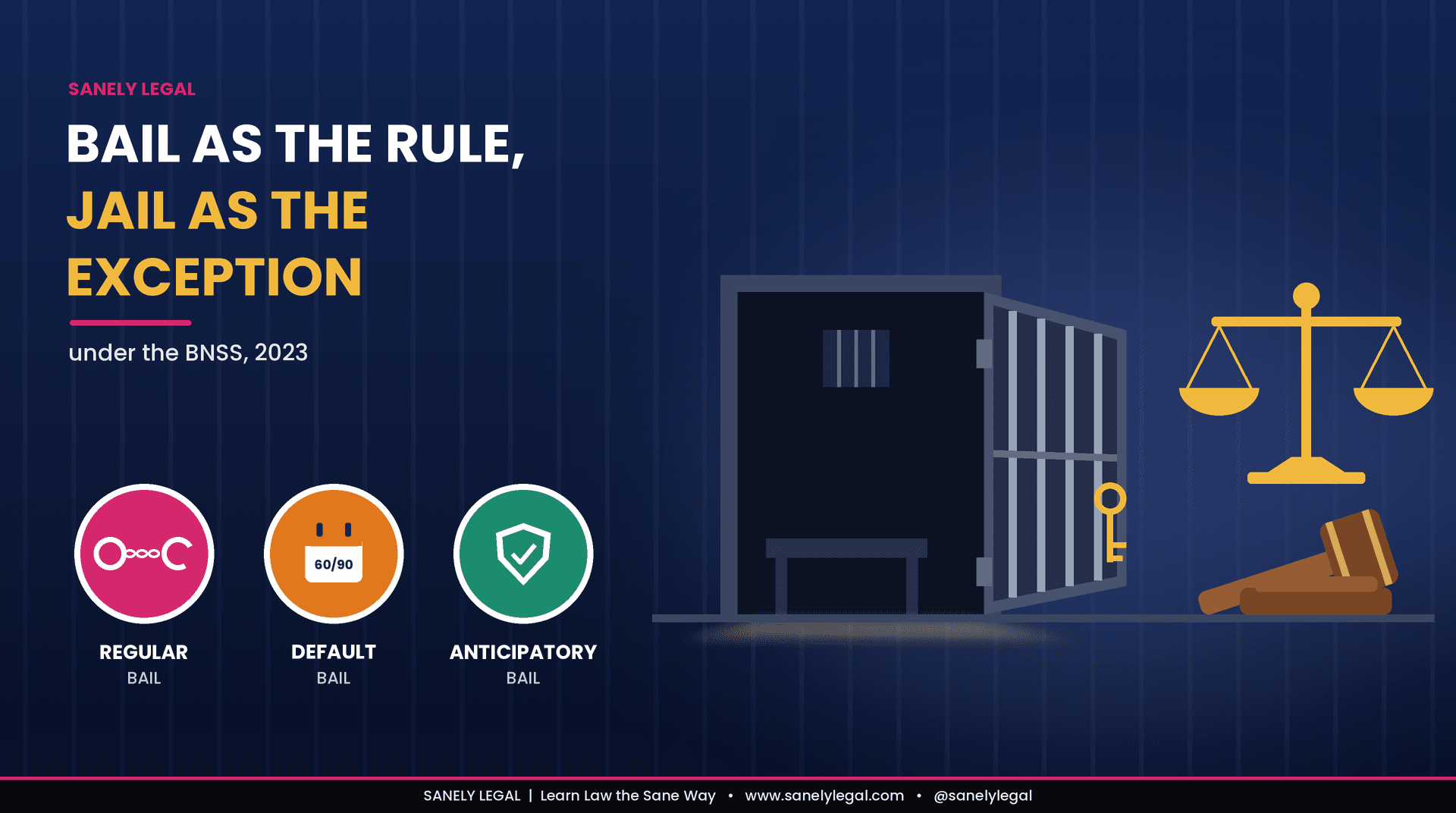
Bail as the Rule,Jail as the exception:Regular,Default and anticipatory Bail under the Bhartiya Nagrik Suraksha Sanhita,2023
The idea that bail is rule and jail is the exception was started by the supreme court for the first time in clear terms State of Rajasthan v. Balchaaand (1977) 4 SCC 308[Case1.1],and it has since become the starting point of every bail discussion.It is a rule that comes from Article 21 of the constitution.

Pre-Litigation Practice in Civil Law: Legal Notices, Rent Agreements and Non-Disclosure Agreements in India
The importance of the pre-litigation stage becomes clearer when different statutory requirements are considered. Section 80 of the Code of Civil Procedure, 1908 imposes a specific notice requirement in suits against the Government or public officers. In commercial disputes, Section 12A of the Commercial Courts Act, 2015 introduces a separate statutory pre-institution mediation requirement for suits that do not contemplate urgent interim relief.
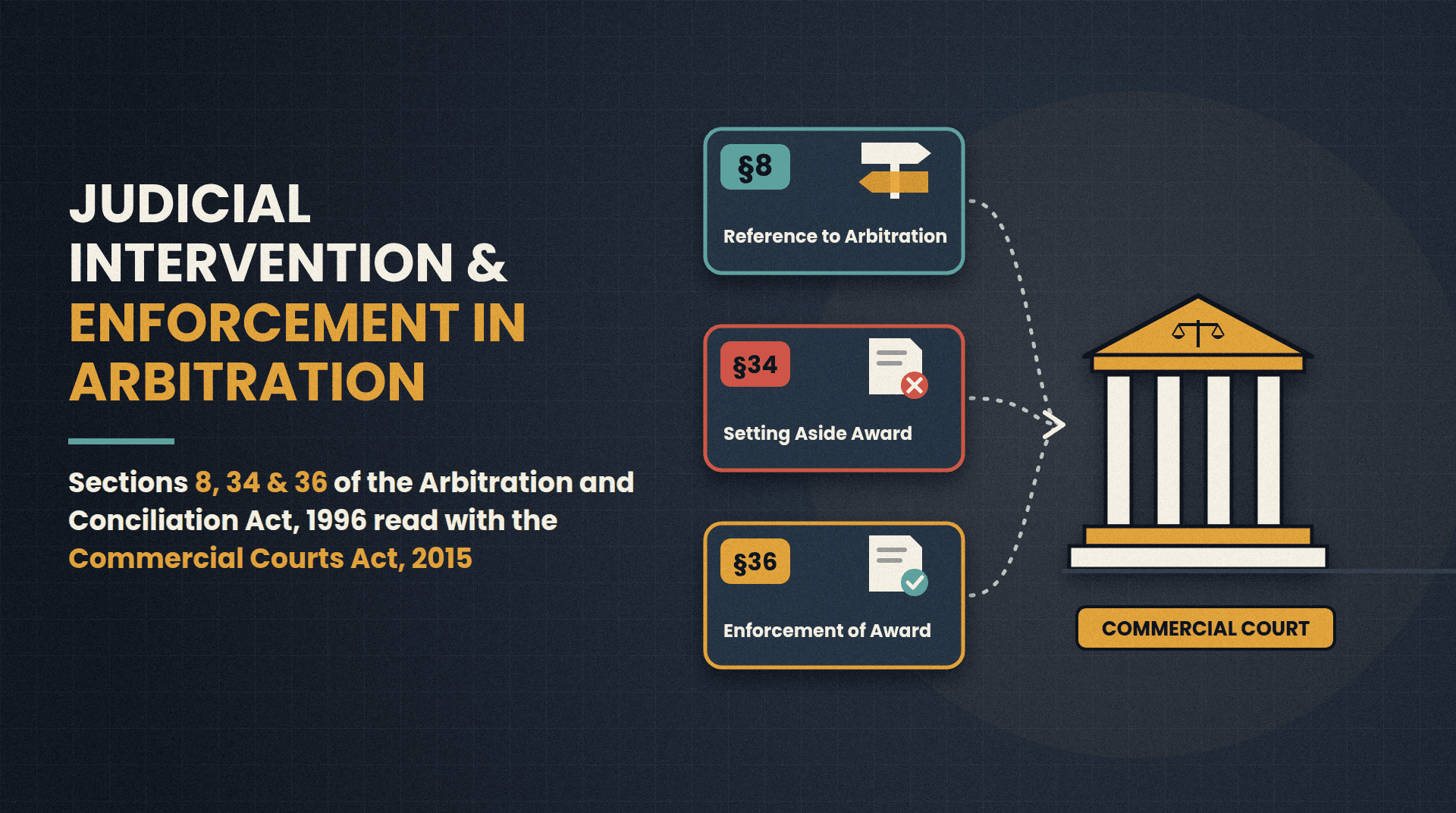
Judicial Intervention and Enforcement in Arbitration: Sections 8, 34 and 36 of the Arbitration and Conciliation Act, 1996 read with the Commercial Courts Act, 2015
ection 8 of the Arbitration and Conciliation Act, 1996 casts a positive, mandatory obligation on a judicial authority to refer parties to arbitration where the subject matter of the action before it is covered by a valid arbitration agreement, provided an application is made not later than the date of submitting the first statement on the substance of the dispute.