

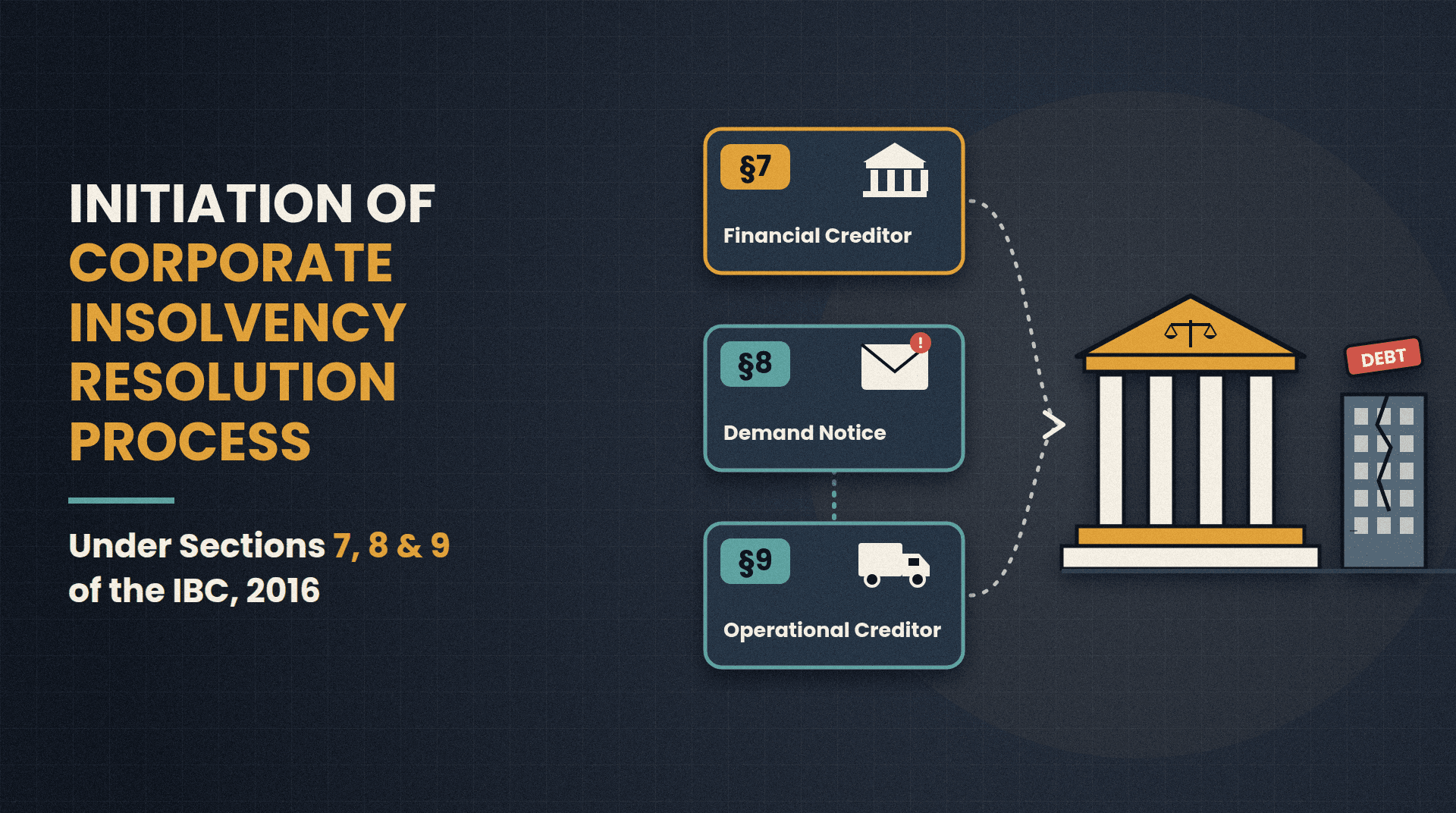
Initiation of Corporate Insolvency Resolution Process under Sections 7, 8 and 9 of the IBC, 2016
MOHD. HASNAIN SHEIKH
15 Oct 2026 24 min read
- Decided
- 15 Oct 2026
Question 1: Distinction in Threshold Requirements, Scrutiny Standards, and Dispute Relevance under Sections 7, 9 (r/w 8), and 10 of IBC 2016
1. Core Scheme of CIRP Initiation: The Insolvency and Bankruptcy Code, 2016 (IBC) establishes a creditor in control, trigger based mechanism for resolving corporate distress. However, the architecture governing initiation differs fundamentally depending on the class of applicant, Financial Creditors under Section 7, Operational Creditors under Section 9 (preceded by a mandatory demand notice under Section 8), and Corporate Applicants under Section 10.
A. Financial Creditor Applications (Section 7): Financial Creditors (Section 7) must demonstrate a 'financial debt' under Section 5(8) and a corresponding 'default' exceeding the statutory threshold (currently ₹1 Crore). Financial debt is defined by the commercial effect of a borrowing having a time value of money. The Section 7 applicant does not need to show that debt is due exclusively to itself; default in respect of any financial creditor above the threshold suffices. The standard of scrutiny applied by the Adjudicating Authority (NCLT) is strictly objective, determining whether debt and default exist. Crucially, the Supreme Court in Swiss Ribbons Pvt. Ltd. v. Union of India [(2019) 4 SCC 17] and Pioneer Urban Land & Infrastructure Ltd. v. Union of India [(2019) 8 SCC 416] affirmed that financial creditors are institutional investors/lenders capable of evaluating financial viability, making admission under Section 7 focused squarely on default.
B. Operational Creditor Applications (Section 8 & 9): In contrast, Operational Creditors (Section 9) must navigate a two-stage statutory requirement. Before filing under Section 9, the operational creditor must serve a mandatory 10 day Demand Notice under Section 8(1) in Form 3 or Form 4. The corporate debtor has 10 days to either demonstrate payment or bring to notice the existence of a 'pre-existing dispute' or record of a pending suit or arbitration. If no payment or notice of dispute is received within 10 days, the operational creditor may file under Section 9. The threshold for operational debt is also ₹1 Crore. The standard of scrutiny applied by the NCLT under Section 9 is dual, the Tribunal must verify not only the existence of operational debt and default, but must affirmatively satisfy itself that NO pre-existing dispute or suit/arbitration existed prior to the receipt of the Section 8 demand notice.
C. Corporate Applicant Applications (Section 10): Section 10 allows the Corporate Debtor itself to initiate CIRP upon experiencing default exceeding ₹1 Crore. The application requires explicit approval by special resolution of shareholders or 3/4th total partners. The standard of scrutiny involves verifying corporate authority, books of accounts, and absence of disqualifications under Section 29A/11. The existence of a dispute between management and creditors is inapplicable, as the corporate debtor voluntarily submits to resolution.
D. Exclusive Relevance of 'Dispute' to Section 9: The existence of a 'dispute' is legally relevant ONLY to Section 9 applications. Under Section 7, the existence of a dispute regarding the underlying transaction or counter-claims raised by the corporate debtor is completely irrelevant, provided debt and default are established. In Innoventive Industries Ltd. v. ICICI Bank [(2018) 1 SCC 407], the Supreme Court held that once the NCLT is satisfied that a financial default occurred, the application MUST be admitted; the debtor cannot raise disputes regarding breach of contract or unliquidated damages under Section 7. This principle was briefly obscured by Vidarbha Industries Power Ltd. v. Axis Bank Ltd. [(2022) 8 SCC 352] which suggested NCLT discretion, but the IBC (Amendment) Act, 2026 has inserted an explicit Explanation to Section 7, reaffirming that mandatory admission applies upon proof of debt and default, rendering dispute defences strictly confined to Section 9.
Comparative Overview of CIRP Initiation Frameworks
Parameter | Section 7 (Financial Creditor) | Section 9 (Operational Creditor) | Section 10 (Corporate Applicant) |
Applicant Identity | Financial Creditor (or jointly / class of homebuyers) | Operational Creditor (goods, services, employment, statutory dues) | Corporate Debtor / Promoter / Authorised Representative |
Pre-Initiation Notice | Not Required (Direct application to NCLT) | Mandatory 10 Day Demand Notice under | Not Required (Requires Special Resolution / Corporate |
Section 8(1) | Consent) | ||
Minimum Threshold | ₹1 Crore (Notification dated 24.03.2020) | ₹1 Crore (Uniform threshold post 2020) | ₹1 Crore (Default by Corporate Debtor itself) |
Relevance of 'Dispute' | Completely Irrelevant. Default alone triggers admission. | CRITICAL BAR. Pre existing dispute completely blocks admission. | Irrelevant. Process initiated voluntarily by debtor. |
Question 2: Pre-Existing Dispute under Section 9 & Standards of Judicial Scrutiny
1. Legislative Intent and Statutory Scheme: Under Section 9 of the IBC, the presence of a 'pre-existing dispute' acts as an absolute statutory bar to the initiation of CIRP. Because operational debts usually stem from commercial transactions for goods or services where quality, delivery, pricing, and counter claims are frequent, the legislature intended to prevent the IBC from being converted into a coercive debt recovery forum for disputed operational claims.
2. The Mobilox Innovations Test: The authoritative landmark defining 'pre-existing dispute' is the Supreme Court's decision in Mobilox Innovations Pvt. Ltd. v. Kirusa Software Pvt. Ltd. [(2018) 1 SCC 353]. The Apex Court interpreted Section 8(2)(a) and Section 9(5)(ii)(d) and laid down the 'plausible contention' test. The Court held that the NCLT at the admission stage is NOT required to satisfy itself as to whether the corporate debtor will ultimately succeed in the dispute, nor is it entitled to examine the merits of the dispute as if it were conducting a trial.
3. Three-Pronged Test for Pre-Existing Dispute: Instead, the NCLT must limit its inquiry to determining whether there exists a genuine, real dispute raised prior to the receipt of the Section 8 demand notice. The dispute must satisfy three conditions: (i) It must exist PRIOR to the date of receipt of the Section 8 demand notice; (ii) It must not be a 'patently feeble legal argument' or an assertion unsupported by evidence; and (iii) It must not be a 'moonshine' or spurious defence created as an afterthought to escape CIRP. If a plausible contention of a dispute exists such as prior correspondence alleging breach of warranty, defective goods, delayed delivery, or invocation of arbitration, the NCLT MUST reject the Section 9 application.
4. How Operational Creditors Can Defeat Spurious Pleas: To defeat a plea of pre-existing dispute, the Operational Creditor must establish that: (a) The defence raised by the corporate debtor in response to the Section 8 notice was raised for the VERY FIRST TIME after receiving the demand notice; (b) There was clean, unconditional acceptance of invoices/goods without protest prior to the Section 8 notice; or (c) The communications relied upon by the corporate debtor do not constitute a dispute regarding the operational debt itself. In K. Kishan v. Vijay Nirman Co. Pvt. Ltd. [(2018) 17 SCC 662], the Supreme Court held that even a cross-claim or an arbitral award challenged under Section 34 of the Arbitration Act constitutes a pre-existing dispute, cementing the standard that operational creditors cannot use CIRP when genuine litigation is pending.
Question 3: Scope of Appeal under Section 61, Limitation Period, and Strict Condonation Rules
1. Statutory Scheme of Section 61(2): Section 61 of the IBC provides the statutory right of appeal to any person aggrieved by an order of the Adjudicating Authority (NCLT) before the National Company Law Appellate Tribunal (NCLAT). However, given that the IBC is a time bound Code designed to preserve economic asset value, the statutory framework imposes strict, non-negotiable temporal constraints on appellate filings.
2. The Strict 30+15 Day Limitation Condonation Cap: Under Section 61(2), an appeal must be filed within thirty (30) days from the date of the order. The proviso to Section 61(2) empowers the NCLAT to condone a delay in filing the appeal, but strictly limits this condonation power to a maximum period of fifteen (15) days, provided 'sufficient cause' is demonstrated. The total outer limit within which an appeal can be entertained by NCLAT is thus exactly forty-five (45) days from the date of the impugned order.
3. The Landmark V. Nagarajan Principles: The seminal Supreme Court ruling in V. Nagarajan v. SKS Ispat & Power Ltd. [(2022) 2 SCC 244] authoritatively settled when the limitation clock begins. The 3-Judge Bench held that limitation under Section 61(2) begins from the date of PRONOUNCEMENT of the order in open court, NOT from the date the order is uploaded on the website, nor from the date a certified copy is received by the litigant (unless an application for a certified copy was filed promptly). The Court clarified that Sections 61(1) and (2) consciously omit the words 'from the date on which a copy of the order is made available', which exist in Section 421(3) of the Companies Act, 2013. The general condonation provisions under Section 5 of the Limitation Act, 1963 CANNOT extend the delay beyond the 15-day statutory cap provided under Section 61(2) of the Code.
4. Ouster of Section 5 Limitation Act Discretion: This strict position was reinforced in Kalpraj Dharamshi v. Kotak Investment Advisors Ltd. [(2021) 10 SCC 401] and Sanket Kumar Agarwal v. APG Logistics Pvt. Ltd. [(2023) 8 SCC 116]. The Supreme Court emphasized that the IBC is a complete self-contained code that overrides general statutes under Section 238. Consequently, the NCLAT has NO inherent jurisdiction or discretion to condone even a single day's delay beyond 45 days (30 days statutory + 15 days condonable). Litigants are under a strict duty of diligence to apply for certified copies immediately upon pronouncement if they intend to file an appeal.
Question 4: Critical Examination of the Insolvency and Bankruptcy Code (Amendment) Act, 2026
1. Overview of the 2026 Legislative Reforms: The Insolvency and Bankruptcy Code (Amendment) Act, 2026 (Act No. 6 of 2026) represents the most comprehensive statutory reform of India's insolvency regime since 2016. The Amendment directly addresses systemic delays at the admission stage, clarifies ambiguous judicial rulings, and modernizes the procedural architecture for CIRP initiation.
A. Mandatory Admission under Section 7 Overcoming Vidarbha Power: The 2026 Amendment inserts an explicit Explanation to Section 7, clarifying that once the existence of a debt and default are established (particularly via an Information Utility record under Section 215), the Adjudicating Authority MUST admit the application. The NCLT is expressly barred from considering any collateral, equitable, or extraneous circumstances such as the solvent status of the corporate debtor, pending receivables, or temporary liquidity issues. This statutory change directly overcomes the contentious ruling in Vidarbha Industries Power Ltd. v. Axis Bank Ltd. [(2022) 8 SCC 352], restoring the absolute mandatory admission rule laid down in Innoventive Industries Ltd. v. ICICI Bank [(2018) 1 SCC 407].
B. Strict Binding Timelines (14-Day Rule at Admission): To enforce procedural rigour, Clause 4 of the 2026 Amendment Act mandates that the NCLT must pass an order admitting or rejecting a CIRP application under Sections 7, 9, or 10 within a strict period of 14 days from receipt. If the NCLT fails to pass an order within 14 days, it is statutorily required to record written reasons for the delay, which are subject to administrative scrutiny by the President of NCLT and IBBI.
C. Redefining 'Security Interest' to Overrule Rainbow Papers: The 2026 Amendment inserts an Explanation to Section 3(31), clarifying that a 'security interest' exists ONLY where created by contract or agreement inter se parties, and NOT where claimed solely by operation of law/statute. This amendment effectively nullifies the Supreme Court's controversial ruling in State Tax Officer v. Rainbow Papers Ltd. [(2022) 13 SCC 121], establishing that statutory government tax claims cannot be treated as secured operational debt, preserving the waterfall priority under Section 53.
D. Codification of Avoidance Transactions & Asset-Specific Plans: The 2026 Act formally inserts statutory definitions for 'avoidance transaction' and 'fraudulent or wrongful trading', creating a unified mechanism for Resolution Professionals to challenge preferential (Sec 43), undervalued (Sec 45), extortionate (Sec 50), and fraudulent (Sec 66) transactions during CIRP. Additionally, the definition of 'resolution plan' under Section 30 is expanded to allow the sale of individual assets or asset pools through multiple resolution plans proposed by different resolution applicants.
E. Introduction of CIIRP, Group Insolvency & Cross-Border Frameworks: The 2026 Reform introduces statutory frameworks for Creditor-Initiated Insolvency Resolution Process .
Question 5: Interplay Between IBC Insolvency Proceedings and M&A Strategies for Distressed Companies
1. Distressed M&A Dynamics: Distressed M&A in India operates across two distinct legal channels: out-of-court negotiated acquisitions (under Companies Act schemes or bilateral debt transfers) and court monitored insolvency acquisitions via a Resolution Plan under the IBC framework. Strategic acquirers increasingly prefer the IBC route due to distinct statutory protections unavailable in negotiated deals.
2. The 'Clean Slate' Doctrine (Section 31 Immunity): The primary advantage of acquiring a target through an IBC Resolution Plan is the statutory protection of the 'Clean Slate' doctrine. In Committee of Creditors of Essar Steel India Ltd. v. Satish Kumar Gupta [(2020) 8 SCC 531] and Ghanshyam Mishra & Sons Pvt. Ltd. v. Edelweiss Asset Reconstruction Co. Ltd. [(2021) 9 SCC 657], the Supreme Court established that upon approval of a Resolution Plan under Section 31(1), all past liabilities, undisclosed claims, statutory tax dues, and operational debts NOT included in the resolution plan are PERMANENTLY EXTINGUISHED. A successful resolution applicant starts with a completely clean slate, immune from surprise legacy liabilities.
3. Resolution Plan vs. Negotiated Out-of-Court M&A: Acquiring outside IBC carries significant liability risks: legacy tax demands, hidden guarantor claims, and operational liabilities follow the target corporate entity. Furthermore, an out-of-court deal requires unanimous consent among multiple lender classes, whereas an IBC Resolution Plan requires only 66% voting approval by value in the Committee of Creditors (CoC) under Section 30(4), binding all dissenting financial creditors and operational creditors once sanctioned under Section 31.
4. Statutory Moratorium under Section 14: The moratorium under Section 14 acts as a statutory shield during negotiations, freezing all civil litigation, legal recovery actions, asset enforcement under SARFAESI, and eviction proceedings against the corporate debtor. This gives the acquirer a stable environment to perform operational due diligence without asset stripping.
5. Section 29A Filter and Avoidance Transaction Due Diligence: Section 29A filters out defaulting promoters, connected persons, and willful defaulters from bidding for their own company, preventing moral hazard. During due diligence, the RP and acquirer investigate avoidance transactions under Sections 43 (Preferential), 45 (Undervalued), 50 (Extortionate Credit), and 66 (Fraudulent Trading). Unlawful pre-CIRP asset transfers made by former promoters can be clawed back for the benefit of the corporate debtor under Section 44/48, enhancing the net asset value acquired.
CHRONOLOGY MATRIX OF LANDMARK JUDGMENTS (2017 – 2026)
Judicial Evolution of IBC Initiation & Appellate Jurisprudence: In accordance with Section 2 of the Submission Instructions, the following chronological table details ten (10) landmark decisions of the Supreme Court of India governing Sections 7, 8, 9, and 61 of the IBC. The table outlines the Ratio Decidendi, Obiter Dicta, and the sequential evolutionary connection demonstrating how later decisions followed, distinguished, modified, or overruled earlier legal positions leading to the 2026 legislative framework.
Case Name & Year | Citation & Coram | Ratio Decidendi | Obiter Dicta / Key Observation | Sequential Connection / Evolutionary Link |
1. Innoventive Industries Ltd. v. ICICI Bank (2017) | (2018) 1 SCC 407 [2-Judge Bench] | Under Sec 7, NCLT only needs to satisfy itself of 'debt' and 'default'. Once default occurs, admission is mandatory. Debtor cannot raise dispute arguments. | IBC is a paradigm shift from 'debtor in-possession' to 'creditor-in control'. Speed of admission is essence of the Code. | FIRST LANDMARK. Established bedrock rule for Sec 7. Directly followed in Swiss Ribbons; temporarily altered by Vidarbha (2022); restored by 2026 Amendment. |
2. Mobilox Innovations Pvt. Ltd. v. Kirusa Software (2017) | (2018) 1 SCC 353 [2-Judge Bench] | Sec 9 requires absence of pre existing dispute. Dispute must exist prior to Sec 8 notice and not be a moonshine defence or patently feeble legal argument. | NCLT must not examine merits or conduct trial; only determine if plausible contention of real dispute exists. | Complements Innoventive by establishing operational debt trigger rule. Followed in K. Kishan and Transmission Corp. |
3. K. Kishan v. Vijay Nirman Company Pvt. Ltd. (2018) | (2018) 17 SCC 662 [2-Judge Bench] | An arbitral award challenged under Sec 34 of Arbitration Act constitutes a 'pre | CIRP cannot be used as a threat mechanism to enforce payment | Extended Mobilox doctrine to arbitral challenges, confirming |
existing dispute' under Sec 9, blocking CIRP admission. | of disputed operational awards. | operational creditors cannot bypass pending judicial disputes. | ||
4. Swiss Ribbons Pvt. Ltd. v. Union of India (2019) | (2019) 4 SCC 17 [2-Judge Bench] | Upheld constitutional validity of IBC in entirety. Validated classification between Financial Creditors and Operational Creditors under Sec 7 and 9. | Financial creditors fund long-term capital assets; operational creditors supply short-term working goods. Differential treatment is legally sound. | Consolidated Innoventive & Mobilox principles, providing constitutional foundation for creditor priority. |
5. Pioneer Urban Land & Infra v. Union of India (2019) | (2019) 8 SCC 416 [3-Judge Bench] | Homebuyers are Financial Creditors under Sec 5(8)(f). Real estate allotted amounts raised have commercial effect of borrowing. | Homebuyers can invoke Sec 7 jointly. RERA and IBC operate in complementary spheres. | Expanded Sec 7 financial creditor class recognized in Swiss Ribbons to cover real estate allottees. |
6. Kalpraj Dharamshi v. Kotak Investment (2021) | (2021) 10 SCC 401 [3-Judge Bench] | Commercial wisdom of CoC under Sec 30(4) is non justiciable. Appeals under Sec 61 cannot challenge business decisions of creditors. | Timelines under IBC are mandatory. Delay beyond statutory condonable period under Sec 61(2) cannot be condoned. | Paved way for V. Nagarajan by strict enforcement of appellate timeline caps under Sec 61. |
7. V. Nagarajan v. SKS Ispat & Power Ltd. (2021/2022) | (2022) 2 SCC 244 [3-Judge Bench] | Limitation under Sec 61(2) runs from date of order PRONOUNCEMEN T, not uploading. Sec 5 Limitation Act cannot extend delay | Aggrieved litigants must exercise due diligence and apply for certified copy immediately upon | SETTLED APPELLATE LIMITATION LAW. Directly applied Kalpraj Dharamshi; followed in Sanket |
beyond 15-day cap. | pronouncement. | Kumar Agarwal (2023). | ||
8. Vidarbha Industries Power v. Axis Bank (2022) | (2022) 8 SCC 352 [2-Judge Bench] | Held that NCLT has discretion ('may') under Sec 7(5)(a) to reject or defer admission despite default if debtor shows financial solvency/receivables. | Distinguished financial distress caused by external regulatory delays from total insolvency. | TEMPORARY DEPARTURE from Innoventive. Created uncertainty; explicitly OVERRIDDEN by 2026 IBC Amendment Act Explanation to Sec 7. |
9. State Tax Officer v. Rainbow Papers Ltd. (2022) | (2022) 13 SCC 121 [2-Judge Bench] | Held statutory state tax dues created charge by operation of law, making State a 'secured creditor' under IBC waterfall. | A resolution plan ignoring statutory government charges is invalid. | CONTROVERSIA L DEPARTURE. Subverted Sec 53 waterfall; explicitly OVERRULED by 2026 Amendment Explanation to Sec 3(31). |
10. Sanket Kumar Agarwal v. APG Logistics (2023) | (2023) 8 SCC 116 [3-Judge Bench] | Reaffirmed V. Nagarajan rule: Limitation for Sec 61 NCLAT appeal begins on pronouncement date. E-filing date governs limitation computation. | Time spent obtaining certified copy is excluded under Sec 12(2) Limitation Act ONLY if application was filed promptly. | Reaffirmed V. Nagarajan and cemented current appellate procedural jurisprudence entering 2026. |
Category 1 - Section 7: Financial Creditor Applications & Admission Standard
Case Name & Year | Innoventive Industries Ltd. v. ICICI Bank & Anr. (2017) |
Citation & Coram | Civil Appeal Nos. 8337-8338 of 2017 | (2018) 1 SCC 407 | Supreme Court of India Coram: Hon'ble Rohinton F. Nariman and L. Nageswara Rao, JJ. |
Issue before the Court | Whether an application under Section 7 of the IBC by a financial creditor must be admitted automatically once debt and default are established, notwithstanding state relief moratorium legislation (Maharashtra Relief Undertakings Act)? |
Brief Facts | ICICI Bank initiated CIRP against Innoventive Industries Ltd. for default on credit facilities exceeding ₹100 Crores. The corporate debtor argued that no default occurred because its liabilities were suspended under a notification issued under the Maharashtra Relief Undertakings (Special Provisions) Act (MRU Act). |
Ratio Decidendi (Binding) | Under Section 7(5)(a), once the NCLT is satisfied that a financial debt exists and a default exceeding the statutory threshold has occurred, admission of the CIRP application is MANDATORY. The Adjudicating Authority is not required to examine any collateral disputes, set-offs, or state moratorium statutes, as Section 238 of the IBC has overriding non-obstante effect. |
Obiter Dicta (Persuasive) | The legislature consciously shifted Indian insolvency law from 'debtor-in-possession' to 'creditor-in-control'. Speed is of the essence under the IBC, and long drawn inquiries into debtor solvency at the threshold stage would defeat the statutory mandate. |
Significance / Link | FIRST SUPREME COURT JUDGMENT ON IBC. Established the mandatory admission principle for Section 7, forming the benchmark restored by the IBC (Amendment) Act, 2026. |
Case Name & Year | Vidarbha Industries Power Ltd. v. Axis Bank Ltd. (2022) |
Citation & Coram | Civil Appeal No. 4633 of 2021 | (2022) 8 SCC 352 | Supreme Court of India Coram: Hon'ble Indira Banerjee and J.K. Maheshwari, JJ. |
Issue before the Court | Whether the word 'may' in Section 7(5)(a) grants discretionary power to the NCLT to refuse or defer admission of a Section 7 CIRP application even when debt and default are established? |
Brief Facts | Axis Bank filed a Section 7 application against Vidarbha Power for default exceeding ₹550 Crores. Vidarbha argued that its default was temporary due to non-receipt of ₹1,730 Crores awarded in its favour by APTEL, and that it was an otherwise solvent power utility. |
Ratio Decidendi (Binding) | The Supreme Court held that the word 'may' in Section 7(5)(a) confers discretionary power on the NCLT to reject or stay a Section 7 application if extraordinary circumstances show the debtor is solvent and capable of clearing debt upon receiving pending regulatory receivables. |
Obiter Dicta (Persuasive) | Unlike Section 9 where admission is mandatory upon default ('shall'), Section 7 uses 'may', indicating that financial creditor applications should not be admitted arbitrarily if business rescue is possible outside CIRP. |
Significance / Link | TEMPORARY DEPARTURE FROM INNOVENTIVE. Triggered wide debate and uncertainty regarding Section 7 admission rigour; explicitly overridden by the Explanation inserted into Section 7 by the IBC (Amendment) Act, 2026. |
Case Name & Year | Swiss Ribbons Pvt. Ltd. & Anr. v. Union of India & Ors. (2019) |
Citation & Coram | Writ Petition (Civil) No. 99 of 2018 | (2019) 4 SCC 17 | Supreme Court of India Coram: Hon'ble R.F. Nariman and Navin Sinha, JJ. |
Issue before the Court | Whether the constitutional validity of various provisions of the IBC, including differential treatment of Financial vs Operational Creditors and Section 29A, is maintainable under Article 14 of the Constitution? |
Brief Facts | Multiple corporate debtors and promoters challenged the constitutional validity of the IBC, alleging that treating financial creditors differently from operational creditors and barring |
promoters under Section 29A were arbitrary and unconstitutional. | |
Ratio Decidendi (Binding) | The Supreme Court upheld the constitutional validity of the IBC in its entirety. It ruled that the classification between financial creditors and operational creditors is based on an intelligible differentia having a rational nexus to the objective of debt resolution. |
Obiter Dicta (Persuasive) | The primary objective of the IBC is corporate revival and preservation of asset value, not recovery of debts. Operational creditors receive fair protection through priority under Section 53 and representation. |
Significance / Link | CONSTITUTIONAL BEDROCK OF IBC. Validated the creditor hierarchy, Section 29A promoter bar, and the primacy of Committee of Creditors (CoC) commercial wisdom. |
Category 2 - Section 9: Operational Creditor Applications & Pre-Existing Dispute
Case Name & Year | Mobilox Innovations Pvt. Ltd. v. Kirusa Software Pvt. Ltd. (2017) |
Citation & Coram | Civil Appeal No. 9405 of 2017 | (2018) 1 SCC 353 | Supreme Court of India Coram: Hon'ble R.F. Nariman and L. Nageswara Rao, JJ. |
Issue before the Court | What constitutes a 'pre-existing dispute' under Section 8 and 9 of the IBC, and what is the standard of inquiry required by the NCLT at the admission stage? |
Brief Facts | Kirusa Software issued a Section 8 demand notice for operational debt under a non-disclosure agreement. Mobilox replied asserting that Kirusa had breached confidentiality obligations resulting in customer loss. Kirusa argued this reply was a spurious post-notice defence. |
Ratio Decidendi (Binding) | NCLT must reject a Section 9 application if a pre-existing dispute or suit/arbitration existed BEFORE receipt of the Section 8 demand notice. The dispute must satisfy the 'plausible contention' test, it must not be a patently feeble legal argument or a moonshine defence. |
Obiter Dicta (Persuasive) | The NCLT at the admission stage cannot hold a trial or examine the merits of the dispute. So long as a real, non-spurious dispute exists prior to the demand notice, Section 9 initiation is barred. |
Significance / Link | THE MAGNA CARTA OF SECTION 9 JURISPRUDENCE. Established the seminal standard for pre-existing disputes, cited universally in all operational creditor litigations. |
Case Name & Year | K. Kishan v. Vijay Nirman Company Pvt. Ltd. (2018) |
Citation & Coram | Civil Appeal Nos. 21824-21825 of 2017 | (2018) 17 SCC 662 | Supreme Court of India Coram: Hon'ble R.F. Nariman and Indu Malhotra, JJ. |
Issue before the Court | Whether an operational creditor can initiate CIRP under Section 9 on the basis of an arbitral award when a challenge under Section 34 of the Arbitration Act is pending? |
Brief Facts | Vijay Nirman obtained an arbitral award against K. Kishan (KTECL) and issued a Section 8 demand notice. K. Kishan had challenged the arbitral award under Section 34 of the Arbitration Act before the civil court. |
Ratio Decidendi (Binding) | The pendency of a Section 34 challenge against an arbitral award automatically constitutes a 'pre-existing dispute' under Section 9 of the IBC. CIRP cannot be initiated on disputed arbitral claims. |
Obiter Dicta (Persuasive) | The IBC cannot be used as a threat mechanism or coercive recovery tool to enforce arbitral awards while statutory challenge proceedings are pending before competent civil courts. |
Significance / Link | Reinforced the Mobilox doctrine by extending pre-existing dispute immunity to challenged arbitral awards, protecting debtors from coercive insolvency pressure. |
Category 3 - Section 61 NCLAT Appeals: Limitation & Scope of Review
Case Name & Year | V. Nagarajan v. SKS Ispat & Power Ltd. & Ors. (2021/2022) |
Citation & Coram | Civil Appeal No. 3327 of 2020 | (2022) 2 SCC 244 | Supreme Court of India Coram: Hon'ble D.Y. Chandrachud, A.S. Bopanna and J.B. Pardiwala, JJ. |
Issue before the Court | When does the limitation period for filing an appeal under Section 61(2) of the IBC commence, and can delay beyond the 15-day condonable period be condoned under Section 5 of the Limitation |
Act? | |
Brief Facts | The liquidator (Nagarajan) appealed against an NCLT order passed on 31 Dec 2019. The order was uploaded on 12 March 2020 and rectified on 20 March 2020. The liquidator filed an appeal on 8 June 2020, claiming limitation ran from copy availability. |
Ratio Decidendi (Binding) | Limitation under Section 61(2) runs strictly from the date of PRONOUNCEMENT of the order in open court. NCLAT has power to condone delay ONLY up to 15 days beyond 30 days upon sufficient cause. Section 5 of Limitation Act CANNOT be invoked to extend delay beyond 45 days total. |
Obiter Dicta (Persuasive) | IBC is a special self-contained code emphasizing rapid resolution. Omission of the phrase 'date on which copy is made available' in Section 61 was deliberate; litigants must act with due diligence. |
Significance / Link | LANDMARK ON SECTION 61 APPELLATE LIMITATION. Settled the non-negotiable 30+15 day limitation cap, routinely enforced across all NCLAT proceedings. |
Case Name & Year | Kalpraj Dharamshi & Anr. v. Kotak Investment Advisors Ltd. & Anr. (2021) |
Citation & Coram | Civil Appeal Nos. 2943-2944 of 2020 | (2021) 10 SCC 401 | Supreme Court of India Coram: Hon'ble A.M. Khanwilkar, B.R. Gavai and Krishna Murari, JJ. |
Issue before the Court | Whether the NCLAT can interfere with the commercial wisdom of the Committee of Creditors (CoC) under Section 31 in approving a resolution plan, and what is the scope of limitation condonation under Section 61? |
Brief Facts | Kotak Investment challenged the CoC's approval of Kalpraj Dharamshi's resolution plan, alleging procedural delays in submission. NCLAT set aside the CoC decision, prompting appeal to the Supreme Court. |
Ratio Decidendi (Binding) | The commercial wisdom of the CoC is supreme and non-justiciable. Neither NCLT nor NCLAT can review the business judgment of the CoC under Section 31 or Section 61, except within the narrow bounds of Section 30(2). |
Obiter Dicta | Timelines in the IBC must be strictly adhered to by all stakeholders |
MOHD. HASNAIN SHEIKH
More precedents
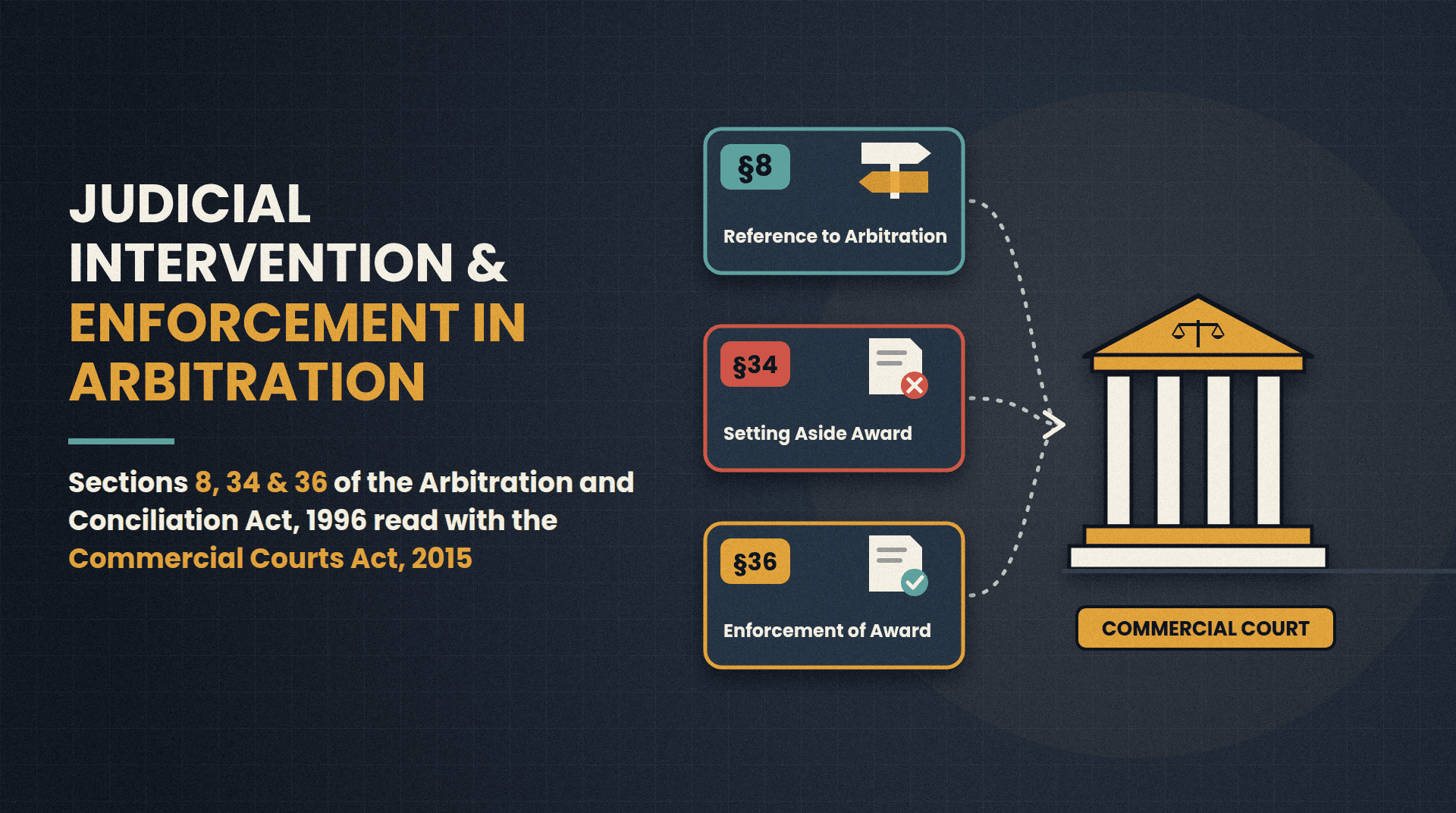
Judicial Intervention and Enforcement in Arbitration: Sections 8, 34 and 36 of the Arbitration and Conciliation Act, 1996 read with the Commercial Courts Act, 2015
ection 8 of the Arbitration and Conciliation Act, 1996 casts a positive, mandatory obligation on a judicial authority to refer parties to arbitration where the subject matter of the action before it is covered by a valid arbitration agreement, provided an application is made not later than the date of submitting the first statement on the substance of the dispute.

Sports Law in India: Governance of National Sports Federations, Athlete Rights and Dispute Resolution
A fundamental right of participation in games or representing India in certain competitions cannot be derived from the provisions of the Constitution. Even so, the governance of sports is governed by constitutional principles where it impinges upon equality, dignity, livelihood, reputation, or access to public opportunities.

Service Jurisprudence and the Law of Summary Suits: Judicial Review of Employment Disputes under Article 311 and Recovery of Money under Order XXXVII CPC, 1908
This rule became the basis of today's review test in B.C. Chaturvedi v. Union of India (1995), according to which judicial review is concerned not with the decision but with the process of making the decision, checking whether the inquiry was conducted within official statutory framework and in accordance with the basic requirements of fairness.