

Service Jurisprudence and the Law of Summary Suits: Judicial Review of Employment Disputes under Article 311 and Recovery of Money under Order XXXVII CPC, 1908
Kavin D.
12 Oct 2026 44 min read
- Decided
- 12 Oct 2026

Question 1: Article 311 and its constitutional protection of civil servant - meaning of ‘reasonable opportunity’ and provisos to Art. 311(2).
Article 311 of the Constitution is the special job security provision for civil servants employed by the Union or a State. It goes further than fundamental rights. According to Article 311(1), a civil servant cannot be dismissed or removed by an authority ranking below that which employs him. According to Article 311(2), which is the main provision in practice, no such civil servant can be dismissed, removed or reduced in rank without an inquiry at which he shall be informed of the charges against him and given a reasonable opportunity of showing cause why the action should not be taken against him. What constitutes this 'reasonable opportunity' was laid down in Khem Chand v. Union of India (1957). It has three elements: (a) an opportunity to refute the charges and establish his innocence, which means the servant must be told of the charges and the evidence against him; (b) an opportunity to put up his defense by cross-examination of witnesses and adducing of evidence on his behalf; and (c) an opportunity to oppose the proposed punishment after the inquiry and once the decision-maker comes to a tentative conclusion on the penalty. In effect, the Supreme Court explained that it consists of two notices at two stages, namely, of the charge and of the punishment.
It was cut drastically by the 42nd Constitutional Amendment Act in 1976 by doing away with the second notice concerning the punishment. It created a great legal controversy which was settled by a five-judge bench in Managing Director, ECIL v. B. Karunakar (1993) whether the civil servant still has a right to know the contents of the inquiry report before any decision on guilt. The answer was in the affirmative. The Supreme Court ruled that the withholding of the report before taking any decision on guilt would deny the civil servant a reasonable opportunity and constitute violation of the constitutional guarantees of justice and fairness. The principle applies not only to governmental but also to quasi-governmental and private organizations carrying out the two-stage inquiry process irrespective of whether it is expressly stipulated in the internal regulations. However, in order to keep administrative process manageable, the Court decided also that it does not render null and void any disciplinary order unless the employee can show that non-disclosure actually prejudiced his case. Three provisos in Article 311(2) limit the protection by allowing the employer to dismiss, remove or reduce in rank a civil servant without an inquiry in three cases: (a) when the dismissal arises out of conduct causing a conviction in a criminal prosecution; (b) when the decision-maker, in writing and with reasons, is satisfied that an inquiry is not feasible; or (c) when the President or a State Governor is convinced that an inquiry would pose a danger to national security.
The Supreme Court examined exception (a) in Divisional Personnel Officer, Southern Railway v. T.R. Chellappan (1976). It decided that this exception exempts the employer from the procedural requirement of a formal departmental inquiry because the person who has been dismissed has already undergone an inquiry and obtained a complete opportunity to defend himself by being found guilty in a criminal proceeding. Moreover, the Court added that probational release under the Probation of Offenders Act does not wipe out the stigma of the conviction so that this exception still applies. Nine years later, a Constitution Bench radically changed the rationale of Chellappan in Union of India v. Tulsiram Patel (1985) by 4:1 majority. It decided that in any of these three cases where an exception is validly used, the need for a departmental inquiry and the requirements of natural justice contained in it are altogether done away with, not just cut down. Exceptions are based on public policy and public interest so that the decision-maker alone is able to determine whether any exception exists. Therefore, Patel in part overruled Chellappan on the point that some basic requirements of natural justice must remain intact under exception (a). Once an exception is validly invoked, the only recourse available to the civil servant is an internal departmental appeal and judicial review on extremely narrow ground - primarily proving that the precondition for applying this exception did not exist or that the decision was dishonest and totally unreasonable.
Question 2: Scope of judicial review of disciplinary proceedings, and standard of interference with quantum of punishment
While courts or tribunals conducting judicial review of workplace disciplinary proceedings have much more limited powers compared to a regular appeal, the foundation of this rule dates back to State of Orissa v. Bidyabhushan Mohapatra (1963), where Supreme Court ruled that so long as the findings of misconduct were supported by some evidence and at least one of the several charges levied against government employee was established, the court will not re-examine the evidence as to its sufficiency and adequacy, nor will it overturn the penalty just because a lesser penalty would have been applicable if only that charge was considered.
This rule became the basis of today's review test in B.C. Chaturvedi v. Union of India (1995), according to which judicial review is concerned not with the decision but with the process of making the decision, checking whether the inquiry was conducted within official statutory framework and in accordance with the basic requirements of fairness, as well as whether there was at least some evidence to support the finding-not whether it was credible and sufficient, as this is solely the employer's prerogative to judge facts. The only body authorized to reconsider evidence and penalty is the internal appeals body, if such is provided for by workplace regulations; court cannot substitute this body in acting as another appeals authority. Courts may intervene only if: (i) the inquiry violated official statutory procedures or basic rules of fairness, (ii) the conclusion is reached on the basis of absolutely no evidence, or (iii) the decision is so absurd as to leave no room for doubt that it has been reached ignoring all relevant facts and basing on nothing else but irrelevance, and violating the Wednesbury standard of unreasonableness (Council of Civil Service Unions v. Minister for the Civil Service).
Severity of punishment (quantum) is subject to even more rigorous secondary judicial review, as defined in Ranjit Thakur v. Union of India (1987). Though generally sentences are not to be interfered with, Supreme Court held that while it is up to the employer or court-martial to decide what sentence to impose, that sentence must "suit the offence and the offender", and not be grossly disproportionate so as to shock the conscience of the court, in which case the disproportion alone becomes powerful evidence of bias. In those rare cases, however, the principle of proportionality permits the court to correct the sentence, even though it is the exclusive province of the employer to choose the penalty. Proportionality standard was subsequently formally adopted in Om Kumar v. Union of India (2001), where Supreme Court held that while reviewing government action for non-compliance with Article 14 (the equality clause) and challenging it as discriminatory, courts use "primary review", and directly compare action to the purpose. However, when challenging the decision, such as the sentence issued under Article 311, for unreasonableness or lack of good faith, courts apply "secondary review", according to Wednesbury standard: courts check whether the authority has taken into account all relevant facts, ignored all irrelevant ones, and issued decision that is not so unreasonable and grossly disproportionate as to be outside the realm of possibility for any reasonable authority. Thus, Bidyabhushan Mohapatra, Chaturvedi, Ranjit Thakur and Om Kumar define clear hierarchy of situations in which courts will not re-evaluate evidence or function as another appeals authority; and in which they will do only if the decision was made in violation of legal procedures, based on absolutely no evidence, or was grossly unfair.
Question 3: Object and Scope of Order XXXVII CPC - Maintainable Claims, Leave to Defend Procedure, and Principles of Unconditional/Conditional Leave
Under Order XXXVII of the Code of Civil Procedure (CPC) a special summary process allows the creditor (plaintiff) to obtain a quick court decision (decree) in favor of his specific money claim, faster than through usual litigation proceedings. Unlike in usual lawsuits, here defendant cannot automatically appear in the court and defend himself, but must first ask for leave (permission) to do so. According to Rule 1(2), the summary procedure is limited to specific kinds of lawsuits: (1) based on financial instruments (bills of exchange, hundies, promissory notes); (2) to recover fixed debt or definite sum of money in terms of a written contract, law or guarantee - excluding general claims for uncalculated damages. Under Rule 2, the petition of lawsuit (plaint) must clearly declare that it is a summary lawsuit without additional requests; in the court summons the defendant must be informed that merely appearance in court does not grant him the right to defend - he must ask for and obtain permission after being summoned for judgment. Under Rule 3(4)-(7), the defendant's application for leave must be accompanied by a sworn statement (affidavit) of his real defence facts; the court may then grant an unconditional leave to defend (if it sees reasonable grounds for that), leave with specific conditions (including trial scheduling and financial deposits) or deny leave at all - granting the victory decree for the plaintiff. Under Rule 4, if a judgment is passed due to non-appearance of the defendant or denial of leave, the court has an extraordinary power to set that judgment aside in specific exceptional situations.
The legal guidelines for judicial discretion in that regard arose from the Calcutta High Court's decision in the case of Kiranmayi Dasi v. J. Chatterji (1949) and were later approved by the Supreme Court. The court stated that a defendant has the right to an unconditional leave to defend if his real defence on the facts or triable legal issue indicate a real or at least reasonable defence. Even if the sworn statement does not prove a defence immediately, but reveals some facts which may be used to form a valid defence during the trial, then the leave must still be granted - at most conditionally regarding the schedule or procedure of trial, but generally without any monetary deposits or securities. However, if a defendant has no defence, or if his arguments are fictitious, then the plaintiff shall win immediately, although in very rare cases the court may exercise a benevolent discretion and allow defending a defendant in case of depositing the financial security in the court.
First the Supreme Court established those guidelines for itself in Mechelec Engineers & Manufacturers v. Basic Equipment Corpn. (1976): it held that the decision of a higher High Court to overrule a reasonable trial court decision granting unconditional leave to defend should be rejected since a definite finding of facts in dispute must not be done until the examination of evidence at the trial. However, that 1976 rule was preceded by certain procedural changes and did not clarify the issue of conditional permissions and therefore was later updated and replaced in IDBI Trusteeship Services Ltd. v. Hubtown Ltd. (2017). In IDBI Trusteeship, the Supreme Court divided the above-mentioned test into five categories: (i) an unconditional leave in case the defence is strong or reasonable; (ii) permission with conditions on trial schedule or procedure in case of real trial issues when the court has some doubts about the good faith of the defendant; (iii) conditional permission to defend with a financial deposit/security - equal to the amount of the claim plus interest - in case the defence presents some controversial questions but is believable yet unlikely; (iv) denial of leave to defend if there is no real defence, no real trial issue or a frivolous argument/harassment; and (v) an absolute rule which overrides all other categories according to which no leave to defend must be granted without a prior deposit of any part of the claim by the defendant.
Two more court decisions illustrate a careful approach of higher courts to the appeal from either side in relation to the judicial discretion. In Sunil Enterprises v. SBI Commercial & International Bank Ltd. (1998) the Supreme Court held that the allegations of a defendant that he received nothing and the bank's officials conspired with other persons to commit fraud create a real issue to be tried in the court and thus the lower courts erroneously denied permission. On the contrary, in Southern Sales & Services v. Sauermilch Design & Handels GmbH (2008) the Supreme Court denied an attempt of overruling a High Court decision which corrected a trial court decision. That trial court demanded a conditional money deposit of a defendant unlimited in terms of the proved amount of the debt according to the documents of the defendant. Thus, higher courts have a justified power to correct mistakes related to the amount of money deposit.
Question 4: Summary suit under Order XXXVII CPC vs ordinary civil suit and vs recovery before the NCLT under the IBC
There are three separate paths by which a creditor may try to recover money. These are an ordinary civil suit, a summary suit under Order XXXVII, or (in case of suing a company) insolvency proceedings initiated under Section 7 or Section 9 of the Insolvency and Bankruptcy Code (IBC) before the National Company Law Tribunal (NCLT). An ordinary civil suit automatically gives the defendant the right to defend himself without clearing any preliminary conditions; it is the slowest method, but the safest and most legally protected. On the contrary, a summary suit reverses the usual course of events-the defendant has to prove to the court on the basis of his sworn statements that there is a reason for going to trial, yet it is limited to the cases described in Rule 1(2), follows the usual evidence laws and may be appealed. An IBC application is much more than a faster civil suit; it is a procedure which is meant to launch an insolvency resolution process for a company (to save it or wind it up in case of bankruptcy), not a private claim for one particular debt owed to one creditor. It was this very difference that was crucial in the rulings of the Supreme Court in Innoventive Industries Ltd. v. ICICI Bank (2018) and Mobilox Innovations Pvt. Ltd. v. Kirusa Software Pvt. Ltd. (2018). According to Section 7, a financial creditor (a bank or some other institution or organization) may begin insolvency proceedings by proving on the basis of his accounts that the payment had not been made-the function of the tribunal at this stage is limited to checking if there really was a default. As for Section 9, it provides that an operational creditor (a supplier or a service provider) must begin with sending a notice demanding repayment; if the answer of the company (or a pending litigation or arbitration case) demonstrates an existence of a dispute (which is not sham and groundless), the supplier is completely cut off from the proceedings and may only rely on the normal courts or on arbitration. Mobilox held that all the tribunal needed to do was to see a plausible non-frivolous dispute requiring additional examination, without making any judgment about the case on its merits.
The structure of the three processes determines which path should be chosen by a creditor. A summary suit is a good choice for a creditor with a clear and considered claim and an undisputed claim against a solvent debtor; its aim is to collect the money rather than deal with bankruptcy of a company-the result of such action will be an enforceable money order, the defendant will retain (limited) right to present his case and there is no threat of stripping him of the management of the company. The choice of the IBC path should be determined by the fact that the main problem is bankruptcy of a debtor, not only the refusal to pay-Section 7 or Section 9 application leads to quick resolution of the matter and to a threat of the stripping of the management of the company, a threat that was upheld to be constitutionally sound by the Supreme Court in Swiss Ribbons (P) Ltd. v. Union of India (2019) due to significant differences between the financial and operational creditors (the former evaluates the solvency of the company from the beginning and possesses clear and documented claims while the latter possess less valuable and less certain claims and often dispute them).
This feature creates the main danger of the IBC path-the possibility of using it by creditors for blackmailing the companies into paying off the bills-and it was discussed in K. Kishan v. Vijay Nirman Co. (P) Ltd. (2018). The Supreme Court ruled that a pending challenge (under Section 34 of the Arbitration Act) to the arbitration decision means that there was a pre-existing dispute, which remains alive until the challenge (and possible appeals) to it is completed, provided that it is not a sham one; therefore, the supplier may not abuse the IBC and bypass the normal procedure of collection. In the light of the constitutional nature of the tribunals, established in Madras Bar Association v. Union of India (2015) and upheld (after the issues related to the appointment of the tribunal members were fixed) in Union of India v. R. Gandhi (2010), it becomes clear that the NCLT is meant to solve only the problems of corporate bankruptcy, and summary suits and ordinary civil suits should be used in other cases.
Question 5: Typing of set, e-filing and cause-list management before the Madras High Court and subordinate civil courts
There are multiple layers of regulation of submitting documents in the Madras High Court and lower civil courts, namely the Civil Rules of Practice and Circular Orders (under Section 122 of the CPC in lower courts), the Madras High Court Original Side Rules, 1956 and the Madras High Court Appellate Side Rules, 1965. All of these conventional rules have been now supplemented by the Madras High Court e-Filing Rules, 2020 (instituted in terms of Articles 225 and 227(2)(b) of the Constitution, Sections 122 of the CPC, 477(1)(d) of the CrPC and Clauses 37-38 of the Letters Patent). Typing of set, also known as paper book, is an orderly and indexed compilation of all the major court submissions and documents provided during appeal, writ or revision petitions considered in the court's Appellate Side. This compilation helps the judges and opposing counsel to get a full record of all submissions with page numbering so that it would not be necessary to constantly request original documents from the lower court. According to Rule 6 of the Civil Rules of Practice and Circular Orders (updated in 2021) there is a certain standard set for all papers in court - the text should be neat and legible, typed or printed on A4 size paper at least 75 GSM thick, which should be bound as a book. Violation of this basic presentation standard - submission of papers which are not properly typed, on poor quality paper or not legible copies - is a common reason of rejection of a filing by the court registry during initial check of the papers. The typing of set should also include the index, listing of all documents with page numbers in accordance with the required order, because the absence of a valid index makes it difficult for the judge to consider the case.
The preparation of a proper typing of set is an imperative task from a practical point of view. The court registry conducts the verification of page numbering, indexing, valuation, fee payments and other format issues in the process of the submission of papers. In case there are any mistakes, the papers are returned for corrections, but not assigned an official number, and the time spent on fixing of these "check slip" errors is not an extension of the legal deadline (limitation period) for submission of the case. After all the errors are corrected and the case receives its number, it is scheduled in the daily court schedule (cause list), and a properly indexed document set enables the judge and court staff to find referred documents without delay during the hearing of the case. The repeated violation of these rules of submission can put the case at risk, because the court can reject the consideration of the petition which violates these rules or even dismiss it for lack of prosecution.
The system of electronic filing (e-filing) has been developed to supplement the system of paper-based submission, but not replace it. The Madras High Court e-Filing Rules, 2020 covers both High Court and subordinate courts/tribunals in Tamil Nadu and Puducherry (central tribunals excluded), allowing the filing of cases electronically or via service centers for the case categories announced by the Chief Justice, such as mandatory electronic filing of cheque bounce cases under Section 138 of the Negotiable Instruments Act in district courts. This is a part of the national initiative: following the directives of the Supreme Court e-Committee in October 2021, e-filing has become mandatory in all High Courts as of January 1, 2022 for cases involving lawsuits of the government, tax cases, arbitrations, commercial disputes, recovery cases (for example, bank loan recoveries) and appeals, including the linking of the lower court electronic record to the appeal file. E-filing of the documents and their subsequent digital bookmarking became an important element of modern cause list management, with the same basic rule as in the paper-based case submission system: the case which is not properly e-filed, indexed and linked to the lower court records is rejected by the court registry and does not appear in the cause list.
All the court rulings below have been taken directly from official primary sources such as certified documents and Supreme Court documents from SCC Online and are chronologically listed according to the three categories in the assignment guidelines. Ratio decidendi refers to the legally binding principle, while obiter dicta refers to observations made by the judges that are not legally binding. The two have been differentiated independently for every judgment below.
Category 1: Article 311 & Judicial Review of Disciplinary Proceedings (Service Jurisprudence)
1. Khem Chand v. Union of India (1957)
Case Name & Year | Khem Chand v. Union of India (1957) |
Citation & Coram | (1957) 3 SCC 600 [also AIR 1958 SC 300]; 5-Judge Bench led by Chief Justice S.R. Das |
Issue before the Court | What constitutes 'reasonable opportunity to be heard' under Art. 311(2)? |
Brief Facts | Government servant undergoing a departmental proceeding claimed that he did not get a 'reasonable opportunity to be heard'. |
Ratio Decidendi (Binding Rule) | Article 311(2) grants a 'reasonable opportunity', which includes three elements: (a) opportunity to show innocence, which requires first being informed of the charges and being supplied with evidence; (b) opportunity to defend by cross-examining the witnesses for the opposite side and producing one's own evidence and witnesses; and (c) second opportunity to make objections regarding punishment once the inquiry is concluded and the authority makes a tentative award of punishment - in effect, requiring two notifications at two different stages. |
Obiter Dicta (Non-binding remarks) | Mention of an older Privy Council judgment on the matter (I.M. Lall, 1948) acknowledging the right to oppose the punishment after the charges are proved. |
Significance / Link to other cases | Establishes fundamental principles of fair hearing rights under Article 311(2). The second notice on punishment requirement laid down in this case was subsequently abolished by 42nd Amendment in 1976, and thus created a gap that was remedied in Karunakar (1993). |
2. Divisional Personnel Officer, Southern Railway v. T.R. Chellappan (1976)
Case Name & Year | Divisional Personnel Officer, Southern Railway v. T.R. Chellappan (1976) |
Citation & Coram | (1976) 3 SCC 190; 3-Judge Bench (V.R. Krishna Iyer, A.C. Gupta, and S. Murtaza Fazal Ali, JJ.) |
Issue before the Court | Upon dismissing government servant under exception (a) of Art. 311(2) based on a conviction, what does the provision skip - only the departmental inquiry, or also the opportunity to make an objection to the punishment? |
Brief Facts | Railway servants, upon being convicted in a criminal court and being placed on probation under the Probation of Offenders Act, 1958 without serving jail sentence, got dismissed under Rule 14 of the Railway Servants Rules without any further hearing, resulting in the cancellation of removal orders by the High Court. |
Ratio Decidendi | Excepting (a) to Art. 311(2) skips only the departmental inquiry, as a person convicted after a full-fledged criminal trial has already received his opportunity to contest the charges. But it does not give an employer the right to dismiss the servant without considering the gravity of the misconduct. Moreover, being on probation cannot efface the conviction, so the exception applies. |
Obiter Dicta | Remarks about taking into account the totality of the employee's past conduct, gravity of the offense, and its effect on the administration while choosing the punishment after a conviction. |
Significance / Link to other cases in the list | Imposed a requirement of minimal fairness upon excepting (a). Overruled nine years later in Tulsiram Patel (1985) with regard to its interpretation of Article 311(2) exception (a) as not wiping out all the natural justice requirements, but reducing them. |
3. Union of India v. Tulsiram Patel (1985)
Case Name & Year | Union of India v. Tulsiram Patel (1985) |
Citation & Coram | (1985) 3 SCC 398; 5-Judge Constitution Bench led by Chief Justice Y.V. Chandrachud (4:1 majority, with M.P. Thakkar, J. dissenting) |
Issue before the Court | In case when any of the three exceptions to Art. 311(2) applies, does an employee retain some right to the fair hearing, and was the decision in Chellappan correct? |
Brief Facts | Government servants challenging their dismissal, removal, or forced resignation without an inquiry on the ground that the exceptions and the respective service rules violated Article 311(2). |
Ratio Decidendi | In the 4:1 majority, the Court held that upon any of the three exceptions to Art. 311(2) being validly applied, the natural justice rights and inquiry requirements are completely wiped out, not just reduced. These exceptions are rooted in public policy and public interest, so it is the sole discretion of the employer to decide on their applicability. Chellappan was partially overruled regarding its interpretation of exception (a). |
Obiter Dicta | Exhaustive analysis of the "doctrine of pleasure" under Article 310, interaction between Articles 309-311 and Article 14, and the principle of expressio unius est exclusion alterius (express mentioning excludes implication). |
Significance / Link to other cases in the list | Conclusive word on the exceptions to Article 311(2); subsequent decisions on skipping inquiries - including Karunakar - proceed upon this ruling. |
4. Managing Director, ECIL, Hyderabad v. B. Karunakar (1993)
Case Name & Year | Managing Director, ECIL, Hyderabad v. B. Karunakar (1993) |
Citation & Coram | (1993) 4 SCC 727; 5-Judge Bench led by Chief Justice M.N. Venkatachaliah |
Issue before the Court | Upon removal of the second notice regarding penalty from Article 311(2) by the 42nd Amendment, does an employee have the right to receive a copy of the inquiry report prior to the decision-making authority making a decision on guilt, if an inquiry is conducted by a person other than the disciplinary authority? |
Brief Facts | Appeals concerning a bunch of government and public sector employees, not receiving a copy of the inquiry report prior to the decision-making authority making its decision on guilt or punishment. |
Ratio Decidendi | If an inquiry is conducted by a person other than the disciplinary authority, the employee has the right to the report prior to making the decision on guilt, to defend himself. The right belongs to the first stage of the inquiry (establishing guilt), and is separate from the second notice regarding penalty, removed by the 42nd Amendment. The rule applies to government, public sector, and private entities upon a two-stage procedure, regardless of the mention thereof in the service rules. Withholding the report does not automatically annul the disciplinary order, unless the employee shows prejudice because of that. |
Obiter Dicta | Remarks about establishing actual harm (prejudice) as the necessary condition for granting relief in natural justice cases, and the conceptual difference between the two stages of inquiry (guilt vs. penalty). |
Significance / Link to other cases in the list | Patched up the gap left by the 42nd Amendment. Read together with Tulsiram Patel and Chaturvedi, establishes the modern regime of fair hearing rights under Article 311(2). |
5. B.C. Chaturvedi v. Union of India (1995)
Case Name & Year | B.C. Chaturvedi v. Union of India (1995) |
Citation & Coram | (1995) 6 SCC 749; 3-Judge Bench (K. Ramaswamy, B.P. Jeevan Reddy, and B.L. Hansaria, JJ.) |
Issue before the Court | What is the scope of judicial/tribunal review over the appreciation of evidence and punishment by a disciplinary authority in its findings of misconduct? |
Brief Facts | The respondent, being an Income Tax Officer, had been departmentally charged with holding assets disproportionate to his known income, and dismissed on acceptance of the report of the Enquiry Officer who found the charges proved. In judicial/review proceeding, the Central Administrative Tribunal, reappreciating the evidence, upheld the charges but reduced the punishment from dismissal to compulsory retirement. |
Ratio Decidendi | Where there has been a breach of natural justice or statutory requirements, where the finding is wholly unsupported by any evidence or the conclusion of law arrived at is absurd or irrational (Wednesbury review), judicial review does not entail a re-appreciation of the evidence; it is limited to examining whether there has been a valid inquiry and if there is some evidence for the finding of misconduct and resultant punishment, without reappreciating the evidence or substituting its findings, since the disciplinary authority alone is the judge of facts and only an appellate authority (if any) can re-appreciate the evidence and revisit the punishment. In this respect, the percentage based benefit of doubt for evidence in disproportionate assets cases (the 10% deduction rule) also comes within evidence-appreciation. |
Obiter Dicta | Observed that the percentage-based benefits of doubt should not be extended case-wise due to their escalation with each such extension. |
Significance / Link to other cases in the list | One of the most cited recent restatements of the Wednesbury based review standard in Indian service jurisprudence; along with Om Kumar (2001) provides the link between fact-finding review and proportionality review of punishment. |
Category 2: Order XXXVII CPC - Summary Suits & Grant of Leave to Defend
1. Kiranmayi Dasi v. J. Chatterji (1945/1949)
Case Name & Year | Kiranmayi Dasi v. J. Chatterji (1945/1949) |
Citation & Coram | ILR (1949) 2 Cal 145; Calcutta High Court (Original Side); Single Bench (Das, J.) |
Issue before the Court | What are the rules for determining whether permission to defend the summary suit should be granted unconditionally, conditionally or denied outright? |
Brief Facts | The plaintiff in a lawsuit has applied for an immediate and final judgment under the summary suit rules, whereas the defendant requests permission ("leave") to defend the lawsuit. |
Ratio Decidendi | (a) The defendant is granted unconditional leave to defend if it is established that there is a substantial defense or triable issue showing a reasonable defense; (b) Where the statement of defence raises triable issues or facts sufficient for building up a reasonable defense and the same is not immediately established but is shown, leave should be granted at most subject to conditions of the time and manner of trial, but not conditions relating to deposit of money; (c) Where there is absolutely no defense or it is a frivolous and sham one, unconditional leave to defend should be refused; however in exceptional circumstances, where the defendant deposits the security money, leave to defend may be granted conditionally. |
Obiter Dicta | Discussions comparing the earlier case law (Radha Kissen Goenka vs. Mahadeolal) and analysing the principles of English courts with regard to Order XIV which inspired the summary judgment procedure. |
Significance / Link to other cases in the list | The foundational judgment adopted later by the Supreme Court in Mechelec (1976). Created the classical spectrum of unconditional/conditional/refusal permission which IDBI Trusteeship v. Hubtown (2017) later updated. |
2. Mechelec Engineers & Manufacturers v. Basic Equipment Corpn. (1976)
Case Name & Year | Mechelec Engineers & Manufacturers v. Basic Equipment Corpn. (1976) |
Citation & Coram | (1976) 4 SCC 687; 3-Judge Bench led by Chief Justice A.N. Ray (with M.H. Beg and Jaswant Singh, JJ.) |
Issue before the Court | Whether a High Court in exercise of revisional jurisdiction under Section 115 CPC can interfere with a discretionary exercise by the trial court of granting full permission ("unconditional leave") to defend a summary suit? |
Brief Facts | The defendant in a lawsuit seeking payment of the price for delivered goods claimed that he received less quantity of the goods than ordered and therefore obtained unconditional permission to defend under summary suit procedure. However, in revision, the High Court set aside this order. |
Ratio Decidendi | On a purely factual question such as genuineness and honesty of the defense, a court shall not form a final view without considering the evidence at a full trial. A High Court cannot substitute its view in place of a trial court's discretionary view merely on account of its disagreement with the latter. Interference by the higher court is justified only in cases where the defense is manifestly and palpably dishonest or unreasonable to an extent which makes granting of unconditional leave entirely improper. |
Obiter Dicta | Observations pointing out that the object of Order XXXVII is to prevent unjustified delay caused by the defendants without any real defense, but to ensure that those having any reasonable defense are not denied the full trial. |
Significance / Link to other cases in the list | This is the first adoption of Kiranmayi Dasi principles by the Supreme Court. Later, in IDBI Trusteeship v. Hubtown (2017) it was held to have been superseded regarding conditional permissions owing to certain procedural amendment made in Order XXXVII Rule 3 in 1976. |
3. Sunil Enterprises v. SBI Commercial & International Bank Ltd. (1998)
Case Name & Year | Sunil Enterprises v. SBI Commercial & International Bank Ltd. (1998) |
Citation & Coram | (1998) 5 SCC 354; 2-Judge Bench (S.C. Agrawal and S. Rajendra Babu, JJ.) |
Issue before the Court | Whether the defendant should be granted permission ("leave") to defend the summary suit if the defendant claims that the financial documents (bills of exchange) were issued without any real consideration or actual financial benefit and the bank's officers conspired with others in a fraud? |
Brief Facts | The bank continued paying and discounting large sums of money on the financial bills accepted by the appellant, despite the fact that it is a defaulter. When the bills went bad, the bank filed a summary suit to recover the money. The appellant requested permission to defend the summary suit on the ground that the bills of exchange were without any real consideration or actual financial benefit and that the bank's officers conspired with others in a fraud. |
Ratio Decidendi | The allegations of fraud, conspiracy and absence of any actual financial benefit are fundamental to the genuineness of the transaction, thus raising the triable issues that cannot be brushed aside at a preliminary stage. It is a grave error committed by the lower courts in rejecting the permission to defend, since it is exactly what Order XXXVII was meant to send to trial. |
Obiter Dicta | Observations indicating that courts must exercise utmost caution in cases where the bank itself behaved unusually and became involved in the fraud. |
Significance / Link to other cases in the list | Provides an important safeguard in summary suits: in cases involving formal financial documents where quick judgments are routine, any serious allegations of fraud as to the legitimacy of the transaction would normally pass the test to obtain a full trial. |
4. Southern Sales & Services v. Sauermilch Design & Handels GmbH (2008)
Case Name & Year | Southern Sales & Services v. Sauermilch Design & Handels GmbH (2008) |
Citation & Coram | (2008) 14 SCC 457; 2-Judge Bench (Altamas Kabir and Markandey Katju, JJ.) |
Issue before the Court | To what extent can the High Court revise the error made by the trial court while fixing the monetary deposit required for granting conditional permission ("leave") to defend and when would the Supreme Court exercise its jurisdiction under Article 136 to correct the same? |
Brief Facts | A case was filed claiming foreign currency. Permission to defend was granted to the defendant but the trial court did not make the deposit amount in proportion to the relevant evidence on record. The High Court corrected this by directing the defendant to deposit 55% of the claim amount. This was exactly the amount supported by the relevant documents on record. |
Ratio Decidendi | Clause (b)(ii) of Order XXXVII Rule 3(5) and Section 115 of the CPC gives the power to the High Court to rectify an error committed by the trial court while fixing the amount of deposit for granting conditional permission. In this case, since the trial court failed to proportion the deposit amount with the written record of the defendant, the High Court exercised its powers to fix this error. |
Obiter Dicta | Observations that higher courts will have no substantial reasons to interfere further once the two levels of lower courts have already considered the appropriate amount of deposit for granting conditional permission. |
Significance / Link to other cases in the list | Illustration of the strict end of the conditional permission spectrum (requires deposit of a high percentage of the claim amount) and establishes the legitimate supervisory powers of higher courts to correct errors made regarding deposit amount requirement. |
5. IDBI Trusteeship Services Ltd. v. Hubtown Ltd. (2017)
Case Name & Year | IDBI Trusteeship Services Ltd. v. Hubtown Ltd. (2017) |
Citation & Coram | (2017) 1 SCC 568; 2-Judge Bench (Kurian Joseph and Rohinton Fali Nariman, JJ.) |
Issue before the Court | What are the applicable standards for granting permission ("leave") to defend a summary suit, as per the amended rules of Order XXXVII Rule 3, following the procedural update made in 1976, since Mechelec is not applicable to conditional permission? |
Brief Facts | A suit was filed by the lender seeking to enforce the corporate guarantee. Permission to defend was sought by the defendant on grounds that the deal (that provided a fixed return of 14.5% on investment of ₹418 crore) was in violation of FEMA/FDI rules. However, in the court proceedings, the defendant admitted a part of the claimed amount of debt. |
Ratio Decidendi | Following the statutory changes made in Order XXXVII Rule 3 in 1976, the Mechelec principle was overruled regarding conditional permissions. Updated principles of granting permission are as follows: (a) Unconditional permission to defend if the defence is strong, fair, or reasonable; (b) Permission with conditions regarding timing of the trial if the issues raised are debatable but the judge has doubt regarding the good faith of the defendant; (c) Conditional permission requiring the deposit of a sum (or security) up to the total amount of claim and interest if the defence appears to be reasonable but it is unlikely to succeed; (d) Complete rejection of the permission if there is no real defence or the defence is silly or frivolous or harassing; and (e) Mandatory deposit rule: Regardless of the situation, no permission can be granted until the defendant deposits any amount of money he/she admits of owing. |
Obiter Dicta | Distinction between genuine and arguable defence on the issue of validity of a guarantee and mere allegation of technical violation of FEMA/FDI rules just to avoid payment. |
Significance / Link to other cases in the list | Primary authority regarding Order XXXVII permission applications. It has superseded Mechelec and constitutes the modern version of principles laid down in Kiranmayi Dasi. |
Category 3: NCLT / Company Law Recovery Proceedings vis-à-vis Civil Court Remedies
1. Madras Bar Association v. Union of India (2015)
Case Name & Year | Madras Bar Association v. Union of India (2015) |
Citation & Coram | [2015] 6 SCR 638 [also (2015) 8 SCC 583]; 5-Judge Constitution Bench led by Chief Justice H.L. Dattu (with A.K. Sikri, Arun Mishra, Rohinton Fali Nariman, and Amitava Roy, JJ.) |
Issue before the Court | Constitutional validity of the setup of the NCLT and NCLAT under the Companies Act, 2013, particularly in relation to the qualification criteria and composition of the selection committee for the technical members. |
Brief Facts | The case was a follow-up to Union of India v. R. Gandhi (2010), where the validity of the NCLT and NCLAT under the old Companies Act, 1956, was decided subject to certain corrections. The present case challenged the updated provision in the new Companies Act, 2013, regarding qualification criteria for technical members and setup of the selection committee. |
Ratio Decidendi | The constitutional validity of the NCLT and NCLAT could not be challenged because it was already established in the earlier Constitution Bench decision. However, the provisions making technical membership restricted to government bureaucrats of Secretary/Additional Secretary level and the setup of the selection committee (where the members of the executive government had more powers) were declared unconstitutional for violating the earlier directions. The central government was directed to correct these legal defects. |
Obiter Dicta | Observation regarding the need to give importance to judicial members in the selection committees in order to ensure the independence of tribunals that take over powers of ordinary civil and company courts. |
Significance / Link to other cases in the list | Constitutional validity and judicial independence of the NCLT/NCLAT framework-the tribunal system for handling insolvency and debt recovery cases under IBC since 2016. |
2. Innoventive Industries Ltd. v. ICICI Bank (2018)
Case Name & Year | Innoventive Industries Ltd. v. ICICI Bank (2018) |
Citation & Coram | (2018) 1 SCC 407; 2-Judge Bench (Rohinton Fali Nariman and Sanjay Kishan Kaul, JJ.) |
Issue before the Court | Whether the company can block the initiation of the insolvency proceeding under Section 7 of the IBC through invoking protection of a state law? What is the standard for admitting a Section 7 application? Can former directors file an appeal after appointment of an insolvency professional? |
Brief Facts | ICICI Bank initiated a Section 7 proceeding to initiate the Corporate Insolvency Resolution Process (CIRP) against the company on account of default. The company argued that it is protected against recovery proceedings through a temporary freeze under the Maharashtra Relief Undertakings (Special Provisions) Act, 1958. After the admission of the Section 7 application, the former directors attempted to appeal against the order on behalf of the company. |
Ratio Decidendi | (1) The IBC is a complete legislative scheme of the central parliament and thus, it overrides the conflicting state laws under Article 254 of the Constitution. (2) Former directors have no right to appeal to the court on behalf of the company once an insolvency resolution professional takes over. (3) In respect of Section 7 application of a financial creditor, the tribunal needs to do nothing more than verify from the records whether there is a financial default. |
Obiter Dicta | Observations on the nature of IBC as an exclusive piece of legislation intended to provide for quick and time-bound insolvency resolution process in place of the old scheme (winding-up suits and BIFR/SICA). |
Significance / Link to other cases in the list | First major judgment of the Supreme Court regarding the admission of Section 7 application under the IBC. Distinction drawn between financial creditor claims (Section 7) and operational creditor claims (Section 8/9) provides the platform for Mobilox (2018). |
3. Mobilox Innovations Pvt. Ltd. v. Kirusa Software Pvt. Ltd. (2018)
Case Name & Year | Mobilox Innovations Pvt. Ltd. v. Kirusa Software Pvt. Ltd. (2018) |
Citation & Coram | (2018) 1 SCC 353; Bench led by R.F. Nariman, J. |
Issue before the Court | What is meant by 'dispute' as defined under Sections 8(2)(a) and 5(6) of the IBC, sufficient to block an operational creditor from filing an insolvency petition under Section 9 of the IBC, and what is the test for its determination? |
Brief Facts | The appellant hired the respondent for TV voting services and refused to make payment due to the alleged breach of the parties' Non-Disclosure Agreement (NDA). Thereafter, the respondent issued a payment demand notice pursuant to Section 8 and then filed an insolvency petition under Section 9. The appellant requested to dismiss the case based on the existence of pre-existing dispute evidenced in the form of previous letters and emails concerning the breach of the NDA. |
Ratio Decidendi | When hearing an application under Section 9 of the IBC, the tribunal examines whether the applicant presented credible grounds for a dispute needing resolution. The tribunal does not take any stance on the substantive merits of the case but only checks if the dispute is actually credible and based on facts - not invented by the party trying to avoid paying off his/her debt. If such a dispute existed prior to the issuance of a demand notice, the insolvency petition needs to be dismissed. In this particular case, the previous emails of the party regarding the breach of NDA were sufficient evidence for a credible dispute and, therefore, the Section 9 application was dismissed. |
Obiter Dicta | Extensive examination of previous Indian and English court decisions (Madhusudan Gordhandas et al.) regarding the distinction between a bona fide dispute and an invented ('moonshine') one created just to avoid debt payments. |
Significance / Link to other cases in the list | The core Supreme Court definition of what qualifies as a pre-existing dispute under the IBC. Protects disputed vendor claims from being channeled to insolvency proceedings, directing them to civil courts or arbitrations - functioning as the equivalent of "triable issue" in the Order XXXVII civil suits. |
4. K. Kishan v. Vijay Nirman Co. (P) Ltd. (2018)
Case Name & Year | K. Kishan v. Vijay Nirman Co. (P) Ltd. (2018) |
Citation & Coram | (2018) 17 SCC 662; 2-Judge Bench (Rohinton Fali Nariman and Indu Malhotra, JJ.) |
Issue before the Court | Does the filing of a court challenge (Section 34 of the Arbitration Act) against an arbitration award qualify as a "pre-existing dispute" which bars an operational creditor from filing an insolvency petition under Section 9 of the IBC? |
Brief Facts | The arbitration tribunal partially allowed the claim of the operational creditor and rejected the counterclaims of the debtor. The latter filed a petition in court to have the arbitration award set aside according to Section 34 of the Arbitration Act. Prior to the court decision on this matter, the operational creditor issued a demand notice under Section 8 and filed a Section 9 insolvency petition under the IBC. |
Ratio Decidendi | Challenging the arbitration award through the filing of a Section 34 petition means that a pre-existing dispute continues. Debt cannot be regarded as undisputed just due to the passing of an arbitration award because the dispute continues until all challenges in court are decided - unless the challenge was invented just for the sake of postponing debt payments. Thus, the filing of a Section 34 or a Section 37 petition does not render the IBC applicable and it cannot be used as a bypass to other ways of debt recovery under the Arbitration Act or civil suits. |
Obiter Dicta | The remarks regarding the fact that the IBC is meant exclusively to solve issues related to insolvency of a debtor and is supposed to be applied in relation to undisputed debts. |
Significance / Link to other cases in the list | The decision in tandem with the Mobilox case constitutes the Supreme Court protection against the abusive filing of insolvency petitions by operational creditors. Has a direct impact on the decision to file a Section 9 petition instead of opting for a traditional civil suit or arbitration. |
5. Swiss Ribbons (P) Ltd. v. Union of India (2019)
Case Name & Year | Swiss Ribbons (P) Ltd. v. Union of India (2019) |
Citation & Coram | (2019) 4 SCC 17; 2-Judge Bench (Rohinton Fali Nariman and Navin Sinha, JJ.) |
Issue before the Court | Whether the differentiation between financial creditors (banks) and operational creditors (vendors and suppliers) under the IBC is constitutional under the Right to Equality (Article 14)? |
Brief Facts | The petitioners submitted a group of writ petitions challenging several provisions of the Insolvency and Bankruptcy Code (IBC). They argued that the law discriminated against operational creditors as they are denied voting seats on the Committee of Creditors (CoC) and required to pass a strict "pre-existing dispute" test under Sections 8-9, while financial creditors are not subject to this test under Section 7. |
Ratio Decidendi | The differentiation between financial and operational creditors is legitimate and serves the purposes of the IBC - protecting distressed companies while at the same time maximizing the debt recovery. The financial creditors analyze the viability of the company right from the start, lend large amounts and have verifiable financial documents. The operational creditors trade in goods/services and deal with small and specific debts that are highly disputable. Therefore, it is appropriate and constitutional to give them different roles in the beginning of insolvency proceedings and within the Committee of Creditors. |
Obiter Dicta | General observations supporting the constitutionality of other important provisions of the IBC, including moratorium provision (Section 14), procedure for withdrawing the insolvency application (Section 12A) and prohibition of defaulting promoters to buy back their companies (Section 29A). |
Significance / Link to other cases in the list | Landmark Supreme Court decision approving of the constitutionality of the IBC. Provides the legal basis for the procedural distinctions between financial and operational creditors provided by Innoventive and Mobilox judgments. |
CHRONOLOGY OF LANDMARK JUDGMENTS
This paper combines three separate areas of law that emerged separately from each other and not in the form of a single line of decisions:
1. Article 311 Service Law: Constitutionality and discipline procedures for government employees.
2. Order XXXVII CPC Summary Suits: When the defendant is permitted ("leave") to defend a summary money suit.
3. Insolvency and Bankruptcy Code (IBC): Corporate insolvency and debt recovery procedures.
Therefore, instead of forcing the three separate areas into one artificial timeline, it is divided into strands and arranged chronologically.
Case Name & Year | Ratio Decidendi | Obiter / Important Observation | Connection to Next Case in Sequence |
|---|---|---|---|
STRAND A - ARTICLE 311 & SERVICE JURISPRUDENCE | |||
Khem Chand v. UOI (1957) | Art. 311(2) reasonable opportunity = two notices/three elements (charges; cross-examination; hearing on penalty). | Privy Council's I.M. Lall relied on for a hearing on penalty. | Foundational; the penalty-notice limb is later removed by the 42nd Amendment (1976), addressed in Karunakar. |
Chellappan (1976) | Proviso (a) dispenses only with the inquiry, not with regard to gravity of conduct in awarding punishment. | Disciplinary authority must weigh conduct, gravity and effect on administration. | Partly overruled by Tulsiram Patel (1985) on the extent of exclusion under the provisos. |
Tulsiram Patel (1985) | Once a proviso to Art. 311(2) validly applies, natural justice is wholly, not partially, excluded. | Doctrine of pleasure (Art. 310) and Arts. 309-311 interplay discussed at length. | Overrules Chellappan in part; leaves open the post-inquiry-report question resolved in Karunakar. |
Karunakar (1993) | Right to inquiry officer's report before finding on guilt survives the 42nd Amendment; no automatic vitiation absent prejudice. | Prejudice as precondition for relief; two stages of inquiry (guilt/penalty) distinguished. | Fills the post-Tulsiram Patel, post-42nd-Amendment gap on procedural fairness at the guilt stage. |
Chaturvedi (1995) | Review confined to decision-making process; no reappreciation of evidence; interference only for no-evidence/Wednesbury unreasonableness. | Caution against extending percentage-based evidentiary benefit of doubt. | Consolidates the fact-finding review standard; read with Ranjit Thakur (1987) and Om Kumar (2001) (discussed in Part A, Q2) for the parallel proportionality standard on quantum of punishment. |
STRAND B - ORDER XXXVII CPC: LEAVE TO DEFEND | |||
Kiranmayi Dasi v. J. Chatterji (1949) | Unconditional leave for a good/fair triable defence; conditional leave only as indulgence; judgment where defence is sham. | English O. XIV RSC authorities and conflicting Calcutta precedents reconciled. | Foundational; adopted by the Supreme Court in Mechelec (1976). |
Mechelec (1976) | High Court in revision cannot displace a trial court's properly exercised discretion on a pure question of fact. | Purpose of O. XXXVII is to stop sham defences, not shut out arguable ones. | Held superseded (for not addressing conditional leave) by IDBI Trusteeship v. Hubtown (2017). |
IDBI Trusteeship v. Hubtown (2017) | Reformulated five-category test for unconditional/conditional leave post the 1976 amendment to O. XXXVII R.3; admitted sums must be deposited regardless. | Genuine triable defence distinguished from bare regulatory-violation assertions. | Current governing authority; developed from and supersedes Mechelec. |
STRAND C - IBC RECOVERY VS. CIVIL REMEDIES | |||
Innoventive Industries (2018) | IBC as complete Parliamentary code prevails over repugnant State law (Art. 254); S.7 examined only for existence of default. | Code's object as consolidating and time-binding insolvency resolution. | First major exposition of the Code; frames the S.7 vs S.8/9 distinction developed in Mobilox. |
Mobilox (2018) | S.9 application fails if a plausible, non-spurious “existence of dispute” is shown; merits not examined at admission. | English/Indian authority on distinguishing genuine disputes from moonshine defences. | Develops Innoventive's S.7/S.8-9 distinction into the operative “dispute” test; read with K. Kishan (2018) and Swiss Ribbons(2019) discussed in Part A, Q4. |
Kavin D.
More precedents

Pre-Litigation Practice in Civil Law: Legal Notices, Rent Agreements and Non-Disclosure Agreements in India
The importance of the pre-litigation stage becomes clearer when different statutory requirements are considered. Section 80 of the Code of Civil Procedure, 1908 imposes a specific notice requirement in suits against the Government or public officers. In commercial disputes, Section 12A of the Commercial Courts Act, 2015 introduces a separate statutory pre-institution mediation requirement for suits that do not contemplate urgent interim relief.
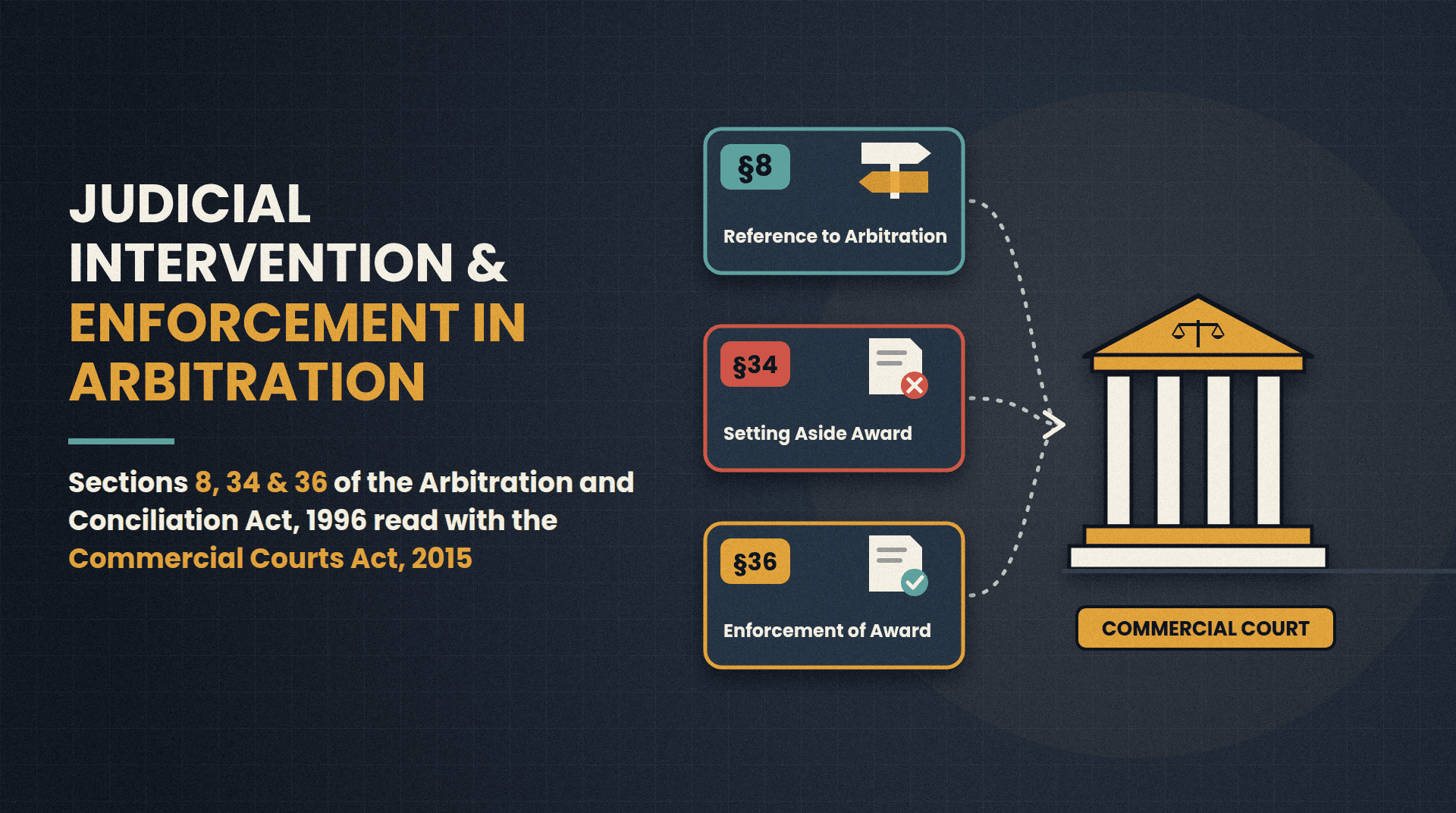
Judicial Intervention and Enforcement in Arbitration: Sections 8, 34 and 36 of the Arbitration and Conciliation Act, 1996 read with the Commercial Courts Act, 2015
ection 8 of the Arbitration and Conciliation Act, 1996 casts a positive, mandatory obligation on a judicial authority to refer parties to arbitration where the subject matter of the action before it is covered by a valid arbitration agreement, provided an application is made not later than the date of submitting the first statement on the substance of the dispute.
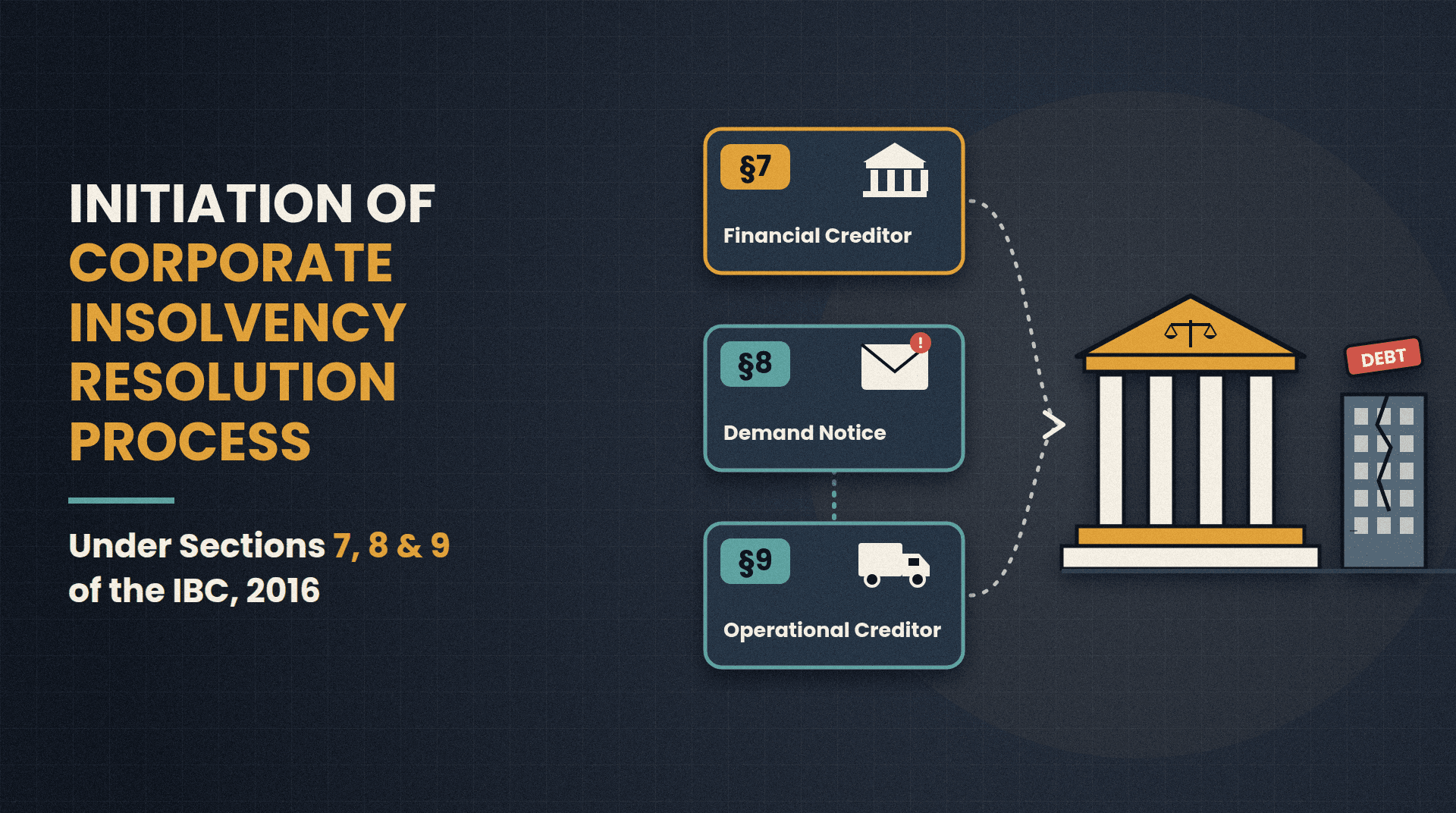
Initiation of Corporate Insolvency Resolution Process under Sections 7, 8 and 9 of the IBC, 2016
The Insolvency and Bankruptcy Code, 2016 (IBC) establishes a creditor in control, trigger-based mechanism for resolving corporate distress. However, the architecture governing initiation differs fundamentally depending on the class of applicant, Financial Creditors under Section 7, Operational Creditors under Section 9 (preceded by a mandatory demand notice under Section 8), and Corporate Applicants under Section 10.