Sports Law in India: Governance of National Sports Federations, Athlete Rights and Dispute Resolution
Siya Holkar
13 Oct 2026 33 min read
- Decided
- 13 Oct 2026
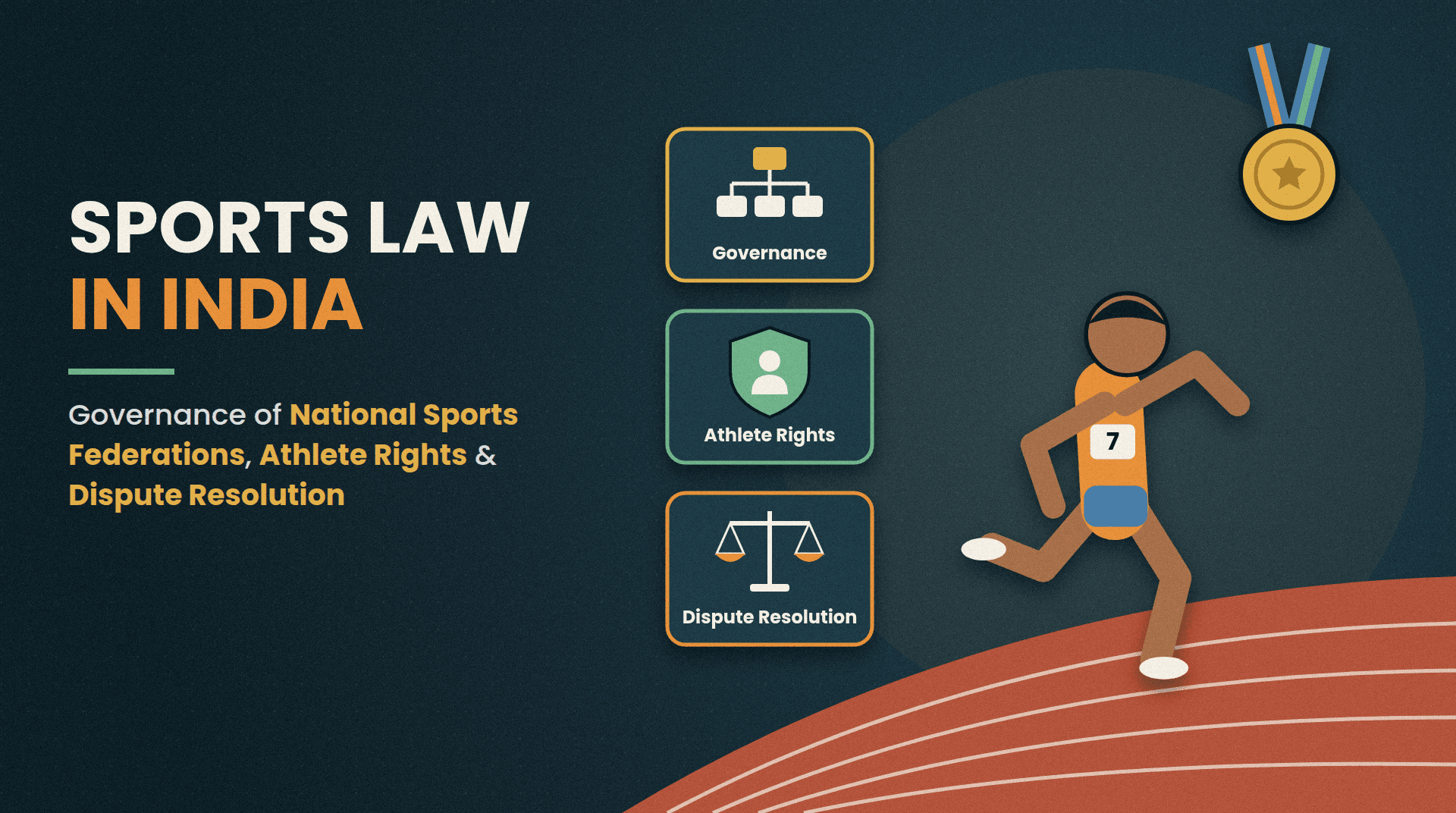
Question 1: Constitutional and statutory regulation of sport
Constitutional basis
A fundamental right of participation in games or representing India in certain competitions cannot be derived from the provisions of the Constitution. Even so, the governance of sports is governed by constitutional principles where it impinges upon equality, dignity, livelihood, reputation, or access to public opportunities. Arbitrariness is barred by Article 14 and calls for public authorities and agencies executing public functions to function rationally and without discrimination. Therefore, this provision is applicable where an athlete has been denied entry based on undisclosed criteria or where the selection norms have been changed after selection. Article 21 covers life and personal liberty and has been extensively interpreted to cover dignity, reputation, means of livelihood, and the right to procedural justice. Thus, the question is one of Article 21 in so far as the selection or the act of discipline would affect the career, reputation, and the earning capacity of the athlete. In no way can these Constitutional guarantees be read to ensure selection but that the process be just and reasonable.
Article 226 holds special significance. The difference between Articles 12 and 226 lies at the heart of legal issues in the field of sports. It may be the case that a sporting organization does not come within the purview of “State” as defined in Article 12; however, a writ may lie under Article 226 against it in its capacity of performing public functions or discharging public duties. In Zee Telefilms Ltd. v. Union of India, the Supreme Court ruled, by majority, that BCCI was not “State” within the meaning of Article 12 as it was neither created by any legislation nor did it come under pervasive state control. But it left open the possibility of a petition under Article 226 against such a private entity. This principle was laid down in the case of Board of Control for Cricket in India v. Cricket Association of Bihar. While BCCI was not considered as “State” under Article 12, the Court acknowledged that it had certain functions of governance in respect of control of cricket, selection of national team and international representation. Hence, it was held that public law remedies were available against the BCCI in terms of Article 226. It leads to a functional approach. A court would more often than not exercise the power of judicial review where the impugned decision related to national selection, representation of India, recognition, elections, eligibility, disciplinary jurisdiction or expenditure of public money. Where the dispute is merely a private contractual dispute like any ordinary employment/endorsement dispute, then there could be an issue about the writ jurisdiction of the Court.
Statutory framework
Traditionally, management of sports in India was governed more by executive policy, federation constitution, international sporting regulations, and financial or recognition conditions rather than by central legislation. The primary tool of policy was the National Sports Development Code of India, 2011. The Sports Code established standards regarding:
recognition of National Sports Federations;
elections and tenure of office-bearers;
age and tenure limits;
representation of athletes;
transparency and accountability;
prevention of conflicts of interest;
maintenance of records and financial accountability; and
prevention of age fraud and manipulation of sporting records.
The implementation of the Sports Code occurred through recognition, affiliation, funding, and judicial review. The effect of the Code would be such that if an NSF needed governmental recognition or financial help, it had to adhere to the governance criteria as laid down by the Ministry of Youth Affairs and Sports. In the case of Rahul Mehra v. Union of India, the Delhi High Court ruled that the Sports Code is not merely a recommendation but a mandatory criterion for recognised NSFs. It may be pointed out that the decision in the above-mentioned case cannot be cited as being decided in 2004 in the present assignment. The 2022 judgment is the relevant precedent.
National Sports Governance Act, 2025
The National Sports Governance Act, 2025 marks a transition from one based on regulatory policies to statutory regulation. The long title of this Act contains the concepts of good governance, ethics, fair play, welfare of athletes, and efficient conduct of sports.
The Act establishes or regulates:
national sports governing bodies;
the National Sports Board;
recognition and registration of sports organisations;
codes of ethics;
safe-sports policies;
athlete grievance mechanisms;
national sports elections;
a National Sports Tribunal; and
recognition-linked governmental oversight.
According to Section 3 of the Act, national sports governing organisations include the National Olympic Committee, National Paralympic Committee, NSFs, and Regional Sports Federations. Section 4 deals with organisational issues such as executive committee structure, athlete membership, women's membership, Ethics Committee, Dispute Resolution Committee, and Athlete Committee. The powers of the National Sports Board under Section 6 include recognition, registration, inquiry, ad hoc management, ethics, safe sports practices, athlete welfare, and international standards. Recognition under Section 8 is subject to certain organisational and governance issues. According to Section 10, recognition or registration can be suspended or cancelled because of various issues such as defective election process, non-publication of audited accounts, or misappropriation of public money. The Act therefore creates a more direct statutory basis for governmental oversight. However, oversight remains subject to the autonomy of sports bodies and the Olympic and international sporting framework. The Act’s preamble expressly recognises both the public functions of national sports bodies and the principle of sports autonomy.
Transparency, age fraud, and good governance
Transparency is critical since NSFs can control a particular sport, determine the eligibility for participation, choose the national team, have control over entry into various competitions, and speak on behalf of India in international events. Monopoly or near monopoly power makes the above criteria even more crucial. The Sports Code had dealt with age limitations and term limits mostly in terms of office bearers and governance structure of the NSFs. Age fraud for purposes of competition is a different matter but is nevertheless a related issue. This may include age fraud through falsification of birth certificates, eligibility fraud, and failure to verify age of an athlete. Age fraud prevention needs evidence, verification, standardized eligibility criteria, audit trails, and right to challenge findings. The 2025 Act enhances the institutional framework by introducing executive committee composition restrictions, athlete representation, ethics code, election procedure, audited accounts, and Board's power to look into irregularities. There is also provision for Safe Sports Policy and internal complaint mechanism for athletes, coaches, and connected persons.
Extent of governmental oversight
Government oversight is not unlimited. It generally operates through four connected mechanisms:
Recognition and funding: the Government may make recognition and financial support conditional upon statutory, regulatory, or Sports Code compliance.
Institutional supervision: the National Sports Board may register bodies, conduct inquiries, issue directions, and suspend or cancel recognition in specified circumstances.
Judicial review: High Courts may review public-function decisions under Article 226, particularly where the body acts arbitrarily or violates governing rules.
Statutory dispute resolution: the National Sports Governance Act creates a National Sports Tribunal, subject to express exclusions for matters reserved for CAS, international federations, internal mechanisms, or anti-doping panels.
The provision of Section 17 is that of the National Sports Tribunal which is meant to provide for the fair and cost-effective resolution of sports disputes. This does not mean that the jurisdiction of the National Sports Tribunal is unlimited in nature. Section 20 exempts from this jurisdiction, amongst others, sports disputes that emerge during major international games, disputes under the exclusive jurisdiction of the international federations or CAS and doping cases under the panel of the National Anti-Doping Act. The present situation can be described as one of regulated autonomy. While the NSFs have autonomy in the technical and sporting aspects, they cannot rely on institutional autonomy as a defence against arbitrariness and misuse of public funding.
Question 2: Anti-doping regulation
Statutory structure
The National Anti-Doping Act, 2022 is Act No. 15 of 2022. The Act is enacted for constituting NADA, regulating the activities relating to anti-doping, implementing the international obligations of India, and giving effect to the UNESCO International Convention against Doping in Sport. Section 2A of the Act makes certain provisions from the World Anti-Doping Code applicable in India. Under the Act, acceptance of anti-doping rules is necessary for participation in any sports competition or activity.
The Act identifies anti-doping rule violations, including:
presence of a prohibited substance or its metabolites or markers;
use or attempted use of a prohibited substance or method;
evasion, refusal, or failure to submit to sample collection;
whereabouts failures;
tampering;
possession;
trafficking;
administration;
complicity; and
prohibited association.
NADA, NADA is a statutory body corporate under section 14. Its functions under section 16 include:
adopting and implementing anti-doping rules;
planning and coordinating testing;
sample collection;
whereabouts management;
investigations;
results management;
education and awareness;
enforcement against athletes, support personnel, NSFs, and sports organisations; and
cooperation with international anti-doping organisations.
The Act therefore gives NADA both an operational and regulatory role. NADA is not merely a testing agency; it coordinates the national doping-control programme, investigates suspected violations, manages results, and initiates proceedings.
National Board for Anti-Doping
The National Board for Anti-Doping in Sports is established under section 7. Its functions under section 10 include:
ensuring implementation of India’s international anti-doping obligations;
advising the Central Government;
monitoring NADA;
reviewing compliance and fair-play measures;
supervising strategic anti-doping planning; and
making recommendations to NADA. The statutory design separates oversight from operational implementation. NADA conducts and manages the anti-doping programme, while the Board monitors NADA and advises the Government. The Act also provides for a Disciplinary Panel and an Appeal Panel.
Strict liability
The strict-liability principle means that an athlete may commit an anti-doping rule violation through the presence of a prohibited substance, metabolite, or marker in the athlete’s sample, without proof that the athlete intended to dope. Strict liability is not equivalent to automatic punishment without procedure. It concerns the method of establishing the underlying violation. It does not eliminate the athlete’s ability to challenge:
the validity of the sample;
the chain of custody;
laboratory deviations;
the accuracy of the analysis;
the existence of a therapeutic-use exemption;
the source of the substance;
the applicable period of ineligibility; or
the availability of no-fault or no-significant-fault reductions.
The World Anti-Doping Code adopts the same approach. Article 2.1 states that presence of a prohibited substance in the sample of the athlete amounts to an anti-doping rule violation. Articles 10.5.1 and 10.5.2 refer to reductions for cases where the athlete can prove that there was no fault or no significant fault or negligence on their part. The case that is more directly connected with the strict-liability principle from the supplied material is the one of Narsingh Yadav. But the statement about the Delhi High Court decision in 2018 upholding the constitutionality of strict liability should be cited only after verifying the decision and the citation. In terms of primary authority for the strict liability result, the better option would be CAS ad hoc award in World Anti-Doping Agency v. Narsingh Yadav & National Anti-Doping Agency. It pronounced the four-year ineligibility period after overruling NADA’s exoneration.
Sample and laboratory safeguards
The athlete may challenge the collection, handling, transportation, and analysis of the sample. The Act permits sample collection and testing under section 20 and establishes the results-management process under section 21. A proper process requires attention to:
notification;
sample identity;
sealing and custody;
A-sample and B-sample procedures;
laboratory standards;
departures from international testing and laboratory standards; and
possible permitted ingestion or therapeutic-use exemptions.
Notice and hearing
The hearing is conducted by the Disciplinary Panel under Section 22 considering the notice given concerning the anti-doping rule violation. It is necessary that the athlete receives proper notice concerning the charge and an opportunity to put up evidence.
Appeal
An appeal is possible under Section 23 by way of the Appeal Panel. Based on the status of the athlete and the relevant anti-doping regulations, the appeal could either be lodged with the national Appeal Panel or CAS.
Reasoned decision
A disciplinary or appellate decision should explain:
the violation found;
the evidence relied upon;
the treatment of the athlete’s explanation;
the treatment of expert or scientific material;
the applicable sanction; and
why any reduction or mitigation was accepted or rejected.
The example of the rule that strict liability does not allow procedural arbitrariness is provided by the case of Shashank J. Rai v. National Anti-Doping Agency-India. According to information, the Karnataka High Court quashed the four-year suspension due to issues concerning sample validity, evidence and lack of reasoning for such a decision. Poovamma M.R. v. Union of India demonstrates another rule that strict liability should be followed with due account for possible mitigation and proper commencement or backdating of ineligibility. The rule can therefore be formulated as: The athlete does not have to prove lack of intent to question the existence of the procedure, reliability of the evidence, reasonableness of the sanction and lack of taking into account mitigation.
Question 3: Athlete-federation relationship and eligibility disputes
Contractual dimension
The athlete-federation relationship has a contractual and regulatory dimension. An athlete normally agrees, expressly or impliedly, to comply with:
federation rules;
selection criteria;
eligibility requirements;
anti-doping regulations;
disciplinary codes;
event rules; and
dispute-resolution clauses.
Also, a club or federation may have contracts pertaining to remuneration, participation, sponsorship, image rights, insurance, and the commitments of the team. On the other hand, the issue of national-team selection is more than just a contract issue. Even if an NSF is a private association, the issue of national-team selection relates to a public function. There may be many cases where the only legal way of representing India in a certain sport is through the federation.
Article 226 and public functions
By way of Zee Telefilms Ltd. v. Union of India, the Court held that BCCI was not a "State" under Art. 12. But it did not exempt BCCI from all accountabilities of law. Zee Telefilms Ltd. v. Union of India, (2005) 4 SCC 649. In the case of BCCI v. Cricket Association of Bihar, it was decided that public function test is different from the Article 12 test. A sports association which enjoys substantial control over the national sport may be subjected to judicial scrutiny under Art. 226 even though it is not a state instrumentality. The Delhi High Court applied the above principle to the NSFs and IOA in Rahul Mehra.
Civil right or contractual privilege?
Selection to a national team is not a guaranteed right. The courts are not inclined to take over the technical expertise of the selection panel. The athlete does not have the right to select himself or herself just because of being good, popular, or having been selected before. More accurately put: The right of an athlete is the right to a fair consideration according to the rules. Judicial intervention is more likely where:
the federation applies an unpublished criterion;
the criterion conflicts with the international federation’s rules;
the selection committee lacks authority;
the decision is mala fide or discriminatory;
relevant performance data are ignored;
the procedure is irrational or opaque; or
the decision is unsupported by reasons.
This can be seen from the Delhi High Court’s case of 2026 involving skier Manjeet. The Delhi High Court issued relief on account of the arbitrary nature of the exclusion and its inconsistency with the criteria established for qualifying. What the Delhi High Court did not do in granting relief was to issue a general right to Olympic selection. It protected the right of the athlete to selection through proper qualification criteria.
Technical deference
The courts also acknowledge that there is technical skill and sporting ability involved in making the selection. In the case of Sujeet v. Union of India, the Delhi High Court warned against judicial interference in the process of selecting the most qualified person for competition when the criteria for selection were laid down by the relevant sports federation. It establishes a middle ground:
where the courts consider legality, fairness, propriety, reasonableness, and compliance with rules;
and where the courts do not generally rank the athletes or apply their own technical judgment.
Thus, the relationship between the athlete and federation is not a strict contractual relationship but rather is a constitutional right without limits.
Question 4: CAS and Indian arbitration law
Nature and jurisdiction of CAS
CAS is an international sports dispute-resolution institution seated in Lausanne, Switzerland. Its jurisdiction is consensual or rule based. It may arise from:
an arbitration clause;
federation statutes;
international federation regulations;
anti-doping rules;
the Olympic Charter;
the World Anti-Doping Code; or
a specific arbitration agreement.
For CAS jurisdiction to exist, the regulations must allow for it, and the claimant should meet the conditions, which include exhaustion of the means of dispute resolution and categorization of the athlete or the event. The CAS award by Shashank J. Rai confirms this. Under Article R47 of the CAS Code, there would be jurisdiction where there was an express provision of jurisdiction in the federation’s statutes and regulations or when there was an arbitration agreement between the parties, but after exhaustion of all other means of dispute resolution. The applicable NADA Anti-Doping Rules distinguished between:
international-level athletes or international events, for which an appeal lay exclusively to CAS; and
national-level athletes or other persons, for which an appeal lay to the National Anti-Doping Appeal Panel.
Accordingly, the CAS Sole Arbitrator ruled that Rai could not be described as an international-level athlete based on the relevant FIBA regulations. This precedent is important insofar as it illustrates that submission to CAS is determined by the wording of the relevant sporting and anti-doping regulations. It is wrong to assert that all athletes from India and all decisions of NADA fall within the jurisdiction of CAS.
CAS under the National Sports Governance Act
This is because the National Sports Governance Act acknowledges explicitly the potential for the jurisdiction of either CAS or international federations. Clause 20 specifically states that matters which fall within the exclusive jurisdiction of either CAS, the international federations, the internal dispute resolution mechanism, or the National Anti-Doping Act are excluded from the jurisdiction of the National Sports Tribunal. The statutory framework is not aimed at removing CAS from jurisdiction. The legislative framework allows the existence of a domestic Tribunal alongside international dispute resolution systems.
Enforceability in India
A CAS decision rendered from Switzerland can be treated as a foreign award in accordance with Part II, Chapter I of the Arbitration and Conciliation Act, 1996 if it meets the criteria stated in section 44. Sections 44 to 52 are the pertinent sections for such awards. It is usually necessary for the award claimant to apply to the concerned Indian court with the award and the arbitration agreement and other documentation as specified in the statute. Defences for non-enforcement may include those listed in section 48, which are as follows:
incapacity or invalidity of the arbitration agreement;
inadequate notice;
inability to present the case;
excess of jurisdiction;
improper composition of the tribunal;
the award not being binding or having been set aside at the seat;
non-arbitrability; or
conflict with the public policy of India.
In the case of Vijay Karia v. Prysmian Cavi E Sistemi S.R.L., the Supreme Court took an enforcement-friendly approach. The section 48 cannot be viewed as an enticement to re-hear the arbitration case on merit. Any judicial intervention shall be confined strictly and the ground of public policy is to be applied restrictively. Thus, CAS awards cannot be considered "automatically enforceable" in India. They can only be enforceable as foreign awards upon compliance with certain requirements. The Indian courts cannot re-examine the sporting merits of a dispute, re-assess the evidence or reverse the decision of the CAS tribunal.
Limits of the CAS-enforcement proposition
The enforceability analysis depends on:
the seat of arbitration;
whether the award is final and binding;
the validity and scope of the arbitration agreement;
whether the award falls within section 44;
whether the award has been set aside or suspended at the seat; and
whether a section 48 defence is established.
Therefore, the correct legal proposition is: A qualifying Swiss-seated CAS award may be enforced in India as a foreign award under Part II of the Arbitration and Conciliation Act, 1996, subject to the limited statutory grounds for refusal under section 48.
Question 5: Sponsorship, broadcasting, endorsements, and image rights
Contractual structure
Sports sponsorship and endorsement transactions commonly involve several contracts:
title or event sponsorship agreements;
broadcasting and media-rights agreements;
athlete endorsement agreements;
merchandising licences;
federation sponsorship arrangements;
image-rights assignments;
exclusivity clauses;
morality clauses;
social-media obligations;
territorial and platform restrictions; and
termination and dispute-resolution provisions.
The legal issues may include:
who owns or controls the relevant commercial rights;
whether an athlete has granted an exclusive licence;
whether the federation has authority to license an athlete’s image;
whether a sponsor’s use exceeds the contractual scope;
whether a campaign creates a false endorsement;
whether competing endorsements breach exclusivity;
whether a broadcast uses an athlete’s image beyond the agreed purpose; and
whether termination or suspension affects continuing image use.
No independent statutory image right
India does not have a single, comprehensive statute creating a standalone “athlete image right.” Protection is instead derived from several sources:
Article 21 privacy and dignity jurisprudence;
personality or publicity-rights principles;
passing off;
trademark law;
copyright law where an original photograph, video, logo, or artistic work is involved;
contract law;
consumer-protection principles concerning misleading endorsement; and
injunctive remedies under civil procedure. The right is therefore fragmented. An athlete’s claim will depend on the factual basis of the unauthorized use and the remedy sought.
ICC Development v. Arvee Enterprises
However, the most relevant ruling in respect of sports cases is ICC Development (International) Ltd. v. Arvee Enterprises. The Delhi High Court noted that “the right of publicity derives its source from the right to privacy and is inherent in a person or in indices of personality like one’s name, image, personality features, signature and voice.” The case supports two important propositions:
the commercial value of an athlete’s identity may arise from association with a sport or event; and
the underlying personality attribute remains connected to the individual unless validly assigned or licensed.
The decision does not mean that event organisers have no rights. An organiser may own event marks, broadcast rights, sponsorship rights, footage, logos, and contractual rights. The point is that those rights do not automatically include ownership of an athlete’s independent personality attributes.
Later personality-rights jurisprudence
Increasingly, Indian courts have awarded interim relief in cases relating to the misuse of celebrity names, photographs, voices, likenesses, and other identifying characteristics. Even if the rationales of the later Delhi High Court decisions in celebrity rights cases can be applied to sports persons by analogy, each case should always be cited with the proper case name, file number, and date of the decision. There are also authorities that warn against referring to publicity rights as an absolute statutory monopoly. In Digital Collectibles Pte. Ltd. v. Galactus Funware Technology Pvt. Ltd., the Delhi High Court observed the presence of claims in respect of personality and publicity rights but clarified that there is no statutory recognition of such a right.
Protection available to athletes
An athlete may challenge unauthorised commercial exploitation where the use:
falsely suggests endorsement;
misappropriates the athlete’s name, image, voice, signature, or distinctive style;
breaches an exclusive endorsement contract;
infringes a registered trademark;
constitutes passing off;
violates privacy or dignity;
copies a protected photograph, film, or artistic work; or
uses AI-generated content in a manner that falsely associates the athlete with a product or campaign.
The strongest claim will usually combine causes of action. For example, an advertisement using an athlete’s photograph without consent may support:
a personality-rights claim;
passing off, if it suggests endorsement;
copyright infringement, if the photograph is copied;
trademark infringement, if a registered mark is used; and
breach of contract, if an existing sponsorship arrangement is affected.
Broadcasting and event rights
Broadcasting rights are usually controlled contractually by the event organiser, league, federation, or rights-holder. This may include the right to record, transmit, archive, distribute, and sublicense event footage. However, a broadcasting agreement does not automatically transfer an athlete’s independent personality rights. Contracts should therefore distinguish between:
event footage;
team or federation marks;
individual image rights;
promotional clips;
archival use;
live broadcast;
social-media clips;
merchandising;
artificial intelligence or synthetic media; and
post-termination use. The legally safer position is that athletes retain control over their personal identity unless they have clearly assigned or licensed specified rights. A federation or organiser should obtain express authority before using an athlete’s name, image, likeness, or voice in commercial advertising outside ordinary event coverage.
Category 1: Governance of Sports Federations and Athlete Eligibility
Case 1: Zee Telefilms Ltd. v. Union of India
Case Name and Year: Zee Telefilms Ltd. v. Union of India (2005)
Citation and Coram: (2005) 4 SCC 649 (India); Constitution Bench. The judgment was delivered by a majority, with a separate opinion.
Issue before the Court: Whether BCCI was “State” within the meaning of Article 12 and whether a petition under Article 32 could be maintained against it.
Brief Facts: The dispute arose from BCCI’s control over cricket-related commercial and broadcasting rights. The petitioners challenged BCCI’s actions and argued that BCCI performed public functions and should be treated as State for constitutional purposes.
Ratio Decidendi: BCCI was not “State” under Article 12 because it was not created by statute and was not subject to pervasive governmental financial, administrative, or functional control. Consequently, Article 32 could not ordinarily be invoked against BCCI on the basis that it was State.
Obiter Dicta: The judgment recognised that the Article 12 conclusion did not necessarily exclude every form of legal or public-law remedy. A private body performing public functions may remain amenable to Article 226, which is textually wider than Article 32.
Significance and connection: The decision separated the Article 12 inquiry from the Article 226 public-function inquiry. BCCI v. Cricket Association of Bihar later relied on this distinction to emphasise accountability in sports administration.
Case 2: Board of Control for Cricket in India v. Cricket Association of Bihar
Case Name and Year: Board of Control for Cricket in India v. Cricket Association of Bihar (2015)
Citation and Coram: (2015) 3 SCC 251 (India); Supreme Court of India.
Issue before the Court: Whether BCCI, despite not being State under Article 12, could be subjected to public-law scrutiny under Article 226 and whether its governance could be judicially reviewed.
Brief Facts: The dispute concerned BCCI’s administration of cricket, conflict-of-interest issues, and the functioning of its governing structures. The Court considered BCCI’s dominant position in Indian cricket and its control over national representation.
Ratio Decidendi: A body may be amenable to Article 226 when it performs public functions, even if it does not qualify as State under Article 12. BCCI’s control over national cricket, team selection, and international representation gave its functions a public character sufficient to attract public-law review.
Obiter Dicta: The Court made broader observations concerning the need for transparency, accountability, institutional integrity, and reform in a body possessing monopolistic control over a major sport.
Significance and connection: The case developed Zee Telefilms by making the public-function principle more operational. It provided the doctrinal basis for later review of NSFs and the IOA.
Case 3: Rahul Mehra v. Union of India
Case Name and Year: Rahul Mehra v. Union of India (2022)
Citation and Coram: 2022 SCC OnLine Del 2438, 2022: DHC:3066-DB (India); Division Bench, Delhi High Court.delhihighcourt.nic+1
Issue before the Court: Whether NSFs and the IOA were amenable to Article 226 and whether compliance with the Sports Code was mandatory for recognised sports bodies and their constituent units.
Brief Facts: The petition challenged aspects of sports administration, including governance and compliance with the Sports Code. The petitioners argued that sports bodies performing public functions could not disregard governance standards imposed as conditions of recognition and funding.
Ratio Decidendi: Recognised NSFs and the IOA may be subjected to Article 226 review in respect of public functions. The Sports Code is binding in the governance of recognised sports bodies where compliance is a condition of recognition, affiliation, or governmental support.
Obiter Dicta: The Court observed that sports autonomy does not amount to immunity from constitutional standards. It also stressed the importance of good governance, transparency, and compliance with age and tenure restrictions.
Significance and connection: The judgment applied the public-function reasoning of Zee Telefilms and BCCI v. Cricket Association of Bihar directly to NSFs. It also provided the doctrinal bridge to statutory regulation under the National Sports Governance Act, 2025.
Case 4: Manjeet v. Indian Olympic Association
Case Name and Year: Manjeet v. Indian Olympic Ass’n (2026)
Citation and Coram: W.P. (C) No. 936 of 2026, judgment (Delhi High Ct. Jan. 30, 2026) (India). The official judgment should be checked for the final party title and neutral citation.
Issue before the Court: Whether the exclusion of an Indian cross-country skier from the Olympic contingent through additional eligibility conditions was arbitrary and contrary to the applicable qualification framework.
Brief Facts: The petitioner challenged exclusion from India’s contingent for the 2026 Winter Olympic Games. The challenge alleged that an ad hoc selection body-imposed conditions not found in the relevant international qualification rules.
Ratio Decidendi: The Court held that an exclusion inconsistent with the applicable qualification framework and unsupported by lawful criteria could be manifestly arbitrary and unfair. The athlete was entitled to consideration according to the governing rules, and the decision violated constitutional standards of fairness.
Obiter Dicta: The Court strongly criticised the use of ad hoc conditions and administrative “whims” that could extinguish an elite athlete’s opportunity without a transparent and rule-based process.
Significance and connection: The case represents a practical application of the public-function and non-arbitrariness principles developed in BCCI v. Cricket Association of Bihar and Rahul Mehra. It does not establish an absolute right to selection; it protects the right to lawful and fair consideration.
Category 2: Anti-Doping Regulation and the National Anti-Doping Act
Case 1: World Anti-Doping Agency v. Narsingh Yadav & National Anti-Doping Agency
Case Name and Year: World Anti-Doping Agency v. Narsingh Yadav & National Anti-Doping Agency (2016)
Citation and Coram: CAS ad hoc Division (OG Rio) 16/025, Award (Ct. Arb. for Sport Aug. 21, 2016; operative part Aug. 18, 2016).
Issue before the Court: Whether WADA’s challenge to NADA’s decision exonerating Narsingh Yadav should succeed and whether the athlete should be sanctioned for the anti-doping rule violations.
Brief Facts: Yadav tested positive for a prohibited substance. NADA accepted his explanation that the substance had entered his body through sabotage and granted him relief. WADA appealed to the CAS ad hoc Division.
Ratio Decidendi: The CAS set aside the exoneration and imposed a four-year period of ineligibility. The award applied the anti-doping strict-liability framework and held that the athlete had not established the conditions necessary to eliminate the sanction.
Obiter Dicta: The award discussed the evidentiary difficulty of sabotage claims and the importance of the athlete’s responsibility for substances found in the athlete’s sample.
Significance and connection: The case illustrates the operation of strict liability before the enactment of the National Anti-Doping Act, 2022. The Act subsequently codified and institutionalised the national anti-doping structure while incorporating the World Anti-Doping Code.
Case 2: Poovamma M.R. v. Union of India
Case Name and Year: Poovamma M.R. v. Union of India (2023)
Citation and Coram: W.P. (C) No. 30022 of 2023, judgment (Ker. High Ct. Sept. 30, 2023) (India).
Issue before the Court: Whether the period of ineligibility imposed on the athlete had been calculated fairly and whether the athlete’s material and mitigation had been properly considered.
Brief Facts: The athlete challenged the anti-doping sanction and sought relief concerning the commencement or calculation of the period of ineligibility. The challenge raised concerns about mechanical sanctioning and the failure to give effect to relevant procedural and mitigating considerations.
Ratio Decidendi: The existence of strict liability does not eliminate the duty of anti-doping authorities to apply the rules fairly, consider relevant material, and calculate the sanction correctly. Where legally justified, the period of ineligibility must be backdated or adjusted in accordance with the governing rules.
Obiter Dicta: The Court criticised a mechanical approach that treats strict liability as a reason to disregard the athlete’s explanation or legally relevant mitigation.
Significance and connection: The case develops the strict-liability principle by distinguishing the substantive violation from the procedural and remedial questions concerning sanction, mitigation, and commencement.
Case 3: Shashank J. Rai v. National Anti-Doping Agency-India
Case Name and Year: Shashank J. Rai v. National Anti-Doping Agency-India (2025)
Citation and Coram: W.P. No. 4710 of 2024, 2025 LiveLaw (Kar) 198 (Karn. High Ct. May 31, 2025) (India).
Issue before the Court: Whether a four-year period of ineligibility could stand where the athlete alleged sample-integrity problems, non-consideration of material evidence, and lack of a reasoned decision.
Brief Facts: The petitioner, a national basketball player, challenged an anti-doping sanction. The challenge raised issues concerning the B-sample process, the evidentiary significance of a dietary explanation, and the reasoning of the disciplinary decision.
Ratio Decidendi: A doping sanction cannot be sustained where the proceedings are materially affected by defects in sample integrity, failure to consider relevant evidence, absence of adequate reasons, or breach of natural justice. Strict liability does not permit procedural arbitrariness.
Obiter Dicta: The Court reaffirmed the importance of reasoned adjudication and warned disciplinary panels against mechanically imposing sanctions without engaging with the athlete’s evidence.
Significance and connection: The case develops Poovamma by giving a stronger remedial consequence to procedural defects. The case should not be confused with the separate CAS jurisdiction award involving the same athlete.
Category 3: CAS and Athlete Image/Personality Rights
Case 1: ICC Development (International) Ltd. v. Arvee Enterprises
Case Name and Year: ICC Development (International) Ltd. v. Arvee Enterprises (2003)
Citation and Coram: 2003 SCC OnLine Del 405, 2003 (26) PTC 245 (Del.) (India); Delhi High Court.
Issue before the Court: Whether an event organiser could claim exclusive rights over the personality attributes of individuals associated with a sporting event and restrain commercial references to the event and its participants.
Brief Facts: ICC sought injunctive relief against advertisements and commercial activity connected with the Cricket World Cup. The dispute raised questions concerning event rights, publicity rights, passing off, and the commercial value of associations with cricket.
Ratio Decidendi: The right of publicity flows from the right of privacy and inheres in the individual or the individual’s indicia of personality, including name, image, voice, signature, and personality traits. It does not automatically vest in the event organiser or corporation merely because the individual became commercially valuable through association with the event.
Obiter Dicta: The Court observed that personality attributes may acquire commercial value through association with sport or an event, but the association does not transfer the core personality right to the event organiser.
Significance and connection: This is the foundational Indian sports-related personality-rights authority. It supports the distinction between event rights owned by organisers and individual identity rights retained by athletes.
Case 2: Shashank J. Rai v. National Anti-Doping Agency, India
Case Name and Year: Shashank J. Rai v. National Anti-Doping Agency, India (2023)
Citation and Coram: CAS 2022/A/9246, Award on Jurisdiction (Ct. Arb. for Sport July 17, 2023); Sole Arbitrator Annett Rombach.
Issue before the Court: Whether CAS had jurisdiction to hear the athlete’s appeal against NADA’s disciplinary decision.
Brief Facts: Rai, an Indian basketball player, challenged a four-year anti-doping sanction before CAS. NADA objected to CAS jurisdiction, arguing that Rai was not an international-level athlete and that the appeal should be made to the National Anti-Doping Appeal Panel.
Ratio Decidendi: CAS held that it lacked jurisdiction. Under the applicable anti-doping rules, CAS jurisdiction depended on the athlete being an international-level athlete or the case arising from participation in an international event. Rai did not satisfy that jurisdictional condition under the applicable FIBA rules.
Obiter Dicta: The award discussed the meaning of “international-level athlete,” the significance of FIBA events, and the temporal connection between international participation and the doping control.
Significance and connection: The case demonstrates that CAS jurisdiction is rule-specific and conditional. It corrects the inaccurate proposition that every Indian anti-doping dispute is automatically appealable to CAS.
Case 3: Vijay Karia v. Prysmian Cavi E Sistemi S.R.L.
Case Name and Year: Vijay Karia v. Prysmian Cavi E Sistemi S.R.L. (2020)
Citation and Coram: (2020) 11 SCC 1 (India); Supreme Court of India.
Issue before the Court: What is the scope of judicial review when enforcement of a foreign arbitral award is resisted under section 48 of the Arbitration and Conciliation Act, 1996?
Brief Facts: The award-debtor resisted enforcement of a foreign award on several grounds, including public policy and alleged defects in the arbitral process.
Ratio Decidendi: Indian courts must adopt a pro-enforcement approach to foreign awards. Section 48 provides limited grounds for refusal, and enforcement proceedings are not an opportunity to re-appreciate the merits or correct alleged errors of fact or law made by the arbitral tribunal.
Obiter Dicta: The Court emphasised that public policy must be construed narrowly and that minimal judicial interference is consistent with India’s obligations under the New York Convention.
Significance and connection: The case provides the Indian enforcement framework relevant to a qualifying Swiss-seated CAS award. It does not itself concern CAS, but it explains the statutory standard that an Indian court would apply when asked to enforce a foreign sports award.
Chronology of Landmark Judgments
Case Name and Year | Ratio Decidendi | Obiter Dicta / Important Observation | Connection and Significance |
ICC Development (International) Ltd. v. Arvee Enterprises (2003) | Publicity rights in here in the individual and the individual’s indicia of personality; they do not automatically vest in an event organiser. | Personality attributes may acquire commercial value through association with sport or an event. | Establishes the foundation for athlete image and personality-rights claims. |
Zee Telefilms Ltd. v. Union of India (2005) | BCCI was not State under Article 12 because it lacked the required statutory basis and pervasive governmental control. | Article 226 may remain available against a private body performing public functions. | Distinguishes Article 12 status from Article 226 review and sets up the public-function doctrine. |
Board of Control for Cricket in India v. Cricket Association of Bihar (2015) | A private sports body performing public functions may be subject to Article 226 review. | Dominant sports bodies must be accountable, transparent, and institutionally responsible. | Develops Zee Telefilms and strengthens public-law review of sports governance. |
World Anti-Doping Agency v. Narsingh Yadav & NADA (2016) | CAS set aside NADA’s exoneration and imposed a four-year sanction under the strict-liability anti-doping framework. | Sabotage and no-fault claims require credible proof; lack of intent alone is insufficient. | Demonstrates strict liability in an Indian athlete’s international anti-doping dispute. |
Vijay Karia v. Prysmian Cavi E Sistemi S.R.L. (2020) | Foreign awards should be enforced unless a narrow section 48 ground is established. | Courts should not re-appreciate the merits of a foreign award. | Supplies the enforcement standard relevant to foreign-seated CAS awards. |
Rahul Mehra v. Union of India (2022) | Recognised NSFs and the IOA are reviewable under Article 226 for public-function matters; Sports Code compliance is mandatory in the recognition framework. | Sports autonomy does not justify departure from good-governance norms. | Applies the public-function doctrine to NSFs and connects judicial review with the Sports Code. |
Poovamma M.R. v. Union of India (2023) | Strict liability does not eliminate procedural fairness or proper calculation of the period of ineligibility. | Mechanical sanctioning without consideration of the athlete’s material is unfair. | Develops strict liability into a fair-procedure framework. |
Shashank J. Rai v. NADA (2023) | CAS lacked jurisdiction because the athlete did not satisfy the applicable international-level-athlete condition. | The award explains the relevance of FIBA’s definitions and temporal proximity to the doping control. | Clarifies that CAS jurisdiction depends on the applicable rules and athlete classification. |
Shashank J. Rai v. NADA-India (2025) | A doping sanction cannot stand where material procedural defects, non-consideration of evidence, or inadequate reasons undermine the proceeding. | Strict liability is not a licence for procedural arbitrariness. | Strengthens the procedural-rights side of anti-doping adjudication. |
Manjeet v. Indian Olympic Association (2026) | Exclusion based on criteria inconsistent with the applicable qualification framework may be manifestly arbitrary and unlawful. | Courts should not permit ad hoc administrative conditions to replace published sporting rules. | Applies the constitutional non-arbitrariness principle directly to athlete selection. |
Siya Holkar
More precedents
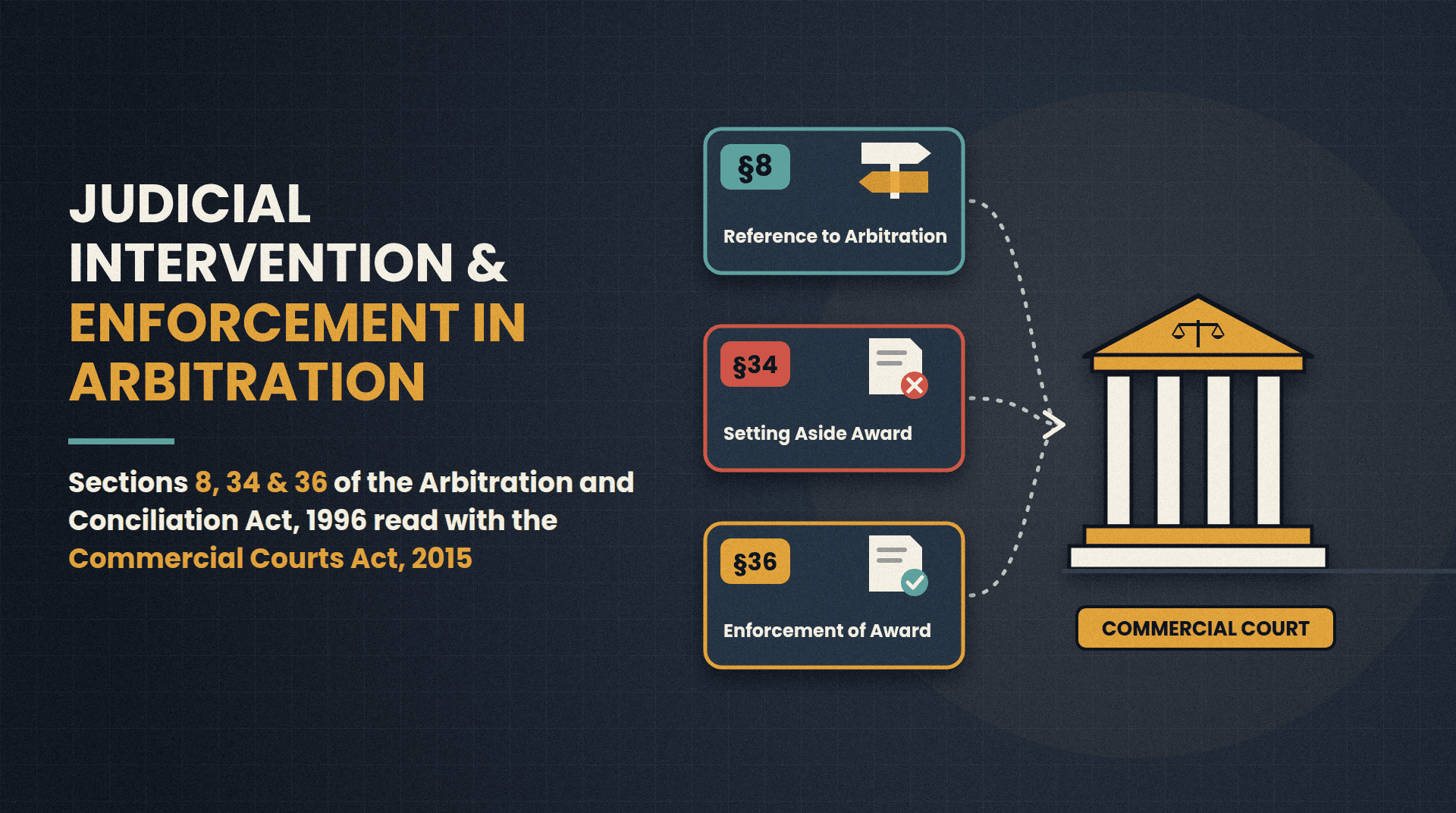
Judicial Intervention and Enforcement in Arbitration: Sections 8, 34 and 36 of the Arbitration and Conciliation Act, 1996 read with the Commercial Courts Act, 2015
ection 8 of the Arbitration and Conciliation Act, 1996 casts a positive, mandatory obligation on a judicial authority to refer parties to arbitration where the subject matter of the action before it is covered by a valid arbitration agreement, provided an application is made not later than the date of submitting the first statement on the substance of the dispute.
Initiation of Corporate Insolvency Resolution Process under Sections 7, 8 and 9 of the IBC, 2016
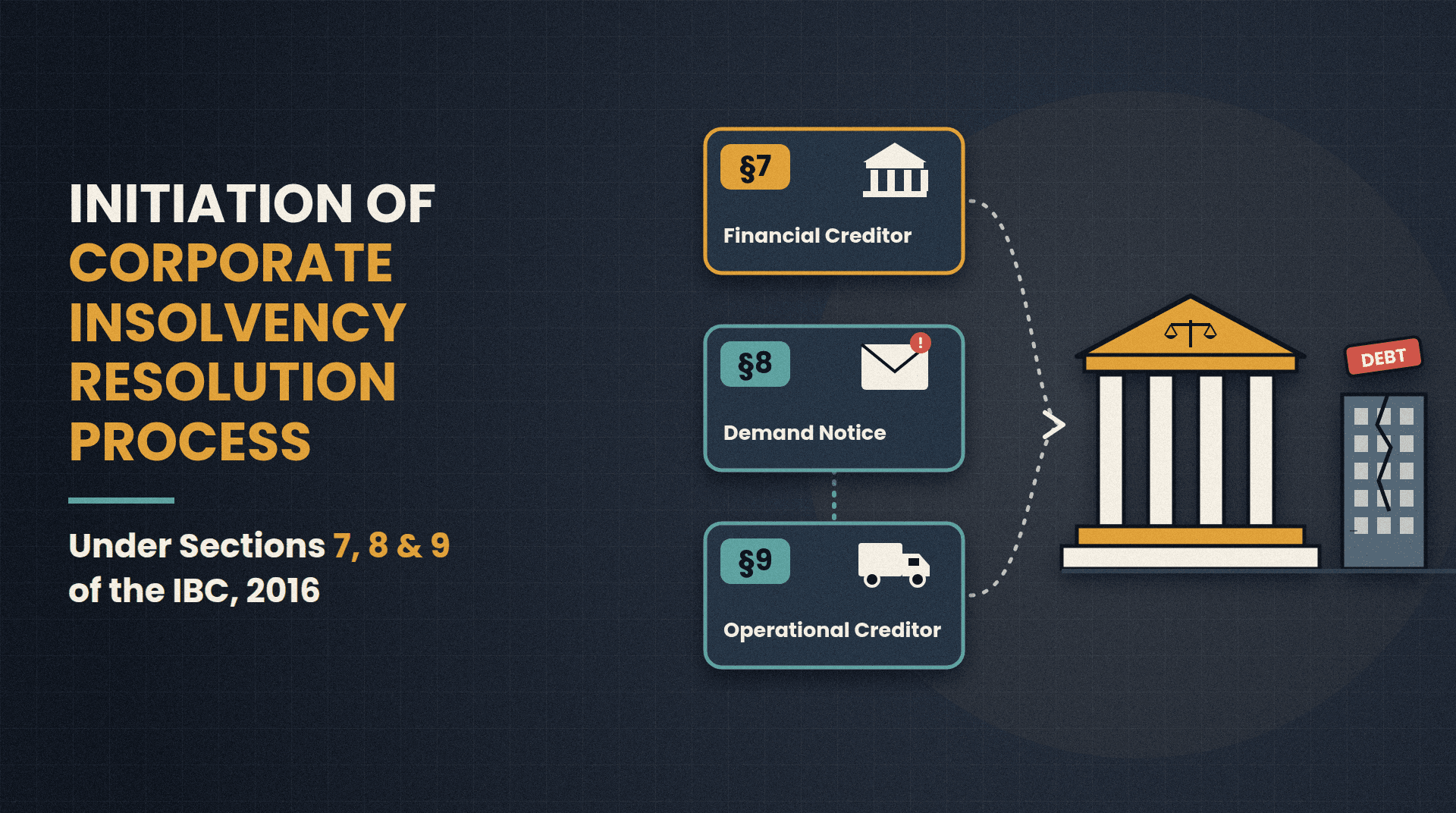
The Insolvency and Bankruptcy Code, 2016 (IBC) establishes a creditor in control, trigger-based mechanism for resolving corporate distress. However, the architecture governing initiation differs fundamentally depending on the class of applicant, Financial Creditors under Section 7, Operational Creditors under Section 9 (preceded by a mandatory demand notice under Section 8), and Corporate Applicants under Section 10.

Service Jurisprudence and the Law of Summary Suits: Judicial Review of Employment Disputes under Article 311 and Recovery of Money under Order XXXVII CPC, 1908
This rule became the basis of today's review test in B.C. Chaturvedi v. Union of India (1995), according to which judicial review is concerned not with the decision but with the process of making the decision, checking whether the inquiry was conducted within official statutory framework and in accordance with the basic requirements of fairness.