Law and Emerging Technology in India: Free Speech, Algorithmic Accountability, Deepfakes and the Question of AI Inventorship
Bhumi Khurana
8 Oct 2026 32 min read
- Decided
- 8 Oct 2026
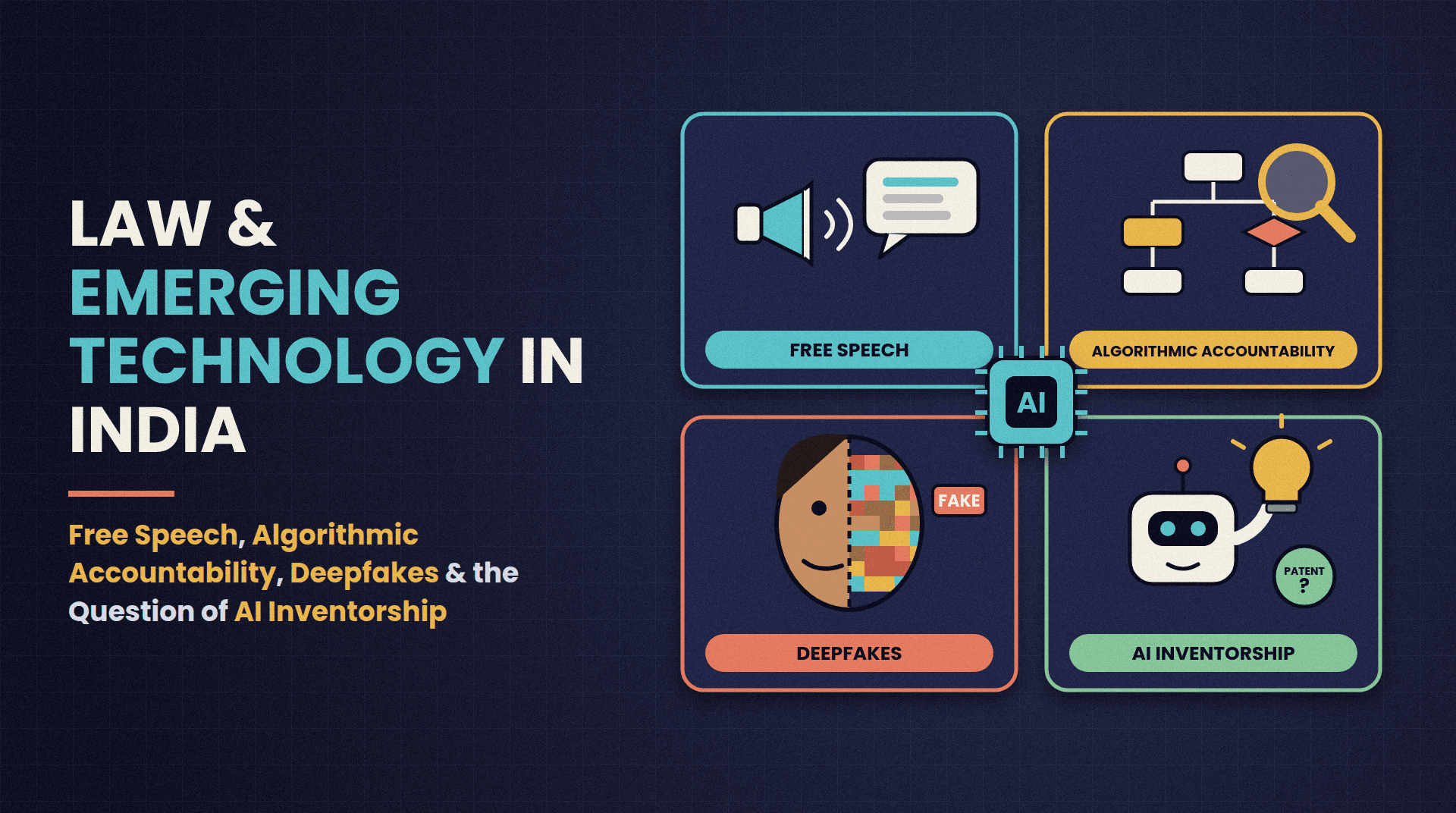
This memorandum contends that digital and AI technologies have created constitutional and IP challenges that have forced Indian law to react in unbalanced ways, developing the law comprehensively and firmly in some instances (free speech, proportionality, manifest arbitrariness) and more thinly and reactively in others (harm inflicted by deepfakes, by opacity of algorithms, by inventing without human authorship). Judicial improvisation such as issuing injunctions based on personality rights established as part of the judicial process, proportionality review, and the doctrine of manifest arbitrariness has thus far borne the brunt of the shock. However, it can't be a continuous substitute for a dedicated statutory response. The case law in Part B, summarized in the chronological table that follows, supports each proposition below.
Q1. Article 19(2), 'Cancel Culture' and the State-Action Boundary
Thesis: Organized private online backlash is not, by itself, subject to Article 19 scrutiny as Article 19(2) is about curbing the power of the State to restrict speech, and not private disapproval of it but Indian law's recent shift towards horizontal interpretation of Article 19 and Article 21 has created a narrow, fact-specific exception which should not be ignored. Article 19(1)(a) provides for the freedom of speech and expression. In contrast, Article 19(2) allows for restrictions to be imposed on the State on eight grounds which include (1) sovereignty and integrity of India, (2) security of the State, (3) friendly relations with foreign States, (4) public order, (5) decency or morality, (6) contempt of Court, (7) defamation and (8) incitement to an offence. The Supreme Court in Shreya Singhal v Union of India, (2015) 5 SCC 1, has struck down Section 66A of the Information Technology Act, 2000, because it goes beyond these bounds and is not sufficiently precise to determine the extent of incitement. The analytical anchor for this answer is the requirement for the Court to be satisfied that there is a tight fit between the restriction imposed and the specific 19(2) ground invoked, the analysis of which is required by that ground. The restriction is by an instrumentality of the State or the State itself. Organised social-media backlash boycotts, mass reporting, coordinated shaming is conduct by private citizens exercising their own Article 19(1)(a) rights (however distasteful the exercise may be), and the traditional 'vertical' conception of fundamental rights, reaffirmed as recently as Zee Telefilms Ltd. v. Union of India, treats such conduct as outside constitutional review; the aggrieved individual's remedies lie in the ordinary law of defamation, harassment or the Information Technology Act's intermediary-grievance mechanisms, not in a writ against the platform's users.
This position, however, is complicated by Kaushal Kishor v. State of Uttar Pradesh, 2023 INSC 4, in which a 5-judge Constitution Bench, with a narrow 4:1 majority, held that, in principle, fundamental rights under Articles 19 and 21 can be enforced against others. The Bench did not thereby make the restriction-grounds of Article 19(2) non-exhaustive; at the same time, it reiterated that the restriction-grounds remain exhaustive and that liability for the 'constitutional tort' must be clearly established between the private actor's statement and the injury suffered. Their joint solution is two-fold: (a) de-platforming and content-moderation decisions by the intermediaries, based on government direction (blocking orders under Section 69A, IT Rules 2021 takedown notices), are already subject to Article 19(2) review; and (b) a merely private 'cancel culture' backlash is outside Article 19 review and the horizontal-enforcement route, available under Kaushal Kishor's formulation, only where there is a clear causal chain to a cognisable injury, such as the one that the government has identified. The second limb of the question, 'how far have courts gone in engaging with platform-driven deplatforming and digital expression in general,' is more developed than it might seem. In Anuradha Bhasin v. Union of India, (2020) 3 SCC 637, the Puttaswamy proportionality test was brought in full force and fury to internet-access cases, where the Court enforced that any restriction on internet-mediated speech must be lawful, necessary, proportionate, and temporary, and that blocking orders must be published and periodically reviewed. The interesting point about this Memo is that it does not propose to fill any space where Parliament or the Court might fill it; it simply offers a space above the line that will be under pressure as more and more platforms, under pressure from the government, pick up on what is being 'nudged' to them and begin to block it as a matter of course. The point is that this Memo does not purport to fill any space that Parliament or the Court might fill; it just offers to put a space above the line that will, when government 'nudges' become ever more common, be pushed to a breaking point. It shall be subject to the Court's and Parliament's decision, at some point, as to whether informal government 'nudging' of platform moderation decisions constitutes State action.
Q2. This is an analysis of 'Deepfakes' and the Adequacy of the IT Act, 2000
Thesis: There is no specific law to address the harm caused by deepfakes in India and the existing provisions that have been pressed into service. Section 66D, 66E and 67 of the IT Act, copyright and the criminal offence of defamation, cheating by personation and identity theft were drafted for a different profile of harm and scarcely address deepfakes at all; more often than not, the current lacuna has been plugged, unsuitably, by ad hoc High Court injunctions based on personality rights.
Section 66D of the IT Act, 2000, is a criminal offense relating to cheating by personation. However, its elements dishonest inducement and impersonation for cheating are awkward in the context of a synthetic pornographic deepfake or a political disinformation video, where the actor intends to harm the reputation or manipulate information. It is important to note that Section 66E is literally just about capturing an image of someone's 'private area', and that a created deepfake nude is arguably a fresh creation rather than a 'capture', meaning it is not obvious, doctrinally, how Section 66E would be applied. Non-consensual deepfake pornography falls under Section 67 (publishing obscene material electronically) and Section 67A (sexually explicit material). However, neither section was intended for synthetic media, nor is either of these sections particular to non-sexual deepfakes (such as for financial fraud or political disinformation and reputational sabotage). There is even less support for copyright law - a deepfake does not copy any of the copyrighted expression of the victim, because their voice and expression are not 'works' in which they have a copyright, so an infringement claim will typically fail because of lack of subject matter, unless the deepfake is based on a copyrighted photograph or film clip used as a training or seed set. The ordinary criminal law of defamation can address some of the harms caused by deepfakes (Sections 356 read with the erstwhile IPC framework, now under the Bharatiya Nyaya Sanhita, 2023) and identity theft (Section 66C, IT Act). However, defamation requires proof of a false statement of fact concerning the victim, which becomes difficult in cases involving convincing deepfakes, which, by definition, are intended to be viewed as real, and in cases where platforms argue that the content is fictional or 'satirical'.
It is this lacuna that the Delhi High Court has filled with a series of orders on personality rights. In the above case, Prathiba M. Singh J. issued an ex parte, omnibus injunction against the use of the actor's name, voice, image, or an AI-generated likeness, emphasizing that "in the era of freely available AI tools, anyone can impersonate a celebrity's persona" and that the law must "respond to this new development." This follows the previous order of Amitabh Bachchan v Rajat Nagi 2022 SCC Online Del 4110 and has been followed in Jaikishan Kakubhai Saraf alias Jackie Shroff v The Peppy Store 2024 SCC Online Del 3664. As far as giving an actionable 'persona' to persons with commercial value is concerned, they are clearly available to high-net-worth celebrities who can file an action in Delhi within a short period of time, but have no criminal deterrent effect, and mean nothing to the ordinary citizen, who has no traceable personality-profile of his own, to give him any comparable remedy in the event of a deepfake. In this author's view, the case for such a statute is strong, for it would require (i) a synthetic-media-specific offence based on the Act of creating and knowingly disseminating a realistic, non-consented digital likeness intended to deceive, and not simply the options for cheating and obscenity or for impersonation, which the IT Act currently focuses upon; (ii) mandatory labelling obligations for AI-generated content on platforms and for generative-AI providers, broadly analogous to Article 50 of the EU AI Act, which imposes transparency obligations on synthetic content (synthetic content timeline pushed back to 2 August 2026); and (iii) a takedown and preservation duty on intermediaries that differs from the ordinary safe-harbour framework outlined in Section 79/IT Rules, 2021, given the different speed at which deep-fakes propagate. The proposed amendments to the IT Rules by the Ministry of Electronics and Information Technology, which mandate the labeling of 'synthetically generated information', are a step in this direction but, as of this writing, remain in the consultation phase.
Q3. Incorporating the concepts of Algorithmic Decision-Making
Article 14, and Manifest Arbitrariness. Integrating Algorithmic Decision-Making, Article 14 and Manifest Arbitrariness. The insight of the manifest-arbitrariness doctrine, which was developed in a context and for purposes far removed from those of technology, is particularly apt perhaps more apt than the classical reasonable-classification test for the scrutiny of automated State decision-making; and, so far, Indian courts and regulators have applied it only in an oblique fashion, through natural-justice challenges to particular automated schemes, rather than through a general framework for algorithmic accountability. The classic way in which Article 14 works is by the twin test of intelligible differentia and rational nexus to the objective for which it is invoked (the 'reasonable classification' test). Article 14 includes a new and independent ground, which has been elaborated upon by Nariman J in Shayara Bano v Union of India (2017) 9 SCC 1, namely the rule/executive action must be 'capricious, irrational and/or without adequate determining principle' or 'excessive and disproportionate' even if it does not discriminate between like classes of persons. It is the more natural doctrinal home of algorithmic review because, unlike classical Article 14 discrimination (where the harm would be that two similarly situated persons were treated differently on an impermissible ground), the paradigmatic harm of an automated eligibility or risk-scoring system would be the lack of an 'adequate determining principle' (condemned in the Shayara Bano decision), even if the system was meant to be tested only based on that. Internet and Mobile Association of India v. Reserve Bank of India, 2020 SCC Online SC 275, is a precedent that is not directly about the welfare-scoring but is the clearest one available on considering transaction monitoring as a less restrictive option than a complete ban on banks dealing with virtual currency exchanges. Algorithmic governance transplants the IAMAI reasoning to create a feasible standard: If a State authority is using an automated eligibility or risk-scoring tool, it must be able to prove (a) a documented, rational basis for the scoring criteria, (b) that less intrusive or more accurate alternatives were considered, and (c) that it has an avenue for the targeted individual to challenge an adverse automatic decision without these things being able to be established, the decision is not only subject of a possible discrimination claim but is also open to a challenge as being manifestly arbitrary.
The most tangible (albeit limited) judicial interaction with "State" decision-making automation has, in fact, been from an unlikely source objections to the Income Tax Department's Faceless Assessment Scheme, 2019, implemented under Section 144B of the Income-tax Act, 1961. In YCD Industries v. National Faceless Assessment Center, WP(C) 5552/2021, the Delhi High Court quashed an assessment order without considering the reply of the assessee or issuing a show cause/cum-draft order, holding that the entire object of the faceless scheme has been defeated when the process safeguards are dispensed with in the name of automation. Later decisions, including a. But the 2026 Division Bench decision, which was made whilst expressly invoking Article 14 equality, has gone further, holding that the assessee's 'right of being heard' is a facet of Article 14 equality, not just natural justice at common law and an important doctrinal step, since it gives the argument a constitutional appearance and makes it available in future automated-decision challenges (predictive policing risk scores, automated eligibility determination for welfare schemes), not just in the tax arena. What is lacking, and what Indian regulators have not yet provided, is a more general transparency or algorithmic audit requirement, such as that laid out in Article 22 of the GDPR (a right not to be subject to an automated decision process) or in the EU AI Act's obligations on high-risk systems. NITI Aayog's 'Responsible AI for All' strategy papers provide principles of accountability but fail to establish an enforceable right, and no Indian regulator has yet issued binding rules for algorithmic audits of the State's use of automated decision-making systems.
Q4. 'Inventor' under the Patents Act, 1970, and the Global DABUS Trend
Thesis: The refusal by the Indian Patent Office for the DABUS application, in 2026, on Stephen Thaler's application for a patent, in line with the current wording of the Patents Act, establishes, correctly, that only a natural person can be an 'inventor' under the Act but the refusal also exposes a real and growing gap between the Act's anthropocentric assumptions and the reality of invention by AI, which the Act never anticipated. The Patents Act 1970, Sections 2(1)(y), 6, 7, and 10, require the naming of the 'true and first inventor,' but the Patents Act does not define this term; rather, the interpretation of the term has been worked out in case law and in Patent Office practice and has been consistently interpreted to apply only to natural persons. The Assistant Controller refused the application on two separate grounds in Application No. 202017019068 (Thaler/DABUS): (i) DABUS, as an AI system, cannot be the 'true and first inventor', since a lack of legal personality does not satisfy the requirement for the 'proof of right' under Section 7(2), which must be derived from a legally recognised inventor; and (ii) the claims, on their own, were lacking in inventive step under Section 2(1)(ja). It was a welcome procedural clarification on the distinction between entitlement challenges and patentability challenges; a companion order during the pre-grant opposition procedure clarified, for the first time in India, that an inventorship objection under Section 25(1)(f) (the criterion for patentability) cannot be raised.
This puts India on the deck of the international status quo. In Thaler v Comptroller-General of Patents, Designs and Trade Marks, [2023] UKSC 49 (20 December 2023), the UK Supreme Court unanimously decided that, as a matter of law, 'inventor' under the Patents Act 1977 meant a natural person, and that DABUS was certainly not a natural person and therefore could not be an inventor. In Thaler v. Vidal, 43 F.4th 1207 (Fed.), the US Court of Appeals for the Federal Circuit likewise found that the owner of a patent has no right to exclude others from making or using the patented method. Cir. A recent decision by the Court of Appeal in the case of ABF v. Comox Valley Hospital (2022) held that 'individual' in the Patent Act was a natural-person word. The Full Federal Court of Australia, in Commissioner of Patents v. Thaler, [2022] FCAFC 62, overturned a previous decision recognizing AI inventorship and reinstated the requirement that natural persons make inventions. In November 2022, special leave was refused by the High Court of Australia. The most important number cited is one granted to DABUS by the South African non-examining registering authority, the Companies and Intellectual Property Commission (2021) a number, most commentators agree (this writer does), with good reason given the lack of substantive examination, to be considered a true doctrinal outlier. Now the unresolved frontier is playing out in Delhi: when Thaler's lawyer described the statutory appeal he filed against the refusal of his patent in April 2026 as "India's first AI-inventorship patent appeal," the case is now before the Delhi High Court, which has sent notice to the Patent Office. In another informative development, the Delhi High Court has also ruled that the Copyright Office must consider the long-awaited application of Thaler to register a copyright in an AI-generated artwork called 'A Recent Entrance to Paradise', which, as in the previous case, was not possible for the AI to be named the copyright owner. It was decided that the "statutory author" of that work should be the person who built and operated the AI system that created the artwork. This author suggests that the Copyright Office's approach distinguishing the protectability of an AI-assisted product from the question of which human is its legal inventor or creator may provide the best template for patent law: rather than amend the definition of 'inventor' to include non-human inventors (which would create significant complications for the concept of 'inventive step' and the requirement for an inventor's oath and the implications of moral rights and other doctrines that are adjacent to the concept of inventor), Parliament could clarify that a person who conceives, directs, selects or meaningfully curates an AI-assisted invention is the legal inventor or creator of that invention; disclosure requirements for the contribution of the AI could be incorporated into Sections 8 and 10. This would help maintain the Act's focus on humans and fill the practical void created by DABUS-like applications.
Q5. Synthesis: Any Unified AI-Specific Framework Required?
Indian law has no doctrinal deficiencies: It has flexible tools like proportionality, manifest arbitrariness, and personality rights which can be utilized to achieve most first-generation AI harms; but it is institutionally under-equipped to establish binding, cross-sectoral standards for AI systems before the onset of harm no single regulator has the powers to do so. No horizontal AI statute adapted to India's capacity constraints and not imported in its entirety from the EU would fill this institutional void without throwing out the good parts. The pattern that emerges from the three answers above is that broadly sound outcomes are achieved (the exhaustive grounds in Article 19(2) are preserved), only after the harm has occurred and only for claimants who have the resources to get before the courts quickly (an algorithm, not a human, made the welfare-eligibility decision, and the harm was not yet realised, which is a transparency requirement that Indian law does not currently provide for). While by no means a model for the EU AI Act (Regulation (EU) 2024/1689) should be emulated in its entirety, the amendment history of the Act in 2026 does provide an interesting comparison and a valuable lesson in the challenge of striking the balance between ambition and institutional readiness. The prohibitions in Article 5 on unacceptable-risk AI systems and the transparency obligations for synthetic and AI-generated content are expected to take effect by 2 August 2026 and 2 February 2025, respectively. The Digital Omnibus on AI on the other hand, which has entered into force on 27 July 2026 following provisional agreement by Parliament, the Council and the Commission, provides a sixteen-month postponement of the most demanding of the Act, binding obligations on the use of 'high-risk' AI systems, foreseen under Annex III of the Act (which includes, among others, systems used in welfare eligibility, biometric categorisation and critical infrastructure), precisely because the harmonised technical standards required to make compliance assessable were not ready by 2 August 2026. The lesson for India is not that risk tiered regulation is wrong, it is that the enforcement mechanism of a law (certification bodies, technical standards, capacity to audit) must be commensurate with its substantive requirements or the substantive requirements become ineffective paper rights – a lesson India's own record of regulation (the RBI circular struck down by IAMAI for lack of evidentiary rigour; the natural justice failures of the Faceless Assessment Scheme FAS) can bear out.
Accordingly, this recommendation is for a more specific, sequenced approach to the Indian framework, and for the need to clarify the relationship between patent/copyright and inventorship through legislation, rather than relying on an adjudicatory, case-by-case approach until the case before the Delhi High Court is resolved on appeal. The EU's full architecture, which it only managed to determine during the year and a half it spent on the Digital Omnibus, should only be considered a general-purpose, EU-style risk-tiered AI regulator after India has the necessary technical-standards and auditing capability to back it, for fear of creating a paper right that, like the one the EU just spent two years and a half trying to pass, is unenforceable. The world's right to free expression is available to everyone, including children. Children have a right to access the world's right to free expression.
Case Name & Year Kaushal Kishor v. State of Uttar Pradesh & Ors. (2023)
The Constitution Bench of five judges, presided over by S. Abdul Nazeer, B.R. Gavai, A.S. Bopanna, V. Ramasubramanian, and B.V. Nagarathna, JJ, presided over the hearing of the case. The Constitution Bench heard the case of five judges, comprising S. Abdul Nazeer, B.R. Gavai, A.S. Bopanna, V. Ramasubramanian, and B.V. Nagarathna, JJ—3 January 2023 (majority by Nazeer J., dissenting by Nagarathna J.).
Issue Before the Court: (i) whether grounds for limiting freedom of expression under Article 19(2) are exhaustive, or whether there are any grounds that the Court Court may specify as balancing Article 19(1)(a) against another fundamental right; and (ii) whether a fundamental right under Article 19 or Article 21 can be enforced against a private individual other than the State or its instrumentalities.
Brief Facts: One Uttar Pradesh government minister made public statements that were allegedly derogatory and prejudicial to the dignity of the victims of the Bulandshahr gang rape, which led to the filing of the petitioner's writ; another minister, from Kerala, made similar statements. The petitions challenged whether such a declaration in the official capacity of a minister, which did not pertain to any of the grounds under Article 19(2), could be curbed or held liable.
Ratio Decidendi: The grounds listed in Article 19(2) to limit freedom of expression are exhaustive, and other grounds may not be read in by referring to other fundamental rights or by conducting a balancing test between fundamental rights. There is no restriction on the enforcement of fundamental rights under Articles 19 and 21 against the instrumentalities of the State alone; in appropriate circumstances, such rights can be enforced against anyone other than the State or its instrumentalities. A simple statement by a minister, even if it conflicts with the fundamental rights of citizens, is not itself a 'constitutional tort' without the ability to establish a causal relationship with the damage occurred, unless the damage is caused directly by the minister, or the minister's fundamental rights are breached due to their ministerial status.
Obiter Dicta: The Bench analysed the debates that took place in the constituent assembly when the Constitution was drafted and extended Article 19(2) in detail; it made general observations on the desirability of the restraint of public functionaries in their political speech and public accountability, and warned of an over-extended concept of 'constitutional tort' that would stifle legitimate political expression by public functionaries observations which, though not strictly necessary to resolve the reference, are most persuasive of the sort for the future. Although the Bench did not necessarily need to attend to each of these points to strike down the reference, the length to which it treated the debates of the constituent assembly in drafting Article 19(2) and generally commented on the desirability of restraint and accountability on the part of public functionaries for political statements and warnings against an overly broad interpretation of what constitutes 'constitutional tort' that might abate legitimate political expression by public functionaries must be noted for its persuasiveness and its value to future horizontal-rights cases.
Significance / Link to other cases: Read together with Shreya Singhal v. Union of India (2015) 5 SCC 1 (which confirms the exhaustive, tightly-fitted character of Article 19(2) restrictions in the online context) and Anuradha Bhasin v. Union of India (2020) 3 SCC 637 (which confirms that State-directed restriction of digital expression attracts full proportionality review), Kaushal Kishor supplies the doctrinal boundary this Memo uses at Q1 to separate State-actionable restrictions on digital speech from purely private 'cancel culture' conduct, while leaving a narrow horizontal-enforcement door open on clear facts.
Case 2: Deepfakes & Cyber Law: The Information Technology Act, 2000
Petitioner's Case Name & Year Anil Kapoor v. Simply Life India & Ors. (2023) Citation & Coram CS(COMM) 652/2023 and I.A. 18237/2023–18243/2023, High Court of Delhi Prathiba M. Singh, J. (order dated 20 September 2023)
Issue before the Court: Whether the name, voice, image, likeness, mannerisms and persona of an actor are protectable from the commercial exploitation of their likeness; whether an ex-parte, omnibus (worldwide, 'John Doe'-style) injunction can be issued to prevent such use where the actor suspects that the infringer is numerous, anonymous, or unidentified; whether an ex-parte, omnibus (worldwide, 'John Doe'-style) injunction is permissible against the impersonation of an actor using artificial intelligence technology, such as deepfakes, face-morphing, or voice-cloning.
Brief Facts: Sixteen individuals and others were identified as using the plaintiff's name, photos, voice clips, catchphrases (including 'Jhakaas'), and even AI-generated deepfake images of the plaintiff without his permission or consent: for false endorsement as a motivational speaker, selling merchandise, cybersquatting, and morphing the plaintiff's image into pornographic and other objectionable content. There is no Indian law that clearly addresses the artificial-intelligence aspect of this misuse.
Ratio Decidendi: A constitutional protection of personality rights (privacy and dignity) as well as the common law of passing-off, dilution and unfair competition, expressly includes protection against impersonation via AI, including deepfakes, GIFs, voice clones, etc., and an ex-parte omnibus injunction (binding named defendants and the 'world at large') is an appropriate remedy where the scale and anonymity of online infringement makes individualised suits impracticable.
Obiter Dicta: Beyond the commercial harm, a celebrity's interest in their image not being used "darkly or grimly" (for example, on pornographic websites) inures to the right to privacy, said Justice Singh, obiter, when citing the technological tools made easily available today that can easily imitate the persona of a celebrity using AI.
The Significance/Linkage of the case: Is that the Delhi High Court had issued a similar order in Amitabh Bachchan v. Rajat Nagi & Ors. AIR 2022 SC 2349 followed and extended in the case of (2022) and, in turn, followed in Jaikishan Kakubhai Saraf ('Jackie Shroff') v. The Peppy Store & Ors. To date, the Indian judicial response to deepfakes has been twofold: the judgment issued by the National Company Law Tribunal in the case of Sachin Tendulkar (2024) and an endorsement video produced by AI, which was subsequently upheld by relief in (2024) pending the institutional framework that is still required.
Case 3 – Algorithmic Accountability in Article 14 and AI Inventorship in Patent Law
Case Name & Year: Shayara Bano v. Union of India (2017) read with Indian Patent Office's refusal of Application No. 202017019068 (Thaler/DABUS) (2026)
Citation & Coram: Shayara Bano, 2017 9 SCC 1, five-judge Constitution Bench — J.S. Khehar, C.J., Kurian Joseph, R.F. Nariman, U.U. Lalit, JJ. (decided 22 August 2017, 3:2). Orders dated 15 April 2026 of the Assistant Controller of Patents & Designs for refusal of examination and opposition before the pre-grant of an Indian patent, Indian Patent Office.
Issue Before the Court: Shayara Bano: Is the practice of talaq-e-biddat (instant triple talaq) manifestly arbitrary or not, irrespective of whether it is discriminatory towards a similar class? Does an AI system qualify as the 'true and first inventor' under the Patents Act, 1970, Section 2(1)(y) and the subsequent Sections 6, 7, and 10, and does it suffice to be the owner of the AI system to satisfy the 'proof of right' requirement of Section 7(2)?
Brief Facts: The petitioner in this case was Shayara Bano, who had divorced her husband by means of instant triple talaq and argued the same before the Court of law. DABUS: Stephen Thaler filed an Indian patent application for a fractal-walled food container, stating that his system, called DABUS, is an artificial intelligence and that he is its owner and operator; he did not name any humans as inventors.
Ratio Decidendi: In the absence of the classical reasonable-classification test, ratio decidendi is simply a law or an executive order, or even a personal law practice which is 'capricious, irrational, or lacks an adequate determining principle' and is 'manifestly arbitrary'. DABUS: An AI system cannot be the 'true and first inventor' because inventorship under the Patents Act, 1970, is only available to a natural person; the ownership of an AI system's code and hardware does not meet the 'proof of right' requirement under Section 7(2); and the scope of an inventorship objection under Section 25(1)(f) is restricted to patentability of subject-matter.
Obiter Dicta: Shayara Bano: Nariman J. discussed the doctrine of arbitrariness in Royappa, Maneka Gandhi, and McDowell and stated generally about the 'thread of reasonableness' that it is not technology specific, but is persuasive for future manifest-arbitrariness cases, even against opaque State decision rules. Noting, without relevance to the entitlement finding, that the Controller had already refused Thaler's applications on similar natural-person grounds in the UK and in the US, and (on appeal) Australia, placing India's denial in the context of a global consensus.
Significance / Link to other cases: The DABUS refusal, taken together with the pending appeal in the Delhi High Court against the September 2022 decision by the Controller General of Patents against the famous Delhi High Court case of Thaler v. Controller General of Patents [2023] UKIPLWG 621 (Delhi HC), and the Copyright Office's August 2026 decision in Thaler's AI-generated artwork, represents the unresolved frontier addressed at Q4 and Q5, and is contrasted internationally with Thaler v. Comptroller-General [2023] UKSC 49 (UK). Cir. The case of 2022 (US) and Commissioner of Patents v. Thaler [2022] FCAFC 62 (Australia).
Chronological Table of Landmark Judgments
Ten landmark decisions spanning the full breadth of the assigned topic are arranged below in strict chronological order, earliest to latest, each showing its ratio decidendi, its persuasive obiter, and its connection to the case that follows it tracing the judicial journey from the foundational free-speech and arbitrariness jurisprudence of 2015–2017, through the proportionality and personality-rights decisions of 2020–2023, to the still-unfolding algorithmic-accountability and AI-inventorship frontier of 2026.
Case Name & Year | Ratio Decidendi | Obiter Dicta / Important Observation | Connection Significance |
|---|---|---|---|
Shreya Singhal v. Union of India (2015) 5 SCC 1 — 24 Mar 2015 | Section 66A of the IT Act, 2000 was struck down as unconstitutionally vague and overbroad, violating Article 19(1)(a); the 'chilling effect' doctrine was applied to online speech for the first time by the Supreme Court. | The Court distinguished 'discussion', 'advocacy' and 'incitement', holding that only the last attracts restriction; it upheld Section 69A (blocking) and read down Section 79 (intermediary liability) to require actual knowledge via a court or government order. | Established the digital free-speech baseline and the vagueness/chilling-effect vocabulary that the arbitrariness and proportionality cases below would extend to non-speech contexts two years later. |
Shayara Bano v. Union of India (2017) 9 SCC 1 — 22 Aug 2017 | By a 3:2 majority, instant triple talaq was struck down; Nariman and Lalit JJ. held it 'manifestly arbitrary' and therefore violative of Article 14, treating manifest arbitrariness as an independent, freestanding ground of invalidation distinct from the classification test. | The plurality traced manifest arbitrariness through Royappa, Maneka Gandhi and McDowell, clarifying that a rule which is capricious, irrational or without adequate determining principle falls foul of Article 14 even absent hostile discrimination. | Decided two days before Puttaswamy (below); together the two 2017 judgments supply this memo's two core doctrinal tools — manifest arbitrariness (here) and proportionality (next). |
Justice K.S. Puttaswamy (Retd.) v. Union of India (2017) 10 SCC 1 — 24 Aug 2017 | A 9-judge Bench unanimously held that privacy is a fundamental right flowing from Articles 14, 19 and 21, and laid down a four-fold proportionality test (legitimate aim, rational nexus, necessity/least-restrictive-means, and balancing) for testing State restrictions. | Overruled M.P. Sharma and Kharak Singh. Treated informational privacy as inseparable from dignity and autonomy in a digital society, anticipating the risks of algorithmic profiling. | Supplies the proportionality template applied, two-and-a-half years later, to internet shutdowns (Anuradha Bhasin) and to regulatory bans on emerging technology (IAMAI v RBI, both below). |
Anuradha Bhasin v. Union of India (2020) 3 SCC 637 — 10 Jan 2020 | Indefinite internet shutdowns were held impermissible; restrictions on internet access under Article 19 must be lawful, necessary, proportionate and temporary, and every such order must be published and be subject to periodic review. | The Court recognised that freedom of speech and trade exercised through the internet enjoy full Article 19 protection, situating digital access itself within the constitutional free-speech framework. | Confirms that State action curtailing digital expression is squarely within Article 19 scrutiny; decided less than two months before IAMAI (below) extended the same Puttaswamy proportionality logic to fintech regulation. |
Internet and Mobile Association of India v. Reserve Bank of India WP (Civil) No. 528 of 2018; 2020 SCC Online SC 275 — 4 Mar 2020 | RBI's blanket circular directing regulated entities to disengage from virtual-currency exchanges was quashed for failing the proportionality test — the RBI could not show that less restrictive alternatives (enhanced KYC, monitoring) had even been considered. | The Court underlined that an evidence-backed, reasoned decision-making process is itself a constitutional requirement for regulating a novel technology, not merely good administrative practice. | The 'evidence and reasoned-alternatives' standard here is the closest Indian analogue to algorithmic accountability before Sanjeev Kumar Bidhuri (below) applied Article 14 directly to an automated decision six years later. |
Kaushal Kishor v. State of Uttar Pradesh 2023 INSC 4; 2023 Live Law (SC) 4 — 3 Jan 2023 | A 5-judge Constitution Bench held (4:1) that the grounds in Article 19(2) are exhaustive and cannot be supplemented by invoking other fundamental rights, but that fundamental rights under Articles 19 and 21 can, in appropriate cases, be enforced horizontally against non-State actors, without diluting the requirement of State action for a constitutional tort claim. | The majority cautioned against loosely branding all harmful private speech a 'constitutional tort', requiring a clear causal nexus between the statement and the injury before liability attaches to anyone other than the speaker. | Draws the Article 19(2) boundary this memo uses for 'cancel culture'; decided months before the Anil Kapoor line of deepfake orders (below) applied Articles 19 and 21 to a different, technology-driven harm. |
Anil Kapoor v. Simply Life India & Ors. CS(COMM) 652/2023, Delhi HC — 20 Sep 2023 | The Delhi High Court granted an ex-parte omnibus injunction restraining unauthorised commercial and AI-driven use — including deepfakes, voice-cloning and morphing — of the actor's name, voice, image and persona, holding personality rights protected under Articles 19 and 21 read with common law passing-off. | Justice Prathiba M. Singh observed that freely available AI tools now let any person imitate a celebrity's persona, and that courts must act to prevent commercial and reputational harm even absent a bespoke statute. | Followed in Jackie Shroff (2024) and Sachin Tendulkar (2024); remained the default judicial response to deepfakes until the Patent Office's 2026 DABUS refusal (below) opened an entirely new AI-law frontier. |
Refusal of Patent Application No. 202017019068 (Thaler/DABUS) — Indian Patent Office Orders dated 15 Apr 2026 (examination and pre-grant opposition) | The Assistant Controller held that DABUS cannot be the 'true and first inventor' under Sections 2(1)(y), 6, 7 and 10 of the Patents Act, 1970, since only a natural person can be an inventor, and that mere ownership of the AI system does not establish a valid 'proof of right' under Section 7(2); the claims were also found to lack inventive step under Section 2(1)(ja). | The pre-grant opposition order clarified that an inventorship objection cannot be raised under Section 25(1)(f), which concerns patentability of subject matter rather than entitlement — a procedural point of first impression in India. | Aligns India with the UK, US and Australian refusals discussed at Q4; less than a month later, Sanjeev Kumar Bidhuri (below) showed the same era's courts applying Article 14 to an actual automated State decision. |
Sanjeev Kumar Bidhuri v. National Faceless Appeal Centre, New Delhi 2026 SCC Online Del 3960, Delhi HC — 12 May 2026 | A Division Bench (Mehta and Kumar, JJ.) quashed a faceless income-tax assessment order for infringing the assessee's Article 14 right to be heard, holding that the assessing officer's failure to communicate whether an adjournment request had been accepted, and to consider the reply eventually filed, was itself a violation of the fundamental right to equality — not merely a common-law natural-justice lapse. | The Court observed, more broadly, that whenever an assessee seeks adjournment, the assessing officer — 'whether faceless or jurisdictional' — must specifically communicate acceptance or rejection and the next hearing date, a procedural expectation of general application beyond this case's facts. | The first concrete Indian ruling to treat a flaw in an automated State process as an Article 14 violation in its own right — turning Shayara Bano's manifest-arbitrariness logic (above) onto an actual algorithmic decision, exactly as this memo argues it should be. |
Thaler v. Controller General of Patents, Designs and Trade Marks (pending appeal, Delhi HC); and Copyright Office decision on 'A Recent Entrance to Paradise' Notice issued 2026; Copyright Office order dated 31 Aug 2026 | The Delhi High Court (Jyoti Singh J.) has issued notice to the Patent Office on India's first AI-inventorship patent appeal. Separately, the Registrar of Copyrights refused to recognise DABUS as 'author' of an AI-generated artwork but held that the work independently satisfies originality under Section 13, and that the human who built and operated the system may be named its statutory author. | The Copyright Office's reasoning — separating the question 'is this work protectable' from 'who may be named the human author' — offers a potential template for resolving the patent-side inventorship deadlock without amending the definition of 'inventor'. | Marks the frontier of India's still-unsettled AI/IP jurisprudence — decided in the same year as Bidhuri's Article 14 extension, together showing 2026 as the year Indian courts began directly confronting AI-specific legal questions addressed at Q4 and Q5. |
Bhumi Khurana
More precedents
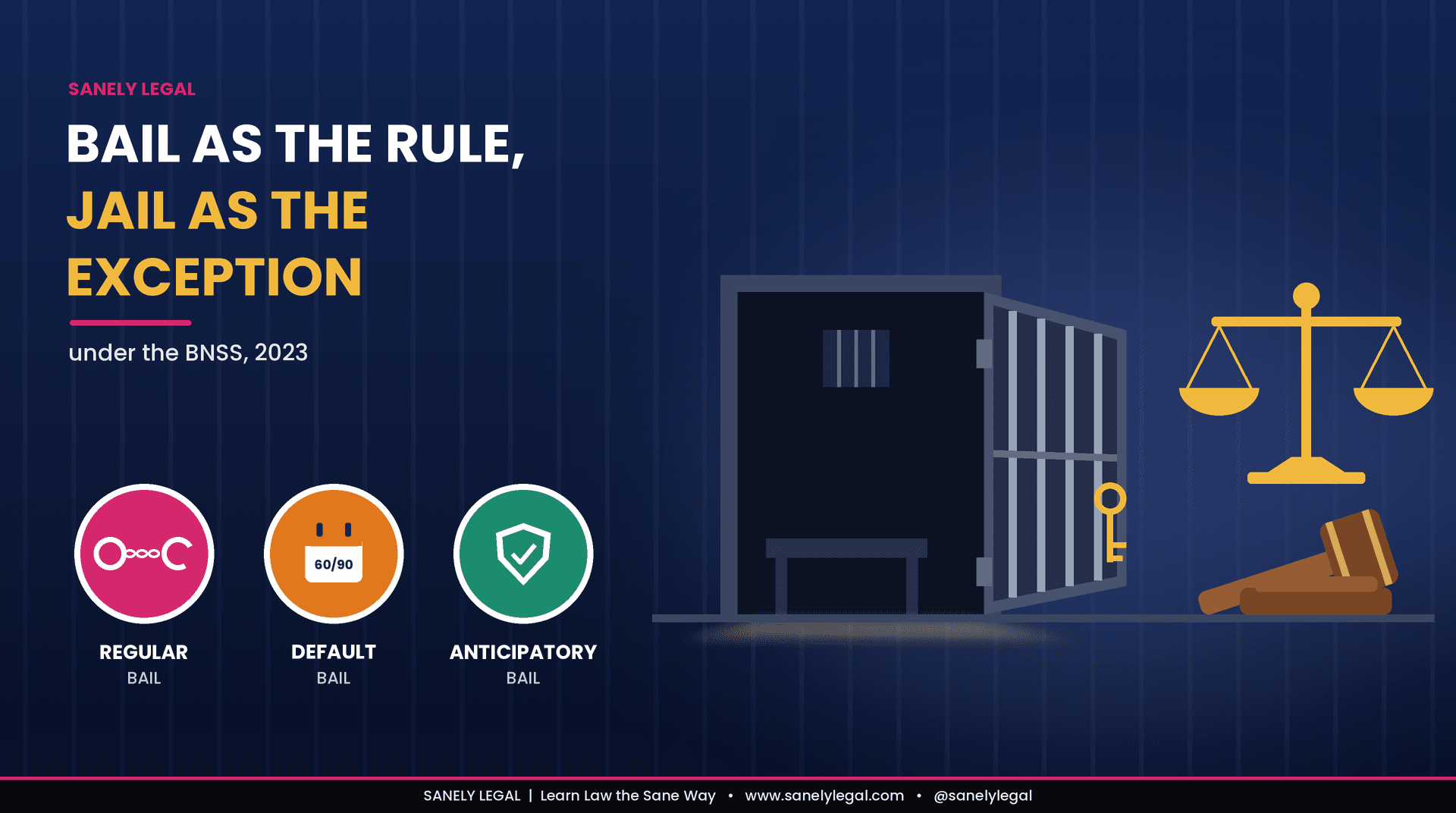
Bail as the Rule,Jail as the exception:Regular,Default and anticipatory Bail under the Bhartiya Nagrik Suraksha Sanhita,2023
The idea that bail is rule and jail is the exception was started by the supreme court for the first time in clear terms State of Rajasthan v. Balchaaand (1977) 4 SCC 308[Case1.1],and it has since become the starting point of every bail discussion.It is a rule that comes from Article 21 of the constitution.
Freedom of Religion and the Essential Religious Practices Doctrine under Articles 25 and 26 of the Constitution of India
Religious liberty in India is not framed as an unqualified institutional privilege. Articles 25 and 26 protect both individual conscience and collective religious autonomy, while making that protection subject to express constitutional limits and, in different ways, to other provisions of Part III. Article 25 speaks of "all persons"; Article 26 speaks of "every religious denomination or any section thereof".
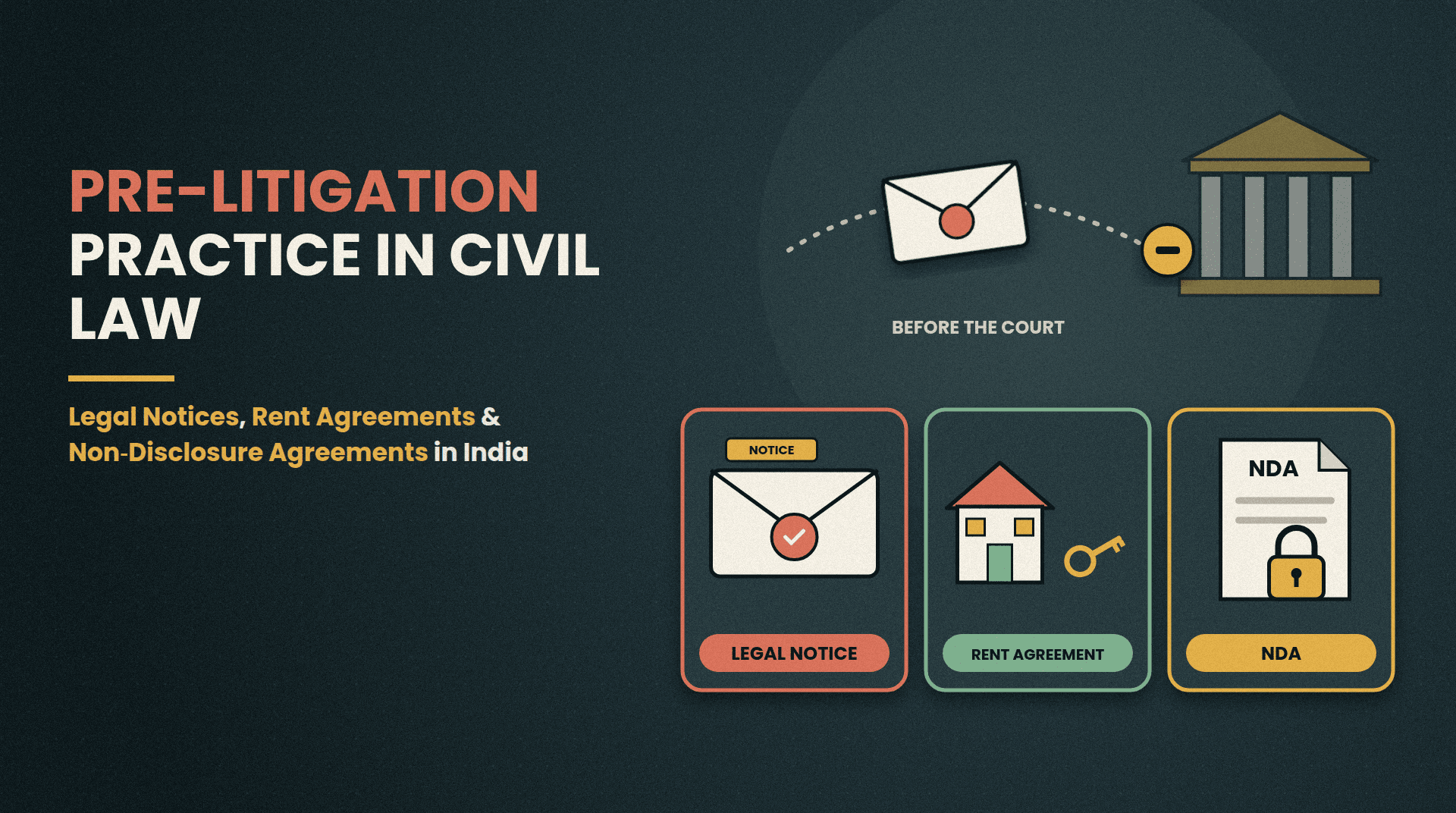
Pre-Litigation Practice in Civil Law: Legal Notices, Rent Agreements and Non-Disclosure Agreements in India
The importance of the pre-litigation stage becomes clearer when different statutory requirements are considered. Section 80 of the Code of Civil Procedure, 1908 imposes a specific notice requirement in suits against the Government or public officers. In commercial disputes, Section 12A of the Commercial Courts Act, 2015 introduces a separate statutory pre-institution mediation requirement for suits that do not contemplate urgent interim relief.