

The Right to Free Legal Aid and Access to Justice: Constitutional Mandate under Article 39A, the NALSA/DLSA Framework, Lok Adalats, Institutional Arbitration and Mediation
Credit: - Ayush Singh
4 Oct 2026 23 min read
- Decided
- 4 Oct 2026
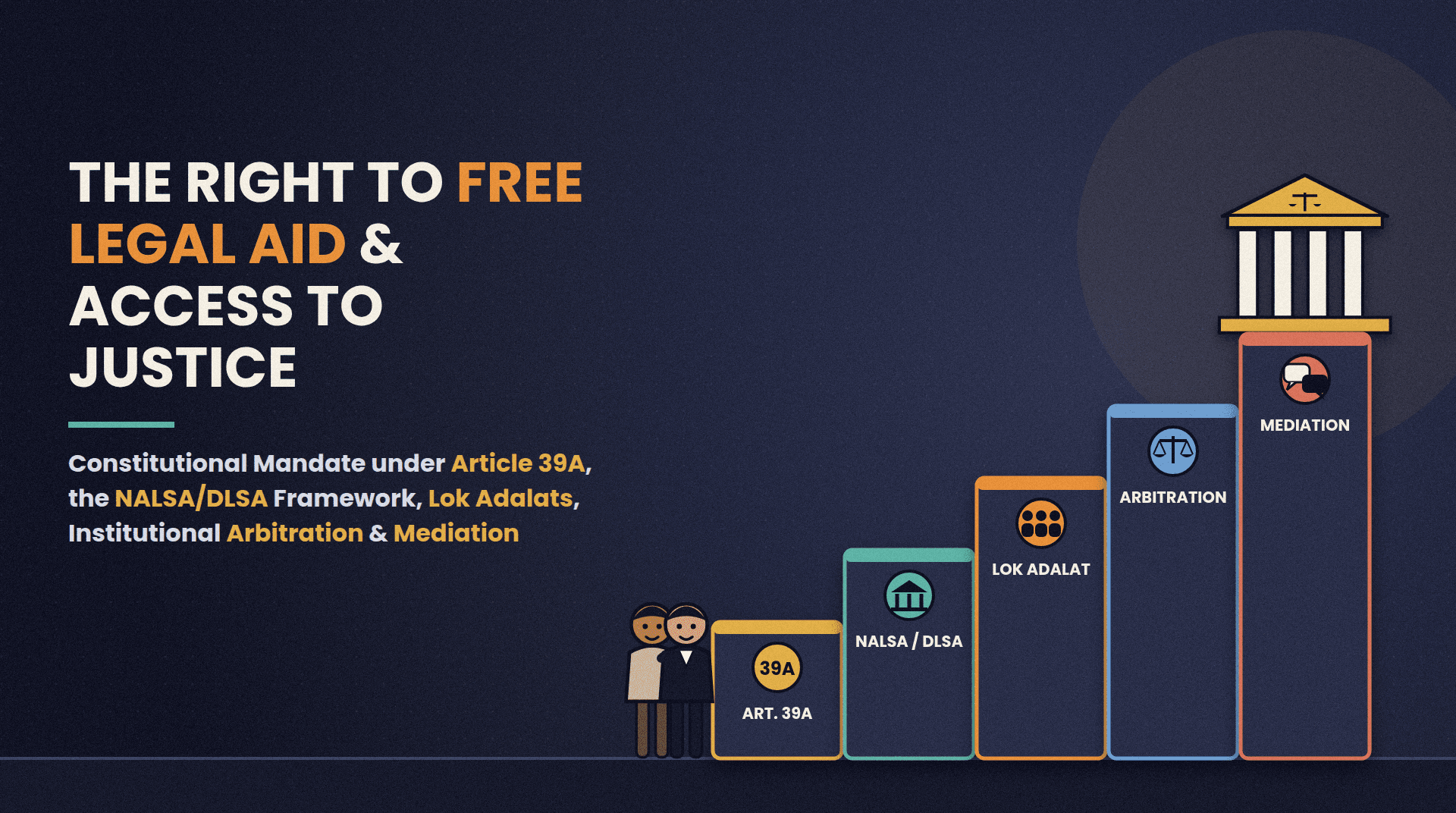
1 Trace the constitutional recognition of the right to free legal aid, beginning with M.H. Hoskot v. State of Maharashtra and Hussainara Khatoon v. State of Bihar. Is free legal aid merely a Directive Principle under Article 39A, or has the Supreme Court read it into the fundamental right to a fair trial under Article 21? Explain with reference to Khatri v. State of Bihar and subsequent case law.
The constitutional recognition of the right to free legal aid actually originates from the US’s courts back in 1932 but it later was introduced in India in 1978 in the M.H. Hoskot v. State of Maharashtra . Also parallel to the Indian courts, the European court in the Airey v. Ireland in 1979 introduced state funded legal assistance in legal proceedings. A brief introduction of the United States’ jurisprudence of legal aid, beginning with Powell v. Alabama in 1932 popularly known as the Scottsboro Boys case where a group of 9 African American teenagers were accused of raping 2 white women on a train near Scottsboro, Alabama. The defendants were tried in three separate one day trials and all were sentenced to death except for 13 year old Roy Wright. The trial judge did not assign specific counsel to each defendant. Instead, he listed all members of the bar as potential attorneys, and only two volunteered on the morning of the trial. The defendants had no meaningful opportunity to consult with counsel or prepare a defence. The Alabama Supreme Court affirmed the convictions, and the defendants appealed to the U.S. Supreme Court. Where one of the most important findings of the Supreme Court were ‘the fact that the right of an accused person to have counsel for his defense was guaranteed expressly (as respects the federal Government) by the Sixth Amendment, notwithstanding the presence of the due process clause in the Fifth Amendment, does not exclude that right from the concept of due process of law. Betts v. Brady narrowed this to a case-by-case test, before Gideon v. Wainwright overruled Betts and held that the right to appointed counsel in serious criminal cases is a fundamental right binding on the states through the 14th Amendment.
Article 14(3)(d) of the International Covenant on Civil and Political Rights (1966), to which India is a party, guarantees an accused the right to have legal assistance assigned, free of charge, where the interests of justice so require and the accused cannot pay. The UN's Basic Principles on the Role of Lawyers (1990) and the later UN Principles and Guidelines on Access to Legal Aid in Criminal Justice Systems (2012) elaborate the same idea globally. To begin with the Indian jurisprudence regarding the free legal aid, the constitutional recognition began with M.H. Hoskot v. State of Maharashtra where Madhav Hayawadanrao Hoskot was convicted in a criminal case relating to cheating and forgery under IPC where the Bombay high court convicted him and he filed a special leave petition under Article 136 which was dismissed and yet the Supreme Court held out that Article 39 is a interpretative aid to Article 21 and that a prisoner’s right to appeal is meaningless without a free copy of the judgment and free legal assistance. The Court read Articles 21, 39A and 142 together to hold that free legal service is part of fair procedure ender Article 21.
Another important findings in the jurisprudence of free legal aid was held out by the case of Hussainara Khatoon v. State of Bihar where in the p. 2 it is held that Article 39A also emphasises that free legal service is an inalienable element of 'reasonable, fair and just' procedure for without it a person suffering from economic or other disabilities would be deprived of the opportunity for securing justice. The right to free legal service is therefore, clearly an essential ingredient of 'reasonable, fair and just' procedure for a person accused of, an offence and it must be held implicit in the guarantee of Art. 21. This is a constitutional right of every accused person who is unable to engage a lawyer and secure legal services, on account of reasons such as poverty, indigence or incommunicado situation and the State is under a mandate to provide a lawyer to an accused person if the circumstances of the case and the needs of justice so require, provided of course the accused person does not object to the provision of such lawyer.
Is free legal aid merely a Directive Principle under Article 39A, or has the Supreme Court read it into the fundamental right to a fair trial under Article 21?
As discussed in the previous judgments of M. H. Hoskot vs State of Maharashtra and Hussainara Khatoon vs State of Bihar, it can be concluded that the free legal aid is not just a mere directive principle for the state but it is associated with fundamental right under Article 21 as laid out in hussainara case, in the Hoskot case it was not as clearly defined as it is in the hussainara case. The various judgments of the apex court in India is clearly stating that Article 39A is clearly associated with the Article 21 and right to speedy trial emerged along with.
REFERENCE TO THE KHATRI v. STATE OF BIHAR
p. 1 of the case very specifically cites ‘The right to free legal services is clearly an essential ingredient of reasonable, fair and just procedure for a person accused of an offence and it is implicit in the guarantee of Article 21 and the State is under a constitutional mandate to provide a lawyer to an accused person if the circumstances of the case and the needs of justice so require, provided of course the accused person does not object to the provision of such lawyer. The State should provide free legal aid to an accused person who is unable to secure legal services on account of indigence and whatever is necessary for this purpose has to be done by the State. It cannot avoid its constitutional obligation to provide free legal services to a poor accused by pleading financial or administrative liability.’ In another p. 2 it is mentioned that this right arises when the accused is first presented to the magistrate. In another case of Sukh Das v. Union Territory of Arunachal Pradesh, the facts stated that Sukh das was convicted for criminal intimidation where he was imprisoned and the high court of Gauhati upheld the sentence stating that the Sukh das didn’t file a application for a right of free legal aid but the Supreme Court of India upheld that right to free legal aid and representation at the state expense of those who can’t afford it is enforceable under Article 21 and not limited merely to a Directive Principle under Article 39A.
2 Under which provision of BNSS, 2023 and when must a Sessions Court assign a pleader at State expense to an undefended accused? What is the legal consequence for a conviction recorded where the accused was not offered legal aid despite being unable to afford counsel?
Section 341 of the Bhartiya Nagrik Suraksha Sanhita, 2023 clearly states that where the accused is unrepresented and does not have sufficient means to engage a representation , then in such cases the court must appoint an advocate at the state’s expense. The high court of every state have the rule making powers in cases like this. Also, the Legal Services Authority Act, 1987 provides under section 12 criteria for eligible people to whom legal aid would be provided free of cost or on state’s expense. The criteria includes :
A member of SCs or STs
A victim of human trafficking or beggar
A woman or a child
A person with disability
Victim of mass disaster, ethnic, violence, caste atrocity, flood, drought, earthquake or industrial disaster
An industrial workman
In custody
Annual incomes less than as described
In case of non compliance of this rule under 341 of BNSS, the Supreme Court has held several key guidelines for such cases through Suk das vs. Union Territory of Arunachal Pradesh where it was stated that failure of Magistrate/Session Judge to inform an indigent, unrepresented accused of the right to free legal aid vitiates the trial, regardless of whether the accused actually asked for a lawyer. In the case of Anokhilal v. State of Madhya Pradesh, it was concluded that the trial was held to be vitiated on account of a fatal constitutional infirmity and the conviction and sentence were set aside as mentioned in the p. 16 of the judgment. Similarly, it can be stated that if there is non compliance, the court shall vitiate the trial and declare it void and order for re-trial from the stage of framing of charges.
3 The Supreme Court has held that the right to legal aid is not satisfied by the mere presence of a lawyer, but requires ‘effective’ representation. Discuss the standard the Court has applied to distinguish effective legal assistance from token or nominal representation, particularly in cases involving indigent or first-time accused persons.
The standard the court has applied to distinguish effective legal assistance from token or nominal representation from the case of Anokhilal v. State of M.P. in the year 2020 where it was seen that Anokhilal was tried for an offence of rape and murder of a nine year old and was charged under IPC and POSCO but the trial was concluded in 13 days without effective representation of Anokhilal. The supreme court held that fast track of trial shall not override the accessibility of justice, the trial was vitiated by the supreme court as mentioned above. The case of Anokhilal mirrors a case on ineffective assistance of counsel and this emerged as doctrine in US through Strickland v. Washington where the US supreme court held that a conviction can be reversed if counsel’s performance fell below an objective standard of reasonableness and prejudiced the defence. This case is not exactly same as it has the two pronged test but it identical to Anokhilal. It was observed that the trial of Anokhilal was concluded within 13 days, and the advocate was appointed on the day of framing of charges which was found ineffective legal assistance. Also, Anokhilal was a first-time offender with no previous criminal history, under section 47 of the Bharitya Sakshya Adhiniyam, 2023 previous good character is relevant and providing them ineffective legal assistance is violation of their right with association with Article 39A.
4 Discuss the shift towards institutional arbitration in India following the 2019 and 2021 amendments to the Arbitration and Conciliation Act, 1996, including the role envisaged for the Arbitration Council of India. How does institutional arbitration differ from ad hoc arbitration, and what advantages has the Supreme Court/Law Commission of India identified in promoting institutional arbitration as a mode of access to justice?
Arbitration in India has historically operated through ad hoc arbitration, where parties themselves choose their arbitrators, decide procedure,, venue, fees and conduct of proceedings. Whereas, institutional arbitration usually provide appointment mechanisms, procedural rules, timelines and oversight by the institution. There has been observed a shift towards institutional arbitration after the 2019 and 2021 amendments to the Arbitration and Conciliation Act, 1961 because the ad hoc arbitration has several drawbacks which could be overcome by institutional arbitration. The major drawbacks were :
Delay in constitution of tribunals- this delay in ad hoc tribunals were because of the section 11 of the act which gave the power to parties to choose arbitrators and they ended up choosing biased arbitrator and this was later challenged in courts, which led to the loss of purpose of the arbitration.
Uncertainty regarding fees- institutions generally provide a pre determined or structured system of fees whereas this remains a point of discussion in ad hoc arbitration .
International competitiveness- international commercial parties frequently select established institutions such as, ICC, LCIA, SIAC.
The 246th report of Law Commission of India on Amendments to the Arbitration and Conciliation Act, 1961 was significantly important. The Commission observed that institutional arbitration had not become widespread in India and that the existing Arbitration Act was essentially institutionally neutral. There were several recommendations made by this committee beginning with encouraging courts to promote institutional arbitration, strengthening arbitral institutions, developing institutional rules, improving the arbitrator appointment mechanism, and reducing unnecessary judicial intervention. Also, the High-Level Committee to Review the Institutionalisation of Arbitration Mechanism in India chaired by Justice B.N. Sri Krishna, submitted its report on 30th July 2017, where it examined the need for institutional arbitration, deficiencies in existing arbitral institutions, and measures to make India a competitive arbitration jurisdiction. Finally in 2019 a Amendment was passed introducing Part I A, section 43A-43M forming the Arbitration Council of India. The major areas of work the council was grading of the institution on various grounds, accreditation of the arbitrators, depository of awards and regulations. Another amendment in 2021, it modified section 43J. The provision was substituted so that qualifications, experience and accreditation norms would be determined through regulations. The overall objective remained the development of a professional arbitration ecosystem. The major advantages Supreme court and Law Commission of India identified were the reduction in unnecessary judicial intervention, increment in qualified arbitrators, reduction of delays in the appointment stage, and lastly structured and predetermined procedure encouraging access to justice.
The Mediation Act, 2023 introduces a structured framework for pre-litigation mediation, and Section 12A of the Commercial Courts Act, 2015 makes pre-institution mediation mandatory for certain commercial suits. Discuss the legal status and enforceability of a Mediated Settlement Agreement under the Mediation Act, 2023, and compare mediation as an access-to-justice mechanism with the Lok Adalat mode in terms of finality of outcome, voluntariness, and judicial oversight.
There are certain statutes that makes it mandatory for the parties to go to mediation before filing of a civil suit. Beginning with section 89 of Civil Procedure code, 1908 which states to refer the parties to settle the dispute outside court which usually includes mediation, followed by Section 12A of the Commercial Courts Act, 2015 which mandatorily requires mediation before filing of civil suits for certain cases. Also Patil Automation Pvt. Ltd. v. Rakheja Engineers Pvt. Ltd., p.2 states that pre institution mediation under section 12A is mandatory, not just merely directory. A commercial suit filed without first attempting mediation which does not genuinely seeks urgent interim relief is liable to be rejected under Order VII Rule 11 CPC. Another case of Yamini Manohar v. T.K.D. Keerthi, held out that urgent interim relief exception via Patil Automation, leaves no absolute right to bypass section 12A merely by praying for urgent interim relief. The commercial court must examine the plaint, documents and facts to see if urgency is genuine or a camouflage to sidestep mandatory mediation. Also it is a general practise of courts to refer parties to mediation in family proceedings like divorce and custody cases.
Comparing between Lok Adalat award and Mediated Settled Agreement, Section 21 of the Legal Services Authorities Act, 1987, states that every award of Lok Adalat is deemed as a decree of civil court and is final and binding on the parties and is not a subject of appeal, whereas a mediated settlement agreement is also final and binding on the parties under Section 27 of the Mediation Act, 2023 and is only appealable under 4 grounds mentioned in section 28 of the Mediation Act, 2023. The proceedings of Lok Adalat is voluntary but mediation not mostly voluntarily, it is a mandatory reference under CPC, and Commercial Courts Act, 2015. Also, the Lok Adalat's operate within statutory provisions of Legal Services Authorities Act, 1987 and is usually chaired by a serving or retired judicial officer along with lay members and is quasi judicial body. Whereas mediation is usually conducted by accredited/empanelled mediator regulated by the Mediation Council of India who are not a judicial officer.
CASE 1 - Origin of the Right to Appointed Counsel | |
Case Name & Year | Powell v. Alabama (1932) — the "Scottsboro Boys" case |
CITATION& CORAM | 87 U.S. 45 (1932) — U.S. Supreme Court, opinion by Sutherland, J. |
ISSUE BEFORE THE COURT | Whether the failure to give nine indigent, illiterate defendants a meaningful, timely opportunity to consult and be represented by counsel in a capital trial violated due process. |
BRIEF FACTS | Nine young Black men were accused of raping two white women on a train near Scottsboro, Alabama. Tried in three one-day trials, they were not assigned specific counsel — the judge merely opened the appointment to the whole local bar, and only two lawyers volunteered on the morning of trial, with no time to prepare. All except a 13-year-old were sentenced to death. |
RATIO DECENDI | In a capital case, where the defendant is unable to employ counsel and is incapable of making his own defence due to ignorance, illiteracy or the like, it is the duty of the court to assign counsel, and failure to give a fair, reasonable opportunity to prepare a defence is a denial of due process. |
OBITER DICTA | Observations that the right to be heard would be of little worth if it did not include the right to be heard by counsel, given a layperson's inability to know the rules of evidence and procedure. |
SIGNIFICANCE TO OTHER LINKING CASES | The foundational U.S. case establishing that appointed counsel can be constitutionally required; precursor to Betts v. Brady and Gideon v. Wainwright. |
CASE 2- India's Starting Point | |
Case Name & Year: | M.H. Hoskot v. State of Maharashtra (1978) |
Citation & Coram: | AIR 1978 SC 1548& V.R. Krishna Iyer, J. (with D.A. Desai, J.) |
ISSUE | Whether an indigent prisoner's right to appeal is meaningful without a free copy of the judgment and free legal assistance. |
BRIEF FACTS | Madhav Hayawadanrao Hoskot was convicted for cheating and forgery under the IPC; his conviction was upheld by the Bombay High Court, and his SLP under Article 136 was resisted on the ground he had no effective means to prosecute an appeal. |
RATIO DECENDI | Article 39A is an interpretative aid to Article 21; a prisoner's right to appeal is illusory without a free transcript and free legal aid, and the Court read Articles 21, 39A and 142 together to hold free legal service is part of fair procedure under Article 21. |
OBITER DICTA | Wider remarks on prison justice and the state's duty to ensure meaningful access to appellate remedies for the poor. |
SIGNIFICANCE | Significance: The founding Indian precedent that began the constitutionalisation of legal aid, predating and setting up Hussainara Khatoon, Khatri and Suk Das. |
CASE 3 - Constitutional Foundation of Legal Aid (Articles 21 & 39A) | |
Case Name & Year | Hussainara Khatoon & Ors. v. Home Secretary, State of Bihar (1979) |
Citation & Coram | AIR 1979 SCR (3) 532 — Bench: P.N. Bhagwati, R.S. Pathak, A.D. Koshal, JJ. |
Issue before the Court | Whether prolonged pre-trial detention of undertrial prisoners without legal representation violates Article 21. Whether free legal aid is merely a DPSP goal. |
Brief Facts | Following newspaper reports, advocate Kapila Hingorani filed a PIL on behalf of undertrial prisoners in Bihar jails, many detained for periods exceeding the maximum sentence for their alleged offences, without trial or legal representation. |
Ratio Decidendi | Speedy trial and free legal aid to an indigent accused are integral to a "reasonable, fair and just" procedure guaranteed by Article 21; the State cannot avoid this obligation by pleading financial or administrative constraints. |
Obiter Dicta | Observations on the need for reform of the bail system for the poor and on the systemic causes of prison overcrowding, going beyond the immediate relief sought. |
Significance / Link to other cases in the list | Marks the shift of free legal aid from a DPSP aspiration to an enforceable Article 21 right; foundational for Khatri and the later NALSA/DLSA statutory scheme. |
CASE 4 - Legal Aid from First Production Before the Magistrate | |
Case Name & Year | Khatri & Ors. v. State of Bihar & Ors. (1980–81) — the "Bhagalpur Blinding" case |
CITATION | AIR 1981 2 SCR 408 & P.N. Bhagwati, A.P. Sen, JJ. |
ISSUE | At what stage does the State's obligation to provide free legal aid to an indigent accused arise, and can the State plead financial/administrative inability to avoid it? |
BRIEF FACTS | A PIL (filed by advocate Kapila Hingorani, following the Hussainara Khatoon litigation) concerning undertrial prisoners in Bihar who had been blinded in police custody and were unrepresented at critical stages of criminal proceedings. |
RATIO DECENDI | The right to free legal aid is implicit in Article 21 and arises from the moment the accused is first produced before a Magistrate, continuing at every subsequent remand; the State cannot avoid this constitutional obligation by pleading financial or administrative inability; the Magistrate/Sessions Judge must inform the accused of this right. |
OBITER DICTA | Observations on the deplorable conditions of undertrial detention and the systemic administrative failures underlying it. |
SIGNIFICANCE | Extends Hoskot from the appellate stage down to the very first production of the accused; directly underlies Section 341 BNSS/Section 304 CrPC jurisprudence. |
CASE 5 - Duty to Inform, Not Just Provide | |
CASE NAME AND YEAR | Suk Das & Anr. v. Union Territory of Arunachal Pradesh (1986) |
CITATION &CORAM | AIR 1986 SC 991 & P.N. Bhagwati, CJ, and R.S. Pathak, J. |
ISSUE | Whether a trial is vitiated where the court fails to inform an indigent, unrepresented accused of the right to free legal aid, even if the accused never asked for a lawyer. |
BRIEF FACTS | Suk Das was convicted for criminal intimidation and wrongful confinement and sentenced to imprisonment; he had not applied for free legal aid, and the Gauhati High Court upheld the conviction on the ground he never sought it |
RATIO DECENDI | The right to free legal aid at State expense for an accused who cannot afford counsel is enforceable under Article 21 and is not confined to a Directive Principle under Article 39A & failure of the Magistrate/Sessions Judge to inform the indigent accused of this right vitiates the trial, regardless of whether the accused actually asked for a lawyer. |
OBITER DICTA | Remarks on the unrealistic expectation that an uneducated, indigent accused would know to assert a right he is never told exists. |
SIGNIFICANCE | Converts the Khatri duty into an affirmative, non-waivable obligation on the court itself; foundational to the modern "duty to inform" line culminating in Ashok v. State of UP (2024) and Reginamary Chellamani (2026). |
Case 6 — Legal Aid in Criminal Trials (Cr.P.C./BNSS — Effective Representation) | |
Case Name & Year | Anokhilal v. State of Madhya Pradesh (2019) |
Citation & Coram | AIR 2019 20 SCC 225 & U.U. Lalit, Indu Malhotra, Krishna Murari, JJ. |
Issue before the Court | Whether a capital conviction can stand where legal-aid counsel was appointed with inadequate time to prepare, resulting in a trial concluded in thirteen days. |
Brief Facts | The accused, arrested for the rape and murder of a nine-year-old, was assigned a legal-aid advocate only shortly before charges were framed & the trial court convicted and sentenced him to death. |
Ratio Decidendi | Formal appointment of legal-aid counsel is insufficient; the accused is entitled to effective legal assistance, meaning adequate time and access to material for counsel to prepare, absent which the trial is vitiated, especially in a capital case. |
Obiter Dicta | Broader remarks on the dangers of excessive haste in death-penalty trials and the need for courts to balance speedy disposal against fairness. |
Significance / Link to other cases in the list | Operationalises the Hoskot/Khatri "effective aid" standard at the trial stage and has been cited in later capital-sentencing cases on the duty to ensure meaningful legal aid. |
Case 7 — NALSA/DLSA Statutory Framework & Lok Adalats | |
CASE NAME & YEAR | State of Punjab & Anr. v. Jalour Singh & Ors. (2008) |
CITATION & CORAM | AIR 2008 2 SCC 660 — Bench: K.G. Balakrishnan, G.P. Mathur, R.V. |
ISSUES BEFORE THE COURT | Whether a Lok Adalat constituted under the Legal Services Authorities Act, 1987 possesses adjudicatory power, or is confined to conciliation. |
BRIEF FACTS | A dispute referred to a Lok Adalat was effectively decided by it on merits rather than through a consensual settlement between the parties. |
RATIO DECENDI | Lok Adalats have no adjudicatory or judicial function; their role is confined to conciliation, and an award can be made only where the parties reach a genuine compromise/settlement in its absence, the case must be returned to the referring court. |
OBITER DICTA | Caution against Lok Adalats behaving like courts, hearing parties and imposing outcomes, which the Court warned would discourage litigants from using the forum. |
Significance / Link to other cases in the list | Defines the statutory limits of the NALSA/SLSA/DLSA Lok Adalat mechanism and is regularly relied on including by High Courts to strike down Lok Adalat orders that exceed conciliatory bounds. |
Case 8 — Institutional Arbitration & Mediation | |
CASE NAME & YEAR | Patil Automation Pvt. Ltd. & Ors. v. Rakheja Engineers Pvt. Ltd. (2022) |
CITATION & CORAM | AIR 2022 10 SCC 1 & K.M. Joseph, Hrishikesh Roy, JJ. |
ISSUES BEFORE THE COURT | Whether pre-institution mediation under Section 12A of the Commercial Courts Act, 2015 is mandatory, and the consequence of filing a commercial suit without attempting it. |
BRIEF FACTS | A batch of commercial suits was filed without the plaintiffs first attempting the pre-institution mediation contemplated by Section 12A, raising the question whether such suits were maintainable. |
RATIO DECENDI | Section 12A is mandatory; a commercial suit filed without exhausting pre-institution mediation and not falling within the urgent-interim-relief exception, is liable to be rejected under Order VII Rule 11 CPC, a power the court may exercise even suo motu with the declaration made prospectively effective from 20 August 2022. |
OBITER DICTA | General observations describing mediation as a vital response to docket congestion and as a "new mechanism of access to justice," and acknowledgment that parties might misuse the urgent-interim-relief exception to sidestep mediation, an issue the Court left to be addressed by later rule-making/legislation. |
Significance / Link to other cases in the list | Operationalises the mediation-first philosophy that the Mediation Act, 2023 later codifies, and illustrates the judiciary's institutional push towards structured, pre-litigation ADR as part of access to justice. |
CASE 9- Clarifying the Section 12A "Urgent Interim Relief" Exception | |
Case Name & Year | Yamini Manohar v. T.K.D. Keerthi (2024) |
Citation & Coram | (2024) 5 SCC 815 |
ISSUE | Whether a plaintiff has an absolute right to bypass mandatory pre-institution mediation under Section 12A of the Commercial Courts Act, 2015 merely by pleading urgent interim relief. |
BRIEF FACTS | The defendant sought rejection of the plaint under Order VII Rule 11 CPC on the ground the plaintiff had not undergone pre-institution mediation under Section 12A & the plaintiff contended the suit fell within the urgent-interim-relief exception. |
RATIO DECENDI | A plaintiff has no absolute right to surpass Section 12A simply by praying for urgent interim relief & the commercial court must examine the plaint, documents and facts to determine whether urgency is genuine or a escape to sidestep the mandatory mediation requirement laid down in Patil Automation case. |
OBITER DICTA | Observations cautioning against mechanical or deceptive invocation of the urgency exception, while equally warning courts against denying genuinely urgent claimants access to interim relief. |
SIGNIFICANCE | Closes the gap Patil Automation (2022) left open, refining the mandatory mediation regime and reinforcing mediation as a genuine, non-evadable step in access to justice for commercial disputes. |
Credit: -Ayush Singh
More precedents
Bail as the Rule,Jail as the exception:Regular,Default and anticipatory Bail under the Bhartiya Nagrik Suraksha Sanhita,2023
The idea that bail is rule and jail is the exception was started by the supreme court for the first time in clear terms State of Rajasthan v. Balchaaand (1977) 4 SCC 308[Case1.1],and it has since become the starting point of every bail discussion.It is a rule that comes from Article 21 of the constitution.

Freedom of Religion and the Essential Religious Practices Doctrine under Articles 25 and 26 of the Constitution of India
Religious liberty in India is not framed as an unqualified institutional privilege. Articles 25 and 26 protect both individual conscience and collective religious autonomy, while making that protection subject to express constitutional limits and, in different ways, to other provisions of Part III. Article 25 speaks of "all persons"; Article 26 speaks of "every religious denomination or any section thereof".

Pre-Litigation Practice in Civil Law: Legal Notices, Rent Agreements and Non-Disclosure Agreements in India
The importance of the pre-litigation stage becomes clearer when different statutory requirements are considered. Section 80 of the Code of Civil Procedure, 1908 imposes a specific notice requirement in suits against the Government or public officers. In commercial disputes, Section 12A of the Commercial Courts Act, 2015 introduces a separate statutory pre-institution mediation requirement for suits that do not contemplate urgent interim relief.